




Abstract
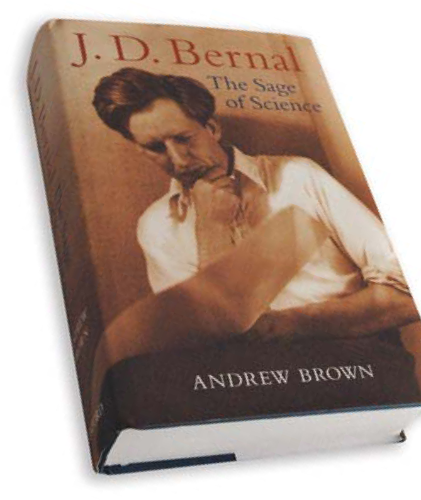
J. D. Bemal: The Sage of Science, by Andrew Brown, Oxford University Press, 562 pages, 2005, $34.95.
John Desmond Bernal has Finally gotten the biography he deserves. Despite the fact that the Irish-born Bernal was a pioneering scientist who laid the foundations for modern molecular biology, he is not well known in the United States. That might change with the publication of Andrew Brown's J. D. Bernal: The Sage of Science. Brown, a practicing radiation oncologist who penned a 1997 biography of physicist James Chadwick, The Neutron and the Bomb, has written a thorough account of Bernal's life with extensive treatment of his scientific accomplishments.
Bernal is a wonderful subject for a biography: A gifted scientist who trained several future Nobel laureates, he was also a libertine with countless affairs, a Marxist with strong views on capitalism and British imperialism, and a raconteur of the first order. His circle of friends and colleagues in Cambridge and in London was a “who's who” of British intellectual life from the 1920s to the 1960s.
Bernal was born in 1901 in Ireland's County Tipperary. His father was an Irish dairy farmer; his mother the accomplished daughter of an American Presbyterian minister. She was raised in California, schooled in New Orleans, and among the first women to attend Stanford University. Her first son, known to family as Desmond, was precocious and curiosity-filled; as a 7 year old his first experiment in chemistry exploded unexpectedly in the backyard, fortunately with no injuries. Bernai was schooled largely in England; as a young man in 1919 he entered Emmanuel College at the University of Cambridge, where he exhibited great passion for math, physics, chemistry, and mineralogy.
Outside the classroom and laboratory, he soon came into contact with a band of radical undergraduates who traveled in socialist circles and whose politics and philosophies enraptured Bernai. “This socialism was a marvelous thing,” Bernai wrote later, as Brown recounts. “Why had no one told me about it before?” By age 18 his conversion to Marxism was total; he never wavered throughout his life.
It wasn't long before Bernai was bestowed with the nickname “Sage,” in which his “range and brilliance were encapsulated,” Brown writes, noting that the moniker was conferred upon him not by a fellow student but by a love interest. After graduating Cambridge, Sage traveled to London to study at the Royal Institution with Sir William Henry Bragg, the Nobel physicist who had won his prize (along with his son) for his work on X-ray crystallography, the study of the structure of molecules. It was in this field that Bernai found his true scientific calling. Others have gotten the credit, but Brown argues that Bernai should be considered the godfather of molecular biology.
Bernai kept busy with more than science and politics. He and his wife Eileen Sprague had an “open” marriage; their many affairs required unconventional arrangements. Eileen's first child was probably not Sage's, and he had two other children by two different mistresses. Brown highlights some of Sage's amorous adventures, but we must wait for a more complete story until 2021 (50 years after his death), when six boxes of his love letters will be unsealed.
In 1939, the British government recruited Bernai to work on war-related issues, despite his political leanings. “When parliamentarian and cabinet member Sir John Anderson, who was in charge of civil defense and knew talent when he saw it, was warned that Bernai was “red,” he replied, “Even if he is as red as the flames of hell, I want him.” Soon thereafter, Bernai was appointed to Britain's Civil Defense Research Committee.
Perhaps Bernal's most interesting wartime assignment was his involvement in Operation Neptune, the maritime aspect of Operation Overlord–the invasion of Normandy–which Brown recounts in detail. The problems of landing thousands of troops and their equipment on defended beaches were formidable, and the shadow of Gallipoli hung over the preparations. The war planners needed detailed knowledge about the nature and topology of the shoreline, and Sage set about doing his part to answer the questions.
Bernai is a wonderful subject for a biography: A gifted scientist who trained several future Nobel laureates, he was also a libertine with countless affairs, a Marxist with strong views on capitalism, and a raconteur of the first order.
As was his nature, he turned to some unorthodox materials. To find the best landing routes, he consulted old maps, charts, and a twelfth-century Norman epic, among other things. And he read every volume of the Proceedings of the Linnaean Society of Caen since 1840. A contribution written by a priest in this obscure source revealed an important fact: The priest observed after a winter storm that the sand in one of the bays had been stripped away to expose underlying peat. Sage surmised correctly that any beach resting on such a marshy base would be treacherous, unable to support heavy, wheeled military equipment. Two days after D-Day, he surveyed firsthand, somewhat bitterly, vehicles mired in the Normandy peat “like flies in amber,” as he put it later in his diary. The visit to the beach sparked something of a controversy; after Bernal's death, his colleague Solly Zuckerman disputed his account of arriving at Normandy so soon after D-Day, calling the idea “fanciful” and “imaginative.” But Brown judges Bernal's account, in combination with other evidence, as likely to be accurate.
After the bombing of Hiroshima and Nagasaki, Bernai was one of the first to speak out against the Bomb, calling for its abolition. “The central case is that these weapons are inhuman in themselves and that their use cannot be tolerated whatever the excuse,” Bernai said, speaking at the World Assembly for Peace in June 1955. “Atomic bombs are evil things, whatever government makes them–American, Soviet, or British.” But the prospects for harnessing atomic energy for peaceful purposes–for producing electricity in underdeveloped nations, for example–were revolutionary, he thought.
Science biographers have the difficult task of lucidly explaining their subjects' accomplishments and ideas; Brown passes this test with flying colors. Bernai wrote widely on the role of science in society and history, and Brown explores some of his more profound observations, including this cautionary sentiment: “The scientists are not the masters of the destiny of science; the changes they bring about may, without their knowing it, force them into positions which they would never have chosen. Their curiosity and its effects may be stronger than their humanity.”
“He wouldn't have entered this yard if he hadn't already made the decision to go to war.”

But one thing always seemed to be stronger than Bernal's own scientific curiosity–his faithful devotion to socialism. His most serious flaw was his unswerving belief in the Soviet system, in Josef Stalin, and in Nikita Khrushchev, with whom he had contact. Beginning in 1931, he took many trips to Russia and in that dark decade was unwilling or unable to accept what he saw and heard about the purges and killings. After the war, Bernai continued to support the Soviet Union and even defended its 1956 invasion of Hungary. Totally embarrassing were his defense of the fraudulent “geneticist” Trofim Lysenko and the obituary he penned about Stalin, in which he praised the leader as a “great scientist.”
Flawed genius though he may have been, Bernal's admirers included some of the biggest names in science, and his contributions were vast and varied. His legacy extends far beyond molecular biology, deep into present-day global security–Bernai was, according to Brown, the first person to use the phrase “weapons of mass destruction.”