




Abstract
It is still not clear whether the planned is even a viable site. nuclear waste repository at Yucca Mountain And the waste keeps piling up.
The United States has been accumulating high-level nuclear waste since the dawn of the atomic age. The nuclear fuel cycle remains an incomplete circle; a process for the final step, disposal, has never been resolved. Today, 60 years' worth of radioactive wastes have piled up across the country at more than 120 sites–all of which are supposed to be temporary. By the end of 2005, about 55,000 metric tons of spent nuclear fuel had built up at reactor sites around the country, plus about 15,000 metric tons of high-level waste from the nuclear weapons complex. For nearly a quarter-century, the government has focused its efforts to find a permanent place to store its highly radioactive waste on the idea of deep, underground geologic repositories–in particular, a site at Yucca Mountain, Nevada. But billions of dollars and many years later, the United States is still struggling to find a solution to its literally growing problem of nuclear waste.
Yucca, in and out: A tunnel inside the planned repository, and an aerial view of the north of the Yucca Mountain crest (top right).
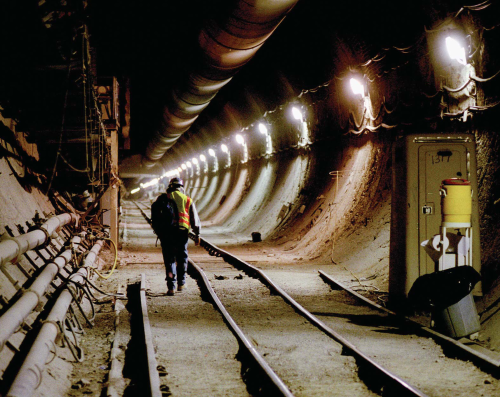
It may seem today that there has only ever been one serious contender for a permanent repository–Yucca Mountain. But that is not the case. Before Yucca, a number of other sites were considered.
It was almost 50 years ago, in 1957, that the National Academy of Sciences first framed a solution to the high-level nuclear waste problem, suggesting that it should be emplaced in a geologic repository. Little action was taken until 1970, when the Atomic Energy Commission (AEC) selected an old salt mine in Lyons, Kansas, as a repository. It was to be the nation's first lesson in siting struggles. The AEC had not investigated the location well enough, and it turned out that the Lyons mine was far from watertight, thanks to an adjacent mine and old oil and gas drill holes. (Moving water can transport nuclear waste to the environment.) The Lyons project turned into a public relations disaster, and the resulting backlash swung the momentum away from underground repositories for a short while, toward the use of long-term, aboveground storage canisters.
Just a few years later, in 1974, India detonated a nuclear test device that used plutonium diverted from its Cirus research reactor. This marked a turning point for the back-end of the U.S. nuclear fuel cycle. Until that point, the U.S. nuclear industry had been planning to reprocess spent fuel, using the plutonium extracted from it to fuel a new fleet of fast breeder reactors. In response to the proliferation dangers that India's detonation revealed, the Ford administration “indefinitely deferred” the reprocessing of spent fuel. President Jimmy Carter continued the prohibition, hoping to set an example for other countries and thereby avoid the potential for diversion of plutonium into nuclear weapons.
Nuclear reactors were designed to store only a nominal amount of spent fuel in their onsite storage pools, where used fuel was to cool down before being sent to reprocessing facilities. The reprocessing ban meant that spent fuel would not be removed from reactor sites and would soon overwhelm their onsite storage capacity. Congress reacted to this predicament by passing the 1982 Nuclear Waste Policy Act (NWPA). The act established geologic repositories as the long-term solution to the problem of storing high-level nuclear waste, and it set in motion the process to site and develop such repositories. The Energy Department was tasked with identifying sites and evaluating them, and the Environmental Protection Agency (EPA) was to develop standards that the Nuclear Regulatory Commission (NRC) would use to determine whether a site should be licensed.
The act, which required the federal government to open a permanent repository by January 31, 1998, envisioned a minimum of two national storage sites. It was understood that if one were in the Western United States, the other would be located in the East. For the first repository, three locations were to be selected from a larger list and then characterized simultaneously, compared, and the best site selected. By 1986, Energy had selected three sites: Yucca Mountain, 90 miles northwest of Las Vegas; Deaf Smith County in the Texas panhandle; and the Hanford nuclear reservation in Washington State.
Active opposition to the Yucca Mountain site remains a thorn in the side of progress on the repository; the state of Nevada has been using courtrooms and Congress as its battlefields.
When Energy “indefinitely deferred” the search for a second site in 1986 (apparently due to a decreased need for a second site), a heated controversy erupted concerning the siting process. Texas, Washington, and Nevada all feared that the bulk of nuclear waste would land in their states. Congress cut off appropriations for development of a geologic repository, and the impasse was broken by the 1987 Nuclear Waste Policy Amendments Act. The legislation reduced the number of sites to be studied down to one: Yucca Mountain. The law also delayed a decision on the need for a second repository until 2010 and prohibited research on crystalline rock repositories at the behest of East Coast states that wanted to take themselves out of the running. As a result, much of the East Coast was eliminated from contention for a potential second site.
Not surprisingly, Nevada found the process established by the 1987 amendments unfair. Opponents of the site felt it singled out a politically weak state (both of Nevada's senators were junior) with no nuclear power plants to be a dumping ground for some of the nation's most dangerous waste. They have been fighting the repository at Yucca Mountain ever since.
By the early 1990s, it had become clear that Energy would not meet the January 1998 deadline to open a repository. Congress demanded that Energy at least prove that Yucca Mountain was a workable site, resulting in a viability assessment in 1998. At the same time, nuclear power plant owners, whose spent fuel pools were filling up, filed lawsuits against Energy for breach of contract because the department failed to take their waste. Energy continues to negotiate with some of the utility companies over their contracts. The NRC also approved nuclear reactors to use aboveground, dry casks as temporary onsite storage if their spent fuel pools were full. More than half the spent fuel pools at U.S. nuclear reactors are now at their capacity, and according to Energy Department figures, in less than 10 years, nearly every reactor will require dry storage.
In February 2002, Energy declared the Yucca Mountain site suitable for a geologic repository. By law, the state of Nevada was allowed a veto of the site, and in April 2002, the governor of Nevada declared his disapproval. But three months later, Congress overrode his veto and approved Yucca Mountain. Although the site has received presidential and congressional seals of approval, Energy is far from getting the final green light for actually building the repository, and it is still not clear whether Yucca is a viable long-term site.
Officially, Energy had only 90 days from congressional approval to submit a construction license application to the NRC, but Energy has not yet done so. Once Energy does submit the license application, the NRC has up to four years to review it and determine whether to grant the license. After that, Energy must submit a second license application in order to receive waste, and again, the NRC decides whether to approve it.
Why is it taking so long for Energy to turn in its license application for construction? Of many contributing factors, three major problems stand out. In July 2004, a federal appeals court rejected the EPA's radiation dose standard for Yucca Mountain, demanding that it evaluate radiation dose limits for a period of up to 1 million years; EPA's previous standard took into account only 10,000 years. Another serious delay was caused by the revelation last year of charges of scientific fraud at Yucca Mountain. Energy discovered e-mail messages dating from the late 1990s that suggested that scientists who worked on water transport issues at Yucca Mountain had falsified data to satisfy Energy quality assurance requirements. (Energy recently released a report stating that the falsifications did not impact the scientific integrity of its assessment of the site.) The third major difficulty is Energy's apparent inability to publish on its website, within six months of submitting a license application, all supporting documentation for the Yucca Mountain site–as per NRC rules. Energy had originally intended to submit a license application by the end of 2004, but the NRC ruled it could not unless it made public all the supporting information.
Energy has developed a draft license application and recently announced that it will submit it sometime in the next few years; it promises to publish a schedule by this summer. Nevada has requested a copy of the draft application so that it may review Energy's case for the suitability of the Yucca Mountain site–a request that Energy has repeatedly denied. In February 2006, in response to a complaint from the state of Nevada, the NRC ruled in favor of Energy–overruling its own advisory board.
Not in my state: Nevada Sen. Harry Reid addresses an anti-Yucca rally in Washington, D.C.
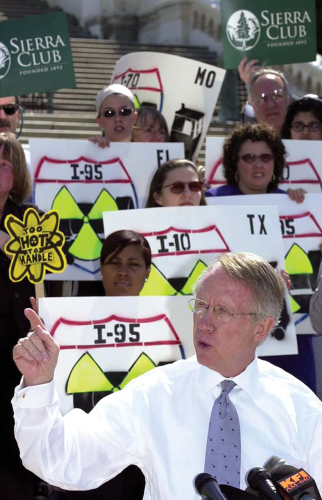
Active opposition to the site within Nevada also remains a thorn in the side of progress on the repository. The state has developed a multipronged approach to derailing the Yucca Mountain site, using courtrooms and Congress as its battlefields. Nevada continues to submit lawsuits on various aspects of nuclear waste disposal, including one against the NRC over the licensing process and against Energy over the siting of a railroad that would carry waste to Yucca Mountain. Nevada's Democratic Sen. Harry Reid introduced a bill in December 2005, the Spent Nuclear Fuel On-Site Storage Security Act, which would allow Energy to take title to spent fuel while it remained in dry-cask storage at reactor sites, thus relieving pressure to open a permanent repository at Yucca Mountain. Nevada also employs scientists who continue to review technical issues at the Yucca Mountain site; they have filed briefs and responses to items such as the draft EPA standards and the Environmental Impact Statement. This holds up the siting process because Energy often must take time to respond to the issues raised by the scientists.
Anti-Yucca opponents argue that politics have overtaken science. As Reid states on his Senate website, the 1987 NWPA amendment put undue political pressure on opening a repository at Yucca Mountain: “Since then, [Energy's] mission has shifted from objectively evaluating whether a site was suitable to isolate radioactive waste to justifying Yucca Mountain as a safe site for storing nuclear waste.”
By singling out Yucca, the revised act pressured Energy to certify the site, and Congress wants to avoid revisiting the issue of site selection because the political costs are extremely high–no politician wants to allow a nuclear waste dump in his or her backyard. The nuclear industry is also eager to solve the nuclear waste problem, which it sees as an impediment to expanding the industry.
The original NWPA attempted to be fair in repository siting. It provided for two repositories to share the burden of nuclear waste among states and regions. Its provision to characterize three sites simultaneously ensured that no one site would bear the political pressure that Yucca Mountain now does. As a Utah newspaper editorial stated in 1981, “Neither Utah nor any other state can properly refuse to bear the nuclear waste burden once [the repository site] has been established to the best of human conditions. However, the honor of making such sacrifice for time without end must confer on the luckless lamb the satisfaction of knowing firsthand that the duty couldn't have been just as well assigned elsewhere.” 1 These comforts were lost with the passage of the 1987 amendments to the act.
Congress wants to avoid revisiting the issue of site selection because the political costs are extremely high–no politician wants to allow a nuclear waste dump in his or her backyard.
Another political problem is funding. As of 2004, Energy had spent more than $8 billion studying Yucca Mountain. The money has come in part from the Nuclear Waste Fund, established by the NWPA, into which ratepayers pay one-tenth of one cent per kilowatt-hour of electricity used. By fiscal 2004, the fund had collected about $22.5 billion. Energy estimates that completion of Yucca Mountain would cost at least $60 billion, most of which would come from the fund, the difference made up by the Defense Department for disposing of its nuclear waste. The problems come in the allocation of funds for work on Yucca Mountain. When Congress sets its budget for the Energy Department, it has frequently not fully funded Energy's request for the Yucca Mountain project due to political influences. The money allocated for the project goes toward further characterization studies and facility construction; if the project were fully funded, the license application might proceed at a faster pace.
Formulating policy is always difficult when confronted with unknown variables. In the case of nuclear waste disposal, those unknown variables stretch over periods of geologic time. The proposed EPA standard requires that we understand repository behavior well enough 10,000 to 1 million years in the future to make accurate predictions of whether the radiation dose standard will be met. This is no small task.
The repository is essentially an “Earth system” engineered features that will operate in a geologic environment. To understand how this system will behave over time requires predicting geologic processes and events. But geology is basically a retrodictive science, one that explains the past; it does not predict future events, such as volcanic eruptions or earthquakes, with accuracy. Using geology to make predictions is an inexact tool and will by definition produce highly uncertain results.
But predictions are useful for policy makers, who see them as a way to legitimize technical policies. 2 Moreover, focusing on technical predictions obscures other aspects of the debate, including economics, values, ethics, fairness, aesthetics, ideology, and local politics. 3 The state of Nevada, for example, makes its case against Yucca Mountain on a technical basis; there is little discussion of the issues of equity and regional politics, though these are central to Nevada's objections.
To understand the debate better, it is important to be familiar with some of the technical issues faced by Yucca Mountain and how the site is being evaluated. Energy and the NRC will decide whether Yucca Mountain meets the EPA dose standard by using a “probabilistic performance assessment.” Performance assessments originate from analyses of nuclear reactors. Though these models may be appropriate for understanding the behavior of an entirely engineered system like a nuclear power plant over its lifetime of 40 to 60 years, it is problematic to apply them to a geologic repository over hundreds of thousands of years.
The complex performance assessment model for the Yucca Mountain site is made up of a number of submodels that simulate different aspects of the system. But the problem with modeling a geologic repository in this manner is that the models cannot be validated or verified. Earth systems are open systems, and as such there is no way to know all the input parameters or processes that might affect the system over time. 4 To use a phrase popularized by Defense Secretary Donald Rumsfeld in a different context, it is the “unknown unknowns–the ones we don't know we don't know” that make validation of an Earth system model like the Yucca Mountain repository impossible. Despite this, Energy maintains it understands all the “features, events, and processes” that will affect repository behavior.
Furthermore, predictions of Earth systems have a reputation for inaccuracy and unreliability, often because they were based on bad as-sumptions. 5 Another shortcoming of performance assessment models is that different modelers working on the same project often arrive at different conclusions. (An International Atomic Energy Agency study on performance assessment models looked at six groups working on a model for the same subject; each group came up with very different results.) 6
There are many technical hurdles involved with predicting whether Yucca will meet the EPA dose standard. Much of the scientific analysis of the site has concerned water. In large part this is because when spent nuclear fuel is exposed to moisture and air–the type of environment expected to exist in the Yucca Mountain repository–it becomes unstable and corrodes or “rusts,” potentially releasing carcinogenic radionuclides. Conversely, spent fuel is stable in a wet and chemically reducing environment, such as exists below the water table; this is the type of repository environment that most other countries are pursuing for high-level waste storage.
If the Yucca Mountain repository can keep out all moisture, there will be little corrosion of the waste canisters and the spent fuel they contain. For years, Energy operated on the assumption that the water flow (the “percolation flux”) from the surface to the water table at Yucca Mountain was very slow, about 4 millimeters per year or less. But in the mid-1990s, scientists from Los Alamos National Laboratory discovered unusually high levels of the isotope chlorine 36 in rocks at the repository level at Yucca Mountain. The high levels of chlorine 36 resulted from atmospheric testing of nuclear weapons over the Pacific Ocean from the 1940s to the 1960s. The presence of the bomb-pulse isotope, which drifted over land and precipitated down, suggests that water traveled very quickly about 200-300 meters from the surface to the repository level in less than 50 years. This demonstrates the existence of “fast path-ways” likely faults and fractures along which water can move rapidly through the rock. This discovery forced Energy to alter its conceptual model for water transport at Yucca Mountain. Just how much water moves along these fast pathways, and where they are located, is not yet understood. 7
The percolation flux depends not only on the presence of fast pathways but also on the amount of precipitation, which is controlled by climate. To predict future precipitation, Energy considered climate at Yucca Mountain back to 400,000 years ago, encompassing periods that had more precipitation than today. What Energy's models do not include are predictions about global climate change that may occur over the next few hundred years. In 2100, carbon dioxide concentrations in the atmosphere may reach levels not experienced since 50 million years ago. Such an increase would likely be accompanied by major temperature increases and climate changes–the future climate at Yucca may well be much wetter than Energy is planning for. 8
One of the most complex predictions concerns how the geochemical environment in the repository will evolve over time. Energy intends to use a “hot repository” design, keeping the temperature of the rock around the nuclear waste above the boiling point of water for hundreds of years, in order to keep moisture away from the waste canisters as long as possible. But over time, the heat and radiation from the nuclear waste will affect the rocks (by changing mineral compositions and creating fractures), the water in the rocks, the waste containers, and the waste itself. These interactions are basically impossible to predict. 9
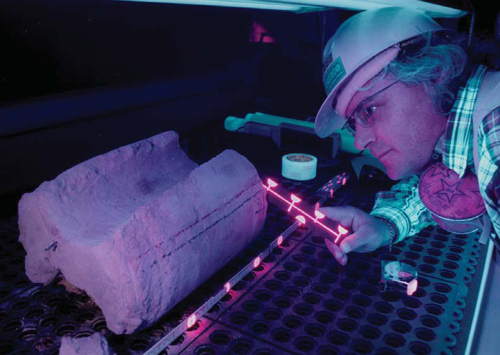
Ebb and flow: A scientist uses ultraviolet light to study how fluids move through rock.
Another difficult prediction involves the tectonic processes that will affect the site over the next 1 million years. Yucca Mountain is located in a seismically and volcanically active area; volcanism poses the greatest threat to the ability of a repository at Yucca Mountain to contain radioactivity. It is possible that volcanic activity could result in the extrusion of magma, corrosive gases, and water into the repository tunnels. Less probable but more disastrous would be for an actual eruption to disturb the repository, spewing radioactivity into the atmosphere. But because there is a dearth of data on which to base predictions of future volcanic activity, the threat posed by volcanic activity is highly uncertain.
Partly in response to the slow progress on Yucca Mountain, the Bush administration is pushing a program, dubbed the Global Nuclear Energy Partnership (GNEP), which would revive the reprocessing of spent fuel. In congressional testimony on March 9, Energy Secretary Samuel Bodman described the project: “GNEP is a comprehensive strategy to enable an expansion of nuclear power in the U.S. and around the world, to promote non-proliferation goals, and to help resolve nuclear waste disposal issues.”
Bodman also called Yucca Mountain “a complement to the GNEP strategy.” But as a waste solution, GNEP has big problems: Some technologies the plan depends on, such as pyroprocessing and advanced nuclear power plants, will not be available for decades, if at all. Furthermore, existing GNEP reprocessing technologies will still create high-level nuclear waste as well as very large volumes of low-level and trans-uranic waste, which must, of course, be stored somewhere. The Bush plan simply defers to a later date the problem of dealing with high-level nuclear waste, when what is needed is immediate work toward an answer. Republican Cong. Joe Barton of Texas summed it up in March, directing this comment to Bodman at the budget hearing: “I am concerned, though, that the scope of this problem may be too broad and it may be premature. I would urge you not to allow the Global Nuclear Energy Partnership to divert focusing resources away from the near-term challenges that must be overcome to ensure the long-term viability of the industry, especially progress at Yucca Mountain.”
Despite years of study and congressional mandates, it has yet to be determined whether Yucca Mountain is a suitable site. Answering this outstanding question is the imperative next step. What's needed now is more research–based on methods other than performance assessment modeling–to finally determine whether or not Yucca Mountain is a viable repository. Yucca should be evaluated in a comparative sense, as was originally planned in the Nuclear Waste Policy Act. It would be helpful to contrast Yucca with data on other well-studied sites worldwide; such locations could include New Mexico's Waste Isolation Pilot Plant (which stores transuranic waste from the nuclear weapons complex) and proposed repositories in Sweden, Finland, and France. Though it may simplify decision making for policy makers, performance assessment modeling is not a legitimate way to evaluate the site. For a complex Earth system like Yucca Mountain, the results of performance assessment modeling masquerade as quantitative analysis, whereas in reality they are riddled with subjectivity.
If Yucca Mountain doesn't measure up under a new comparative analysis, Congress will need to swallow hard and face the siting issue again. Instilling a sense of fairness in the legislation will help enormously, as will a look back at the original NWPA. Looking abroad can also serve as good guidance; France, Sweden, Finland, and Germany, all of which intend to open repositories, plan to involve citizens from the affected municipalities in the siting process. This consultative approach is in stark contrast to the U.S. “decide, announce, defend” policy.
Selecting a site for a national nuclear waste repository is one of the most difficult examples of policy making; there's a lot of pain per pound for the politicians involved. Despite problems encountered at Yucca Mountain, a geologic repository is by far the best solution to the nuclear waste problem. Even if a repository at Yucca is completed, politicians won't be able to avoid the siting issue forever. If Yucca were to open, it would be filled close to capacity with waste that has been temporarily stored around the country. Another repository would have to be opened to store future waste. The debate is not nearly close to being over–it's merely a harbinger of what is yet to come.
Supplementary Material
Nuclear Waste Policy Act of 1982
Senate Resolution 2099: Spent Nuclear Fuel 5 On-Site Storage Security Act of 2005
Global Nuclear Energy Partnership Strategic Plan
Footnotes
1.
Quoted in E. W. Colglazier and R. B. Lan-gum, “Policy Conflicts in the Process for Siting Nuclear Waste Repositories,” Annual Review of Energy, 1988, vol. 13, pp. 317-357.
2.
Daniel Sarewitz and Roger Pielke Jr., “Prediction in Science and Policy,” Technology in Society, April 1999, vol. 21, pp. 121-133.
3.
Charles Herrick and Daniel Sarewitz, “Ex Post Evaluation: A More Effective Role for Scientific Assessments in Environmental Policy,” Science, Technology, and Human Values, Summer 2000, vol. 25, pp. 309-331.
4.
For a discussion see Allison Macfarlane, “Uncertainty, Models, and the Way Forward in Nuclear Waste Disposal,” in Allison Macfar-lane and Rodney Ewing, eds., Uncertainty Underground: Yucca Mountain and the Nation's High-Level Nuclear Waste (Cambridge, Massachusetts: MIT Press, 2006). One of the first detailed discussions of this issue can be found in Naomi Oreskes, Kristin Shrader-Frechette, and Kenneth Belitz, “Verification, Validation, and Confirmation of Numerical Models in the Earth Sciences,” Science, February 4, 1994, pp. 641-46.
5.
For references, see Allison Macfarlane, “Uncertainty, Models, and the Way Forward in Nuclear Waste Disposal.”
6.
I. Linkov and D. Burmistov, “Model Uncertainty and Choices Made by Modelers: Lessons Learned from the International Atomic Energy Agency Model Intercomparisons,” Risk Analysis, December 2003, vol. 23, pp. 1297-1308.
7.
June Fabryka-Martin et al., “Water and Radionuclide Transport in the Unsaturated Zone,” in Uncertainty Underground.
8.
Mary-Lynn Musgrove and Daniel Schrag, “Climate Change at Yucca Mountain: Lessons from Earth History,” in Uncertainty Underground.
9.
See G. S. Bodvarsson, “Thermohydro-logic Effects and Interactions,” and William Murphy, “The Near Field at Yucca Mountain: Effects of Coupled Processes on Nuclear Waste Isolation,” both in Uncertainty Underground.