




Abstract

Russia continues to transition from its Cold War nuclear stockpile, further reducing its total nuclear forces in 2005 but also announcing plans for new weapon systems and upgrades of existing ones. The Russian government appears to be attempting to reassert its nuclear strength after years of decline in order to underscore its status as a powerful nation. To this end, President Vladimir Putin said Russia has reinstated large-scale military exercises, and military officials made several statements about the role of Russia's nuclear posture.
We estimate that as of early 2006, Russia has approximately 5,830 operational nuclear warheads in its active arsenal. This includes about 3,500 strategic warheads, a decrease of some 300 from last year's level due to the withdrawal of approximately 36 intercontinental ballistic missiles (ICBMs) from operational service. Our estimate of operational nonstrategic nuclear weapons is 2,330 warheads, more than a thousand warheads fewer than our previous estimate (see “Russian Nuclear Forces, 2005,” March/April 2005 Bulletin) due to a recount of operational launch platforms and Russian statements about reductions.
Estimating the size, composition, and status of the total Russian nuclear stockpile has always been difficult due to the lack of official information. Based on the best available data, we estimate that the current stockpile of intact warheads is around 16,000. With just over one-third (about 5,800) considered active and operational, the balance occupies an indeterminate status. Some may be officially retired and awaiting disassembly; others may be in short- or long-term storage, similar to the U.S. categories of “responsive force” or “inactive reserve.”
Russian officials made several statements in 2005 about why Russia needs to maintain and modernize its nuclear forces. Following several embarrassing missile launch failures in 2004, Putin took a personal interest in improving the image of Russia's nuclear capability. “Large-scale, regular army and navy exercises have resumed after what was too lengthy a hiatus,” Putin told the Russian Security Council in June 2005. On August 16, he flew aboard a Tu-160 Blackjack bomber and participated in the test-launch of a Kh-555 conventional cruise missile in the Arctic.
In December, Col. Gen. Yury Baluyevsky, chief of the Russian general staff, clarified Russia's strategic posture, telling Novosti that Russia “had long stopped preparing for large-scale nuclear and conventional wars. We will continue to prepare for the defense of our territory, but we will not be preparing for a war on foreign land.” In a January 2006 Wall Street Journal op-ed, Defense Minister Sergei Ivanov added his first priority “is to maintain and develop a strategic deterrent capability minimally sufficient for guaranteed repulsion of contemporary and future military threats.”
On December 24, 2005, Col. Gen. Nikolai Solovtsov, the commander of Russia's strategic missile forces, reaffirmed another layer to Russia's posture. Amid a dispute between Russia and Ukraine over natural gas supplies, Solovtsov told ITAR-TASS that Russia's “nuclear umbrella” defends “not only Russia but also all [Commonwealth of Independent States] countries, including Ukraine,” an interesting statement given Ukraine's aspiration to join NATO. Solovtsov also pointed to proliferation as a justification for Russia's nuclear arsenal, saying that “many countries are eager to come in possession of nuclear weapons; the nuclear club will be expanding.” Russia's plans to develop its strategic missile forces will take “into account all these threats. We're working on new missile complexes and new types of equipment with completely new characteristics,” he added.
As we predicted two years ago, the emerging U.S. antiballistic missile defense system has provoked a direct Russian response. Missile defense appears to be a major part of Russia's decision to retain multiple-warhead ICBMs and to develop new weapons capabilities. In November, Solovtsov said that new warheads for silo-based Topol-M missiles (NATO designation SS-27) and mobile Topol-Mls (SS-X-27) are undergoing testing. One type of warhead reportedly involved a maneuverable reentry vehicle known as “Igla” that changes altitude and direction to evade missile defenses. Indeed, at the December commissioning ceremony of the fifth Topol-M ICBM regiment at Tatishchevo, Solovtsov emphasized that the weapon “is capable of penetrating any missile defense system.” (Unidentified U.S. officials confirmed that the November 1, 2005, Topol-M test-launch had a shorter than usual boost phase, and that after being delivered into orbit, the reentry vehicle flew to a lower trajectory, where it was able to maneuver.)
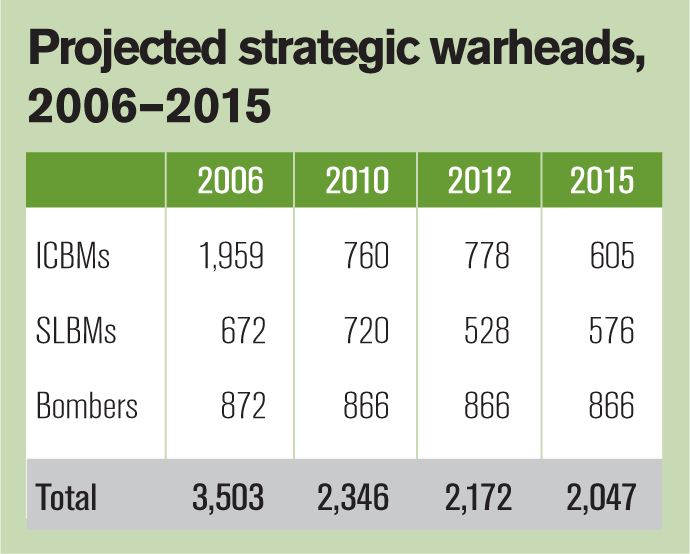
Since 2004, Russian officials have made several announcements that suggest what the future strategic force might look like after implementation of the 2002 Moscow Treaty, which sets an upper limit of no more than 2,200 operationally deployed strategic warheads by 2012 for both the United States and Russia. Officials described significant changes to the size and composition of the ICBM force, lesser changes for the submarine force, and a bomber force that will remain essentially the same. The table “Projected Strategic Warheads, 2006-2015” (see p. 67) contains estimates based on several assumptions: that the annual deployment of Topol-Ms continues at about six single-warhead missiles per year; that Russia commissions two new third-generation strategic subs and maintains five operational Delta Ills; and that Blackjack bomber production remains low.
If these plans are realized, they will significantly reduce Russia's emphasis on ICBMs, traditionally the backbone of its strategic forces, by withdrawing most of the multiple-warhead SS-18s and SS-19s. This will result in a 60 percent decrease of ICBM warheads, from nearly 2,000 to roughly 760 during the next four years. A decision to equip single-warhead missiles with multiple warheads after START I expires in 2009 would change this projection significantly.
Operational Russian strategic offensive weapons

ALCM: air-launched cruise missile; ICBM: intercontinental ballistic missile; MIRV: multiple independently targetable reentry vehicle; SLBM: submarine-launched ballistic missile; SRAM: short-range attack missile.
Russia has approximately 6,000 additional nonoperational, intact warheads.
The last 15 rail-based SS-24 Mis, the division at Kostroma, were withdrawn from service, leaving four ICBM types: SS-18s, SS-19s, SS-25s, and SS-27s. Significant changes are expected in the next four years. Russia will likely retire approximately 40 SS-18s produced in the early 1980s and up to 400 warheads. Some 45-50 newer version SS-18s and approximately 30 SS-19s will undergo modifications and upgrades to extend their service lives for another 15 years. Eventually, Russia will deploy only two types of ICBMs: Topol-Ms and Topol-Mls.
The fifth Topol-M regiment entered service in December 2005 with the Tatishchevo division in the Saratov region, bringing the number of operationally deployed SS-27s to 44. The new regiment appears to be equipped with less than a full complement of missiles due to a lack of funding. Deployment of the Topol-M began at Tatishchevo in 1997. Russia's 2006 budget includes funds for six Topol-Ms. Russia plans to deploy three Topol-Mls later this year at Teykovo (near Moscow) and six more in 2007.
Since the Topol-M carries a single warhead, a future force of two divisions, or 200 missiles, would result in a dramatic reduction from the nearly 2,000 ICBM warheads operational today, or the approximately 6,500 ICBM warheads of 20 years ago. If Russia wanted to increase the number of ICBM warheads, it could do so in one of several ways: equip each missile with more than one warhead; deploy more missiles; or both. Rumors have circulated in the Russian media that Moscow might equip the Topol-M with between three and six warheads. START II prohibited placing multiple warheads on ICBMs, but the United States and Russia abandoned this landmark agreement in 2002. Yet because START I prohibits increasing the number of warheads attributed to a specific ICBM type, Russia probably will wait until after 2009, when the treaty expires, to increase Topol-M's pay-load. The Topol-M has a throw weight of 1.2 tons, similar to the U.S. Minuteman III, which can carry up to three warheads.
The number of road-mobile SS-25s continues to gradually decrease from a peak of 360 a few years ago to the 291 now deployed at nine locations. The single-warhead SS-25 entered service in 1985, and its service life may have to be extended due to the slow introduction of the Topol-Ml. A November 29, 2005, test-launch of a 20-year-old SS-25 was intended to verify that the missile can serve beyond its original design life of 10 years. Following the test, a Russian Strategic Missile Force statement confirmed that “the Topol [SS-25] service life could be extended to 23 years” with some modification. This could enable the oldest missiles to remain operational through 2009 and the newest ones through 2018.
Operational Russian nonstrategic and defensive weapons

ABM: antiballistic missile; ASM: air-to-surface missile; ASW: antisubmarine weapons; SAM: surface-to-air missile; SLCM: sea-launched cruise missile.
Russia has approximately 4,170 additional nonstrategic warheads in its reserve.
The number of SS-19s also continues to decline, with 129 remaining in service, down from 140 in January 2005. The six-warhead missile was scheduled for elimination under START II, but after the agreement's demise, Putin declared that deployment of “tens” of additional SS-19s with “hundreds of warheads” would begin in 2010. Any new deployments are likely to be made from the 30 or so SS-19s that have been in storage; older versions are likely to be retired by 2009. An SS-19 was flight-tested on October 20, 2005.
Of the 14 original Delta III subs, six remain: The Petropavlovsk-Kamchatsky, Svyatoy Giorgiy Pobedonosets, Zelenograd, and Podolsk are based at Rybachi on the Kamchatka Peninsula; the Ryazan and Borisoglebsk are based in Gadzhiyevo. The military may be using a seventh non-operational Delta III, located at Rybachi, as a test platform. Though rumors suggest that Russia might retire the Delta Ill-class subs during the next few years, this will have to be coordinated with the introduction of new Borey-class SSBNs in order to achieve the planned goal of 208 submarine-launched ballistic missiles (SLBMs) in 2010. On September 30, the navy test-fired an SS-N-18 Ml SLBM from the Svyatoy Giorgiy Pobedonosets.
Two Borey-class subs are under construction at the Severodvinsk shipyard on the Kola Peninsula–both of them behind schedule. The military has pushed back the service entry of the initial boat, the Yuri Dolgoruki, until 2007, according to the new commander-in-chief of the Russian Navy, Adm. Vladimir Masorin. The navy first flight-tested the SLBM that the sub is to carry, the Bulava (NATO designation SS-NX-30; also called RSM-56 in Russia or Bulava-M for morskoy, “naval”), on September 27, 2005, and fired a second test on December 21. The navy launched the missiles from the Dmitri Donskoi, a Typhoon-class submarine that has been modified to be a test platform for the Bulava. The submerged submarine launched the missiles from the White Sea toward a target at the Kura test range in Kamchatka.
Each Borey-class sub will carry 12 Bulava missiles, which Russia provided new details about as part of the July 2005 START data exchange. The three-stage, solid-fuel SLBM is almost 38 feet long and weighs approximately 81,000 pounds at launch–10 feet shorter and 17,000 pounds lighter than the SS-N-23 SLBM. (The U.S. Trident II D5 weighs 127,000 pounds.) It is unclear how many warheads the Bulava will carry (the December 21 flight-test carried only a single reentry vehicle). Media reports have speculated as many as 10, but more reentry vehicles increase weight and limit range. After the completion of flight-testing, Russia will declare the warhead count under START. (When the treaty expires in 2009, Russia and the United States will no longer be required to declare the warhead count for new ballistic missiles.) Meanwhile, inadequate funding for the Bulava program means “there is little chance the missile can be put into service … in 2007” as planned, according to Yuri Solomonov, chief missile designer at the Moscow Institute of Thermal Technology.
The keel of the second Borey-class sub Alexander Nevsky was laid down at Severodvinsk in March 2004 with delivery scheduled for 2008 at the earliest. A third boat, tentatively named Vladimir Monomakh, is scheduled to begin construction in March 2006 and to be completed in 2012. The Russian Navy would like to acquire three additional Borey SSBNs for a total of six, but if construction continues at the current pace, the final sub would not be ready until 2026–30 years after the keel was laid on the Yuri Dolgoruki. The future fleet, more than likely, will be about the size of the British or the French SSBN fleets, which have four subs each.
The Russian Navy conducted three SSBN deterrent patrols in 2005, two in 2004, two in 2003, and none in 2002–far from the 61 patrols conducted in 1990. The U.S. Navy, in comparison, continues to operate at near-Cold War levels and conducts more than 40 SSBN patrols per year.
Projected strategic warheads, 20062015
Russia continues to upgrade its Blackjack bombers with improved avionics and communications equipment and to modify them to carry new types of missiles with conventional and nuclear warheads. This includes a nuclear variant of a new cruise missile (Kh-102), similar to the U.S. advanced cruise missile but with a prop engine. The weapon has been under development for more than a decade and may be deployed in 2006. Like the United States, Russia has begun to convert a portion of its air-launched cruise missiles (ALCMs) to non-nuclear versions (Kh-555s). In December 2004, a senior Russian Air Force official stated that the first Kh-555s had been delivered.
Small-scale production of the Blackjack resumed in 2004. The Russian Air Force will receive one bomber in February and another by the end of 2006, a senior air force official told Novosti in December 2005. Russia's new defense plans envision a force of 75 bombers in 2010. If Blackjack production continues after 2006, the bombers will likely replace Bears on a one-for-one basis. The development of conventional ALCMs seems to indicate that Russia envisions a more active bomber force.
In a 1992 letter to the UN. secretary-general, President Boris Yeltsin pledged that production of warheads for ground-launched tactical missiles, artillery shells, and mines had stopped and that all such warheads would be eliminated. In addition, Russia would dispose of half of all airborne and surface-to-air warheads, as well as one-third of all naval warheads. In 2004, the Russian Foreign Ministry stated that “more than 50 percent” of all these warhead types have been “liquidated.” “With a Russian nonstrategic stockpile of some 19,600 warheads in mid-1988, the implementation of the Yeltsin initiative would leave a stockpile of some 6,500 nonstrategic warheads.
Based on operational nuclear-capable delivery platforms, knowledge about the size and composition of the nonstrategic stockpile during the Cold “War, and statements made by Russian officials about implementation of the 1991-1992 presidential initiatives, we estimate that Russia maintains approximately 2,330 operational non-strategic warheads and some 4,170 nonstrategic warheads in reserve. The operational warheads include: approximately 700 warheads for antiballistic missile and air defense systems (the A-135 system around Moscow and the SA-10 Grumble/S-300 system); some 975 air-to-surface missiles and bombs for delivery by land-based Tu-22M Backfire and Su-24 Fencer strike aircraft; and 655 warheads for cruise missiles, anti-air missiles, antisubmarine rockets, and torpedoes delivered by submarines, surface ships, and land-based naval aircraft. All naval warheads are stored on land.
Supplementary Material
Treaty Between the United States of America and the Russian Federation on Strategic Offensive Reductions (SORT/Treaty of Moscow)