




Abstract
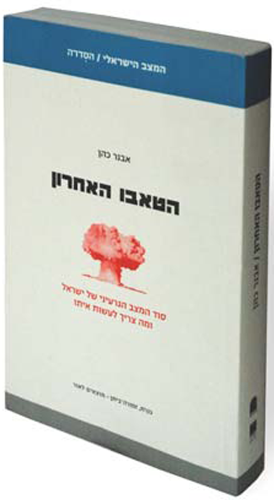
The Last Taboo: Nuclear Weapons, Secrecy, and the Threat to Democratic Government (Hatabu Ha'akharon: Sod Hamatzav Hagarini Shel Israel U-ma Tzarikh La'asot Ito), by Avner Cohen. Kinneret and Zmora-Bitan Publishers, 334 pages, 2005, $17 (NIS 78).
Since the 1950s, the world has learned to live with (or bury its head in the sand with regard to) the threat of nuclear war, nuclear radiation, and nuclear accidents. In The Last Taboo, researcher Avner Cohen again addresses Israel's “nuclear option.” (The Hebrew-language book is scheduled to be published in English later this year.) Cohen, most well known for his groundbreaking 1998 book Israel and the Bomb, here focuses more closely on Israel's nuclear weapons facility at Dimona, tracing its existence through political and historical perspectives. The Last Taboo is also a passionate manifesto against Israel's ongoing policy of opacity–to possess, but not acknowledge, its nuclear arsenal.
Cohen's anti-opacity arguments essentially boil down to two. First, it is anachronistic, he says, because it is accepted throughout the world (including in Israel) that the Israeli arsenal boasts a variety of weapons, from nuclear to thermonuclear warheads. (And, Cohen adds, Israel also has the capability to manufacture biological and chemical weapons.) Second, the policy of opacity makes it impossible to hold useful domestic public debate on the ideology of nuclear warfare and the conditions for resorting to it, on effective civilian supervision of Dimona, and on safety issues including who has access to the nuclear “red button.” As Israeli strategist Yehoshafat Harkabi put it, decision making in Israel is such that nuclear weapons are ultimately the private domain of the “captain”–the country's leader. In today's situation, one person, or a very small group of people, wields the kind of destructive power that in Greek mythology belonged to the gods. Thus a dichotomy is set up between the limitations of humans, who are prone to making mistakes, and the unlimited consequences of their decisions.
In practice, opacity is only a symptom of a much broader social phenomenon: the unwillingness to confront sensitive nuclear topics.
Israel's nuclear enterprise–including the Israel Atomic Energy Commission, which oversees the Dimona Nuclear Research Center and Israel's other nuclear facilities–operates under the auspices of the Defense Ministry. The same is true for the conglomerate Israel Military Industries and the RAFAEL Armament Development Authority. The political executive who is directly (and apparently exclusively) in charge of this kingdom of secrets is the Israeli prime minister. While there is a small Knesset subcommittee that supposedly monitors nuclear affairs, and in the past few years the state comptroller has been granted access to Dimona, it is doubtful that any of these bodies have the ability and know-how to keep a real eye on the nuclear facilities, whose reports are top secret in any case.
In practice, opacity is only a symptom of a much broader social phenomenon: the unwillingness of Israeli Jewish society to confront the supposedly sensitive nuclear topic, leaving it instead to those presumably more qualified. Few intellectuals have cornered the government and posed hard questions. There have been arguments within the scientific community and between scientists and the government, but these have not been made public. It is worth noting that a group of intellectuals established a Committee for Nuclear Disarmament in the Middle East in 1966–but it lasted only until the 1967 War, breaking up over disagreements between its doves and hawks.
Cohen is correct when he states that all democracies with nuclear weapons programs reached the initial decision secretly and non-democratically. In most cases, it has been a one-man decision. However, after the preliminary stage, the matter was brought into the open and legislation was passed on subjects like responsibility, accountability, transparency, and administrative oversight. Everything was institutionalized and transparent (apart from the technical and military aspects, of course), permitting an ongoing and aboveboard public debate on nuclear arms.
In Israel, the opacity policy prevents the issue from being dealt with in this manner, which is essential in a properly functioning democracy. Because the subject is taboo, various silencing mechanisms have been devised that violate democratic principles and have nothing to do with safeguarding state secrets and national security. There are several semi-official reasons for opacity. One argument is that Israel has made certain promises to the United States. Another is the idea that abolishing opacity would spark a regional nuclear arms race. And others say that opacity diminishes the likelihood of a “legitimate” nuclear attack on Israel because there is (supposedly) no certainty that it has nuclear weapons. The strangest argument is that opacity is a good deterrent because it shrouds Israel's military capabilities in mystery.
Cohen addresses all of these contentions relatively convincingly. Israel, he points out, is already considered a nuclear power despite its insistence on opacity, and coming out of the nuclear closet would be beneficial for it. Israel would achieve global recognition as a legitimate nuclear power, similar to India and Pakistan. Cohen proposes that the three nations, which refuse to join the Nuclear Non-Proliferation Treaty (NPT), should form a special or separate nonproliferation arrangement or treaty. This, in addition to moving beyond opacity, would help avoid a regional arms race, he says, because most other countries in the region have already signed the NPT. And abandoning opacity would also bring about greater democratization in Israel.
Cohen favors a nuclear-armed Israel, however reserved he is about actual nuclear use. But while he is fiercely critical of opacity, he avoids asking a cardinal question, so that he, too, is responsible for perpetuating the “last taboo.” The question is this: Let's say that for reasons of security or national defense, Israel needs the nuclear option, or might in the future. How much more fissile material must Israel produce at Dimona? As things stand, especially in view of the opacity policy, it does not seem that the government, the prime minister, the Knesset, or any other body has the power to shut down Dimona, regardless of whether or not it is actually needed. (After all, no organization is eager to liquidate itself, even after its job is done.) Neither does it seem that there is any nonaffiliated body in the Israel Atomic Energy Commission, which has the most interest in keeping the reactor open, that can tell us exactly what the dangers are in Dimona's continued operation–and that, apparently, is the real purpose of opacity today.
“Look, honey, Lassie was trying to tell us something.”
The enforcement of the “taboo” probably has another cause that Cohen may not feel comfortable mentioning: the unspoken pact between Israel's whitest doves and the most aggressive hawks. For the “national” camp, the nuclear weapons that Israel is supposedly hiding in the basement are a guarantee that no pressure, foreign or domestic, can force Israel into genuine territorial concessions. The doves, on the other hand, regard Israel's arsenal as a solid basis for the claim that Israel is so strong militarily that it can afford generous territorial concessions in return for peace treaties, and that in this new era, territory no longer counts for much. Implicitly, both parties in this critical controversy see nuclear arms as the ultimate weapon as they joust for public support.
Though Cohen does not go this far with his own critique, remaining seemingly enthralled by the bomb's black magic, The Last Taboo is an important, thought-provoking book. Anyone who cares about the fate of Israel and the human race should sit down and read it, whether or not they agree with the conclusions.