




Abstract
Thought you knew missile proliferation? Think again.
Cruise missiles are spreading across the globe at an alarming rate, threatening to escalate regional tensions.
In the early morning hours of August 11, 2005, in a remote and arid part of Pakistan's western Balu chistan province, Pakistani engineers test-launched a weapon like no other in their country's ambitious missile development program. Instead of employing a large solid- or liquid-fueled rocket as traditional ballistic missiles do, the new weapon was propelled off its launcher by a small solid-rocket booster on the missile's tail. Compared with the huge plume and readily detectable infrared signature produced by a ballistic missile's rocket engine, the booster's plume was so small that it avoided detection by early warning satellites stationed above Earth in geosynchronous orbits. Once the missile was safely away from its launcher, the booster quickly dropped away. An engine took over and propelled the missile to an altitude of only 610 meters (2,000 feet), after which it dipped back down and, like a low-flying airplane, followed the folds of the earth along a pre-programmed course.
Immediately after the successful test, Pakistani President Pervez Musharraf announced the achievement, declaring, “The biggest value of this system is [that] it is not detectable. It cannot be intercepted.” 1 Had Pakistani officials wished to keep the test a secret, they could have readily done so, but they were keen to tell the world that Pakistan had just joined the small but growing club of nations that possess land-attack cruise missiles (LACMs).
Some states have long seen the value of acquiring LACMs capable of delivering conventional as well as mass-destruction pay-loads. The United States and Russia possess nuclear-capable LACMs; China's newly tested LACM is probably nuclear capable, and both Britain and France have LACMs armed with conventional payloads.
But not until very recently has a series of seemingly small events nudged LACM growth toward a “tipping point” that has all the hallmarks of a new global arms race. 2 The first occurred in 2002 when the 34-nation Missile Technology Control Regime (MTCR) formulated and adopted the Hague Code of Conduct, which established a broad international norm against the spread of ballistic missiles. The MTCR was born in 1987 to limit the spread of weapon systems capable of carrying weapons of mass destruction, including ballistic and cruise missiles. The regime members, however, regrettably left cruise missiles out of the Hague code. In doing so, the international community may have inadvertently legitimated the acquisition of cruise missiles.
More profound was a second event that occurred during the 2003 Iraq War. Five crude Iraqi LACMs managed to evade otherwise successful U.S. missile defenses. Because they did not produce any known casualties, or derail coalition military operations, Iraq's use of LACMs was generally viewed as a footnote to an otherwise swift and successful military campaign. But to specialists both within the U.S. government and elsewhere, the chief lesson became that ballistic missile defenses alone cannot address the threat of low-flying cruise missiles. And because they are significantly less expensive than missile defenses, LACMs, in combination with existing ballistic missile arsenals, make defending against all types of missile threats a daunting challenge. This simple message is adding considerable momentum to LACM acquisition around the globe.
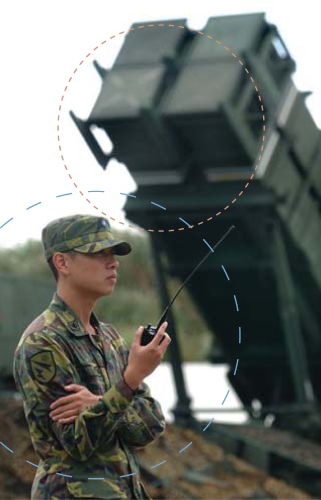
Strait tension: Missile defense deployments, like this one in Taiwan, may spark a cruise missile race.
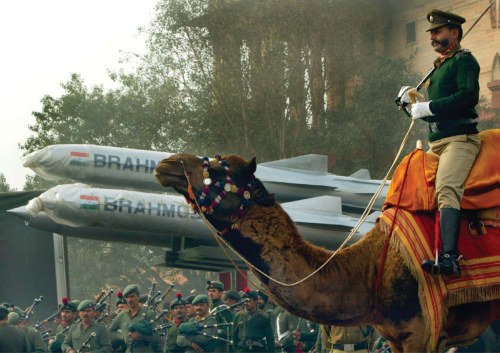
India, together with Russia, is developing the BrahMos supersonic cruise missile, which will have the this one capability to strike targets at sea or over land to a range of 290 kilometers (180 miles). In East Asia, China and Taiwan are rushing to deploy LACMs with ranges of 1,000 kilometers (621 miles) or more, while Japan is toying with developing a cruise missile for “preemptive” strikes against adversary missiles. In the Middle East, Israel once stood alone as the only country possessing LACMs, but now Iran is pursuing multiple cruise missile programs for both land and sea attack. (Iran has also provided the terrorist group Hezbollah with unmanned aerial vehicles, or UAVs, whose technology is similar to cruise missiles.) Meanwhile, in April 2005, Ukraine's export agency unveiled plans to market a new LACM, called the Korshun. The design of this new missile appears to be based solely on the Russian Kh-55, a nuclear-capable, 3,000-kilometer-range (1,860-mile) cruise missile, which Ukrainian and Russian arms dealers had illegally sold to China in 2000 and to Iran in 2001. 3
These rapid and successive developments, among others, suggest that the proliferation of missiles capable of delivering weapons of mass destruction is approaching a critical threshold. The surprising fact is that cruise missiles, not ballistic missiles, constitute the primary problem. While India, Iran, North Korea, and Pakistan have developed new medium-range ballistic missiles (1,000-3,000 kilometers in range) during the last decade, since the end of the Cold War, overall trends show a significant net decrease in worldwide ballistic missile arsenals. 4 Yet ballistic missiles, and defenses against them, command virtually the exclusive attention of decision makers and analysts. Flying under the radar, both literally and figuratively, cruise missiles potentially present a far more pressing threat than their ballistic counterparts–and the U.S. quest to sell ballistic missile defenses is making matters worse.
AN EVASIVE ALTERNATIVE
Since the launch of the first operational German V-2 rocket in 1944, ballistic missiles have furnished their owners with the symbolic cachet of military sophistication–not to mention the confidence that comes with possessing weapons capable of arriving reasonably close to their targets without the prospect of interception. But in several respects, LACMs present decidedly more attractive offensive options.
Besides being capable of carrying nuclear warheads, LACMs, due to their aerodynamic stability and accuracy (they are able to deliver pay-loads within tens of meters of a target or better), can efficiently deliver conventional and biological payloads. LACMs equipped with sprayers are more effective than ballistic missiles in delivering biological agents by at least a factor of 10. In order to deliver a crude first-generation nuclear warhead, LACMs need a nose cone with a sufficiently large diameter that is capable of carrying a payload weighing around 500 kilograms (1,100 pounds). Iraq's Seersucker cruise missile, used in the 2003 Iraq War, carried a 500-kilogram conventional warhead and had a diameter of .76 meters (2.5 feet). The U.S. Tomahawk LACM has a diameter of .52 meters (1.7 feet), which demands a smaller, more advanced nuclear warhead design.
Along for the ride: An Indian soldier escorts BrahMos cruise missiles during a January 2004 New Delhi parade.
In contrast to larger ballistic missiles, LACMs provide more flexible and survivable launch options from air, land, and sea platforms, while offering easier maintenance in harsher environments. Existing cruise missile defenses, including the best U.S. systems, come up short against low-flying LACMs (see “What If by Sea?” p. 30), and cruise missiles on average cost four to ten times less than ballistic missiles to acquire.
Until recently, though, the symbolic and psychological power of ballistic missiles trumped cruise missiles' superior efficiency. The growing effectiveness of ballistic missile defenses has altered the equation. Whereas U.S. missile defenses performed poorly against Iraq's ballistic missiles during the 1991 Gulf War (the Government Accountability Office generously attributed a 9 percent interception rate to them), greatly improved Patriot missile defenses intercepted all nine of the ballistic missiles Iraq launched in 2003. That the Patriot batteries failed to detect or intercept any of the five primitive LACMs launched by Iraq only bolstered their value as an alternative. In fact, the addition of LACMs to the Iraqi missile threat sowed such confusion among U.S. forces that it contributed to a series of friendly fire casualties: a Patriot erroneously shot down two friendly aircraft, killing three crew members, while an American F-15 crew destroyed a Patriot radar, in the belief that they were being targeted. 5
Though development work for most new LACM programs began before the 2003 Iraq War, evidence suggests that states have already absorbed the war's lessons. “This was a glimpse of future threats. It is a poor man's air force,” the chief of staff of the 32nd Army Air and Missile Defense Command told the New York Times shortly after the fall of Baghdad. “A thinking enemy will use uncommon means such as cruise missiles and unmanned aerial vehicles on multiple fronts.” 6
WHO'S ON OFFENSE?
The case of Taiwan illustrates how the deployment–or prospective deployment–of ballistic missile defenses furnishes a potent rationale for various states to possess cruise missiles, and how this dynamic holds the potential to trigger regional instability. For several years China has deployed its M-series ballistic missiles in provinces within reach of Taiwan. According to the Pentagon's latest annual report to Congress, China deploys up to 730 M-series missiles, with another 100 expected in a year. 7 These missiles are believed to possess sufficient accuracy to make conventional payloads effective against Taiwan's military “ace in the hole”–its large, modern air force. But Taiwan is constrained to operate its air force from a small number of airfields. Alone, China's ballistic missiles are not capable of closing Taiwan's airfields, but they could delay the Taiwanese Air Force from taking to the air to meet and defeat China's less potent air threat in the first critical hours of a war. Pinned down, Taiwan's aircraft would become vulnerable to the first and subsequent waves of attacking Chinese aircraft.
Responding to China's ballistic missile threat, in the mid-1990s Taiwan purchased U.S. Patriot Advanced Capability (PAC)-2 missile defense batteries and is planning to acquire the latest hit-to-kill PAC-3 interceptors in the near future. In September 2004, China countered by testing a new LACM named Dong Hai-10, with a range of 1,500 kilometers (932 miles) and the capability of being delivered to within 5 meters (16 feet) of its target. China already deploys the Ying Ji-63 LACM and the Israeli-furnished Harpy UAV, both of which have a range of around 500 kilometers (311 miles). 8
In theory, Patriot missiles can intercept low-flying LACMs only if the interceptors have advanced, fire-control-quality radar information–preferably provided by an airborne platform–on the precise whereabouts of the incoming LACMs in enough time to determine that they are enemy targets and to take multiple shots at them. This is a tall order, even for the U.S. military, no less, Taiwan's. Accordingly, China's addition of cruise missiles and UAVs to the offensive equation could severely cripple the Patriot's effectiveness against both ballistic and cruise missiles.
The high cost of the Patriot system has sparked debate within Taiwan about whether missile defense is an adequate counter to the Chinese threat. “Relying on purely defensive systems to protect ourselves from China means we will have to outspend them 10 to 1…. That is impossible in the long run,” an anonymous Taiwanese government official told the Financial Times in the aftermath of China's 2004 cruise missile test. 9 To ease missile defense spending, Taiwan plans to stretch out its Patriot deployments to 2019. 10 In the meantime, Taiwan has turned to cheaper, offensive solutions.
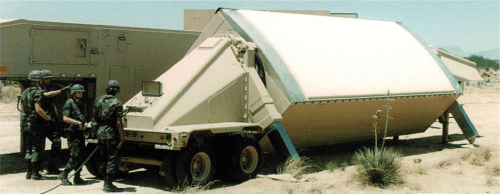
See anything? A Theater High Altitude Air Defense radar.
In early 2005, Taiwan test-fired its first LACM, the Hsiung-Feng 2E, or “Brave Wind,” in the hopes of a large-scale deployment in four years. Taiwanese military analysts have also discussed the possibility of instituting a “preventive self-defense” strike option, entailing the early use of cruise missiles to sow confusion in China's strike plans. 11 This predilection toward usurping control at the outset of a conflict suggests a dangerously low threshold for initiating hostilities.
Taiwan is not alone in exploring the possibility of preemptive strike options. In October 2004, a Japanese Defense Agency panel report stipulated a requirement for launching preemptive strikes against ballistic missile launch installations. 12 Such tactics were at first thought to revolve around the use of ballistic missiles, but Japanese defense officials are now considering using cruise missiles, in part because they anticipate fewer adverse reactions, both inside and outside of Japan, to acquiring LACMs rather than ballistic missiles. 13
Japan also has budgetary reasons for being interested in such offensive options. Each PAC-3 interceptor missile costs an estimated $4.75 million, while each Standard Missile (SM)-3 interceptor, launched from U.S.-built Aegis ships, runs four times that amount. At these prices, Japan's defense budget will accommodate the purchase of only 12 to 13 PAC-3 and 9 SM-3 interceptors each year. With Chinese and North Korean ballistic missile arsenals already large and growing, and with LACMs in the picture, economic and strategic logic dictates consideration of cheaper offensive options, despite Japan's post-World War II constitutional constraints against offensive military options.
Such offense-defense calculations are no different in South Asia and the Middle East. India, fearing a presumed Pakistani numerical ballistic missile advantage, has long sought to acquire Israel's Arrow missile defense system, a move that would violate MTCR restrictions. After having thwarted India's initial attempts to acquire the system, the Bush administration reportedly relented as part of a July 2005 deal whereby India will place its civilian nuclear facilities under international monitoring. 14
India has also expressed interest in Patriot missile defense interceptors. Within a month of Washington's deal with India, Pakistan conducted its surprise launch of the Babur LACM, which sent a potent message to New Delhi. The Babur's launch also came a few days after India and Pakistan had agreed in principle to notify each other before missile tests, but the agreement–like the Hague code–deals only with ballistic missile launches.
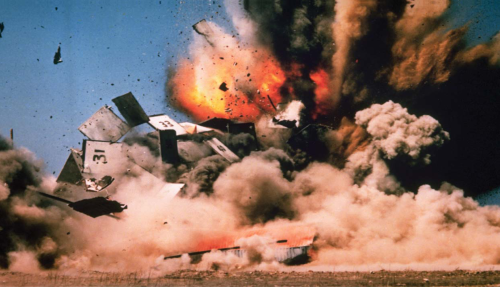
Deadly accuracy: A U.S. Tomahawk cruise missile obliterates its test target—a warehouse-sized structure—after a journey of more than 400 miles.
In the Middle East, Iran has responded to Israel's brisk deployment of Arrow and Patriot missile defenses by converting around 300 Chinese Seersucker anti-ship cruise missiles into LACMs, equipping them with turbojet engines and new guidance systems. 15 Iranian dissidents also claim that Tehran has successfully reverse-engineered Ukraine's Kh-55. 16 Iran apparently views LACMs as impervious to existing missile defenses and as an efficient way to increase the likely success of ballistic missile launches by overloading Israeli and U.S. missile defenses. 17
A TEMPTING WEAPON
By fixating on the familiar threat of ballistic missiles, strategic planners and nonproliferation specialists are in danger of overlooking the more likely threat of cruise missiles. As far back as December 1996, a congressionally mandated independent review panel chaired by Robert Gates, former director of the CIA, chided the intelligence community and, by implication, policy makers for “an inconsistency in … its treatment of ballistic and cruise missiles.” 18 While the Gates panel found ample reason for concern about cruise missile threats, it disclosed that the intelligence community had dismissed LACMs, despite their technological feasibility, largely because it couldn't imagine reasons and scenarios for their use. The intelligence community has since sought to treat the threats with greater balance.
Missile defense priorities have also lacked evenhandedness. While improved defenses against short- and medium-range ballistic missiles have made cruise missiles more attractive offensive options, cruise missile defense programs remain stalled. Some modest capability to deal with low-volume attacks will eventually reside in fighters equipped with advanced detection and tracking radars. But existing U.S. programs are underfunded, while interoperability, doctrinal, and organizational issues thwart the military services from producing truly joint and effective systems. 19 Looming large in any missile defense debate is the question of affordability. During the height of the Reaganera Strategic Defense Initiative, defense strategist Paul Nitze, no critic of missile defenses, argued that they should be “cost effective at the margin,” meaning that it should be less expensive to make incremental improvements to missile defenses than it would be to achieve offensive gains. Whereas such a proposition always seemed impossible against ballistic missiles, it appears inconceivable when arsenals of relatively cheap LACMs are added to the mix. As the predominant, if not exclusive, purveyor of missile defenses globally, the United States would do well to remind its friends and allies of what its missile defenses can–and cannot–do against current and prospective missile threats.
Faulty missile nonproliferation policy also needs urgent attention. The second-class status of cruise missiles will not change until the Hague code gives equal normative status to both ballistic and cruise missiles. A more progressive approach to addressing missile proliferation within the MTCR is also needed to stanch the LACM epidemic. The United States correctly points its finger at Russia and China (not a formal regime member but an adherent to its principles) for their inconsistent export practices. Most notably, China's fingerprints are all over Pakistan's Babur LACM, despite Islamabad's claims to the contrary. 20 China's quest to join the MTCR ought not to gain the required unanimous consent of the membership until such suspicions are allayed. MTCR members should also encourage Russia to ignore Indian strategists' requests to help the Indian military develop strategic-range LACMs in response to Pakistan's new missile.
U.S. export behavior warrants adjustment as well. During the last few years, Washington has sought to loosen MTCR rules governing the sale of both large UAVs and missile defense interceptors. In early 2002, the Bush administration created a confidential interim policy governing the export of UAVs that otherwise merited the strictest export controls. 21 Rumors were afloat in 2003 that the White House was contemplating the removal of missile defense interceptors altogether from MTCR consideration. Though the White House has grand plans for global missile defenses and views UAVs as tools that allow for the precision delivery of conventional weapons rather than tools for mass destruction, it is foolish to view interceptors or large UAVs as purely defensive systems, incapable of offensive use. Large UAVs can deliver nuclear payloads or large quantities of chemical or biological agents, and the ubiquitous use of the Soviet-era SA-2 interceptor as a basis for building offensive missiles belies such an innocent interpretation. In the end, incautious U.S. missile defense and UAV sales would accelerate rather than abate the cruise missile tipping point.
Though new weapons don't inherently increase the risk of conflict, when coupled with preemptive doctrines, advanced weapons that are difficult to detect and could allow for a surprise attack–particularly ones seen capable of decisive results without recourse to nuclear weapons–may tempt states to take highly risky actions. Past wars in the Middle East come readily to mind, but so too does China's increasing reliance on a doctrine espousing “actively taking the initiative” to catch the enemy unprepared. That Taiwan and Japan, driven by the high cost of missile defenses and the perceived benefits of cruise missiles, have also turned to preemptive strike notions, ought to be a matter of great concern. By tying precision conventional strike weapons to truly offensive war doctrines, states may inadvertently be moving closer to lowering the vital threshold between peace and war.
What if by sea?
After spending two decades and $92.5 billion pursuing a flawed national ballistic missile defense, the Defense Department is turning some of its attention to what has been termed “asymmetric missile defense”-defending against a cruise or ballistic missile launched off the U.S. coast.
In response to prodding from Defense officials, Congress included $10 million for an Asymmetric Warfare Initiative in the 2006 defense appropriations bill. The initiative will provide funding for an analysis of the asymmetric missile threat and for Missile Defense Agency (MDA) officials to recommend defense options. All eyes will be on the agency's recommendations, as preliminary efforts to come up with effective asymmetric missile defenses have underestimated the cost and technological difficulties of developing and deploying such systems, while exaggerating the threat.
Indeed, not much is officially known about the feasibility of a sea-launched missile off the coast of the United States. The possibility certainly exists, but using ballistic or cruise missiles in a maritime setting requires a certain level of technological capability and training, making it a head-scratching choice for a non-state actor with abundant crude options to inflict damage.
Officials from defense contractor Lockheed Martin have suggested that a combination of existing missile defense systems-Patriot Advanced Capability (PAC)-3 batteries and Aegis destroyers armed with Standard Missile-3 interceptors-could protect the northeastern seaboard for a surprisingly low initial cost of $1 billion. But it is unclear if the Pentagon has rectified problems with the PAC-3 radars, which didn't even detect Iraqi cruise missile launches during the 2003 Iraq War.
The Aegis weapon system has fared better in testing against medium-range ballistic missiles, but its attitude control system has not worked in a multi-pulse mode, which would presumably weaken its effectiveness against cruise missiles, whose varying flight paths are trickier to track than the arches of ballistic missiles. Attempting to enhance its ability to detect cruise missiles, the Pentagon awarded Raytheon a contract in November 2005 worth up to $1.3 billion to contribute to the development of a new radar system. The Pentagon plans to test the system, known as the Joint Land Attack Cruise Missile Defense Elevated Netted Sensor System, in 2009.
Lockheed also offered up its Terminal High Altitude Area Defense system to defend against the hypothetical asymmetric threat, but the system could be used for this purpose only if its kick-stage received the extra fuel needed for increased maneuverability, a modification that could be incorporated into the system by 2010 at the earliest. Even if these systems were fully developed, they would not be able to provide coastal defense for the United States unless they were fielded in great numbers, which would be cost-prohibitive.
Uncertainty about who should be responsible for asymmetric missile defense programs is further hampering efforts. The Joint Theater Air and Missile Defense Office has traditionally overseen cruise missile defense efforts, but that appears likely to change. At a December 2005 military conference, Lt. Gen. Trey Obering, director of the M DA, told Inside the Army that the agency was in a position to “expand” into supervising cruise missile defense programs, despite its earlier reluctance.
As is often the case, the Pentagon will probably hedge its bets with asymmetric missile defense and spread its funding across a variety of weapon systems. If it is truly concerned about a sea-launched missile threat, the Pentagon would do well to focus on increasing maritime surveillance capabilities instead of investing in technologies that may not pay off for decades, if ever.
Victoria Samson is a research analyst at the Washington, D.C.-based Center for Defense Information.
Supplementary Material
International Code of Conduct Against Ballistic Missile Proliferation
Supplementary Material
Intelligence Analysis on the Long-Range Missile Threat to the United States
Supplementary Material
Ballistic and Cruise Missile Threat
Footnotes
1.
“President Musharraf Compares Babur Missile with India's BrahMos,” Islamabad PTV World in English, August 11, 2005 (Foreign Broadcast Information Services [FBIS] transcribed text).
2.
Malcolm Gladwell, The Tipping Point: How Little Things Can Make a Big Difference (New York: Little, Brown and Co., 2000).
3.
The initial Ukrainian disclosure indicated that Iran received six missiles, but
evidence indicates twelve. On the missile sale, see NIS Export Control
Observer, February 2005 ( ); on plans for Korshun cruise missile,
see Piotr Butowski, “Ukraine Unveils Its
‘Korshun’ Missile,” Air and
Cosmos, April 8, 2005, p. 24.
); on plans for Korshun cruise missile,
see Piotr Butowski, “Ukraine Unveils Its
‘Korshun’ Missile,” Air and
Cosmos, April 8, 2005, p. 24.
4.
Joseph Cirincione, “The Declining Ballistic Missile Threat, 2005,” Carnegie Endowment for International Peace, January 25, 2005.
5.
Dennis M. Gormley, “Missile Defence Myopia: Lessons from the Iraq War,” Survival, vol. 45, no. 4, Winter 2003-04, pp. 61-86.
6.
Michael R. Gordon, “A Poor Man's Air Force,” New York Times, June 19, 2003, p. 1.
7.
“U.S. Reports China Missile Build-up,” BBC News, July 20, 2005.
8.
“China Test-Firing New Cruise Missile Which Threatens Taiwan: Journal,” Space Daily, September 19, 2004.
9.
Kathrin Fülle, “Taiwan Speeds up Race to Match Beijing Missiles,” Financial Times (Asia Edition), September 25, 2004, p. 3.
10.
11.
Chang Li-the, “Taking a Look at Taiwan's Cruise Missile Requirements and Capabilities–A Report on the Successful Test-Firing of the Hsiung-Feng 2E,” Chien-tuan K'o-chi (Defense Technology Monthly), July 2005, (FBIS report in Chinese, October 3,2005).
12.
“Preemptive Strike Ability Said Necessary for Japan,” Japan Times, October 2,2004.
13.
Interviews with Japanese defense officials in Tokyo, March 2005.
14.
Dana Milbank and Dafna Linzer, “U.S., India May Share Nuclear Technology,” Washington Post, July 19,2005, p. Al.
15.
Lothar Ibrugger, NATO, “Report of the NATO Parliamentary Assembly, Subcommittee on the Proliferation of Military Technology, Missile Defences, and Weapons of Mass Destruction,” November 2004.
17.
“Iran Seeks Cruise Missile to Support Shihab,” Middle East Newsline, June 10,2004.
18.
19.
Gormley, “Missile Defence Myopia.”
20.
Robert Hewson and Andrew Koch, “Pakistan Tests Cruise Missile,” Jane's Defence Weekly, August 17,2005.
21.
See Dennis M. Gormley and Richard Speier, “Controlling Unmanned Air Vehicles: New Challenges,” Nonproliferation Review, vol. 10, no. 2, Summer 2003, pp. 66-79.