




Abstract
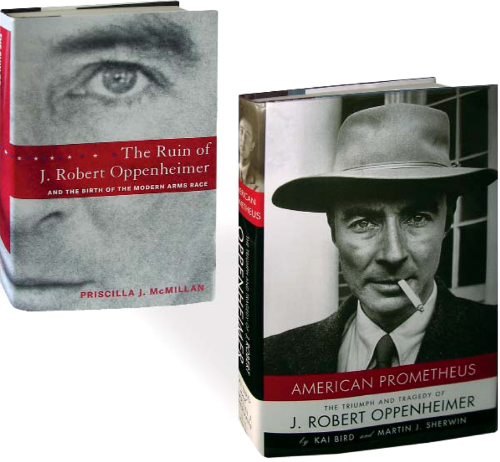
American Prometheus: The Triumph and Tragedy of J. Robert Oppenheimer, by Kai Bird and Martin J. Sherwin. Alfred A. Knopf, 719 pages, 2005, $35.
The Ruin of J. Robert Oppenheimer: And the Birth of the Modern Arms Race, by Priscilla J. McMillan. Viking, 384 pages, 2005, $25.95.
In September 1978, while makevg a docudrama series on J. Robert Oppenheimer for the BBC, I visited attorney Roger Robb at his holiday home on Cape Cod. Robb had prosecuted Oppenheimer at his 1954 security hearing that became, in effect, a treason trial. I proudly carried with me a collection of FBI documents very recently released under the Freedom of Information Act, and, at one point, I presented Robb with one.
The document described how he and Lewis Strauss, then-chairman of the Atomic Energy Commission (AEC), believed the hearing board was going to clear Oppenheimer and pleaded with FBI Director J. Edgar Hoover to intervene. It was behavior at least improper and probably illegal, and Robb, who by 1978 was a federal judge, was clearly embarrassed. “Damned if I remember this,” he responded. A few weeks later came a written denial and a threat to sue; in the end he backed down. As Kai Bird and Martin J. Sherwin write in American Prometheus, “the documentary record is clear–he was lying.”
While following the narratives of earlier biographies, both American Prometheus and Priscilla McMillan's The Ruin of J. Robert Oppenheimer include this anecdote among a wealth of new and engrossing detail that freshly illuminates Oppenheimer's extraordinary life and character. Both books have been long in gestation. I recollect hearing of Sherwin's biography while producing our television series in the late 1970s. For her part, McMillan started work on The Ruin some 20 years ago. Both works have benefited from the painstaking research and the literally hundreds of interviews the authors carried out.
Oppenheimer, in an increasingly disturbed state, tried to strangle his best friend with a luggage strap. Later, he left a poisoned apple on the desk of his tutor.
The books are very different but manage to complement one another. American Prometheus is the first full biography of Oppen-heimer and will no doubt cast a long shadow over any related projects in the future. In contrast, McMillan focuses in greater detail, and with the zeal of a campaigner, on the six-year conspiracy, from 1949 to 1955, that led to the hearing and the destruction of Oppenheimer's influence on the nuclear energy program.
In American Prometheus, Bird and Sherwin layer detail in a way that builds an impression of Oppenheimer's complex character that is greater than the constituent parts. Born into a wealthy German-Jewish family in 1904, Oppenheimer described himself as “an abnormally repulsively good little boy,” and until he graduated in chemistry from Harvard at 21, work and science dominated his life–he had never even dated. Thus when he traveled abroad in 1925 to face the new challenges of studying physics at Cambridge, his homesickness led him to despair and to breakdown. During that first Christmas abroad, he found himself walking on a Brittany beach, contemplating suicide. Not long afterward, in an increasingly disturbed state, he tried to strangle his best friend with a luggage strap. Later, he left a poisoned apple on the desk of his tutor. He was diagnosed with dementia praecox, a condition akin to schizophrenia and considered incurable.
Hoping to dispel his emotional crisis, in March 1926 two friends accompanied Oppenheimer on a trip through Corsica. This certainly helped Oppenheimer achieve some kind of resolution. Bird and Sherwin surmise that during the trip he had read Marcel Proust, and this brought him to face his own indifference to the feelings of others, what Proust described as a “terrible and permanent form of cruelty.” Coming to terms with this part of himself may have broken his depression, but the flaw remained with him.
By the time Oppenheimer returned to the University of California at Berkeley after three years in Europe, his self-confidence had grown immeasurably, and his brilliance, his looks, and his wealth attracted a coterie of admirers, both male and female. For those inside his charmed circle, he was wonderful. For those outside, it was a different matter. His sharp tongue and arrogance were legendary. At Berkeley, he built his own school of physics, with an attractive aura of culture and philosophy. His students idolized him. He was an ideas man, not good on detail, but someone who could open doors for others.
BOOK ROUNDUP
Inquiring minds
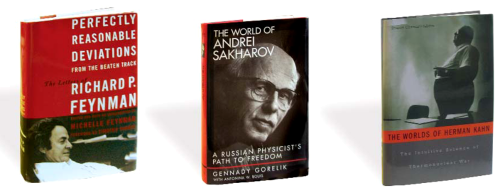
Perfectly Reasonable Deviations from the Beaten Track, edited by Michelle Feynman. Basic Books, 2005.
The World of Andrei Sakharov, by Gennady Gorelik. Oxford University Press, 2005,
The Worlds of Herman Kahn, by Sharon Ghamari-Tabrizi, Harvard University Press, 2005,
Readers can't seem to get enough of Richard Feynman. Nobel laureate, physicist, painter, bongo player, even TV personality-Feynman may have been the closest thing to Buckaroo Bonzai that real life had to offer. For those who have already read books written by or about Feynman, this collection of his personal correspondence, assembled by daughter Michelle, won't hold many surprises. But his hearty commitment to science, healthy disrespect for conformity, and terrific love of life come across in his letters, giving the impression of an intellectual adventurer. And although there is no plot or even much connectedness to speak of between sections, this quality gives the book a certain liveliness-it's fun to get to know Feynman.
Shortly after Feynman came into the public eye in the mid-1 960s, another physicist across the globe was gaining worldwide attention-not for his science, but for speaking out from behind the Iron Curtain in favor of democracy, human rights, and a nuclear test ban. Andrei Sakharov, the “humanitarian scientist,” is the subject of Gennady Gorelik's in-depth biography. It's Sakharov-plus, the feac/c-backstory for those who want to examine not just the roots of Sakharov's transition from Soviet weaponeer to outspoken humanitarian but also the hairs on the roots. The first nearly hundred pages explore Sakharov's scientific patrilineage-the teachers of his teachers, the heroes of his heroes-without actually talking much about Sakharov. For the patient reader, this detail helps inform Gorelik's eventual description of Sakharov's evolution into one of the twentieth century's most important dissidents.
Herman Kahn, too, was another radical thinker, unafraid to speak his mind on nuclear war (though he, unlike Sakharov, had the benefit of living in a free and open society). The wry and blunt Kahn believed that “sick humor loosened public inhibitions” about confronting the nuclear age, writes author Sharon Ghamari-Tabrizi. Famous in smallish security circles as the irreverent author of On Thermonuclear War, to the broader public Kahn is perhaps most often misre-membered as the basis for Stanley Kubrick's Dr. Strangelove. (Kahn was an influence on Kubrick's character, Ghamari-Tabrizi says, but not the inspiration.) Well-written and straddling the worlds of wonk-talk and pop culture, the narrative meanders comfortably-it is Kahn in soft focus, against a colorful, shifting 1950s, early 1960s era backdrop, a time when nuclear war was a thing people really worried about. For talking about it frankly and with a sense of humor, Kahn was both praised and reviled. Ghamari-Tabrizi's own tone, irreverent and incisive, is a perfect match for her fascinating subject.
American Prometheus is rich in revealing cameos of the people in Op-penheimer's life and particularly good in capturing his relationships with women. There is Jean Tatlock, his first true love, a child psychiatrist who was a depressive and who eventually committed suicide. The two came close to marrying, and it was Jean who introduced him to left-wing activities, though not, the authors show, to Communist Party membership.
When their affair ended, Oppen-heimer married the difficult Kitty Puening. Few people liked Kitty. Op-penheimer's sister-in-law described her as “one of the few really evil people I've known.” Others have been kinder, including Bird and Sherwin, but the Oppenheimer family life, according to physicist Abraham Pais, “looked like hell on Earth.” Seemingly as a foil to this marriage, Oppen-heimer began an affair with Ruth Tol-man. She was 11 years his senior and, significantly, married to a “very dear friend” whose discovery of the affair, some thought, brought about his fatal heart attack.
Though his left-wing activities nearly cost him his place on the embryonic bomb project, Oppenheimer's ability and charm persuaded project leader, Gen. Leslie Groves, to ignore the warnings of his security advisers (their findings were to dog Oppen-heimer for the rest of his life) and to appoint him head of the laboratory at Los Alamos. In time, he earned the respect of everyone affiliated with the lab. English physicist Jim Tuck found “the spirit of Athens, of Plato, of an ideal republic” at the laboratory. Even Edward Teller approved of Oppen-heimer as director. The excitement of the challenge kept any moral qualms at bay. However, once the bomb was used–against Japan, not Germany–the triumph turned rapidly sour, particularly for Oppenheimer.
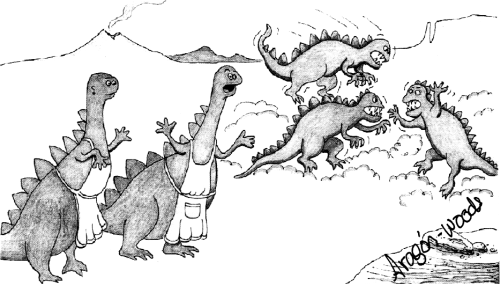
“My goodness, Mabel, where in the world do they get all that energy, and what's to become of them?”
I had always thought there was something contrived and theatrical in Oppenheimer's rapid post-war disillusionment. However, in one telling chapter, Bird and Sherwin give a real sense of his fear for the future unless some form of international atomic energy control was realized. He sadly found President Harry S. Truman determined to hang on to the American monopoly and watched as U.S. representatives to the United Nations let any hope of an international agreement slip away.
Even though he became a Washington insider, Oppenheimer never lost his belief that an arms race was suicidal and dangerous, and in time this brought him into conflict with powerful enemies. In 1949, the Soviets tested their first atomic bomb. In the aftermath, there was a powerful move to develop the hydrogen bomb. This plan was resisted by Oppenheimer's influential AEC General Advisory Committee because it believed the H-bomb was genocidal and had yet to be proven feasible. Here is where The Ruin begins its main narrative. For much of the book, Oppenheimer himself is in the background, but McMillan is angrily fighting on his behalf and indicting those who prosecuted him. I admire what she's done, but I query one of her presumptions.
In supporting Oppenheimer's resistance to the H-bomb, she argues that, had Truman been willing to brave the political fallout and not rushed to build the new weapon, he could have left the scientists to secretly investigate its feasibility while he explored Soviet willingness to mutually halt the weapon's development. But could Truman really have done that? He would have had to brave the political reaction within the United States to losing its nuclear monopoly and to the realization that spy Klaus Fuchs had probably given the Soviets vital classified H-bomb information. Truman also would have had to face the anti-communist hysteria accompanying the Korean War, seen at the time as a likely precursor to World War III. As one of Truman's aides noted, the president “said there actually was no decision to be made on the H-bomb.” In the climate of the time, if it was possible, it was going to be done.
I have no such caveats about McMillan's description of the conspiracy to unseat Oppenheimer. There is no doubt that Oppenheimer's cruel streak played its part. He alienated both Strauss and the secretary of the air force with his arrogant rudeness. But the calculated vindictiveness he encountered in return, particularly inspired by Strauss, beggars belief. In 1953 it was Strauss who mobilized media baron Henry Luce to publicly attack Oppenheimer with a Fortune article. And, McMillan relates, he also met with and encouraged the congressional aide, William Borden, to frame the letter of accusation that provoked President Dwight D. Eisenhower to set in train preparations for the hearing.
During those preparations, Strauss worked with the FBI to bug the offices and tap the telephone of Oppen-heimer's lawyer. He also arranged for the New York Times to leak news of Oppenheimer's plight just prior to the hearing–the board blamed Oppenheimer's lawyers for the leak. Then, during the hearing, Oppenheimer's lawyers were denied access on security grounds to documents that were made available to prosecutor Robb, who spent a week briefing the board while Oppenheimer's defense was denied the same privilege. Strauss did everything to ensure a guilty verdict, including bribing his own commissioners to vote against granting Op-penheimer clearance and having the final decision rewritten by a Luce journalist.
It is a shameful series of events, all well authenticated by McMillan. But perhaps most extraordinary, even though his career was ruined, Oppen-heimer never once, in the last 13 years of his life, publicly criticized the government or the AEC. According to Bird and Sherwin, Oppenheimer's secretary, Verna Hobson, believed he saw the hearing as the unavoidable outcome and indictment, not of any single cruel act of his, such as his humiliation of Strauss, but of his entire life and how he had lived it. It would seem that, after all, he had never finally come to terms with the flaws in his character.