




Abstract
During the last 60 years, we missed several opportunities to contain the nuclear threat. it's not too late to learn from our mistakes.
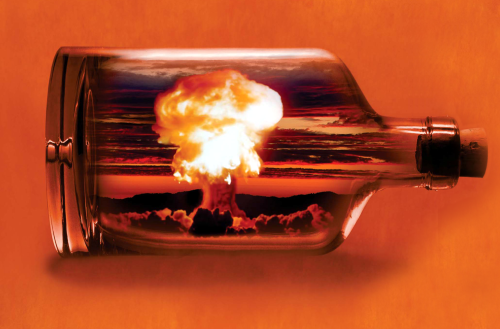
The hope of civilization,” president Harry S. Truman said in his message to Congress in October 1945, “lies in international arrangements looking, if possible, to the renunciation of the use and development of the atomic bomb.” One month later, Truman joined the leaders of Britain and Canada to propose to the new United Nations that all atomic weapons be eliminated and that nuclear technology for peaceful purposes be shared under stringent international controls. By 1946, he had a detailed plan that included many of the nuclear nonproliferation proposals still debated today, including a ban on the production of new weapons and fissile material for weapons; international control of nuclear fuel; a strict inspection regime; and complete nuclear disarmament.

60 YEARS: ON THE BRINK
IN THE FIRST FIVE YEARS OF DWIGHT D. EISENHOWER'S PRESIDENCY, THE UNITED STATES THREATENED OR CONSIDERED USING NUCLEAR WEAPONS ON AT LEAST SIX SEPARATE OCCASIONS.
But in the United States, opponents of the proposal said America should hold on to its nuclear monopoly. In the Soviet Union, Joseph Stalin wanted his own bombs. Both nations opted to seek security through atomic arsenals, not atomic treaties. The end result? The number of nuclear weapons grew from the two fission bombs held by the United States in November 1945 to more than 27,000 nuclear and thermonuclear bombs held by eight or nine nations today.
Was this the preordained outcome of the nuclear age? Was the arms race inevitable? Debating “What if?” scenarios is tricky business. Many undoubtedly believe U.S. nuclear policy has been validated by history: The Soviet Union collapsed and America is still here, so what's the problem? But this logic is a bit like hikers who believe that their path up and down the mountain was the only way to get to the other side, even when others point out a safer, quicker path around the mountain.
Unlike these hikers, the United States was not compelled to follow just one path after it began its journey. During the last 60 years, we have come upon numerous forks in the road, guided by nuclear minimalists on the one side and nuclear expansionists on the other. Usually, as with the first fork in the 1940s, the expansionists prevailed. But not always. And although, at times, expanding nuclear arsenals seemed the more realistic option, there were several roads not taken that would have left us more secure today.
Having survived the Cold War, we now find ourselves staring at the steep face of another mountain. The path we choose over the next few years will determine whether we build a safer world or launch another great wave of proliferation, vastly increasing the probabilities for the use of these weapons by nations or terrorists.
Now, as then, there is a clash of strategies. Proposals to reduce stockpiles, end production of nuclear weapon materials, increase international controls, and create new mechanisms for producing nuclear fuel vie with strategies to deploy new nuclear weapons, preserve large nuclear arsenals indefinitely, block selected nations from getting nuclear technology, and counter proliferation through military action. The nuclear expansionists defend these latter strategies as “new thinking” best suited to an era when terrorists and rogue nations can ignore arms control treaties and exploit our supposedly naive faith in international law. But, as the history of the last six decades reveals, this so-called new thinking has time and again led us down a dead end. 1
A small group of Manhattan Project scientists at the Metallurgical Lab in Chicago were, in the spring of 1945, increasingly concerned about the uncontrolled spread of atomic energy and the moral implications of using the atomic bomb. While A-bomb research was conducted primarily in Los Alamos, New Mexico, the Chicago lab focused on the production of fissile materials that would form the core of the explosive device. In June 1945, Nobel laureate James Franck formed a committee to consider the implications of the bomb, including Eugene Rabinowitch, the ultimate drafter of the committee's report (and, six months later, cofounder of the Bulletin), and Leo Szilard, an early advocate of the bomb who had become concerned about its use on Japan after Nazi Germany's defeat.
A depiction of scientists at the University of Chicago observing the world's first self-sustaining nuclear reaction on December 2, 1942.
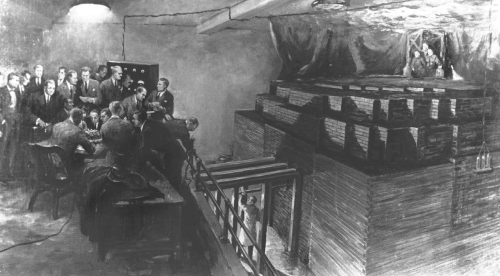
Their report warned that the United States could not rely on its nuclear monopoly indefinitely. And presciently, it observed that a numerically superior arsenal would offer only false security, as a “quantitative advantage in reserves of bottled destructive power will not make us safe from sudden attack.” If no international agreement were developed after the first detonation of the bomb, then there would be a “flying start of an unlimited armaments race.” 2
The Franck Report pinpointed nuclear materials as the critical choke point. Under an international agreement, they said, uranium could be accounted for, and there could be a check on the conversion of natural uranium into fissile material. Such an agreement must be backed by controls: “No paper agreement can be sufficient since neither this or any other nation can stake its whole existence on trust in other nations' signatures.”
The Interim Committee in charge of atomic bomb policy chaired by then-Secretary of War Henry L. Stimson did not seriously consider these recommendations. But the Chicago scientists had hit upon a core truth: Preventing proliferation had to be a political solution; the science of nuclear technology could not be otherwise contained. They urged that the use of nuclear bombs “be considered as a problem of long-range national policy rather than military expediency.”
Above: A house constructed 3,500 feet from “ground zero” at the Nevada Test Site is destroyed by a nuclear test on March 17, 1953.

“Dr. Franck stressed the concern of scientists over the unequal development of moral responsibility and technical knowledge. He expressed their conviction that they could no longer retreat to an ivory tower, hut had a duty to warn political leaders whom they could approach without breaking their oath of secrecy, of the alarming political implications of the tapping of atomic power.”
“Behind the Decision to Use the Atomic Bomb: Chicago 1944-45,” October 1958
When the Soviet Union spurned the Baruch Plan, Connecticut Democratic Sen. Brien McMahon, a staunch proponent of atomic energy control, lamented the lost opportunity.
“Six long years have now elapsed since we went hefore the United Nations and offered to share with the world all that is good in atomic energy. We asked no special hoon for our own country–except the hoon of peace, which one and all would share alike. We asked others to accept no controls that we were not willing and eager to accept ourselves. We sought only to hanish forever the evil in atomic energy and to harness its elemental power for the enrichment of human lives everywhere.”
“Survival–The Real Issue of Our Times,” August 1952
This impulse would find new life after the war. The U.S.-British-Canadian proposal to form a U.N. Atomic Energy Commission was adopted by the United Nations in December 1945. On June 14, 1946, Bernard Baruch, the U.S. representative to the commission, presented the detailed U.S. recommendations. Baruch was nothing if not dramatic. “We are here to make a choice between the quick and the dead,” he said. “If we fail, then we have damned every man to be the slave of fear.”
Baruch based his plan on the Acheson-Lilienthal report, submitted to President Truman by then-Undersecretary of State Dean Acheson and U.S. Atomic Energy Commission (AEC) Chairman David Lilienthal in March 1946. The plan sought to establish an International Atomic Development Authority that would own and control the “dangerous” elements of the nuclear fuel cycle, including all uranium mining, processing, conversion, and enrichment facilities. Only “non-dangerous” activities could be conducted on a national level, and even then only with a license granted by the proposed Development Authority. Baruch reasoned that this structure would make verification relatively simple since the mere possession of a uranium conversion or enrichment plant by a national authority would be a clear violation. His version of the plan also included automatic punishment for violations, a step further than the recommendations of Acheson and Lilienthal. 3 Since the objective of the Baruch Plan was not only to restrain the spread of nuclear weapons, but also to prevent an arms race and eliminate the bomb altogether, it proposed that once the Development Authority could ensure that no other state was able to construct the bomb, the United States would guarantee the elimination of its entire nuclear stockpile.
Approved by the U.N. Atomic Energy Commission on December 31,1946, the plan was opposed by the Soviet Union in the U.N. Security Council. Stalin saw the bomb as more than a weapon. It was a symbol of industrial might, scientific accomplishment, and national prestige. Stalin told his scientists: “Hiroshima has shaken the whole world. The balance has been broken. Build the Bomb–it will remove the great danger from us.” 4
Stalin was not about to accept any plan that limited Soviet national sovereignty and that might have locked in, even if only for a short time, the U.S. nuclear advantage. Knowing the Americans would refuse, the Soviets proposed that any agreement require Washington to disarm prior to the establishment of an international authority.
Stalin was right. The United States would not compromise. Manhattan Project leader Gen. Leslie Groves argued that the Soviets would not be able to build the bomb for one to two more decades. Secretary of State James Byrnes saw the bomb as a trump card in meetings with Stalin and Soviet Foreign Minister V. M. Molotov. Even Baruch came to believe that the plan could only be accepted on its own terms, since, “America can get what it wants if she insists on it. After all, we've got it and they haven't.” 5
The combination of Soviet opposition and growing faith in the sustainability of American superiority proved too much for the Baruch Plan. For a brief time in 1946, this revolutionary vision to abolish the ultimate weapon seemed within reach. In a matter of months, it was defunct. And so began the arms race.
Historian David Holloway and others argue persuasively that even had world leaders followed physicist Niels Bohr's advice for “an open world” and the sharing of atomic information, Stalin would still have wanted a bomb of his own. Neither Truman nor Stalin saw the bomb as Bohr did–a common threat to the world. Stalin thought the danger was not the bomb, but the U.S. monopoly of the bomb. He wanted to get the bomb and then negotiate. Truman saw it as a tool to contain Stalin and preserve U.S. security. He was not about to give it up. But did the arms race have to then accelerate? Did we have to manufacture hundreds, then thousands of bombs?
The U.S. decision to effectively abandon international control efforts and race to build a numerical and then a qualitative nuclear advantage proved Baruch's fearful prophecy. The development of strategies and plans on both sides to fight and win a nuclear war, the creation of vast nuclear weapon complexes, and the deployment of intercontinental ballistic missiles and fleets of ballistic missile submarines were dangerous, expensive, and unnecessary. Rather than guaranteeing national security, these actions brought us several times to the brink of global annihilation–and at an enormous cost. Since 1940, the United States alone has spent approximately $7.5 trillion on nuclear weapons, or about $115 billion each year on average (in 2005 dollars). 6
Ultimately, what drove the arms race was not the military utility of the bomb, but its perceived diplomatic value. It began early on, with arguments that dropping the bomb on Japan would also have a deterrent effect on the Soviet Union. The Soviets understood this, but did not respond as the proponents of atomic power politics had predicted. Molotov said years later that the Soviets rejected the Baruch Plan because they understood that the bombs dropped on Japan “were, of course, not against Japan but against the Soviet Union: See, remember what we have. You don't have the atomic bomb, but we do–and these are what the consequences will be if you stir. Well, we had to adopt our tone, to give some kind of answer, so that our people would feel more or less confident.” 7
The idea that political power comes from the barrel of a gun-assembly fission bomb took hold in U.S. policy. Even James Co-nant, the president of Harvard who had overseen the Manhattan Project and was a voice for nuclear restraint, wrote Stimson in 1947, “I am firmly convinced that the Russians will eventually agree to the American proposals for the establishment of an atomic energy authority of worldwide scope, provided they are convinced that we would have the bomb in quantity and would use it without hesitation in another war.” 8

UNBEKNOWNST TO THE UNITED STATES, THE SOVIET UNION ALREADY HAD SOME 170 NUCLEAR WEAPONS ON CUBAN SOIL WHEN THE JOINT CHIEFS OF STAFF RECOMMENDED A MILITARY STRIKE AGAINST CUBA ON OCTOBER 27, 1962.
After the coup in Czechoslovakia and the Berlin crisis, both in 1948, Truman ordered an increase in weapons production. The United States soon had 50 atomic bombs; by late 1949, the arsenal had grown to more than 200. This was the crucial fork, the road wrongly taken that effectively institutionalized a policy of nuclear one-upmanship. When the Soviets tested their first fission bomb that year, Truman raised the stakes, accelerating a program to build the “Super,” or fusion bomb. Lilienthal, the AEC chairman, wrote in his diary, “More and better bombs. Where will this lead … is difficult to see. We keep saying, ‘We have no other course’; what we should say is, ‘We are not bright enough to see any other course.’” 9
Many of the scientists responsible for the first nuclear weapon strongly opposed the Super. The AEC had asked for the advice of its General Advisory Committee on the entire nuclear weapons program. As part of the eight-member group, Conant and J. Robert Oppenheimer, the former head of the Manhattan Project, joined in the unanimous opinion against the H-bomb. The committee believed it a weapon of genocide: “The use of this weapon would bring about the destruction of innumerable human lives; it is not a weapon which can be used exclusively for the destruction of material installations of military or semi-military purposes. Its use therefore carries much further than the atomic bomb itself the policy of exterminating civilian populations.” 10 Even if the Soviets developed the H-bomb, they argued, the United States could deter its use with atomic weapons.
The scientists' views did not prevail. Albert Einstein wrote in the March 1950 Bulletin, “The idea of achieving security through national armaments is, at the present state of military technique, a disastrous illusion. … The armament race between the U.S.A. and the U.S.S.R., originally supposed to be a preventive measure, assumes hysterical character.” 11

ACCORDING TO THE DEFENSE DEPARTMENT, THERE WERE 32 ACCIDENTS INVOLVING THE U.S. NUCLEAR ARSENAL BETWEEN 1950 AND 1980.
The United States tested its first H-bomb on November 1, 1952, with a yield of 10.4 megatons. Predictably, the Soviets tested their first fusion device a year later on August 12, 1953. The American “Bravo” test of March 1, 1954, exploded the first deliverable H-bomb (with a yield of 15 megatons), and the Soviets tested their first true H-bomb on November 23, 1955.
Three decades later, then-Bulletin editor Harrison Brown surveyed the results of this competition: “We now find ourselves locked in an arms race with the Soviets which has gone on for nearly 40 years and has reached the point where there are more than 50,000 nuclear weapons–representing a total yield of about 13,000 megatons–deployed by the United States and the Soviet Union. Remembering that the bomb that obliterated Hiroshima was but 0.01 megaton, we begin to appreciate the enormity of the overkill potential in the hands of the superpowers.” 12
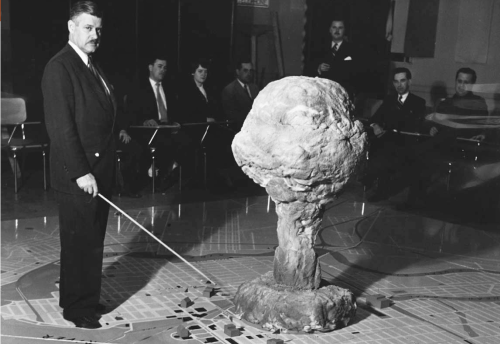
A Canadian civil defense instructor demonstrates the effect of an atomic bomb bursting over Ottawa in 1952.
It could have been even worse. Several times over the last 60 years, U.S. leaders did choose the path of control, restraint, and international cooperation. It paid off. Others followed America's lead.
By the early 1960s, the arms race had made the United States more vulnerable, not less. America went nuclear nuts in the 1950s, sprinkling nuclear weapons through the armed forces like jelly beans. The U.S. nuclear arsenal mushroomed from just under 400 weapons in 1950 to more than 20,000 by 1960. Moscow's arsenal likewise jumped from 5 warheads in 1950 to roughly 1,200 in 1960. The United States was ahead but afraid. As the atomic scientists had warned, numerical superiority did not bring security. Tensions were high, and confrontations in Berlin (1961) and Cuba (1961 and 1962) put the world on edge.
The development of the hydrogen bomb, with a destructive power orders of magnitude greater than previous nuclear weapons, was an unnecessary excess to many scientists.
“We believe in peace based on mutual trust. Shall we achieve it by using hydrogen bombs? Shall we convince the Russians of the value of the individual hy hilling millions of them? If we fight a war and win it with H-bombs, what history will remember is not the ideals we were fighting for hut the method we used to accomplish them.”
“The Hydrogen Bomb,” April 1950
Moreover, the threat no longer came from just two states. Britain joined the nuclear club in 1952, France in 1960, and China was not far off. In 1958, the U.S. intelligence community concluded that, if things proceeded as they had over the previous 10 years, then as many as 16 states could have nuclear weapons by 1968.”
U.S. leaders were thus faced with the crucial question of how to protect the nation in the face of such a severe threat. Build more weapons or try to climb down? For John F. Kennedy, the answer was clear. In September 1961 the new president said “the risks inherent in disarmament pale in comparison to the risks inherent in an unlimited arms race.” 14 Kennedy organized the Arms Control and Disarmament Agency to pursue this vision and to provide at least some balance in national policy discussions. He began negotiations for both a Comprehensive Nuclear Test Ban Treaty and a nonpro-liferation pact. He signed the Limited Test Ban Treaty with the Soviet Union in 1963, calling it a “first step” in a series of threat reduction measures he hoped would follow.
Kennedy did not live to finish the job, but his successor Lyndon B. Johnson picked up the baton. On July 1, 1968, he signed the diplomatic crown jewel of his presidency: the Treaty on the Non-Proliferation of Nuclear Weapons (NPT). President Richard Nixon later won ratification of the agreement and signed it into force in a March 1970 Rose Garden ceremony. “Let us trust that we will look back,” Nixon said, “and say that this was one of the first and major steps in that process in which the nations of the world moved from a period of confrontation to a period of negotiation and a period of lasting peace.”
In many ways it was. The NPT was a bipartisan effort that produced a measurable increase in national and international security. The NPT and the test ban proved–or should have proved–the substantive link between controlling existing nuclear arsenals and controlling the spread of nuclear weapons to other nations. Though denied by many today, it was clearly recognized at the time. As a recently declassified 1958 National Intelligence Estimate (NIE) noted: “A U.S.-U.S.S.R. agreement provisionally banning or limiting nuclear tests would have a restraining effect on independent production of nuclear weapons by fourth countries. However, the inhibiting effects of a test moratorium would be transitory unless further progress in disarmament–aimed at effective controls and reduction of stockpiles–were evident.” 15
The collapse of the Iron Curtain offered an unparalleled opportunity to return to a long-castoff ideal.
“The events 0/1989 and early 1990 in Europe have been breathtaking, with implications in many directions for a better world. But will that world really he a hetter place as long as a nuclear threat hangs over it? … This may he an opportune time to return to the ideals that motivated the Lilienthal Plan–removing the scourge of nuclear weapons from the Earth. Accomplishing such a project in this still-troubled world might well he impossible. Yet, we owe it to humanity to try once more because of the enormous importance it has for us and our progeny.”
“A Rallying Cry–Renew the Movement,” March 1990
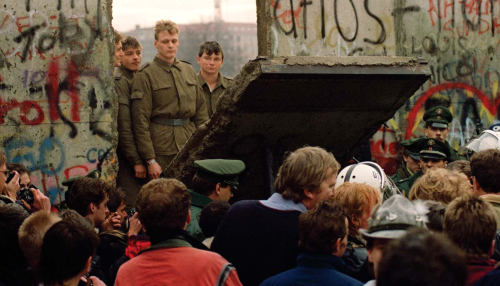
East German border guards demolish a section of the Berlin Wall to open a new crossing point between East and West Berlin on November 11, 1989.
Subsequent NIEs reaffirmed this linkage. The first assessment conducted during Kennedy's presidency, in September 1961, looked at 15 countries that might develop nuclear weapons programs during that decade. It judged seven as unlikely to do so in the next few years, but warned, “These attitudes and views could change in the coming years with changing circumstances, e.g., if it became increasingly clear that progress on international disarmament was unlikely.” 16 But the test ban, the NPT, and other disarmament efforts made a difference. Taking the nonproliferation fork in the road made the United States and the world more secure. NIEs in 1963, 1964, and 1966 confirmed a steady decrease in the number of “likely” or “possible” new nuclear states. 17 By the end of the 1960s, even though France and China did test nuclear weapons, only two other states were of real concern (India and Israel). The diplomatic dam held.
These nonproliferation victories were popular with the public but fiercely opposed by Cold War hawks. The test ban was a particularly tough fight and conservative rhetoric was at a fever pitch. Democratic Sen. John Stennis of Mississippi wrote in his subcommittee report, “Soviet secrecy and duplicity require that this nation possess a substantial margin of superiority in both the quality and quantity of its implements of defense.” 18 A few years later, opponents of the NPT were equally adamant. Republican Sen. Strom Thurmond of South Carolina opposed the treaty because it would “prevent the modernization of armaments in the Western European countries, thereby removing a counterforce to Soviet designs.” 19 Stennis called it “unilateral disarmament.” 20
The progress of the 1960s gave way to the nuclear ambivalence of the 1970s, when arms limitation agreements coexisted with warhead multiplication and India's 1974 nuclear test, and reverted to nuclear expansionism again in the 1980s. Then, the talk was of preparing to fight and win a global thermonuclear war. Today, defenders of those policies insist the Reagan administration buildup was necessary to encourage Soviet reform and to reach real arms reduction agreements. Not so, claimed Anatoly Dobrynin, longtime Soviet ambassador to the United States. “The impact of [President Ronald] Reagan's hardline policy on the internal debates in the Kremlin and on the evolution of the Soviet leadership was exactly the opposite from the one intended by Washington,” he said. “It strengthened those in the Politburo, the Central Committee, and the security apparatus who had been pressing for a mirror image of Reagan's own policy.” 21
In their quest to use atomic diplomacy to constrain, deter, or intimidate other countries, America's leaders encouraged an arms race and allowed other states to obtain the very weapons that could constrain or deter the United States. Fearful of domestic political repercussions if they looked weak on national security, they squandered the national treasury rather than invest in programs that could have improved both national and international security.
For 60 years, we followed a convoluted path that has led us back to the brink of disaster. The United States and Russia retain thousands of warheads on hair-trigger alert. Stockpiles of fissile material located in the former Soviet Union and other countries are insecure and could plausibly fall into the hands of terrorists. Countries such as Iran evoke their sovereign right to develop ostensibly peaceful nuclear power that could have decidedly non-peaceful applications. The nuclear have-nots chafe at the hypocrisy of the nuclear weapon states that have no intention of eliminating their arsenals.
So, once again, we stand at a crucial fork in the road. But, whereas our path six decades ago was circumscribed by the looming threat of Soviet power, today's political climate allows for considerably more freedom of movement. The global non-nuclear norm is stronger than ever. Most of the 183 non-nuclear weapon states party to the NPT believe what the treaty says: We should eliminate nuclear weapons. (And 66 percent of the American public feels the same way.) The world has fewer nuclear weapons than it did 15 years ago, and fewer countries have or are considering nuclear weapon programs.
In the United States, formidable budgetary pressures will make it difficult for any president to spend hundreds of billions of dollars on a new generation of nuclear weapons. And there is a growing appreciation among politicians and military officials of the limited military utility of nuclear weapons. “I think the time is now for a thoughtful and open debate on the role of nuclear weapons in our country's national security strategy,” Republican Cong. David Hobson of Ohio said this February. “It's been 15 years since the end of the Cold War, and in my opinion, the Department of Energy's weapon-complex decision making is still being driven by the nuclear weapons structure put in place over the past 50 years.” 22
Moving ahead requires an objective threat assessment. The main danger to the United States today does not come from a nation intentionally attacking with nuclear weapons. Deterrence is alive and well. Even a nuclear-armed North Korea or Iran would know that the use of any such weapon would be regime suicide. The most urgent threat is a terrorist attack, and the number one goal must be to ensure that any such attack is non-nuclear.
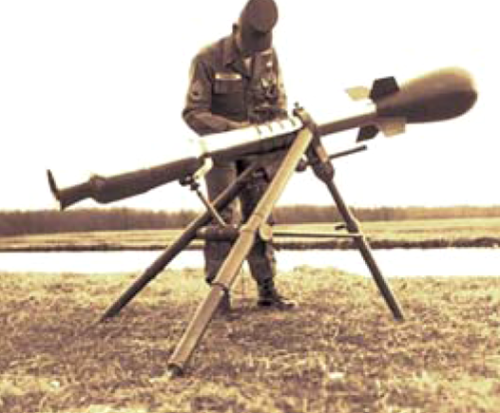
BETWEEN 1954 AND 1992, THE U.S. ARMY FIELDED SOME 11,500 NUCLEAR WEAPONS FOR TACTICAL BATTLEFIELD USE.
Hurricane Katrina provided some idea of what it would mean to have a U.S. city disappear from the national grid. Many, in fact, have compared the storm to Hiroshima. But Hiroshima was much worse. The bomb, small by today's standards, killed 140,000 people and destroyed or damaged 70,000 of the 76,000 buildings in the city.
But, like the known risk to New Orleans, the government response to the nuclear threat has been woefully inadequate. Former Sen. Sam Nunn says, “American citizens have every reason to ask, ‘Are we doing all we can to prevent a nuclear attack?’ The answer is, ‘No, we are not.’” Now is the time to shore up the nuclear security dams and levees that can prevent this ultimate disaster. A broad expert consensus already exists on the core elements of such a plan: secure all weapons-usable materials (highly enriched uranium and plutonium) against theft or diversion; end the production of these materials; end the use of these materials in civilian research, power reactors, and naval reactors; and eliminate the large surplus stockpiles of these materials held by the United States, Russia, and other nations. 23
Many of the programs to implement these steps are now in place. All that's lacking is real action and real money. We should, for example, commit to a global cleanout of nuclear materials stored in vulnerable sites in dozens of nations during the next four years, instead of the ten years currently planned. We could buy up an additional 500 tons of Russian highly enriched uranium and down-blend it into fuel for U.S. nuclear reactors, rather than continue the lethargic pace of the current program.

AS OF SEPTEMBER 2005, THE INTERNATIONAL ATOMIC ENERGY AGENCY HAD CONFIRMED 220 NUCLEAR SMUGGLING INCIDENTS SINCE 1993, 18 OF WHICH INVOLVED HIGHLY ENRICHED URANIUM OR PLUTONIUM.
As an added bonus, such steps–though focused on preventing nuclear terrorism–would also help prevent new states from acquiring nuclear weapons and reduce current stockpiles. To completely address those dangers, we can hearken back to the early Truman proposals that coupled weapons elimination with strict, verified enforcement of nonproliferation. Dramatic reductions in nuclear forces could be joined, for example, with reforms making it more difficult for countries to withdraw from the NPT by clarifying that no state may withdraw from the treaty and escape responsibility for prior violations of the treaty or retain access to controlled materials and equipment acquired for “peaceful” purposes. 24 Serious restructuring of the international supply of nuclear fuel is also needed. As Baruch and others recognized early on, it is inherently dangerous to spread the technologies that can both produce fuel for nuclear reactors and material for bombs. We cannot rely on any state's good intentions, since intentions–and states–change.
Regrettably, U.S. policy has emerged as the key obstacle to implementing these measures. Current strategy holds that large nuclear arsenals are still necessary to national security and that the proliferation problem does not stem from the weapons themselves, but only from certain countries that possess these weapons. This “new thinking” is derived straight from the Cold War strategies of the 1950s. Now, as then, the United States seeks security through arsenals much larger than any competitor and plans to use nuclear weapons against even non-nuclear threats. Now, as then, the belief is that U.S. force can prevent or eliminate the bad proliferators (Iraq, Iran, and North Korea, now; the Soviet Union and China, then), while forging alliances with the good proliferators (India and Israel, now; Britain and France, then).
The war with Iraq was the direct application of this approach. The failure of the war exposes the bankruptcy of the underlying strategy. Regime change in Baghdad has not encouraged Tehran to renounce its nuclear ambitions. And it was carrots, not sticks, that led to the breakthrough in the nuclear talks with North Korea, by offering Pyongyang energy aid, economic cooperation, and security assurances.
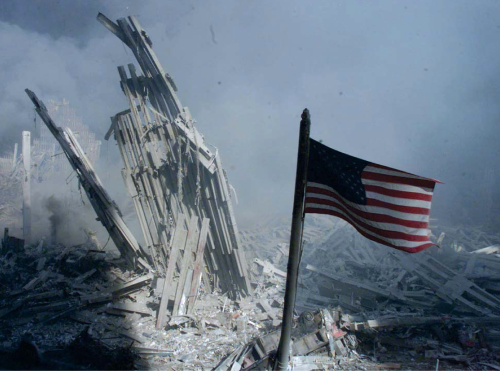
“In the struggle to keep weapons of mass destruction away from terrorists, time is not on our side. Complacency is an enemy in this struggle, and we must seize the moment to turn heightened concerns into actions.”
“Redefining the Threat,” September/October 2005
To access the complete collection of Bulletin articles, visit the Bulletin Archive at bulletinarchive.org.
A policy that seeks to limit nuclear weapons to U.S. allies offers only superficial security. Alliances and the governments that form them are ephemeral. Iran used to be a friend; the United States sold Tehran its first nuclear reactor. Iraq used to be a friend, armed by U.S. aid. Pakistan is a friend now, but a change in government could put nuclear weapons directly in the hands of Islamic extremists. Even “responsible” nuclear states cannot always prevent the illicit transfer or theft of nuclear technology. The best way to limit proliferation is to limit the number of nuclear states, weapons, and materials. President Kennedy understood that. He worried not only about China acquiring nuclear weapons, but also about Cold War allies such as Canada, Sweden, and Australia, and about the dangers from our own weapons.
At key points along the 60-year-long nuclear road, officials opted to expand arsenals, while trying to control others' acquisition. Today's nuclear world is the result. It is time to take the other path. We need bold action now, just as much as in 1945. It should not take another 60 years before the scientists' plea for a “long-range national policy” is answered. We do not want to go up that mountain again.
Footnotes
1.
The author gratefully acknowledges the research of Jane Vaynman and Joshua Williams of the Carnegie Endowment for this article.
2.

3.
Len Weiss presents an excellent detailed history of these proposals in “Atoms for Peace,” Bulletin of the Atomic Scientists, November/December 2003, pp. 34–41,44.
4.
Cited in David Hollo way, Entering the Nuclear Arms Race: The Soviet Decision to Build the Atomic Bomb, 1939-1945 (Washington, D.C.: The Wilson Center, 1979), p. 41.
5.
Lawrence S. Winner, One World or None: A History of the World Disarmament Movement Through 1953 (Stanford: Stanford University Press, 1990), p. 254.
6.
Discussions with Stephen I. Schwartz, September 2005. This figure is based on Schwartz's 1996 Atomic Audit estimate of $5.8 trillion, updated to include spending over the past 10 years and converted to 2005 dollars.
7.
From Sto sorok besed s Molotovym: Iz dnevnika F. Chueva (Moscow: Terra, 1991) cited in David Hol-loway, Stalin and the Bomb (London: Yale University Press, 1994), p. 164.
8.
Conant to Stimson, January 22, 1947, Stimson papers, box 154, folder 18, cited in Martin J. Sherwin, “How Well They Meant,” Bulletin of the Atomic Scientists, August 1985, p. 14.
9.
Cited in Barton J. Bernstein, “Truman and the H-Bomb,” Bulletin of the AtomL· Scientists, March 1984, p. 13.
10.
Ibid.
11.
Albert Einstein, “Arms Can Bring No Security,” Bulletin of the Atomic Scientists, March 1950, p. 71.
12.
Harrison Brown, “Linking Past and Future,” Bulletin of the Atomic Scientists, August 1985, pp. 4-7.
13.
Director of Central Intelligence, “National Intelligence Estimate 100-2-58, 1 July 1958” (approved for release July 2004). Of these sixteen, they assessed five as “likely” to do so.
14.
John F. Kennedy, “Address Before the General Assembly of the United Nations,” September 25, 1961.
15.
Director of Central Intelligence, “National Intelligence Estimate 100-2-58,” p. 2.
16.
Director of Central Intelligence, “National Intelligence Estimate Number 4-3-61,” September 21,1961, p. 9.
18.
Cited in Glenn T. Seaborg, Kennedy, Khrushchev, and the Test Ban (Berkeley: University of California Press, 1981), p. 278.
19.
“Atom Treaty Hit Again by Thurmond,” Washington Post, February 11, 1969.
20.
Warren Unna, “Stennis Criticizes A-Treaty,” Washington Post, February 28, 1969.
21.
Anatoly Dobrynin, In Confidence (New York: Times Books, 1995), pp. 482, 495, cited in Lawrence S. Winner, Toward Nuclear Abolition, vol. 3 (Stanford: Stanford University Press, 2003), p. 308.
22.
Cong. David Hobson, 2005 Arms Control Association Luncheon Address, “U.S. Nuclear Security in the 21st Century,” Washington, D.C., February 3,2005.
23.
These recommendations are elaborated in the 2005 study from the Carnegie Endowment, by George Perkovich, Jessica Mathews, Joseph Cirincione, Rose Gottemoeller, and Jon Wolfsthal, Universal Compliance: A Strategy for Nuclear Security (Carnegie Endowment for International Peace: Washington, D.C., 2005), pp. 83-125.