




Abstract
When libya renounced weapons of mass destruction, U.S. officials gave the credit to good intelligence. A closer look reveals the intel wasn't what it was cracked up to be.

The scene was stunning. As Christmas 2003 approached, the seeming leader-for-life of Libya, long suspected of seeking weapons of mass destruction (WMD), suddenly renounced all such intentions. U.S. press announcements and briefings spun the events as the product of the American invasion of Iraq, ostensibly undertaken in service of the broader mission of counterproliferation.
Less than three months later, in a last-ditch defense of his agency's hyped Iraq intelligence estimates, CIA Director George J. Tenet spoke at Georgetown University. A major feature of his presentation concerned intelligence on Libya's WMD program, which he held up as a success story to impress those observers not willing to credit his extravagant claims for how accurate the Iraq reporting had been.
With the reputations of the CIA and U.S. intelligence community on the line, Tenet punched hard: “Only through intelligence did we know each of the major programs Libya had going.” Tenet repeated that “only through intelligence” had the CIA known when Libya began its nuclear program, when precisely Muammar Qaddafi put it on the back burner, and at what point in time it was resurrected. The CIA, Tenet averred, had penetrated Libya's illegal network of WMD suppliers, knew of its efforts to obtain longerrange missiles, and broke down the denials of Libyan officials by demonstrating what it knew. “This was critical when the Libyans approached British and U.S. intelligence about dismantling their chemical, biological, and nuclear weapons programs,” he insisted. “Intelligence was the key that opened the door to Libya's clandestine programs.” 1
Adding momentum to Tenet's claims, the Commission on the Intelligence Capabilities of the United States Regarding Weapons of Mass Destruction (commonly known as the WMD Commission) concluded in its March 31, 2005 report: “Collection and analytic efforts with regard to Libya's weapons programs … represent, for the most part, an Intelligence Community success story.” 2 Though not quite so effusive as the CIA director, the presidential commission found that U.S. intelligence accurately assessed the nuclear equipment Libya possessed, correctly judged that Libya had chemical weapons, had been generally accurate in projections of Libyan missile capability, and that analysts had shown “a commendable willingness” to revise conclusions when they obtained fresh information. 3
All this seems quite impressive at first blush, but the sum of the parts does not add up to the whole. A deeper review reveals what might almost be termed an iron law of intelligence: As the political salience of an issue rises, the difficulty of deriving objective intelligence estimates increases exponentially. The Libyan case exhibits the same kinds of difficulties with intelligence reporting as the Iraqi one, or indeed the bloated estimates of Soviet capabilities decades before.
It is also not true that the outlines of the Libyan programs were visible “only through intelligence.” A wide variety of public observers were on the same page as U.S. intelligence. The one aspect that falls largely within the purview of clandestine collection was the relationship of Pakistani nuclear smuggler A. Q. Khan to Libya, but the CIA learned about this inadvertently by focusing on Pakistani nuclear networks rather than on Qaddafi.
The Bush White House's version of Libya's disarmament neglects the evolution of Qaddafi's fitful policy of rapprochement, pursued in an effort to escape U.S. and U.N. sanctions imposed upon Libya for its 1980s terrorist schemes. In short, the story of Libya's WMD programs, its voluntary disarmament, and U.S. intelligence appreciations of these developments, is a fable for the age of nuclear proliferation.
NUCLEAR SHOPPING SPREE
In 1968, King Idris of Libya signed the Nuclear Non-Proliferation Treaty (NPT). He had little to lose by doing so, since Libya had not undertaken much in the way of nuclear research and, as a country flush in oil, was not anxiously pursuing nuclear power.
That soon changed after Qaddafi came to power in 1969. He sent a colleague to the People's Republic of China in 1970 with a cash offer for a prototype nuclear weapon. Beijing refused. Three years later, offers were made to French concerns for the purchase of equipment suitable for electromagnetic enrichment. These too were rejected. Then, in 1974, Libya reached an agreement with Argentina to buy equipment for and training in uranium prospecting. (Qaddafi's attempt to annex the Aozou Strip in Chad in the early 1980s was, in part, predicated on a belief that the region might possess uranium ore, which Libya lacks.) Libya also approached U.S. companies for nuclear reactors, but the Nixon administration refused export licenses. The following year Libya finally signed an agreement with the Soviet Union providing for construction of a small 10-megawatt research reactor and an associated research center at Tajoura, west of the capital Tripoli. The reactor went on line in 1981. 4
A second track in Qaddafi's effort remained covert. The Libyan leader had good relations with then-Pakistani Prime Minister Zulfikar Ali Bhutto, and in 1973 Tripoli completed an arrangement to help finance Pakistani nuclear weapons research in exchange for access to the knowledge developed in that program. Like many Libyan initiatives, rhetoric outran reality and little assistance flowed from this agreement, though it did open a channel of historic significance. When Gen. Mohammed Zia ul-Haq assumed power in Islamabad, the supposed accord evaporated. During the same period Qaddafi made a fruitless nuclear cooperation pact with India, hoping for weapons assistance.
To round out its weapons development efforts, Libya tried to cultivate a relationship with a West German company, Orbital Transport- und Raketen-Aktiengesellschaft (OTRAG), which some observers saw as a cover organization for a Libyan military rocket program. Libya invited the German concern to build a rocket base in the Sahara, but OTRAG would never successfully develop and manufacture a missile or orbit a satellite.
Despite its clear intent to build or obtain nuclear weapons, in 1981 Libya reached an agreement with the International Atomic Energy Agency (IAEA) to implement safeguards and submit to the agency's inspection protocols. Qaddafi's rhetoric underwent a marked change in the early 1980s. In June 1981 he characterized nuclear weapons production as “the top of the list of terrorist activities. … I have nothing but scorn for the notion of an Islamic bomb.” 5 Yet, the Libyan leader refused to foreswear pursuing nuclear energy for peaceful purposes, which of course carried its own potential for more nefarious goals.
Still, Tripoli made no visible effort to obtain enrichment technology or to procure a plutonium-reprocessing capability, either of which was necessary if it desired the fissile material for a weapon. In June 1987, however, Qaddafi once again changed course. He declared a nuclear bomb the only way small nations could protect themselves from the superpowers, and later reportedly tried to bribe a Soviet admiral to leave behind a submarine with its atomic warheads as he withdrew from the Mediterranean. 6
The Reagan administration, which marked Libya as an enemy and terrorist threat from its first months in office, would gleefully have promoted any intelligence conclusions that pointed to Libyan acquisition of nuclear weapons. Instead, a 1982 Defense Department guidance document contained an intelligence survey of potential nuclear weapons states by the year 2000 that mentioned 31 countries but excluded Libya. 7 Libya's pursuit of nuclear weapons was hardly mentioned in a 1986 white paper issued to justify U.S. military activities against Libya, in the assorted State Department pronouncements on nuclear proliferation, and at the 1987 NPT Review Conference.
THE POOR MAN'S ALTERNATIVE
Qaddafi had not so much abandoned his quest for WMD as changed direction. To Libya, WMD offered a shield against the application of U.S. power, and if Qaddafi could not attain a nuclear capability, chemical weapons offered a less effective, and more accessible, alternative.
During the 1980s, Libya focused its efforts on erecting an infrastructure suitable for the manufacture of chemical weapons. The best intelligence on the Libyan program came from West Germany's intelligence service, the Bundesnachrichtendienst (BND). By the time Tripoli had signed agreements in early 1985 for the construction of what became its major weapons facility, the BND had already rendered 10 reports on the subject, while the German foreign ministry began reporting similar information from diplomatic sources that July.
Though the BND missed some Libyan activities, across the Atlantic, it appears that the CIA and other U.S. agencies were so focused on exposing Qaddafi's terrorist network that they saw little of this evolution. An April 1986 diplomatic protest regarding certain German exports to Libya indirectly provides the first indication of U.S. awareness. Tripoli's program garnered additional public attention in the summer of 1987 when the government of Chad charged that Qaddafi had used chemical weapons during fighting on its territory. (Libya had no chemical weapons production capability at the time.)
The CIA eventually zeroed in on Libya's activities by tracking its exports and banking transactions with a list of companies and financial institutions that involved concerns in Belgium, France, Germany, Hong Kong, and Japan. 8 U.S. spy satellites spotted a potential facility in Rabta, about 40 miles southwest of Tripoli. By July 1988, intelligence analysts were confident that the Rabta plant was meant to produce chemical weapons. Not willing to wait, however, the Reagan administration leaked the initial Rabta charges to the press before Christmas 1987, and officials began making charges off the record soon thereafter. 9
Relations between the two countries were tense–on April 5, 1986, a bomb exploded in a West Berlin disco, killing two American servicemen; a former Libyan embassy official was found to be connected to the bombing. In response, the United States bombed Tripoli 10 days later. Within the U.S. government, there were fears that Libya would retaliate, and the administration appears to have done whatever it could to raise public concern about what it saw as a growing threat.
After approaching the West German government with what it knew about Libya's nascent program, “Washington went public with its intelligence. On October 25, 1988, in one of his first public speeches as CIA director, William Webster identified Rabta as the largest chemical weapons plant in the Third World. Estimates of a production capacity of 22,000-84,000 pounds per day of mustard gas and sarin nerve gas soon followed. On January 7, 1989, Qaddafi contrived to appear at the hotel in Tripoli where most of the Western press was staying. He denounced the use of chemical weapons and declared, “America must understand that her policy of surrounding us and using force against us will fail.” 10
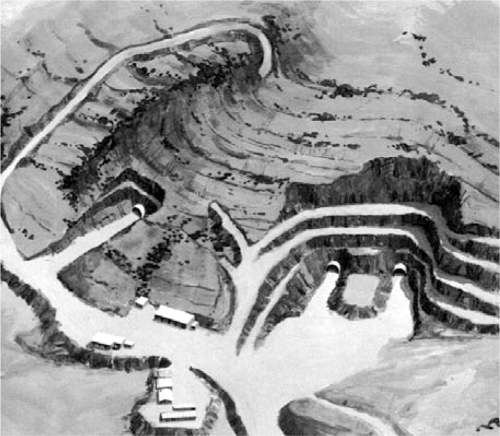
Mystery maze: A sketch of the elusive Tarhuna site.
Despite cascading charges, as the intelligence picture fleshed out it lost its focus. It turned out that Libya had used chemical weapons in Chad–but they were not indigenously manufactured. Rather they were reportedly obtained from Iran in exchange for sea mines the Iranians could use in their tanker war in the Persian Gulf.” Similarly, Webster rescinded the constant refrain that Qaddafi was currently producing chemical weapons. In testimony before Congress in 1989, he reported that the Rabta facility had suffered toxic chemical leaks during test runs some months earlier and was not producing anything at all. 12 Still, some intelligence estimates continued to say otherwise, and in early March 1990 President George H. W. Bush maintained that the Rabta plant had gone into production. 13
The exact status of Libya's WMD programs remained muddled for the next few years. In January 1992 congressional testimony, CIA Director Robert Gates reported that Libya had converted Rabta to a conventional pharmaceutical plant to avoid proliferation charges, adding that Tripoli had no intention of giving up its WMD programs and had amassed a stockpile of 100 tons of chemical weapons. Libya had supposedly begun work on a new chemical weapons plant, though Pentagon officials later told reporters they had no imagery supporting its existence. Gates also charged that Qaddafi had been making a concerted effort for several years to build a biological weapons research and production program, though without success. 14 In effect, the crystallization of the charges about Rabta began a cycle during which it was extremely difficult for intelligence analysts to discount the purported threat of Libyan WMD.
The case of the supposed new weapons plant exemplified the pattern of uncertainty. Following Gates's 1992 testimony, U.S. intelligence identified both the city of Tarhuna and the city of Sebha as the site of the plant. (The Sebha site was later reported to be dormant.) In 1995 the Egyptian government, after receiving the latest U.S. briefing on Libyan “WMD, rejected the charges and supported Qaddafi's assertion that the Tarhuna facility consisted of nothing more than empty tunnels. A U.S. intelligence official in Washington effectively confirmed this account by stating that “the Libyans are completing the boring and lining of the tunnel complex,” and could not begin installing equipment until that had been done. 15 Defense Secretary William J. Perry reiterated the charges in early 1996. But over time, the lack of evident developments in Libya made the dire intelligence conclusions about a vast chemical weapons program harder to sustain.
ATTITUDE ADJUSTMENTS
Thanks to evidence gleaned from 2003 IAEA inspections, we now know that Libya's nuclear program had been much more active in the 1990s than was known at the time. Libya had resumed talks on nuclear cooperation with Russia in 1997 and contracted with it the next year for $8 million-worth of refurbishing at Tajoura. Also in 1997, in what probably marked the opening of Tripoli's connection with the A. Q. Khan nuclear smuggling ring, Libya imported 20 early generation gas centrifuge machines along with components for 200 more. Following that, it acquired a pair of more advanced centrifuges in 2000 and placed orders for another 10,000. Qaddafi's precise motivations are unknown, but he may have thought that his nuclear activities could serve as a bargaining chip to trade against sanctions imposed after the bombing of Pan Am Flight 103 over Lockerbie, Scotland, which was found to be the work of a Libyan intelligence officer. Or he may have thought that they could deter potential U.S. attacks.
The big intelligence breakthroughs concerned Libyan missiles, not anything else. During the summer of 1999, Indian Customs officials boarded a North Korean vessel that was en route to Libya and discovered missile components, machine tools, and blueprints for modified versions of Scud B and C rockets. Seven months later, British inspectors at Gatwick Airport seized 32 crates of missile parts labeled as automotive spares that were allegedly bound for Libya.
Amid the welter of charges, Libya increasingly chafed under international sanctions. In particular, Libya's oil industry, unable to procure spare parts or the latest drilling technology and barred from important markets, suffered tremendously. The story of the 1990s is really that of Qaddafi's realization of these problems and his gradual move toward rapprochement. In 1992 and 1999 (the year in which he expelled Palestinian terrorist Abu Nidal from refuge in Tripoli), Qaddafi used emissaries to offer WMD deals to Washington. Former Sen. Gary Hart acted as intermediary in the 1992 Libyan disarmament offer, just weeks after Gates's proliferation testimony. The 1999 attempt went through former diplomatic personnel. 16 By 2001, the Libyan leader's attempt at rapprochement became so plain it was addressed in the journal Foreign Affairs.”
In 1999, John A. Lauder, the head of the CIA director's center for non-proliferation, showed some awareness of Tripoli's ambivalence when he told a presidential commission that Libya was merely suspected of “aspiring to nuclear weapons capability” but was “decades away” from reaching nuclear sufficiency. A National Intelligence Estimate (NIE) that year projected no Libyan nuclear weapon until 2015. 18 On the parallel track of delivery means, Lauder noted, Tripoli continued to acquire missile-related equipment, but foreign help remained essential to any progress it might make. 19 The agency's official 2000 report to Congress repeated the point about reliance upon foreign suppliers–not only in regard to missiles but also chemical WMD and nuclear weapons–and noted that Libya was an NPT member, subject to full-scope IAEA safeguards. 20
In late 2001, the CIA's unclassified semiannual report to Congress on WMD acquisition, however, adopted a new tone under the George W. Bush administration. Nuclear infrastructure replaced ballistic missiles as the lead item in the text, and the report emphasized Libyan procurement of dual-use items, adding ominously, “Libya and other countries reportedly used their secret services to try to obtain technical information on the development of weapons of mass destruction, including nuclear weapons.” 21 From the WMD Commission, we now know that the intelligence community in December 2001 completed a fresh NIE on Libyan weapons programs that advanced the expected date for a Qaddafi bomb from 2015 to 2007. A second report in February 2002 confirmed that version of the threat, though there was not unanimity in the intelligence community. 22
Analysts appear to have mounted a rear-guard action in an effort to take some of the edge off the newly pessimistic projections and to hedge against the softness of their data in a way the Iraq estimates had not. The NIE noted that its somber casting of the date assumed that all foreign assistance and technology transfers would proceed apace and that Libya's intentions and incentives would be unwavering. The estimate did not take into account the possibility of political or economic developments that could transform the picture. A December 2001 NIE on foreign ballistic missile threats concluded there was no danger of a Libyan missile capable of reaching the United States until at least 2015. 23
Libya's ongoing interest in rapprochement was clear. In 2002, Libya signed an international protocol designed to inhibit the spread of long-range ballistic missiles. Qaddafi also signed the 1999 Convention for the Suppression of the Financing of Terrorism and adhered to the 1991 Convention on the Marking of Plastic Explosives for the Purpose of Detection (the twelfth international protocol against terrorism Libya had joined). Yet, in January 2003, on the eve of the Iraq War, the CIA put out a fresh report alleging that several hundred Iraqi scientists had passed through Libya during the preceding decade, working on chemical and biological weapons. A month later, CIA Director Tenet, in his 2003 threat briefing, charged that Libya had stockpiled “at least” 100 tons of chemical weapons and quoted Qaddafi saying that Libya had the right to possess WMD. 24
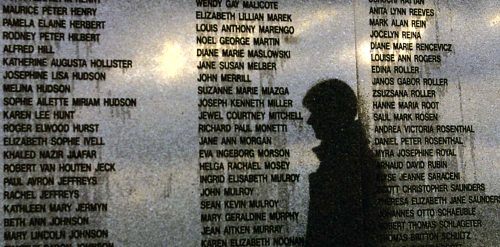
Terror's toll: A memorial to the victims of the Pan Am Flight 103 bombing.
A MATTER OF TIMING
The Bush administration's claim that Libya disarmed because of the Iraq War rests on a coincidence of timing. In March 2003, days before U.S. forces jumped off from Kuwait, Qaddafi's eldest son, Seif Islam Qaddafi, approached British intelligence (MI-6) officials in London with an offer to negotiate the divestiture of Libyan WMD. Prime Minister Tony Blair discussed the possibility with President Bush when they met at Camp David that month. Bush quickly involved the CIA in the Libyan negotiations. In September 2003, a British-U.S. intelligence team held a round of talks in Tripoli and asked for experts to evaluate the Libyan facilities. Intelligence analysts also became aware that the German freighter BBC China had left Dubai in the United Arab Emirates en route to Libya with a load of A. Q. Khan's nuclear equipment. Through the intercession of the German government, the ship owners diverted the vessel to Ta-ranto, Italy, on October 4, where five containers of centrifuge parts were seized. A few weeks later, the first of two CIA/MI-6 inspection teams visited Libya. Impressed by the access it was given, the team visited about a dozen facilities. A follow-up trip took place starting December 1.
Another Libyan delegation simultaneously proceeded to Vienna, meeting on December 20 with IAEA chief Mohamed ElBaradei, who followed them back to Tripoli with his own team of experts. The IAEA report of February 20, 2004 contained much food for thought. It surveyed the active Libyan overseas procurement program of the 1990s in a very concrete fashion and showed that Libya had actually received blueprints for a nuclear weapon from A. Q. Khan–but that the weapon was a Chinese design from the 1960s and was too large to fit any Libyan missile. Plus, Tripoli lacked the personnel to interpret the technical data.
The investigation also established that Qaddafi had never possessed a functional uranium enrichment facility–though Libya did erect a test bed with a triple-cascade of centrifuges. Qaddafi had off-the-books uranium yellowcake dating from the 1970s and had succeeded in converting some of it into fissile material precursors (such as uranium hexaflu-oride) in the mid-1990s, but only small amounts were involved, and no uranium was ever actually enriched. In addition, the IAEA confirmed that Tajoura actually contained a desalinization plant; that Sebha had been used for yellowcake storage, not chemical weapons; and that Tarhuna had been a missile development facility. 25
SO WHAT OF THE INTELLIGENCE?
With this much now known about Libya's WMD programs, U.S. intelligence agencies should have a good sense of where they went right and wrong in tracking its programs. Yet, the WMD Commission's portrayal of U.S. intelligence on Libya as a success is too facile by half. Commissioners facilitated their conclusion by narrowly construing the question as one of the accuracy of intelligence immediately before and after December 19, 2003–the date Libya renounced its WMD intentions–as if these two static pictures convey understanding of a dynamic subject. Relying on static pictures is the kind of technique often used to shape intelligence reporting, as in the 2001 NIE, in which excluding Libyan economic and political issues facilitated the projection of a 2007 Libyan nuclear bomb.
A longer view reveals a different picture. During the 1970s and 1980s, public sector observers and the intelligence community were not far apart in appreciating a Libyan (“Islamic”) bomb as a danger, but not an immediate threat. The on-again, off-again character of Tripoli's activity and the absence of any high-capacity reactor capability or enrichment facility made that projection stick. But WMD estimates became complicated once an overlay of chemical and biological weapons was added to the mix. Suspicions concerning Rabta confused the whole issue, which acquired a political salience that impeded accurate intelligence. Once Qaddafi's apparent intent to undertake large-scale production of WMD became an established feature of the Libya reporting portfolio, stepping back from the threat projection became quite difficult.
Nuclear booty: President Bush arrives at Oak Ridge to view forfeited Libyan centrifuge parts.

Consider the Libyan chemical stockpile. Assessments varied on when exactly chemical weapons went into production at Rabta. By 1992, however, Gates confidently asserted the Libyan stockpile consisted of up to 100 tons of mustard gas. Little over a decade later, in 2003, Tenet made out the stockpile to be “at least” 100 tons. There are two points here: first, that in a decade the estimate of the Libyan stockpile never changed; second, that the figures demonstrate the same kind of assumptions trap that bedeviled U.S. intelligence on Iraq. After December 2003, the actual Libyan stockpile was shown to be 23 tons, all of it more than a decade old. Gates was correct that Rabta had been converted to a pharmaceutical plant–but the Libyans apparently never resumed production even as the CIA identified one facility after another as the “new” chemical weapons plant. The Libyans had equipment in storage for a second plant but never tried to establish one. The WMD Commission characterized this error by saying that U.S. intelligence correctly judged that Libya possessed agents and munitions, “but Libya's actual chemical weapons stockpile proved to be smaller than estimated.” 26 In fact, this was an overestimate of more than 300 percent, and the error persisted for more than a decade. The miscalculation is further magnified because the chemical “WMD were the only weapons of mass destruction that Qaddafi actually had.
On biological weapons, the WMD Commission avoided making a summary judgment, though it was unable to confirm that Libya “maintained the desire for an offensive biological weapons program,” which had long been a staple of U.S. intelligence reporting to Congress, the American people, and presumably policy makers. 27 In the end, every potential biological weapons facility the CIA and MI-6 visited in 2003 had legitimate pharmaceutical uses. The single concrete piece of biological weapons data often cited by the CIA is the statement of a senior Libyan official that Tripoli “intended” such a program but that “it never went beyond the planning stage, and that [Qaddafi] considered the biological program too dangerous and ordered its termination sometime prior to 1993.” 28 Thus, throughout the decade prior to Libyan disarmament, the CIA credited Tripoli with an intention–a desire–its leader had reportedly rejected. The language in the most recent public CIA report, that “Libya disclosed past intentions to acquire equipment and develop capabilities related to biological warfare,” obscures weak intelligence analysis while allowing for a potential Libyan “breakout.” 29
On nuclear weapons, the WMD Commission again takes the path of least dispute by focusing on the interplay with the A. Q. Khan network. The commission awards intelligence with high marks for assessing what equipment Libya had obtained. But the key intelligence judgment–the change in NIE projections between 1999 and 2001 to predict a Qaddafi bomb by 2007 (that is, six years versus sixteen)–is passed over very lightly. The report does, however, observe that the CIA inspections revealed the 2007 date had been unrealistic. Why then was it included in the NIE projection? What kinds of pressures had been put on analysts to arrive at it? And why were the 2001 estimate's terms of reference cast as they were? These questions all go by the boards.
By failing to address these key questions, the WMD Commission is able to portray intelligence reporting on Libya as a success. The real story shows the grit of intelligence work. Predicting developments in foreign lands is inherently difficult and never occurs in isolation from the surrounding domestic politics. Forecasting has problems of its own. Covert proliferation adds another level of difficulty. And policy preferences continue to play a role, never mind the commission's pious finding that it could see no evidence of politicization. The evidence is there, not just on Iraq, but in the case of intelligence “success” on Libya.
BEST OF THE BULLETIN ARCHIVE: I ibyan WMD programs
For these articles and more, visit the online Bulletin Archive at www.bulletinarchive.org.
Footnotes
1.
George J. Tenet, “Iraq and Weapons of Mass Destruction,” remarks as prepared for delivery at Georgetown University, February 5, 2004, p. 9.
2.
Commission on the Intelligence Capabilities of the United States Regarding Weapons of Mass Destruction, “Report to the President of the United States” (hereafter cited as WMD Commission Report), March 31, 2005, p. 252.
3.
Ibid, p. 251.
4.
The historical account presented here depends primarily on published accounts and expert reports. See Steve Weissman and Herbert Krosney, The Islamic Bomb (New York: Times Books, 1981); and John K. Cooley, Libyan Sandstorm: The Complete Account of Qaddafi's Revolution (New York: Holt, Rinehart and Winston, 1982), pp. 229-239. The story of the China mission, carried out with Egyptian assistance, was first revealed by Mohammed Heikal in The Road to Ramadan (New York: Quadrangle, 1975), pp. 76-77. The Carnegie Endowment for International Peace's Leonard S. Spector completed several reports on this period: Nuclear Proliferation Today: The Spread of Nuclear Weapons, 1984 (New York: Vintage Books, 1984), pp. 149-164; and The Undeclared Bomb: The Spread of Nuclear Weapons, 1987-1988 (Cambridge: Ballinger Publishers), 1988, pp. 196-206.
5.
Cooley, Libyan Sandstorm, p. 229.
6.
George Tremlett, Gaddaffi: The Desert Mystic (New York: Carroll and Graf, 1993), pp. 267, 276.
7.
Richard Halloran, “Spread of Nuclear Arms is Seen by 2000,” New York Times, November 15, 1982, p. A3.
8.
See David B. Ottaway, “Behind the New Battle with Libya,” Washington Post, January 8, 1989, pp. Cl, C4.
9.
See Michael B. Gordon, “U.S. Thinks Libya May Make Chemical Weapons,” New York Times, December 24, 1987, pp. AI, A2.
10.
Tremlett, Gaddaffi, p. 270.
11.
David B. Ottaway, “U.S. Says Libya Near Chemical Weapon Production,” Washington Post, September 15, 1988, p. A19.
12.
R. Jeffrey Smith and Patrick Tyler, “Libyan Plant Extensively Damaged,” Washington Post, March 16, 1990, pp. Al, A38.
13.
Michael R. Gordon, “Plant Said to Make Poison Gas in Libya Is Reported on Fire,” New York Times, March 15, 1990, pp. AI, A6.
14.
Elaine Sciolino with Eric Schmitt, “U.S. Agents Say Libya is Adding and Hiding Chemical Weapons,” New York Times, January 22,1992, pp. AI, A8.
15.
John Lancaster, “Egypt Denies Libyan Chemical Arms Site,” Washington Post, May 30,1996, p. A25.
16.
See Gary Hart, “My Secret Talks with Libya and Why They Went Nowhere,” Washington Post, January 18, 2004, p. B5; and Martin Indyk, “Was Kadhafi Scared Straight? The Record Says No,” Los Angeles Times, March 28, 2004, p. A18.
17.
Ray Takeyh, “The Rogue Who Came in from the Cold,” Foreign Affairs, vol. 80, no. 3, May/June 2001.
18.
WMD Commission Report, p. 260.
19.
CIA, “Unclassified Statement for the Record by Special Assistant to the DCI for Nonproliferation John A. Lauder on the Worldwide WMD Threat to the Commission to Assess the Organization of the Federal Government to Combat the Proliferation of Weapons of Mass Destruction,” April 29,1999, p. 3.
20.
CIA, “Unclassified Report to Congress on the Acquisition of Technology Related to Weapons of Mass Destruction and Advanced Conventional Munitions, 1 July Through 31 December 2000,” p. 6.
21.
CIA, “Unclassified Report to Congress on the Acquisition of Technology Relating to Weapons of Mass Destruction and Advanced Conventional Munitions, 1 July Through 31 December 2001,” p. 6.
22.
CIA, National Intelligence Estimate (NIE) 2001-19-HJ-I, cited in WMD Commission Report, p. 253^1. The CIA/DIA report cited is SPWR 021602-5, February 16, 2002.
23.
CIA, “Foreign Missile Developments and the Ballistic Missile Threat Through 2015” (unclassified NIE summary), December 2001, p. 13.
24.
George Tenet, CIA, “The Worldwide Threat in 2003: Evolving Dangers in a Complex World” (DCI Worldwide Threat Briefing), February 10, 2003, p. 9.
25.
International Atomic Energy Agency, “Implementation of the NPT Safeguards Agreement of the Socialist People's Libyan Arab Jamahiriya,” GOV/2004/12, February 20, 2004.
26.
WMD Commission Report, p. 251.
27.
Ibid, pp. 251, 255.
28.
Senior Executive Intelligence Brief 011104-02, January 12, 2004, cited in WMD Commission Report, pp. 251, 255.
29.
CIA, “Unclassified Report to Congress on the Acquisition of Technology Relating to Weapons of Mass Destruction and Advanced Conventional Munitions, 1 July Through 31 December 2003,” p. 4.