




Abstract
A government program for improving the reliability of America's nuclear stockpile is being transformed into an initiative to churn out a new generation of nuclear weapons. And nobody is even bothering to ask why they're necessary.
When the nuclear age burst into existence 60 years ago, there was initially little public debate about the wisdom of creating and then using the most destructive weapons ever built. The defeat of Japan and looming apprehension about the Soviet Union saw to that. Members of Congress, the media, and ordinary citizens, despite some apprehension, all took it as a given that the atomic bomb was now an inevitable, if not essential, element of U.S. military power for the foreseeable future.
Many scientists felt otherwise, but military and political leaders largely ignored their concerns. And so the vast infrastructure established less than three years earlier at places like Los Alamos, Hanford, and Oak Ridge began to churn out additional bombs, and the military began to grapple with how it would utilize such awesome weaponry.
Today, 70,000 warheads, 1,030 nuclear tests, and almost $6 trillion later, we stand on the edge of another era in the history of our uneasy relationship with the Bomb. Most people, apart from the relative handful whose job it is to monitor nuclear developments, probably assume that this era began nearly 16 years ago, with the end of the Cold War. They would be wrong. Because when the Cold War ended, what went unquestioned, in official circles at any rate, was the continued primacy and relevance of the U.S. nuclear arsenal.
Now, one influential congressman is trying to change that. But his efforts, if successful, may not lead to a comprehensive review of the underlying rationale for the U.S. stockpile. Instead, his model is being embraced by the nuclear bureaucracy as the means to transform itself into a theoretically less expensive, more efficient, and more capable infrastructure, able to produce an entirely new arsenal geared toward today's and tomorrow's threats. The United States is on the verge of committing itself to churning out a new generation of nuclear weapons without fully vetting the consequences for itself and its efforts to halt and roll back proliferation worldwide.
Hobson's choice
For the past two years, Republican Cong. David Hobson of Ohio, chairman of the House Appropriations Subcommittee on Energy and Water Development, has frustrated the Energy and Defense departments, as well as his party leaders, by systematically derailing the Bush administration's efforts to develop new nuclear weapons (most notably the “bunker-busting” Robust Nuclear Earth Penetrator) and to make it easier to resume nuclear testing in Nevada.
In public appearances, Hobson has called for a “thoughtful and open debate on the role of nuclear weapons in our country's national security strategy.” 1 In 2004, he pointedly asked an audience at the National Academy of Sciences, “Has our current inventory of thousands of nuclear weapons dissuaded North Korea from building nuclear weapons? Is Iran being dissuaded from developing [a] nuclear weapons capability by our massive stockpile? These are rhetorical questions because we all know the answer is no.” Summing up his concerns, Hobson declared, “We cannot advocate for nuclear nonproliferation around the globe and pursue more usable nuclear weapon options here at home.” 2
Frustrated by what he considered the administration's lack of responsiveness to his concerns, Hobson last year took additional action. In the fiscal 2005 consolidated appropriations bill–in language reportedly inserted at the last minute with his Senate counterpart, Republican Pete Domenici of New Mexico–Hobson created the Reliable Replacement Warhead (RRW) program, described simply as a “program to improve the reliability, longevity, and certifiability of existing weapons and their components.” 3 In later remarks, he characterized the purpose of RRW as providing “the research and engineering problems necessary to challenge the workforce while at the same time refurbishing some existing weapons in the stockpile without developing a new weapon that would require underground testing to verify the design.” 4
Hobson's intentions regarding the RRW thus seem clear. He is seeking to steer Energy and the weapons laboratories away from exotic and provocative new nuclear weapons and toward design and engineering work intended primarily to allow the refurbishment of some portion of the existing arsenal–improving longevity and maintaining reliability in the process without resorting to nuclear tests–while at the same time providing enough technical challenges to keep weapons designers active and engaged in the upkeep of the stockpile.
This is not the first time that policy makers have sought to rein in the nuclear bureaucracy. In 1993, the Clinton administration and Congress secured an indefinite extension of the short-term nuclear testing moratorium legislated in 1992 by negotiating with the Energy Department and the leadership of the weapons labs (Los Alamos, Lawrence Livermore, and Sandia national laboratories) to create what is now known as the Stockpile Stewardship Program. Under the terms of this deal, the laboratories agreed not to challenge the moratorium in return for a $4 billion a year, 10-year program (now consuming $6.5 billion annually). Utilizing an array of sophisticated diagnostic and simulation devices and programs, the laboratories affirmed they would be able to maintain and certify the stockpile without resorting to full-scale underground nuclear tests. (Although the option to resume underground testing in Nevada under extraordinary circumstances, with presidential authorization, was retained.)
A key element of stockpile stewardship, the Life Extension Program (LEP), is expressly designed to maintain and refurbish existing warheads and components as needed. The underlying philosophy of the LEP is to keep changes to a minimum, particularly when it comes to the design of the nuclear explosive package. But whereas the mantra of LEP is to maintain the existing arsenal, the RRW allows for complete upgrades of warhead components, including the nuclear explosive package.
This distinction has not been lost on LEP's detractors. Despite the significant largesse it brought to the laboratories, stockpile stewardship was and remains controversial. Laboratory and Energy officials claim that although the program they designed continues to function well, over the longer term it is incapable of supporting the changes now said to be necessary to allow the arsenal to adapt to shifting security paradigms. In addition, they argue that stockpile stewardship is financially unsustainable because it is too costly to maintain the many diverse types of existing warheads with a decrepit weapons complex. 5
Another core argument against stockpile stewardship centers on concern over warhead reliability, either with regard to how aging is affecting the expected performance of a given warhead or class of warheads, or how accumulated small changes in a warhead–caused by replacing certain components with new ones–might have unintended negative consequences on a weapon's explosive yield.
There is, unfortunately, a great deal of confusion and obfuscation when the words unreliable and nuclear weapons are brought together. An “unreliable” warhead is not, in the parlance of the nuclear establishment, a weapon that won't explode. More likely, it is a weapon that may not meet the labs' and the military's extremely stringent performance requirements. For example, a warhead with an intended yield of 475 kilotons that only produces 400 kilotons in theoretical simulations is considered unreliable because it may no longer be capable of inflicting the specific level of damage required by the military's targeting doctrine. (See “Defining Reliable,” March/April 2001 Bulletin.) Yet, even at that reduced yield–nearly 27 times more powerful than the bomb that destroyed Hiroshima–a warhead is capable of inflicting massive damage on its target. (And it's hard to imagine that potential adversaries would somehow feel less threatened by a nuclear warhead of “only” 400 kilotons.) In any event, for high-value targets, more than one warhead is typically assigned to ensure the requisite level of destruction.
In fact, in more than a decade of intense scrutiny, the stockpile stewardship program has not identified any major concerns about the viability of the U.S. nuclear arsenal. The laboratory directors have annually and repeatedly certified the stockpile to be safe and the nuclear components to be 100 percent reliable. It would be difficult to improve on that record.
The bureaucracy buys in
Perhaps sensing an opportunity, officials from the nuclear weapons laboratories and the Energy Department have enthusiastically embraced and expanded upon Hobson's RRW concept, presenting it as the linchpin to transforming both the nuclear stockpile and the massive complex that supports it.
In expansive testimony before the Senate Armed Services Subcommittee on Strategic Forces in April, Linton F. Brooks, administrator of the Energy Department's semiautonomous agency, the National Nuclear Security Administration (NNSA), asserted the RRW was the solution to the myriad problems plaguing the weapons complex and the nuclear stockpile. 6
According to Brooks, “Today's Cold War legacy stockpile is the wrong stockpile from a number of perspectives.” From a technical standpoint, he said, most existing warheads are designed to produce the largest yield at the lowest weight and size, resulting in weapons with very tight performance margins that are difficult and costly to manufacture and maintain and were not designed for longevity in an environment where periodic nuclear testing was no longer an option. (However, Brooks did not buttress his claim by providing any historical documentation of a technical failure that rendered highly suspect or inoperable a significant portion of the nuclear arsenal since the enactment of the Partial Test Ban Treaty some 42 years ago. Certainly no such catastrophic failures have arisen since stockpile stewardship was initiated in 1993.)
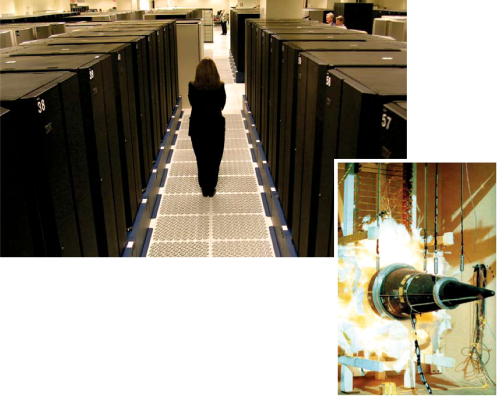
This is only a test: The ASCI White supercomputer, used by Lawrence Livermore for simulations of nuclear explosions (above). Components of a Peacekeeper missile being subjected to a fiery test (right).
The stockpile “may also be wrong from a military perspective,” Brooks argued. It currently contains too many high-yield weapons, offers little or no capability against hard and deeply buried targets, provides no way to limit collateral damage, and cannot destroy chemical or biological munitions, he said. (Yet, as analyst Ivan Oelrich at the Federation of American Scientists has noted, countries that believe their buried, strategic assets are threatened by nuclear weapons possess a very effective, low-tech counter-measure: Dig deeper.) 7
And because the existing weapons production infrastructure (which essentially collapsed under decades of neglect, intense congressional scrutiny, and legal enforcement actions in the late 1980s and early 1990s) is presently incapable of producing significant quantities of materials, components, or finished weapons, Brooks claimed it was necessary to retain a large number of weapons (nearly 5,000, according to estimates by the Natural Resources Defense Council) in non-deployed status as a “hedge against a technical failure of a critical warhead or delivery system, or against unforeseen geopolitical changes.” (Brooks, however, never specifically addressed precisely what unforeseen geopolitical change could possibly necessitate the redeployment of up to 5,000 additional warheads.)
Finally, Brooks argued that today's weapons are not as secure as they could be from physical attack by terrorists. Redesigned warheads, he suggested, would remedy this problem and help reduce burdensome security costs at Energy facilities around the country, especially those imposed following 9/11. However, because access to weapon-grade fissile material, let alone complete weapons, is the last and highest hurdle to prevent a country or group from “going nuclear,” it is difficult to imagine a scenario in which the government would significantly reduce security around operational weapons or those in storage or transit. Any cost savings from such enhancements, therefore, would likely be marginal at best. 8
Brooks insisted that transforming both the stockpile and the infrastructure were essential and that transforming one would drive the transformation of the other. Significantly, he stressed that a key part of this transformation “will be to retain the ability to provide new or different military capabilities in response to [the Defense Department's] emerging needs.” If the RRW program meets expectations, “we should be able to develop and produce, by the 2012-15 time frame, a small build of warheads in order to demonstrate that an RRW system can be manufactured and certified without nuclear testing.” At that point, according to Brooks, the government could decide to truncate or halt some ongoing programs intended to prolong the lives of so-called legacy warheads. If that happened, the resulting savings could be used to introduce more RRWs into the stockpile. This, in turn, could propel the effort to consolidate and rebuild the weapons complex.
Not surprisingly, Brooks's testimony provoked sharp and immediate responses from opponents of new weapons development. Democratic Cong. Ellen Tauscher of California, whose district includes Livermore, told the Washington Post, “They are determined to build new weapons, and whatever logical argument we come up with in a bipartisan way, they jump the fence.” In response, NNSA spokesman Bryan Wilkes contradicted Brooks, telling the Post, “The focus of the RRW program is to extend the life of those military capabilities provided by existing warheads, not develop warheads for new or different military missions.” 9 But, significantly, Brooks asked that a statement by Mira Ricardel, the acting assistant secretary of defense for international security policy, be inserted in the RRW hearing's record: “We don't need a smaller Cold War era nuclear stockpile; we need capabilities appropriate for twenty-first century threats.” 10
Indeed, the purpose of the RRW tends to be very much in the eye of the beholder. According to the New York Times, John Harvey, NNSA's director of policy and planning, “said the culminating stages of the program would include ‘the full-scale engineering development’ of new prototype warheads.” Harvey claims: “Our goal is to carry out this program without the need for nuclear testing. But there's no guarantees in this business, and I can't prove to you that I can do that right now.” 11
Testifying at a Senate budget hearing in mid-February, Energy Secretary Samuel Bodman said that the RRW is “a matter of maintaining what we have. I think some have suggested it's creating something new. It's maintaining what we have.” 12 Yet in a letter to Democratic Sen. Dianne Feinstein of California less than a month later, Bodman wrote that, “If, in the future, the [Defense Department] identifies requirements for new or different military capabilities, it is conceivable that certain concepts identified in the RRW program could be applied in the development of warheads to meet these new requirements.” 13
This view was echoed in early April, when NNSA deputy administrator Everet Beckner told the Oakland Tribune in a revealing comment that the development of new warheads or new military capabilities is “not the primary objective, but [it] would be a fortuitous associated event.” In an interview a few days later with the Albuquerque Journal, Beckner again refused to rule out this possibility. “I think we don't really know yet,” he said of the ultimate outcome of the program. 14
But, as it turns out, they do know the ultimate outcome. It's now a matter of public record. In mid-July, three months after Brooks testified before the Senate Armed Services subcommittee, a Secretary of Energy Advisory Board task force released a report on the future of the weapons complex (originally requested by Hobson in 2004) that Brooks had mentioned and that clearly influenced his testimony. The report presents a sweeping vision for what the complex, and the stockpile, should look like in 2030. Its core recommendation is to consolidate all weapons production, disassembly, and fissile material storage functions at one location, possibly the Nevada Test Site. “The immediate initiation” of work on the RRW program will make this possible.
RRW tag team: Cong. David Hobson (left) and Sen. Pete Domenici (right).

Like several previous statements from inside the nuclear bureaucracy, this report demonstrates that even before the RRW program gets fully under way, it is already moving well beyond the parameters Hobson demarcated in 2004. “Specific operational military characteristics of the 2030 stockpile are not yet defined,” notes the report. “However, the task force believes that the RRW is the first of a family of warheads that embodies all of the desirable characteristics of the sustainable stockpile. Furthermore, the task force envisions a stockpile that is continuously modernized through a series of design-production cycles that would allow the stockpile to meet an evolving or changing threat environment.” The task force also “recommends that a new version of the RRW, incorporating new design concepts and surety features, be initiated on planned five-year cycles. This family of weapons will form the basis of the sustainable stockpile of the future that will replace the current Cold War stockpile.” 15
What's remarkable about this report is that it presents a fully formed plan for overhauling the weapons complex, even as the authors acknowledge there are no specific military requirements for nuclear weapons this far into the future. In effect, they lay out a self-justifying blueprint for regularly replacing the entire current stockpile with new classes of thoroughly modern warheads to meet any and every contingency.
Time for a real debate
The Energy Department requested $9.4 million for the RRW in fiscal 2006. This was subsequently increased to $25 million by Hobson and Domenici's subcommittees. (Domenici, however, has already included language in his version of the bill prohibiting any spending to implement the task force's recommendations. “While there is always room for improvement,” Domenici said, “I believe our labs are doing good work and I do not think we should rush into any quick fixes.”) 16 The House and Senate Armed Services committees, however, while endorsing the RRW, authorized spending only the amount requested by the administration. Final action on all these bills was pending as this article went to press.
For their part, congressional Democrats have made clear they are “willing to explore the concept of the RRW program” but that their unequivocal support will come only if it meets a number of explicit criteria, including leading to “dramatic reductions in the nuclear arsenal, including complete dismantlement of the weapons and safe disposal of fissile components,” reducing “the reliance of the U.S. on nuclear weapons and de-emphasiz[ing] the military utility of nuclear weapons,” and leading to “ratification and entry into force of the Comprehensive Test Ban Treaty.” In addition, the program should not “introduce new mission or new weapon requirements, particularly for tactical military purposes.” 17
Yet, if the RRW program proceeds it will almost certainly gradually supersede stockpile stewardship, transforming, its advocates hope, the arsenal and the weapons production complex into a more modern, more agile, and less expensive operation. Whether this is desirable, necessary, or feasible are matters that have thus far received relatively little attention.
Through all of this, there is an unspoken assumption that nuclear deterrence must continue to be a major element of U.S. security policy for the foreseeable future. Few people, certainly not in Congress, are willing to question this assumption, at least not publicly.
Hobson should be applauded for questioning wasteful and unnecessary nuclear weapons programs, and for striving to inject a healthy dose of reality into discussions of nuclear warfare. With few exceptions, congressional oversight of nuclear weapons historically has been lax to nonexistent. 18 For Hobson, Tauscher, and others to immerse themselves in the details, ask critical questions of officials, and attempt to bring some coherence and fiscal accountability to the process is welcome and refreshing. 19
But a real debate on the future role of U.S. nuclear weapons would consider whether there should even be a role for such weapons more than 15 years after the end of the Cold War. Hobson himself concedes that the future role for U.S. nuclear weapons should be “very, very limited.” But like so many others, he insists, “as long as other nations have stockpiles of nuclear weapons, the United States will always need a robust nuclear deterrent to defend us and maintain a balance of power that stabilizes the nuclear-armed world.” 20
Yet other countries retained their stockpiles of biological weapons, and that did not dissuade President Richard Nixon from ordering the destruction of U.S. biological warfare agents in the early 1970s. Similarly, chemical weapons, once considered indispensable, were declared militarily unnecessary in the 1990s and are now being incinerated at depots across the country. Instead of seeking to reflexively match or checkmate other countries, why not consider the full range of costs and benefits of maintaining the nuclear status quo? That would certainly be in keeping with Hobson's warning that “every dollar spent on [the Energy Department's] nuclear weapons work is a dollar not spent on some other competing national priority,” such as armor for Humvees and troops fighting in Iraq, or health care.
And if some of today's nuclear weapons are not as safe as they could be, why must we manufacture a new generation of “inherently safe” warheads? Why not follow the example of Dick Cheney, who as defense secretary in June 1990, ordered the prompt removal from ground alert and subsequent dismantlement of more than 1,100 short-range attack missiles when it was discovered that the conventional high explosives in their W69 warheads could ignite in an accident involving the missile's propellant or an aircraft fire? 21
A smaller, more modern, more efficient nuclear weapons production complex would probably be less expensive and safer to operate than what exists today. But getting there would cost well over $100 billion. 22 A decision now to stop relying on nuclear deterrence could reap tremendous savings, applicable to military and nonmilitary programs alike.
U.S. possession of a massive strategic and tactical nuclear arsenal has done and can do nothing to prevent terror attacks on U.S. soil or overseas. Neither can such weapons be used in response to such attacks without severe political, military, and environmental repercussions (a situation unlikely to be altered even if warheads somehow capable of reducing collateral damage are ever deployed). The formidable U.S. stockpile, and the highly visible role it continues to play in U.S. security posture, has done nothing to slow or reverse the nuclear programs of North Korea and Iran. To the contrary, the U.S. arsenal and the Bush administration's plans for augmenting and enhancing it have been cited as justification by both countries for their aggressive and thus far unyielding postures.
It is also difficult to construct a plausible scenario in which a nuclear-free but conventionally superior United States could be successfully bullied or blackmailed by a nuclear-armed foe. The overwhelming firepower, precision strike capabilities, and swift global reach of U.S. forces would make this an extremely risky and losing proposition for any rational decision maker (and irrational leaders, or those willing to die for their cause, are by definition undeterrable). Advocates of rejuvenating the nuclear arsenal also argue that new weapons and capabilities will actually serve nonproliferation goals by reassuring allies who might otherwise “go nuclear” to defend themselves. But, tellingly, these advocates are the only ones peddling the notion that a theoretical lack of confidence in the U.S. “nuclear umbrella” will increase the number of nuclear-armed states.
If we are not willing, at this late date, to reexamine our assumptions about nuclear weapons, then we cannot have an honest and open debate. Neither can we expect other nations to take us seriously when we stress the fundamental importance and necessity of nuclear nonproliferation. This debate has, in fact, been under way for some time. But it has been carried out almost exclusively behind closed doors inside the military, which once demanded a nuclear weapon for every conceivable mission. But as the Federation of American Scientists' Oelrich has noted, beginning in the 1960s, the United States systematically denuclearized many of these missions–not due to political pressure or moral angst, but because modern-day conventional weapons offer better alternatives. “If we start with the premise that we have nuclear weapons and we need to find a role for them, then we shall always find a role for them,” he adds. “But if we look at the military missions we need to perform, including deterrence and neutralizing tunnels, we will only rarely if ever fall upon nuclear weapons as the optimal solution.” 23
Let the debate begin.
↗
↗
↗
For these articles and more, visit the online Bulletin Archive at www.bulletinarchive.org.
Footnotes
1.
David Hobson, “U.S. Nuclear Security in the Twenty-First Century,” address to Arms Control Association, February 3, 2005.
2.
Remarks by David Hobson, chairman, House Appropriations Subcommittee on Energy and Water Development, symposium on “Post-Cold War U.S. Nuclear Strategy: A Search for Technical and Policy Common Ground,” National Academy of Sciences Committee on International Security and Arms Control, August 11, 2004.
3.
The Advanced Concepts Initiative, previously created by Energy to explore other nuclear weapons ideas, was terminated and its $9 million budget transferred to the RRW. Jonathan Medalia, “Nuclear Weapons: The Reliable Replacement Warhead Program,” Congressional Research Service, May 24, 2005, p. 6.
4.
Hobson, “U.S. Nuclear Security in the Twenty-First Century.”
5.
See, for example, Senate Armed Services Subcommittee on Strategic Forces, statement of Linton F. Brooks, administrator, National Nuclear Security Administration, Energy Department, April 4, 2005; K. Henry O'Brien, et al., “Sustaining the Nuclear Enterprise–A New Approach,” May 20, 2005 (document available at  ); and “Recommendations for the Nuclear Weapons Complex of the Future–Report of the Secretary of Energy Advisory Board Nuclear Weapons Complex Infrastructure Task Force,” July 13, 2005, p. vi.
6.
Senate Armed Services Committee, statement of Linton F. Brooks, April 4, 2005. See also “Sustaining the Nuclear Enterprise–A New Approach” and “Recommendations for the Nuclear Weapons Complex of the Future.”
7.
Ivan Oelrich, “Comments on Republican Policy Paper, ‘Nuclear Deterrence,’” Federation of American Scientists, June 2005.
8.
Significant savings could be achieved, however, if the number of stored weapons and the number of sites where fissile materials are currently stored were substantially reduced, as proposed in “Recommendations for the Nuclear Weapons Complex of the Future.”
9.
Walter Pincus, “Plan to Study Nuclear Warheads Stirs Concern,” Washington Post, April 6, 2005, p. A2.
10.
Ibid.
11.
William J. Broad, “U.S. Redesigning Atomic Weapons,” New York Times, February 7, 2005, p. A1.
12.
David Ruppe, “Warhead Replacement Program Intends No New Weapons, U.S. Energy Department Head Says,” Global Security Newswire, February 16, 2005.
13.
Masakatsu Ota, “New U.S. Study Envisions New Types of Nuke Arms,” Kyodo News Service, April 19, 2005.
14.
Quoted in Daryl Kimball, “Replacement Nuclear Warheads? Buyer Beware,” Arms Control Today, May 2005.
15.
“Recommendations for the Nuclear Weapons Complex of the Future,” pp. 7, 13.
16.
David Ruppe, “Task Force Urges U.S. to Adopt New Nuclear Weapons ‘Family,’” Global Security Newswire, July 15, 2005.
17.
House Committee on Armed Services, National Defense Authorization Act for Fiscal Year 2006, 109th Cong., 1st sess., 2005, H. Rep. 109-89, pp. 463-65, 511-12.
18.
Stephen I. Schwartz, “Congressional Oversight of the Bomb,” in Stephen I. Schwartz, ed., Atomic Audit: The Costs and Consequences of U.S. Nuclear Weapons Since 1940 (Washington, D.C.: Brookings Institution Press, 1998), pp. 485-517.
19.
20.
Hobson's remarks at the symposium, “Post-Cold War U.S. Nuclear Strategy: A Search for Technical and Policy Common Ground.”
21.
Robert S. Norris and William M. Arkin, “Nuclear Notebook,” Bulletin of the Atomic Scientists, September 1990, p. 48.
22.
Without providing any details, “Recommendations for the Nuclear Weapons Complex of the Future” predicts that it would cost $155 billion between 2006 and 2030 to accomplish the transformation it outlines (pp. E1-2).
23.
Oelrich, “Comments on Republican Policy Paper, ‘Nuclear Deterrence.’”