




Abstract
When you carry a fake Gucci handbag, you're carrying it for bin Laden. That's the alarm being sounded by a string of law enforcement agencies and industry associations, including Interpol, the Department of Homeland Security, the Motion Picture Association of America, and some software and luxury goods manufacturers. They say the sale of counterfeit products–including stolen intellectual property such as films, music, computer games, and imitation luxury clothing–is a lucrative and largely untraceable money source for Al Qaeda, Hezbollah, and other global terrorists.
To be sure, counterfeiting is a profitable business. Interpol and U.S. law enforcement agencies estimate that companies lose $400 billion to $450 billion annually to counterfeiters worldwide. (U.S. companies are hit the worst, accounting for more than half the total losses.) Yet, historically, busting traffic in bootleg Harry Potter DVDs and fake Rolexes has not been high on the priority list for law enforcement agencies otherwise occupied with drug smugglers and violent criminals. Counterfeiting is perceived as a victimless crime, and it's hard to inspire public outrage over the plight of multibillion dollar corporations, especially when a genuine pair of Armani shoes costs upwards of $450.
Then came 9/11, and companies and financial investigators that had complained for years about official complacency found receptive and anxious ears in Washington. Now lawmakers talk of connections between DVD pirates in Los Angeles and Lebanese terrorist outfits launching attacks in Israel. In testimony before Congress in 2004, Richard K. Willard, the senior vice president and general counsel of the Gillette Company ominously noted that “seized Al Qaeda training manuals recommend the sale of fake goods as a financing source for its terrorism.” An anticounterfeiting bill pending before Congress declares “ties have been established” between counterfeiting and terrorism, and the secretary general of Interpol, Ronald Noble, has said that “intellectual property crime is becoming the preferred method of funding for a number of terrorist groups.”
Yet, the evidence to support Noble's contention that counterfeiting is emerging as the preferred method to fund terrorism is shaky. Indeed, the limited evidence available is largely anecdotal and, maddeningly for investigators, often inconclusive.
After the 9/11 attacks, intelligence and law enforcement agencies searched widely for terrorism financing sources–through drug sales, stolen and resold baby formula, and even illegally redeemed grocery coupons. Industry lobbyists such as the Federation Against Copyright Theft and the International Intellectual Property Alliance, which have pushed for tougher sentences for convicted counterfeiters, have spent millions on their own research. They and law enforcement have turned up some compelling tales.
For instance, in 2002 Danish customs officials intercepted a shipment of knockoff shampoos, creams, and cologne out of Dubai, sent by an alleged Al Qaeda member who may have been remitting proceeds to the group. In Panama, authorities recently apprehended a suspected counterfeiter of household appliances who also may have been the Latin American point of contact for Palestinian terrorist groups. (Central and South America are home to large Middle Eastern expatriate communities, as well as free trade zones where counterfeiters run rampant.) And then there's the counterfeiting suspect whose home the Los Angeles Sheriff's Department searched last year. He had displayed small Hezbollah flags in his bedroom, along with a photograph of Hassan Nasrallah, the group's leader. In each of these cases–and a few frequently cited others–investigators suspect counterfeiters diverted at least some proceeds to terrorist organizations. But beyond circumstantial connections, there's little to suggest that counterfeiting, though profitable, is now terrorists' favorite funding source, or even a very big one.
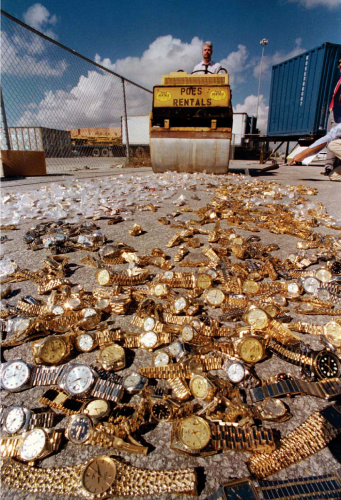
Taking a licking: More than $600,000 worth of counterfeit designer watches about to get smashed by a U.S. Customs agent.
“I do not have proof,” acknowledged Larry Johnson, a former high-ranking U.S. counterterrorism official, to the House Committee on International Relations in 2003. Now the chief executive officer of Berg Associates, which investigates financial crimes on behalf of businesses, Johnson said, “There is no obvious, significant link connecting terrorist attacks to product counterfeiting.” But, he cautioned, “The infrastructure for the activity and the threat is in place.”
At the same hearing, Asa Hutchinson, then the Homeland Security undersecretary for border and transportation security, likewise noted that officials hadn't “established a direct link between profits from the sale of counterfeit merchandise and specific terrorist attacks in the United States.” Yet, Hutchinson assured lawmakers that “We do have credible and specific intelligence which indicate that intellectual property crimes and terrorist organizations are linked.”
Perhaps unsurprisingly, the most outspoken proponents of a terrorist link–the affected industries–are also those who are the most explicit critics of law enforcement's lackadaisical approach toward counterfeiting. Victor Comras, a former State Department official and member of the United Nation's Al Qaeda monitoring group, doesn't rule out the possibility that some are hyping the terrorism link to mobilize an official response. Counterfeiting crimes “don't get the same attention as drugs and terrorism,” he says. And maybe for good reason. “Probably most of it has nothing to do with terrorism.”
But Comras adds that situation might change, since trafficking in pirated goods offers a high payoff with a low risk of being caught or severely penalized. That's precisely counter-feiting's allure. In fact, one private investigator in Los Angeles who has worked with law enforcement says terrorists are “stupid if they're not doing it.”
What's needed now, Comras says, is the awareness that links may develop. When connections are discovered, the government should at least freeze the assets of the individuals in question. But even that's not happening now, Comras complains. U.N.-designated Al Qaeda financiers still run businesses abroad, he says. And despite the Bush administration's assertions that terrorists' financing channels are weaker, Comras notes that the pace of recruitment activities–to which most of their money goes–is accelerating as the number of attacks increases.
However, Comras believes that diverting more resources to track down counterfeiters is not the answer. In that respect, he looks favorably upon the recent initiatives of the Department of Homeland Security, which has shifted its counterfinancing strategy to focus less on proving links between counterfeiters and terrorists through investigations, and more on shoring up vulnerabilities in the economic system that terrorists might exploit. For instance, the department's “Operation Cornerstone” has a unit dedicated exclusively to training banks, brokerage firms, and other financial institutions on ways that terrorists raise and launder money, such as through cash smuggling and insurance fraud.
One former Treasury Department official, who worked on terrorist financing investigations after 9/11 and asked not to be identified, is frustrated by the murkiness of the whole counterfeiting problem. “Personally, do I think it's happening? The answer is yes. But it's hard to get the smoking gun,” he says.
Claims of credible indicators aside, the biggest law enforcement agency in the world isn't ready to say that where there's smoke there's fire. A spokesman for the FBI, which conducts counterfeiting and terror financing investigations with Homeland Security, says, “At this time, we are not aware of any connection between terrorist groups and pirated goods. I'd be interested if you hear from someone who is.”