




Abstract
Upstart nuclear-weapon-free zones could yield enormous security benefits for the entire world. It's no wonder the idea is gaining traction.
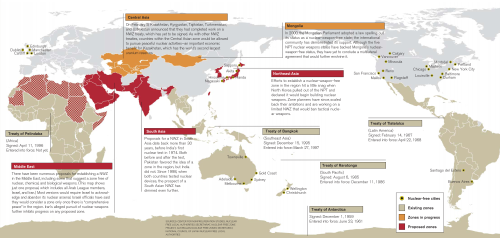
Little by little, the nuclear-weapon-free world appears to be gaining ground. Since 1967, more than 100 countries across the globe have formed four nuclear-weapon-free zones (NWZs). Throw in the 1959 Treaty of Antarctica, the Seabed Treaty, and the Outer Space Treaty, which ban nuclear weapons from their respective areas, and more than half of the globe is theoretically insulated from the nuclear threat. (Not to mention the thousands of nuclear-free towns and cities–self-declared designations that remain largely symbolic. A selection of cities is shown below.)
Several regions are working to widen the coverage of NWZs. In order to increase the chances of new zones taking hold in parts of the world where there are significant security challenges, like the Middle East and the Korean Peninsula, arms control advocates have begun promoting the broader benefits of the zones. If all five of the Nuclear Non-Proliferation Treaty's (NPT) nuclear weapon states were to guarantee not to use or threaten the use of their arsenals against all existing NWZs, some argue that more countries would sign on to a zone.
NWZs could also more generally serve as regional security forums. “Because the causes of insecurity vary from region to region, security solutions do not come in a ‘one-size fits-all’ package,” Mohamed ElBaradei, director general of the International Atomic Energy Agency, told the first-ever conference of NWZ countries in April. “It is for this reason that regional dialogues, as we see in the nuclear-weapon-free zones, are so beneficial.”
John E. Endicott, who has worked for more than a decade to build a NWZ in Northeast Asia, agrees. By establishing a regional dialogue in the form of a NWZ, countries could address security issues ranging from tensions over mutually claimed regions to the lasting legacies of war atrocities. “All of these things can be … done away with at a working level, rather than popping up like they do all of the time,” he says.
There have been numerous proposals for establishing a NWZ in the Middle East, including some that suggest a zone free of nuclear, chemical, and biological weapons. (This map shows just one proposal, which includes all Arab League members, Israel, and Iran.) Most versions would require Israel to acknowledge and abandon its nuclear arsenal. Israeli officials have said they would consider a zone only once there is “comprehensive peace” in the region. Iran's alleged pursuit of nuclear weapons further inhibits progress on any proposed zone.
On February 9, Kazakhstan, Kyrgyzstan, Tajikistan, Turkmenistan, and Uzbekistan announced that they had completed work on a NWZ treaty, which has yet to be signed. As with other NWZ treaties, countries within the Central Asian zone would be allowed to pursue peaceful nuclear activities–an important economic benefit for Kazakhstan, which has the world's second largest uranium reserves.
Proposals for a NWZ in South Asia date back more than 30 years, before India's first nuclear test in 1974. Both before and after the test, Pakistan favored the idea of a zone in the region, but India did not. Since 1998, when both countries tested nuclear devices, the prospect of a South Asian NWZ has dimmed even further.
In 2000, the Mongolian Parliament adopted a law spelling out its status as a nuclear-weapon-free state; the international community has demonstrated its support. Although the five NPT nuclear weapons states have backed Mongolia's nuclear-weapon-free status, they have yet to conclude a multilateral agreement that would further enshrine it.
Efforts to establish a nuclear-weapon-free zone in the region hit a little snag when North Korea pulled out of the NPT and declared it would begin building nuclear weapons. Zone planners have since scaled back their ambitions and are working on a limited NWZ that would ban tactical nuclear weapons.
(Africa)
Signed: April 11, 1996
Entered into force: Not yet.
(Southeast Asia)
Signed: December 15, 1995
Entered into force: March 27, 1997
(Latin America)
Signed: February 14, 1967
Entered into force: April 22, 1968
(South Pacific)
Signed: August 6, 1985
Entered into force: December 11, 1986
Signed: December 1, 1959
Entered into force: June 23, 1961