




Abstract
The world is finally getting serious about cleaning up orbital debris–but U.S. plans for the militarization of space could be the spoiler.
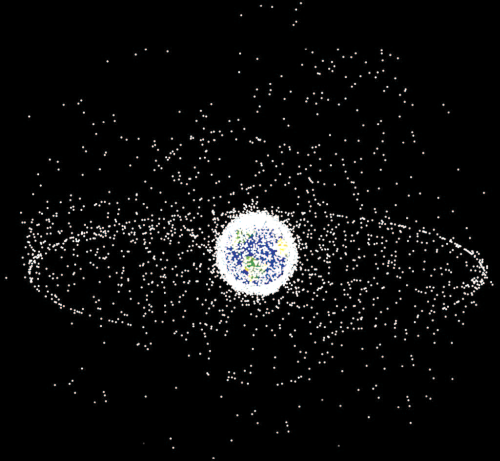
The next time you've got clear nighttime skies, take a long look into the infinite cosmos. What is out of sight–but shouldn't be out of mind–is that you are gazing into our planet's largest junkyard.
Earth orbit is littered with a jumble of dead or near-dying satellites, lens caps, spent motor casings, and leftover rocket stages. But that's not all. There are scads of separation bolts, momentum flywheels, clamp bands, launch vehicle fairings, and adapter shrouds. Mix into the blend bits of discharged propellant, flakes of paint, hardware fragments from explosions in space, and droplets of nuclear reactor coolant. At one point, even a toothbrush was reportedly whisking through the global space commons.
The U.S. Strategic Command, headquartered at Offutt Air Force Base in Nebraska, keeps a space surveillance network of sensors ever vigilant on tracking well over 13,000 human-made space objects, baseball-size and larger, orbiting Earth. A mere 7 percent of this total represents operational satellites, with 15 percent being derelict rocket bodies. The largest percentage of trackable objects–about 78 percent–amounts to orbiting riffraff that zips through space at high speed. Ground-based radars can also sweat the small stuff, being able to detect objects as tiny as 3 millimeters across.
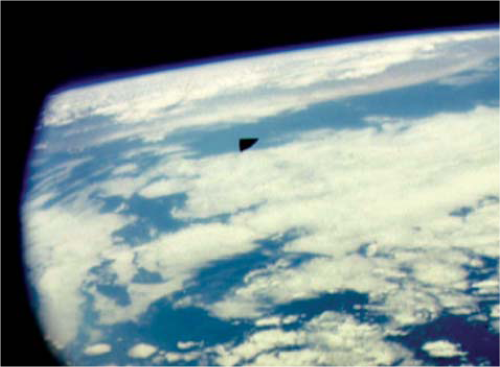
The primary source of large orbital debris is from explosions, especially of old upper stages left in orbit with stored energy sources, such as residual propellants, high pressure fluids, even batteries that blow their tops. At low Earth orbit, space debris travels at 10 times the speed of a rifle bullet. A marble-sized piece of flotsam, for example, would smack a satellite with about the same energy as a 1-ton safe dropped from the top of a five-story building. No wonder that the crewed space shuttles, as well as that mega-structure, the International Space Station, have been maneuvered out of harm's way more than once from an errant chunk of junk. More recently, the preliminary results of a NASA risk assessment concluded that space debris accounts for 11 out of 20 of the most likely scenarios that could lead to the loss of another shuttle.
Piece on Earth: A chunk of thermal insulation tile floating near the space shuttle.
And it's getting worse. The amount of orbital detritus is increasing at a rate of 5 percent per year. By the end of the century, a satellite in geostationary orbit will have a 40 percent chance of colliding with another object during its operational lifetime. Even if a chunk of debris is too small to destroy a spacecraft, an object just a fraction of an inch can wreak havoc with a satellite's optics. And the trend toward building cheaper constellations of microsatellites could further aggravate the problem. Like their larger counterparts, they too are vulnerable to bits of debris–but their diminutive size and proliferating numbers add to the worries about the growing clutter in Earth's orbit.
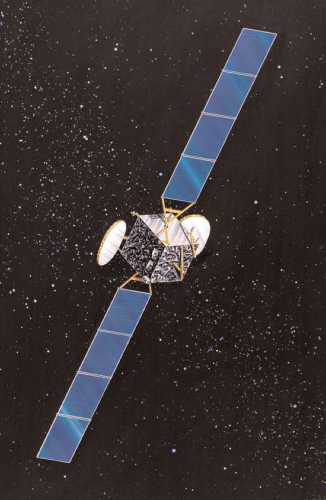
What happens up there matters down here–and not just because errant pieces of space hardware occasionally rain down on terra firma. Satellites are the physical infrastructure of the information age. We increasingly rely on them for communications, internet access, navigation, military surveillance, and environmental research. Recall what happened in 1998 when–for reasons still not entirely clear, a single satellite, the Galaxy IV, lost its bearings: 45 million people, including hospital personnel, were disconnected from their paging service. Local affiliates of National Public Radio ceased broadcasting. Reuters was unable to send wire stories to media outlets, while Chinese Television Network couldn't transmit news feeds. ATMs experienced service interruptions, as did credit card systems at gas stations and grocery stores.
Even more worrisome: Imagine the implications if space debris were to unexpectedly destroy an early warning satellite of a nuclear-armed nation.
On the plus side, the mounting pile of credible data on space debris is prompting countries to get serious about addressing the issue. Representatives of spacefaring nations are gathering at international forums to draft guidelines for keeping Earth's orbit clean. Yet, beneath the veneer of cooperation, there's growing tension as well. U.S. military planners talk openly of developing the capabilities to defend America's satellites from attack and to deny other countries access to the ultimate high ground. Those concerned with mitigating the space debris problem shudder at the prospect of nations smashing one another's satellites in Earth orbit. Worse still, some countries could respond to provocation by purposely creating debris fields to destroy satellites, much in the way that countries lofted cables tethered to balloons to sheer off the wings of enemy aircraft in World War I. And it is the United States, the country that gains the most from its fleet of civilian and military satellites, which has the most to lose.
Talking trash
Until about 1990, most of the models of what the space environment looked like were based on analytical work. Due to a dearth of data, postulations, equations, and estimates dominated orbital debris studies.
Fast-forward to today. Thanks to inspections of space shuttle surfaces and equipment change-outs on spacecraft, such as the Hubble Space Telescope, “confidence keeps increasing” regarding space debris issues, explains Nicholas Johnson, chief scientist and program manager for orbital debris at NASA's Johnson Space Center in Houston. “Errors are reduced, so we have higher confidence. That's really the name of the game now.”
High impact: Result of a space debris simulation, showing the effect of a small aluminum sphere striking a thick block of aluminum at 4.2 miles per second (top); orbital debris hole made in the panel of the Solar Max satellite (above).
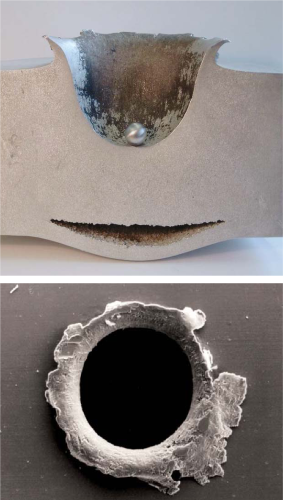
Oddly, getting some respect for orbital debris took time. Don Kessler, a veteran space “debrisologist” and meteoroid consultant in Asheville, North Carolina, recalls that an early 1980s space shuttle was found to have come back to Earth with a pitted window. After testing, it turned out that the tiny crater was produced by a paint flake. That pit served as a real data point and swung people's attention to the fact that a problem existed. “It just made all the difference in the world as far as our research was concerned,” Kessler recollects.
Kessler and his colleagues keep themselves busy cataloguing the ever-expanding taxonomy of space debris and its progeny. Last year, for instance, New Scientist reported that space observers noticed dozens of faint objects, measuring about one foot in diameter, which looped around the Earth in strange, elongated orbits. After some puzzling, researchers concluded the objects were likely layers of thermal blankets that had been torn off of satellites as a result of explosions or collisions with micrometeoroids. Like scraps of paper in a windstorm, the solar radiation buffets the blankets, which explains their peculiar orbits. But unlike blowing paper, the thermal shielding is traveling faster than 3,000 feet per second and could do serious damage if it crossed paths with a satellite.
One of the more bewildering contributions to the cluttering of space involves old nuclear-powered spy satellites launched by the Soviet Union between 1967 and 1988. Ground-based radar measurements indicated that 16 of a total of 31 radar-snooping ocean reconnaissance satellites, dubbed RORSATs, spewed quantities of their liquid sodium-potassium reactor coolant after they went into retirement.
That wasn't quite in the plan. After a RORSAT's work was finished, the satellite shot its reactor's fuel core high above Earth into a “disposal orbit,” where it wouldn't reenter the Earth's atmosphere for several hundred years. But in ejecting the core from the main body of a RORSAT, poor plumbing allowed the sodium-potassium coolant to leak. The result: Thousands upon thousands of droplets spilled into space. Paula Krisko, a space debris specialist working for Lockheed Martin at NASA's Johnson Space Center, has estimated that a hailstorm of 110,000-115,000 coolant droplets of various sizes now circuit the Earth. Some very small globules have started inching down into altitudes where they stand to be a hazard to spacecraft.
Kessler first discovered the globules and traced them back to their source. As is often the case with exotic species of space debris, they were not so much discovered as stumbled upon. “That to me indicates that there ought to be some undiscovered ones out there yet,” Kessler says. “So many were surprises … it's hard to imagine what the new surprises might be.”
But, Kessler doesn't have trouble imagining the source of these new surprises, noting that yet another issue is cropping up in space debris circles: the “runaway threshold.” Kessler contends that collisions in space are slowly introducing quantities of smaller debris. To prove his assertion, he utilized data from a 1985 U.S. Air Force antisatellite (ASAT) test, whereby an F-15 jet lobbed a missile at the Solwind P78-1 satellite, shattering it. In studying the pieces of refuse produced, their radar cross sections, and other available data, Kessler concluded that low Earth orbit is unstable and that debris resulting from collisions is a major problem that would be very costly to control. (In fact, one piece of debris from the 1985 test passed less than a mile from the International Space Station 14 years later.)
Kessler has deduced that we are on the threshold of having a critical density of objects in low Earth orbit. Even if all other sources are eliminated, collisional fragmentation will continue to get worse. “And that's where we are,” he says.
Adding to the problem, some satellite operators are not cleaning up after themselves. Communications satellites are often launched into geostationary orbit (an altitude of 22,237 miles), where they travel at the same speed as Earth's rotation, allowing them to remain at a fixed point relative to antennae and ground stations on the planet below. Under existing international guidelines, once a satellite in geostationary orbit reaches the end of its operational life, it should be boosted up an additional 300 kilometers (186 miles) into a disposal orbit–thereby making room for other satellites to take advantage of the valuable geostationary real estate. But a survey recently conducted by Ruediger Jehn at the European Space Agency's Space Operations Centre in Darmstadt, Germany, revealed that only about one-third of satellite operators actually boosted their satellites into a graveyard orbit. The rest either halfheartedly nudged them upwards by 100-200 kilometers (62-124 miles), or abandoned their satellites altogether. Russia was the worst offender, but satellite operators in the United States and China also share some of the blame.
The reluctance to play by the rules is, in part, borne out of costs. It requires considerable fuel to boost a satellite's altitude, and some satellite owners would rather use that fuel to squeeze out a few extra months of operability (and profit) from their hardware. NASA's Johnson, however, emphasizes that catastrophic failures in a spacecraft may also prevent a country from performing removal operations. In some cases, there is every intention to maneuver satellites, but for reasons beyond operators' control, their crippled spacecraft, unfortunately, can't be dispatched into a graveyard orbit.
Silent running: When the Galaxy IV satellite lost its bearings in 1998, it disrupted communications for millions.
Already, spacecraft are bumping into one another. The first recognized fender bender between cataloged objects from different missions happened in July 1996. The French military reconnaissance spacecraft CERISE was clipped by a portion of a rocket stage (one fragment of many created when the entire upper stage of a European Ariane booster exploded a decade earlier). A boom on the CERISE snapped off during the clash, although the satellite was later able to continue its mission, which is eavesdropping on weak high-frequency communications.
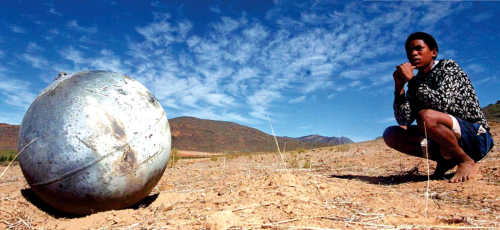
It's raining debris: A metal sphere, believed to be part of an old satellite, fell to Earth and landed on a farm outside Cape Town, South Africa, in April 2000.
Earlier this year, another meeting of metal occurred above Earth. This time a discarded U.S. upper stage from a 1974-launched booster tangled with a third-stage fragment from a Chinese CZ-4 launch vehicle that had detonated in orbit in March 2000.
Each of these speed bumps yielded more debris. The episodes were reported in the April issue of The Orbital Debris Quarterly News, a publication of the NASA Orbital Debris Program Office at the Johnson Space Center. Also added was this bit of less-than-cheery news: “As the number of objects in Earth orbit increases, the likelihood of accidental collisions will also increase…. If future spacecraft and rocket bodies are not removed from LEO [low Earth orbit] within a moderate amount of time after the end of mission, e.g., within 25 years, the rate of accidental collisions will increase markedly later in this century.”
Pandora's box
“My one-liner, which I repeat like a robot to multiple audiences, is: ‘Space debris kills, and it kills indiscriminately,’” says Michael Krepon, president emeritus of the Henry L. Stimson Center, a nonprofit, nonpartisan institution devoted to enhancing international peace and security based in Washington, D.C. He warns that debris could nullify the hard-earned advantages the United States now enjoys in low Earth orbit.
Krepon explains that the appreciation of the threat posed by space debris has grown quite a bit since the United States and the Soviets tested kinetic energy ASATs during the Cold War. These days, when the air force talks about pursuing space control, it emphasizes the preference for doing so through “temporary and reversible” means, such as radio jamming or using lasers to blind sensors. The army is still channeling some funds toward the development of a kinetic energy ASAT, although Krepon senses that has more to do with pork than policy. “I don't believe that the army leadership is any more enthusiastic about debris-producing space warfare than is the air force,” he says. “The narrow problem of budget add-ons for kinetic energy-ASAT work now lies primarily with some small contractors in Alabama who have gotten their senator [Republican Jeff Sessions], who happens to chair the relevant Senate Armed Services subcommittee, to support their work.”
But there is a larger problem, Krepon adds. “If the U.S. opens this Pandora's box by initiating space warfare with ‘temporary and reversible’ effects, we have no control over the techniques that others will use to respond. We can try to be polite, while they can choose to be messy.”
Unfortunately, Krepon suggests, “space debris is easy to generate, especially when someone is trying to do so.” Indeed, rival countries that do not enjoy the U.S. high-tech advantage might resort to cruder methods of space warfare, such as kinetic energy “mines” that slam into satellites. Or they might, literally, adopt a shotgun approach, launching payloads of gravel or other types of orbital buckshot to pummel spacecraft.
Theresa Hitchens, vice president of the Center for Defense Information in Washington, D.C., notes that debris-causing weapons “present a danger to all satellites whether military, civilian, or commercial. It is also an environmental issue, if certain areas of space become so polluted that they are unusable. The world will suffer.”
Yet, it is precisely because of this universal threat to orbital navigation that Hitchens also sees a silver lining to the debris cloud. The concern over space debris could open the door to new multilateral dialogue on inhibiting the weaponization of space–perhaps even compelling a reluctant United States to take a seat at the negotiating table. “It seems to me that it would be in the U.S. military's interest to try to prevent other nations from developing debris-creating weapons, which are in fact easier to develop than high-power jammers and blinders,” she says. Furthermore, if the U.S. Air Force is ambivalent about kinetic energy and destructive weapon systems because of concerns about “space fratricide” from debris, it would have little to lose through a treaty barring such weapons. It is the classic approach to arms control, Hitchens points out. You negotiate away something you don't really want in the first place and would be bad for others to have.
There's cause to be hopeful since, after nearly 50 years of rocket launchings and satellites tossed into Earth orbit, the issue of space litter has been globally spotlighted as a problem. Action plans are being agreed to. Steps are being detailed and executed–all in the hopes of tidying up and safeguarding the orbital environment for future space users.
NASA's Nicholas Johnson explains that leading space agencies of the world have formed the Inter-Agency Space Debris Coordination Committee (IADC). A recent annual meeting brought 110 experts from around the globe together in order to address orbital debris issues and to encourage operations in Earth orbit that restrain the growth of orbital debris. The cooperation has been very good within the IADC, says Johnson–so productive, in fact, that an orbital debris document being drafted by the United Nations is likely to be based on the IADC work. The best success story for the IADC to date, he says, has been dramatically reducing the number of major explosions in Earth orbit. Nations are re-engineering the innards of fuel tanks to assure that leftover fuels don't mix into a volatile cocktail that could result in the catastrophic production of shrapnel.
Nevertheless, there is the realization that current reduction measures will lead, at best, to stabilizing the growth of the debris population. Still needed are more efficient measures to selectively deorbit spacecraft and rocket stages at completion of their respective missions from populated regions.
Veteran space debris analyst Don Kessler sums it up: “Your best hope is to first identify what is going on … and do what you can to stop it.”
Space debris
↗
↗
↗
For these articles and more, visit the online Bulletin Archive at www.bulletinarchive.org.