




Abstract

On April 21, a delegation of members of Congress from Oregon and Washington State wrote to leaders of the House Subcommittee on Energy and Water Development, hoping to draw attention to the $268 million in proposed cuts to environmental cleanup funding at the Hanford Site, a former nuclear weapons production facility in southeastern Washington State.
“The level of funding requested by [Energy] for next year is not sufficient to maintain cleanup progress at the Hanford Site. We believe the proposed reductions go too far and will unnecessarily and unjustifiably delay cleanup progress,” their letter read.
The proposed cuts would affect more than just Hanford. The 2006 budget lays out cleanup funding cuts at more than 10 other Energy Department sites. In total, the administration reduced Energy's cleanup budget by $548 million. But even as cleanup activities face a 7.8 percent cut, Energy's nuclear weapons activities continue to receive more money–a $47 million increase in the proposed 2006 budget.
Thus begins the latest round of the decades-long “bombs vs. cleanup” debate. In the late 1980s, Energy officials attempted to convince Congress of the need to reinvest in the nation's aged and deteriorated nuclear weapons and testing complex, which had effectively collapsed. The Reagan administration acquiesced to a “grand bargain.” In exchange for starting cleanup at its most contaminated sites, Congress allowed Energy to move forward with plans to revitalize the weapons complex.
Yet there were still doubters. At a January 1989 hearing, Ohio Democratic Sen. John Glenn, then the chairman of the Governmental Affairs Committee, summed up the sentiment of some in Congress when he asked Energy officials: “What good is it to be protected with nuclear weapons, if we poison our people in the process?” Events overtook the plan, and in 1989, the Soviet Bloc crumbled, ending the Cold War and subsequent plans to produce new nuclear weapons.
Still, cleanup began in earnest. Energy created the Office of Environmental Restoration and Waste Management in 1990 to oversee the cleanup of hundreds of contaminated nuclear weapons sites. It also began a long-term “stewardship” program, recognizing that access to large areas of severely contaminated land, ground-water, and river sediments would need to be permanently restricted.
President George W. Bush entered office in 2000 with a much different agenda than his predecessors. His administration aimed to transform Energy's nuclear disarmament activities into a readiness program and to make new nuclear weapons. And so, Energy embarked on a “top to bottom” review of its cleanup program, with the goal of freeing up tens of billions of dollars that could be spent on other military priorities. In 2002, the department unveiled its “accelerated cleanup” initiative designed to condense from 70 to 30 years the time it would take to complete all environmental cleanup activities and to save more than $29 billion.
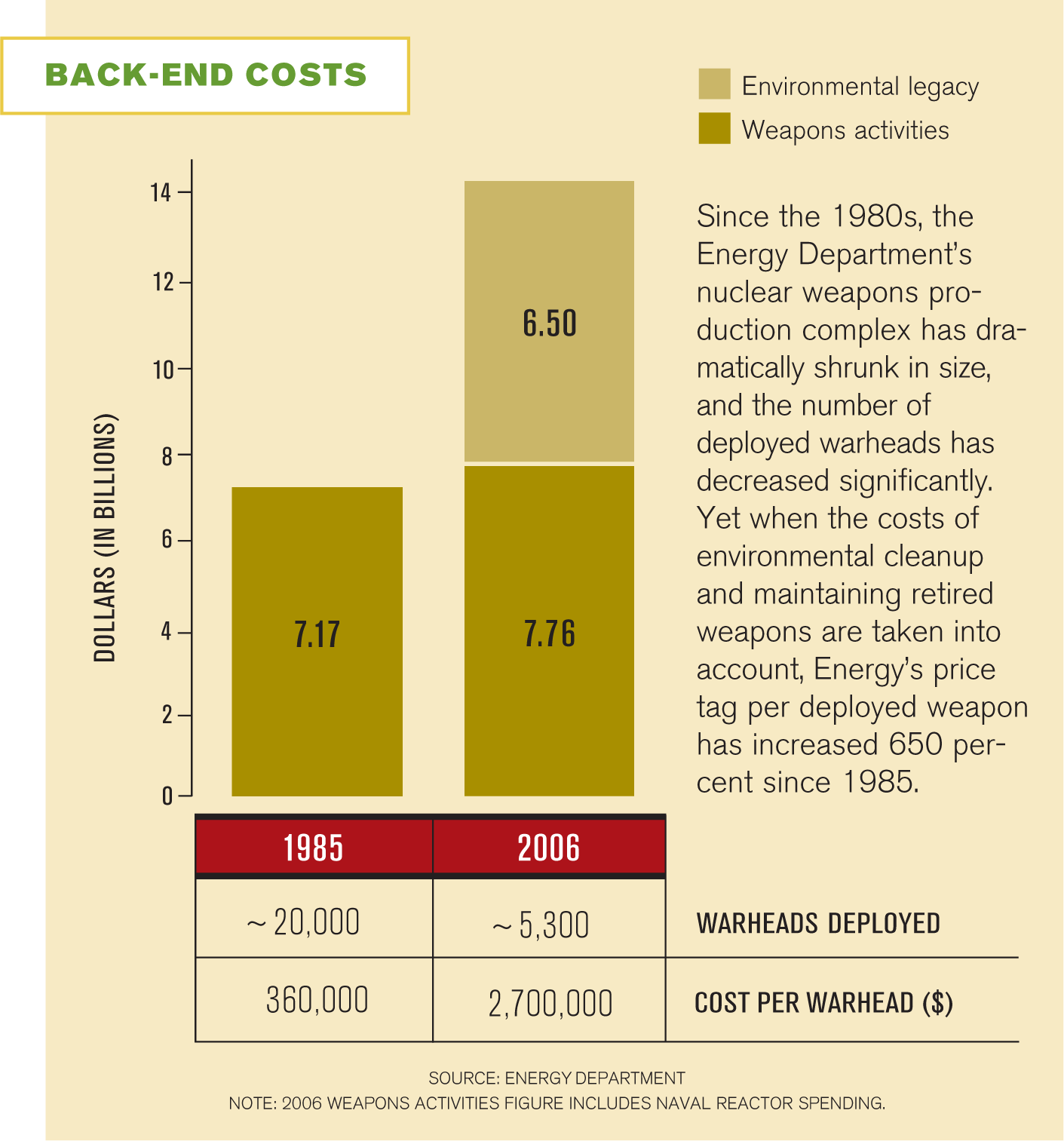
With far less flourish, Energy also announced that warhead dismantlement would grind to a halt after it completed work on several hundred weapons slated for dismantlement under START I. Its new priority would be to reconstitute the weapons production and testing complex, and to build new nuclear arms as the 2002 Nuclear Posture Review recommended. Members of Congress remain unconvinced of the need for new nuclear weapon development and have forced Energy to agree to dismantle an additional 4,000 weapons. Their resistance comes as the cost to maintain Energy's active nuclear arsenal (factoring in maintaining excess warheads and cleanup) has increased by 650 percent since 1985–when nearly four times as many nuclear weapons were deployed (see “Back-End Costs,” p. 18).
How does the Energy Department plan on paying for its weapons program? The single largest source of funds comes from its 2002 decision to curtail by more than 60 percent the geological disposal of canisters of defense high-level waste, the by-products of the chemical separation of spent reactor fuel. In 2003, the Government Accountability Office estimated that it would cost more than $100 billion to process and dispose of this high-level waste–making this Energy's single most expensive cleanup activity. About 80 percent of this total cost will be spent on processing waste into radioactive glass logs for geological disposal. By reducing the amount of waste it plans on sending to the proposed Yucca Mountain waste repository, Energy can free up tens of billions of dollars.
The Energy cleanup program is based on the “polluter pays” policy, and funding for cleanup activities is drawn from the same U.S. Treasury account as funding for nuclear weapons activities. Since 1990, Energy has spent more than $60 billion on cleanup, and the estimated total life-cycle cost over 70 years is $265 billion. Under the accelerated cleanup program, Energy estimates the total cost will drop to $145 billion. (Energy is not known for consistency. In its 2006 budget justification for the environmental management program, Energy boasts of reducing the program's life-cycle costs by more than $50 billion. The original cost savings estimate of $29 billion has disappeared.)
At the Hanford Site, where more than two-thirds of Energy's high-level wastes are stored, it could cost as much as $57 billion to process and dispose of all of the wastes accumulated from decades of plutonium production. High-level wastes also await cleanup at South Carolina's Savannah River Site, the Idaho National Laboratory, New York's West Valley Site, and Tennessee's Oak Ridge Site.
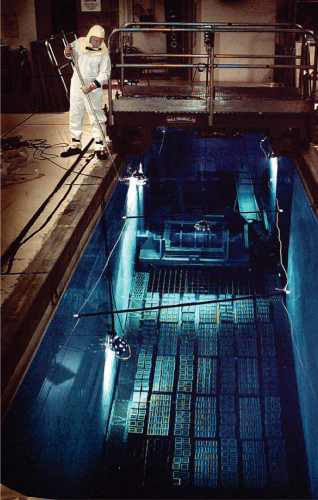
Residual effects: Brookhaven National Laboratory's leaky spent fuel pool before its 1997 draining.
To save money, Energy intends to dispose of approximately 90 percent of Hanford's high-level wastes onsite and to process the remainder into glass for geological disposal. In the process, it will permanently close 177 large underground waste tanks and related infrastructure. In order to process the high-level waste, Energy is building a costly and complex new waste-treatment facility at Hanford. Construction of the facility has been delayed as Energy attempts to address several safety concerns at the site: the risk of seismic activity, the inherent generation of hydrogen by the wastes in the plant's pipes, and fire protection.
BACK-END COSTS
The proposed budget cutbacks haven't helped either. Among the cuts that the Oregon and Washington congressional delegation pushed to restore is $64 million for the continued construction of the treatment plant. Ninety million dollars of the total proposed Hanford cuts would come from the program to clean up the site's single-shell waste tanks. (As of mid-May, the House Armed Services Subcommittee had agreed to restore $122 million to the Hanford budget, including funding for the treatment plant and the tank cleanup.)
Energy officials have said that some cuts can be attributed to progress made on the cleanup. But for others, that progress has not been fast enough. Currently, some 100 million gallons of waste are stored in aging underground tanks at Hanford, Savannah River, and Idaho National Laboratory. More than a third of Hanford's tanks, many of which are larger than the Washington State capitol dome, have leaked into the surrounding ground and ground-water. At Savannah River, Energy's only large-scale high-level waste processing facility has put in canisters less than 10 percent of the radioactivity that Energy had planned to place in them. With far less radioactive waste going into far fewer canisters scheduled for geological disposal, Energy has adopted a new strategy to deal with the excess waste.
After a bitter and contentious battle last year, Congress authorized Energy to redefine as much as 90 percent of its high-level wastes as “incidental,” allowing for their permanent, shallow burial onsite at the Savannah River Site and Idaho National Laboratory. Hanford was excluded from the law, after vigorous protests by Washington's governor and U.S. Senate delegation.
Washington State had good reason to oppose this provision. Under the terms of Hanford's accelerated cleanup plan, Energy will dispose of the contents of at least 62 tanks on-site, next to the last free-flowing stretch of the Columbia River. Energy also plans on dumping more than six times the amount of toxic, long-lived transuranic wastes that Nuclear Regulatory Commission officials provisionally agreed to in 1997.
Meanwhile, the move to clean up sites over shorter periods of time has led to less thorough cleanups. Take for example, Energy's accelerated cleanup initiative at Brookhaven National Laboratory (BNL) on Long Island. At BNL, three defunct and heavily contaminated reactors sit in a densely populated area and threaten to leak into Long Island's primary freshwater aquifer. The reactors have amounts of radioactivity comparable to some of the high-level radioactive waste tanks at Hanford. In 2003, Energy decided to decommission BNL's most contaminated reactor, yet under its cleanup standards, the amount of residual contamination, including plutonium, is thousands of times higher than Environmental Protection Agency recommendations.
To combat the potential for Energy to leave local communities with major long-term contamination, states are fighting back. Washington State, New Mexico, Kentucky, and the Yakama Indian Nation have sued Energy to require stricter compliance with environmental cleanup laws and are pressuring their congressional delegations to lend their support. The sooner the better. The most daunting and dangerous cleanup challenges left over from nearly a half century of weapons production are just beginning.