




Abstract
The first U.S. national intelligence director must set aside spin and learn to navigate a perilous path.
John Negroponte will face some significant obstacles as the nation's first director of national intelligence (DNI), an important job strewn with pitfalls. Negroponte, however, is familiar with booby traps, both figurative and literal; it was on his watch as ambassador to Iraq that improvised explosive devices made the road between the Baghdad airport and his embassy impassable, forcing him to hop on a helicopter to get to his plane. What the DNI may soon discover is that the booby traps lurking within the U.S. intelligence community dwarf those he faced in Iraq.
One pitfall that Negroponte keeps stepping into harks back to his days as U.S. ambassador to Honduras, from late 1981 through 1986. Known then as “the Proconsul” because of his imperious efforts to implement the Reagan administration's anti-Sandinista policy (in which Honduras served as a base for CIA-backed rebels), Negro-ponte turned a blind eye to Honduran human rights abuses. During the Proconsul's reign, embassy reports were doctored to ensure that Honduras met congressional conditions for foreign aid and to make the country look better in annual State Department human rights reports. Notices of human rights violations had to be double- and triple-checked before Negroponte let them be sent to Washington. Many of the violations involved torture. (During Negroponte's time in Honduras the CIA formally prohibited the approval of or participation in torture and instructed officers to try to dissuade torturers. One wonders what became of those orders.)
A 1982 Honduran military operation–in which an American priest, among others, was executed on the orders of Gen. Gustavo Alvarez Martinez, the country's military strongman–was made possible by U.S.-provided air support that Negroponte denied having furnished. The next year, an intelligence report revealing that General Alvarez had given the orders never made it out of Negro-ponte's embassy. Negroponte's defenders say he was under tremendous pressure from the Reagan White House. But that does not excuse his actions, and any evidence of his positive interventions in Honduras, by contrast, is noticeably weak.
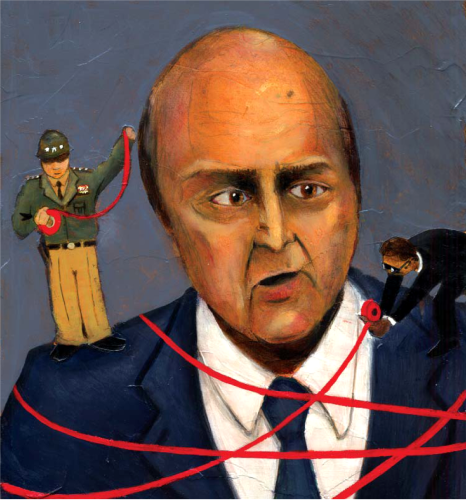
This Honduran history has a clear parallel in today's challenges for the incoming director of national intelligence. By law the DNI is responsible for producing accurate intelligence estimates to guide policy. The nation is just coming off the buildup to the Iraq War, in which intelligence estimates were manipulated for political ends. The machinery that created these estimates will be part of the DNI's office. Apart from its implications about his attitude on human rights, Negroponte's time in Honduras shows that the new DNI is willing to play the kind of games with information that enabled Iraq.
U.S. intelligence on Iran and North Korea is woefully inadequate, owing to the familiar dearth of human on-the-ground sources. The National Intelligence Estimate (NIE) on Iran, last cast in 2001, is under revision at the time of this writing, and CIA Director Porter Goss's recent Senate testimony suggests a North Korea NIE is in the works as well. But the situation is susceptible to the same kind of intelligence spin that Saddam Hussein's “nuclear weapons” received before the Iraq War. As DNI, it is urgent that Negroponte rise quickly above this political approach. Because he has no previous intelligence experience, there is reason to doubt he can do this–a sizable pitfall.
Right now, Negroponte is a field marshal with no army. This may free him to manage, but it forces him to butt heads with the many agency chiefs he is supposed to command.
The DNI is responsible for a CIA that has accrued an unenviable list of shady practices involving holding, relocating (off the books), and interrogating prisoners, or (if those practices are too politically sticky) sending them to other nations with dependably harsh security services. Moreover, Goss is determined to make his agency more aggressive; Negroponte's record suggests he may be like-minded.
Here lies another booby trap that Negroponte will find difficult to sidestep: The simmering controversy over the CIA's treatment of prisoners. The CIA inspector general is investigating half a dozen torture cases, including one that involves a Canadian and another that involves an Egyptian, which could spark an international scandal. In North Carolina, a CIA contract officer was recently brought to trial in the first legal test of the agency's right to torture. The defendant has resorted to the Nuremberg defense: He claims simply to have followed a “higher authority”–the president.
This is a lose-lose situation for the CIA. If the court convicts, the agency will appear callous to the rest of the world; if it acquits, the Bush White House will have another score to settle with the CIA. It would take only a few torture cases to discredit the “bad apple” excuse that has been dished out to explain away torture cases so far. Thanks to his experience in Honduras, DNI Negroponte has little credibility on torture issues–an unfortunate situation, because as Abu Ghraib demonstrates, America could easily lose many of the world's hearts and minds.
More of Negroponte's character can be discerned from his time in Vietnam. As a young State Department field officer, Negroponte at first believed that the U.S. effort there was a waste, but eventually he came to feel that the United States had a moral obligation to Saigon. When Henry Kissinger negotiated a truce in 1972 that Ne-groponte felt was disadvantageous to Saigon, he told Kissinger off. As a result, Negroponte was banished to a subordinate embassy position in Ecuador.
There are at least two ways to read this episode. If Negroponte still believed in the strength of Saigon's military position in 1972, it says little for his ability as the DNI to apply the “reality test” to intelligence. But it also shows that he proved willing to tell truth to power (at least, his perceived truth). That's a good trait in a DNI, unless he were fiercely defending bad intelligence–another booby trap.
We are in a particularly delicate moment in the evolution of the U.S. intelligence community. Donald Rumsfeld's Pentagon is busting out in all directions and has made several moves that encroach on traditional CIA roles and missions. The FBI, despite its chronic inability to put its own house in order, has done the same. Both agencies are biting into the foreign intelligence role. Morale at the CIA has sunk so low that in early March President George W. Bush made a trip out to Langley to reassure the weary spooks. The job of the DNI requires a diplomatic touch, particularly since the law that created the position provides precious few tools to work with, especially regarding the Pentagon. The imperious proconsular approach will not work–one more pitfall to be wary of.
Then there's the CIA, presenting a thicket of booby traps. Under orders to double its cadre of spies, the CIA's entire training and support network will have to be revamped–without slackening the pace of fieldwork, in the middle of an intense (and intelligence-intensive) counterinsurgency operation in Iraq and a multifront war on terrorism. Goss has already shown his management skills are limited. He has ignited something of an internal war at Langley, complicating the agency's expansion.
Negroponte will have to serve as the safety valve between rank-and-file CIA officers and their director. At the same time, Negroponte will have to referee between the CIA and the other agencies that want its turf, while pushing them to help the CIA by handing over personnel with relevant language and other skills. On top of this, Negroponte has to function in a legal environment in which he actually has no command authority over Rumsfeld's intelligence juggernaut. Moreover, he's got to take over key elements of the CIA, including the National Intelligence Council (which crafts the estimates), the staff that produces the President's Daily Brief (the top secret report produced for the president's eyes only), and the quasi-independent (but CIA-dominated) Terrorist Threat Integration Center–all at the same time. Those moves will inevitably threaten the CIA's sense of corporate integrity and raise questions about Negroponte's ability to serve as impartial arbiter.
Amid this welter of headaches, the DNI must establish himself as an institutional player. Right now Negroponte is a field marshal with no army. This may free him to manage, but it forces him to butt heads with the many agency chiefs he is supposed to command. Negroponte may feel the need for larger resources within his own office, and the law permits him to build capacity by establishing fusion centers such as the National Counter-terrorism Center, which was created by statute. Another pitfall: Such centers can be formed only by duplicating or absorbing existing staffs from the agencies, and each move promises to threaten morale at the agency affected.
Meanwhile, the intelligence technical community is in disarray over questions about the next-generation spy satellites, which are grossly over budget and way behind schedule. [See “Satellite in the Shadows,” p. 26.] The money for those satellites pressures the overall National Foreign Intelligence Program and sets up a major dispute over budgets, given the mandate to expand the clandestine service. Even the Bush administration cannot continue indefinitely to throw cash at intelligence. But the satellite program belongs to Rumsfeld. When it comes to the Pentagon, the DNI's role is essentially advisory. The law gives Negroponte authority to oversee the expenditure of funds, but that power may not survive the first clash over money for technical intelligence.
Make no mistake: Negroponte is a tough character, patient and resourceful. After all, this is a guy who met his wife at a dinner party in Saigon, bent her ear during a flight to Paris the next day, then waited eight years to reconnect and marry her. Negroponte survived Kissinger and banishment to Ecuador, and he might do well as DNI. But there may be a reason why half a dozen candidates refused the same appointment. There are more booby traps in this job than there are along the road to the Baghdad airport, and John Negroponte lasted only eight months in Iraq. Stay tuned.