




Abstract
With sensors in the ground, water, and air, the global system to detect nuclear tests already exceeds designers' expectations. Its potential now depends on political will.
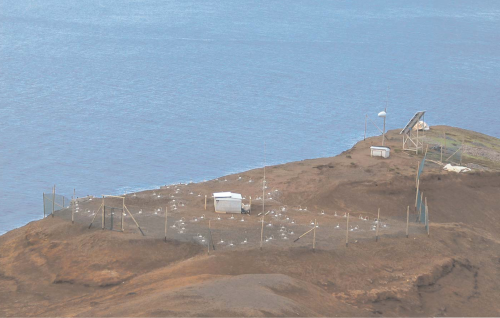
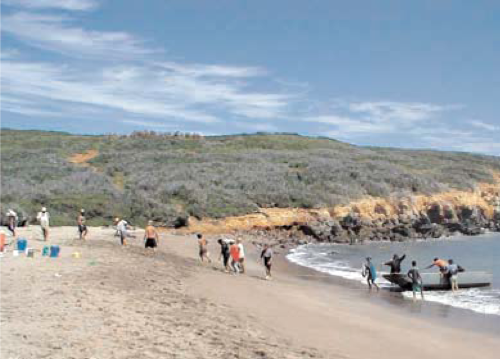
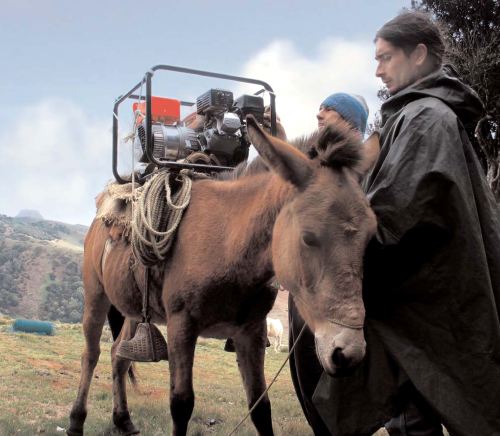
IMS staff installed an infrasound station (one array, far left, and a generator, above) on remote Robinson Crusoe Island, Chile, in April 2004, and a hydroacoustic station on Socorro Island, Mexico (below left), in May.
Wolfgang Hoffmann, executive secretary of the nascent organization that will verify compliance with the nuclear test ban, recently declared that the agency's Vienna-based monitoring system has achieved global coverage. 1 The unfinished system already exceeds its designers' expectations and will be even more powerful when complete.
Compliance with the 1996 Comprehensive Test Ban Treaty (CTBT), which bans nuclear tests in all environments, will be verified by a regime consisting of four elements: an International Monitoring System (IMS), consultation and clarification procedures, on-site inspections, and confidence-building measures. 2 The keystone is the monitoring system, which is designed to detect nuclear tests conducted anywhere on earth–in the atmosphere, underwater, on the surface, and underground. In terms of its global reach and interconnectedness, the IMS is the most ambitious remote monitoring system ever planned for a multilateral arms control agreement. It will eventually comprise 321 monitoring stations and 16 radionuclide laboratories located in some 90 countries. This network will transmit vast amounts of data via a dedicated global communications infrastructure to the International Data Center (IDC) in Vienna for compilation and analysis.
Developing the system is the task mainly of the Preparatory Commission (PrepCom) for the Comprehensive Test Ban Treaty Organization (CTBTO). When the test ban treaty enters into force, it will be the CTBTO's duty to operate and further develop the verification network.
Much progress has been made constructing the network: about half the verification system is installed, the data center and the global communications infrastructure are fully functional, and the Provisional Technical Secretariat, which does most of the work on the system, continues to gain experience in running the different elements of the test ban verification network. About 85 stations now contribute data to the IDC. The secretariat estimates that the system will be nearly 85 percent complete by 2006 and says it could be finished by 2008. The first system-wide performance test will take place sometime from April to June 2005.
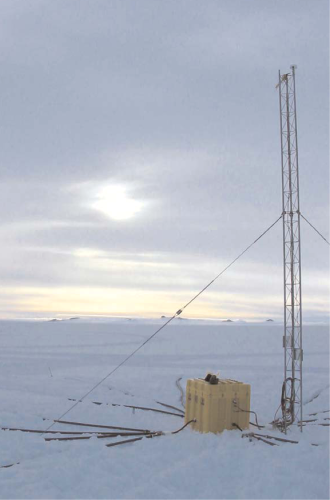
Windless Bight, Antarctica: Cold ears—an infrasound array rebuilt for the CTBTO.
The tools to verify
Establishing the international monitoring system, with its stations scattered around the globe, many in remote and inaccessible locations, has posed management and engineering challenges unprecedented in arms control verification. Some stations already existed when the IMS was first planned, but most have had to be built from scratch or substantially upgraded. The monitoring system uses four technologies to detect possible nuclear tests: seismic, hydroacoustic, infrasound, and radionuclide.
The global communications infrastructure (GCI) enables the International Data Center to receive most information from the monitoring network in near-real time. A monitoring station transmits its signal to one of three geosynchronous satellites, which act as communications hubs. The signal is then relayed via other satellites or transmitted directly to the data center. The system can carry up to 11.4 gigabytes of data per day. The quality and availability of data will improve as more stations are completed and as the satellite system expands.
The IDC was inaugurated in January 1998 and began operations that May. The center receives, collects, processes, analyses, reports on, and archives data from the monitoring system. Data is initially processed automatically, and the first reports are available within two hours. The center also produces, archives, and distributes raw and processed data to treaty signatories via the communications uplink. One important product is the “Revised Event Bulletin,” which, if compiled from seismic, hydroacoustic, and infrasound data, can be available within four to six days after an event. Radionuclide data may take up to two weeks to compile because samples must be physically collected at the monitoring site and analyzed at a radionuclide lab. The secretariat is planning to automate this process using new on-site technologies.
The IDC has been providing monitoring system data and reports to treaty parties on a trial basis since February 2000 through secure-access accounts. The test ban treaty gives signatories–not the CTBTO–the responsibility of drawing conclusions about IMS data regarding possible treaty violations; the data center's reports are unbiased as to the nature of any event.
International Monitoring System and auxiliary stations
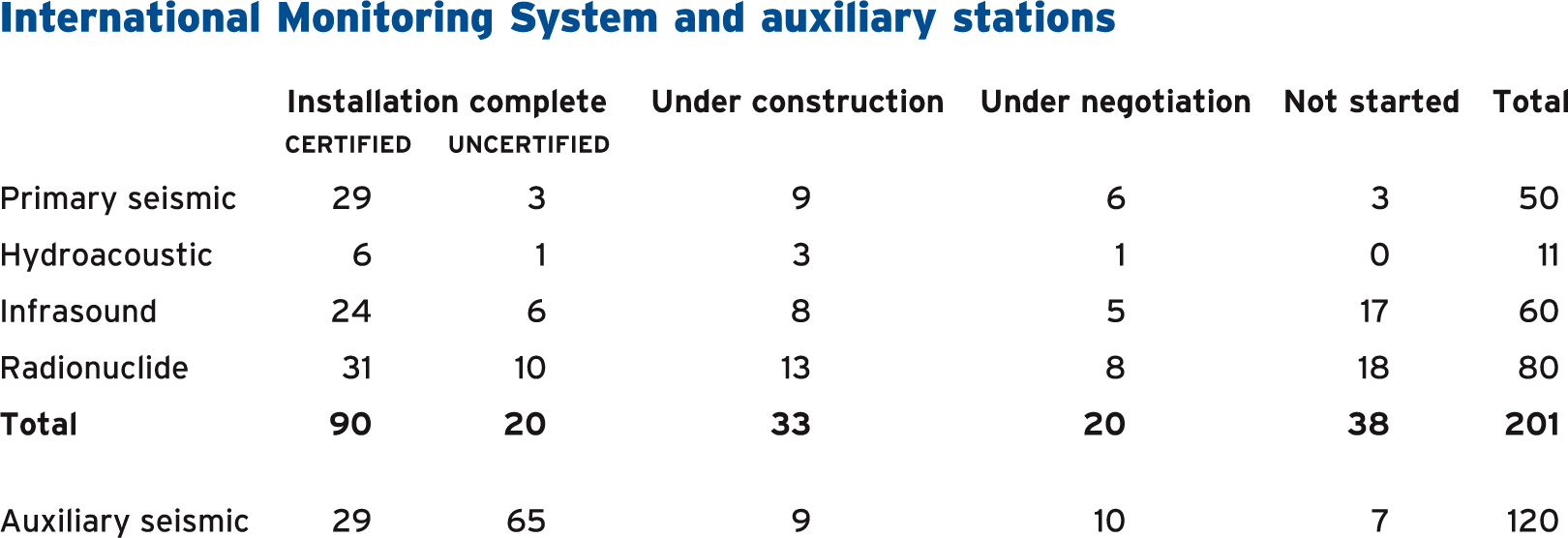
SOURCE: PROVISIONALTECHNICALSECRETARIAT, CTBTO. DATA AS OF DECEMBER 31, 2004.
Getting better all the time
It is difficult to precisely pinpoint the effectiveness of the monitoring system in detecting and identifying illicit nuclear tests–not only is the system constantly improving, but nuclear tests are no longer being conducted. It is clear that the system's capabilities already exceed the estimates its designers, the Group of Scientific Experts, made during treaty negotiations in the early 1990s. This is due to benefits derived from synergies between the different types of IMS data, advances in monitoring and communications technologies, and the growing expertise that comes from testing and developing the system. As far back as 2001, the Independent Commission on the Verifiability of the CTBT concluded that the treaty could be verified “with high probability.” 3 Subsequent reports have broadly reiterated this conclusion. 4
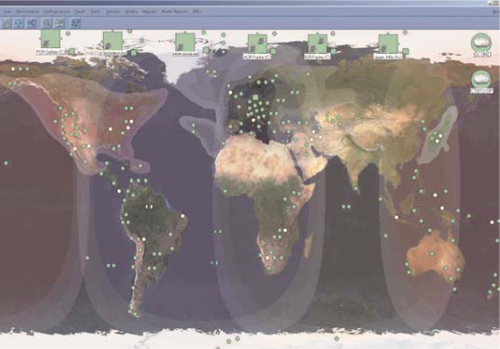
Global sentinels: Screengrab of the near real-time world map used by GCI network operators.
Even in its unfinished state, the probability is very high that the monitoring system would detect a 1-kiloton nuclear explosion by seismic means alone. (It's worth noting that militarily significant tests are likely to have yields of 5-10 kilotons.) Generally, the monitoring system can detect explosions as low as 10-25 tons. How well the system can detect activities depends on the type of test and where it is detonated. Underground explosions in hard rock can be reliably detected and identified down to a yield of 100 tons. At some locations, such as the former Soviet test site at Novaya Zemlya, tests are detectable down to 10 tons or less. An atmospheric nuclear explosion with a yield greater than half a kiloton would be detected and identified with high confidence in the northern hemisphere, as would those above 1 kiloton worldwide–the radioactive fallout alone would make an atmospheric test easy to detect. Underwater oceanic nuclear explosions are likely to be reliably detected and identified at yields down to 1 ton or even less–some scientists estimate that monitoring stations would pick up subsurface explosions with yields as low as 60 kilograms, anywhere in the world.
The official treaty regime will be supplemented by a global network of scientific seismic stations that are not part of the international monitoring system but that will add substantial capability to test ban verification. Other supplemental capabilities include the “national technical means” of individual countries, in particular those of the United States, which runs its own network of seismometers, radionuclide detectors, and satellite-based sensors.
What can't it do?
With the capability to distinguish between the signatures of a nuclear test and myriad other events, the International Monitoring System (IMS) is a remarkably sensitive and versatile tool.
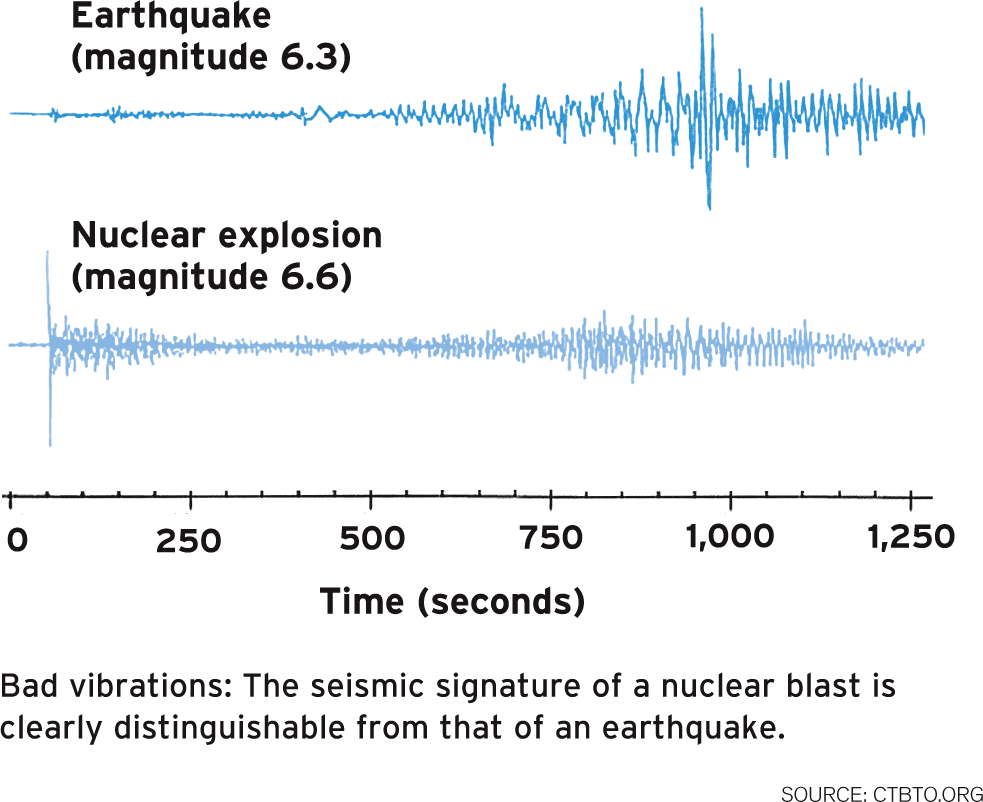
The partial network of monitoring stations, which use seismic, hydroacoustic, infrasound, and radionuclide sensors, detected the 2003 breakup of the space shuttle Columbia, as well as the still-mysterious incidents that led to the sinking of the Kursk, a Russian submarine. The stations can detect whale sounds, noise generated by Antarctica's shifting ice, volcanic eruptions, earthquakes, and other seismic activity.
In total, from February 2000 to July 2004, the Comprehensive Test Ban Treaty Organization (CTBTO)'s International Data Center notified nations subscribing to its service of 100,000 events recorded by the monitoring system. None of these events was a nuclear test.
Seventy-eight IMS stations registered the enormous December 26, 2004 earthquake off the Indonesian coast that launched the devastating tsunami. Although the data center registered and reported the earthquake, it had no immediate way to predict the subsequent tsunami. “Our mission is not to detect earthquakes and tsunamis, but we want to adapt our system so that it can also function to this end,” Bernhard Wrabetz, a CTBTO spokesman, told Agence France Presse.
That would probably require wrangling with some test ban treaty parties. Some signatories, most notably China, have said they want to restrict the release of data gathered by the monitoring system. Even if the organization overcomes the data-sharing hurdle, the monitoring system would have to be significantly modified or integrated with other networks before it could provide early warnings for tsunamis.
Many scenarios about how a country could get away with a secret nuclear test have been debunked over the years and today have little credibility. The most persistent fantasy has been “decoupling”–conducting a nuclear test in an underground cavity to muffle the test's seismic signature. This is not easy. The cavity would need to be sealed (to prevent radionuclides from escaping) and large enough to dampen the seismic waves without overstressing the rock. According to the American Geological Institute, a 5-kiloton explosion, successfully decoupled, would require a salt cavity 43 meters in diameter–roughly the size of the Statue of Liberty. 5 Decoupling also requires specialized knowledge, equipment, and personnel. Because successful decoupling requires a precise yield estimate, only nations with significant testing experience are likely to accomplish it.
What lies ahead
Without a change in U.S. policy, it is unlikely that the nuclear test ban treaty will enter into force anytime soon. [See “CTBT: Forecasting the Future,” p. 50.] As a result, the treaty faces the unusual prospect of having an almost fully fledged verification system but no legally binding aspect that would permit treaty compliance to be officially verified. Because Article IV of the treaty provides that at entry into force, “The verification regime shall be capable of meeting [the treaty's] verification requirements,” there has been a natural inclination, both on the part of the PrepCom and the Provisional Technical Secretariat, toward completing the verification system as soon as possible.
The CTBTO's budget has, as a result, grown from $27.7 million in 1997 to $88.5 million in 2003. The steep rise reflected the rapid growth of the new organization and the high establishment costs of a global monitoring system. The planned budget for 2005 is about $51.5 million and 42.5 million euros, totaling about $107 million (due to the dollar's decline, the PrepCom has adopted a split budget, making precise comparisons with previous years difficult). 6
The CTBTO's collection rate of assessments from member states is unusually high for an international organization, with about 90-97 percent of the budget collected annually. But in light of the protracted delay in achieving the treaty's entry into force, some states are now beginning to question whether work should continue at the same pace as in the past.
The regime provides constantly improving verifiability, and the costs of running the monitoring system are likely to decrease after it is fully operational. The system is also proving capable of providing valuable scientific and civil side benefits. For instance, had the information that the data center received on the December 26, 2004 earthquake been connected to an early warning system, it may have helped save thousands of lives that were lost in the resulting tsunami.
Some observers have called for the CTBT's provisional entry into force, both for its own sake and to allow the verification system to become fully functional and usable. From a verification perspective, it would be better to use the monitoring system in an official, legally binding way. But provisional entry into force, even if politically and legally achievable, would have the disadvantage of relieving the pressure on states that have not signed and/or ratified.
Moreover, a formal move toward provisional implementation is really unnecessary–significant elements of the regime are already being implemented. The CTBTO is practically in place, the monitoring system is largely functional, and states are already receiving monitoring data. States can use such information, unilaterally or collectively, to determine whether a nuclear test has taken place. As long as states continue to fund the construction and provisional operation of the verification system, it will be online and providing data.
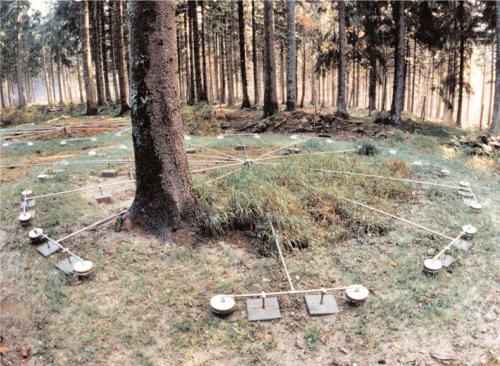
Bavarian Forest, Germany: An IMS infrasound setup is the real watcher in the woods.
Until the treaty enters into force, neither the formal consultation, clarification, and compliance mechanisms nor the on-site inspection provisions of the verification regime can be used. Yet even without entry into force, if a state believes a nuclear test has been carried out, it could initiate consultations with another state or request a meeting of the PrepCom. The PrepCom could decide to become involved in a compliance issue if enough treaty signatories pushed for it. If that did not work, a state could apprise the U.N. Security Council of the matter.
So strong is the taboo against nuclear testing that the test ban treaty's entry into force, while highly desirable, may not be absolutely necessary for the verification and compliance system to function virtually as planned. In the meantime, work on the International Monitoring System should continue apace.
Footnotes
1.
David Ruppe, “Earth Fully Covered by Nuclear Test Surveillance System, Official Says,” Global Security Newswire, September 17, 2004.
2.
Primary sources for this article were: Ben Mines, “The Comprehensive Nuclear Test Ban Treaty: Virtually Verifiable Now,” Verification Research, Training and Information Centre (VERTIC), Brief no. 3, 2004; Ola Dahlman, Jenifer Mackby, Svein Mykkeltveit, and Hein Haak, “Cheaters Beware,” Bulletin of the Atomic Scientists, January/February 2002, pp. 28-35; Oliver Meier, “CTBT Verification: Technical Progress Versus Political Stasis,” Verification Yearbook 2002, (London: VERTIC, 2002); David Hafemeister, “Effective CTBT Verification: The Evidence Accumulates,” Verification Yearbook 2004, (London: VERTIC, 2004).
3.
Independent Commission on the Verifiability of the CTBT: Final Report, (London: VERTIC, 2002).
4.
National Academy of Sciences, Technical Issues Related to the Comprehensive Nuclear Test Ban Treaty, (Washington, D.C.: National Academy Press, 2002); Gen. John Shalikashvili (ret.), “Findings and Recommendations Concerning the Nuclear Test Ban Treaty,” State Department, January 4, 2001.
5.
Verification of Nuclear Testing Treaties, Chapter VI (Washington, D.C.: Office of Technology Assessment, 1988), p. 100.
6.
Based on the January 10, 2005 exchange rate ($1 equals 0.77 euros).