




Abstract
The nuclear test ban treaty can't enter into force until eleven “holdout” nations both sign and ratify it–including the United States. Many seem to be hiding behind U.S. inaction.
Although the Comprehensive Nuclear Test Ban Treaty (CTBT) was designed to ban the “bang,” not the bomb, it was widely expected to contribute both to nuclear disarmament and nonproliferation. Yet today, politicians and experts, especially in the United States, continue to debate the usefulness of a treaty focusing exclusively on nuclear testing. After all, critics say, the CTBT does not prohibit the development or acquisition of nuclear weapons by non-nuclear weapon states, nor does it bar the expansion of arsenals or the use of nuclear weapons in conflict.
The United States, which pushed the international community toward a consensus during negotiations, has failed so far to ratify the agreement. That, and the continuing reluctance of other key countries to sign on, has delayed, if not derailed, the treaty's entry into force. It is important to understand what this means for efforts to prevent further proliferation of nuclear weapons.
Worse than hoped, better than expected
India refused to join the consensus on the treaty's text–and refused again, along with North Korea, to sign the treaty in 1996. U.S. decisions and actions since 1999 have further set back prospects for the CTBT's entry into force. Actions by North Korea, and more recently by Iran, also dampen nonproliferation efforts.
On October 13, 1999, the U.S. Senate rejected the treaty. The political reasons for the treaty's defeat have been detailed elsewhere. 1 But after failing a few months earlier to impeach the president, congressional opponents saw the vote on the treaty as an opportunity to hand Bill Clinton a political defeat. Meanwhile, White House and Senate Democrats misplayed their hands; with overconfidence, they walked into a trap set by Senate Republicans to defeat the treaty. 2 Moreover, the Clinton administration failed to make a convincing case that the United States would be better off with the treaty than without it.
September 1999: Holding pictures of North Carolina Republican Jesse Helms, protestors demonstrate against the senator's refusal to hold hearings on the CTBT.

September 24, 1996: President Bill Clinton signs the CTBT at the United Nations in New York City.

The most disappointing aspect of this episode was that the treaty was not given the substantive vetting that an international agreement should receive from the Senate. Truncated hearings only scratched the surface of issues that should have been explored in depth. The president's political enemies, along with those opposed to the treaty, used concerns about verification and nuclear stockpile issues to garner the votes against ratification.
When the Republican Party regained the White House in 2000, many expected that the new administration's policy review would not favor the treaty. However, the results of interagency debates and policy considerations actually led to a policy that was less negative than feared.
Although the Bush administration decided not to seek ratification, it also decided to remain engaged in most Preparatory Commission (Prep-Com) activities–principally building international monitoring stations. 3 It halted only U.S. support for entry-into-force or post-entry issues, such as preparing for on-site inspections. This meant that the United States continued paying more than 90 percent of its annual assessment to the Prep-Com and continued cooperating with the Provisional Technical Secretariat in the installation, operation, and maintenance of key International Monitoring System stations, particularly those in which the United States was directly involved. [See “CTBT: Watching the World,” p. 58.]
With the United States still paying most of its assessment, PrepCom participants were relieved that implementation activities would continue. Many countries expressed the hope that U.S. policy eventually would revert to its pre-Bush administration, pro-CTBT position.
At the same time, some delegations were elated at the change in U.S. policy. One Israeli representative, for example, declared that the United States had let Israel “off the hook” (presumably meaning that it would not have to face the prospect of intrusive on-site inspections by its regional enemies).
Chinese delegates seemed relieved that China would not any time soon be subject to international monitoring or inspections, and the Chinese made it clear in subsequent statements that they would make it difficult for the United States to benefit from the International Monitoring System before ratifying the treaty.
Various other delegations saw an opportunity to save money and stepped up their opposition to the proposed annual budget increases required to build and maintain the monitoring stations and the International Data Center. They argued that the pace of implementation should slow down to match the reduced prospects for the treaty's entry into force.
For the Provisional Technical Secretariat, the impact has been more complicated. The now-remote prospects for entry into force have made it hard to argue for increased funding to meet the PrepCom's ambitious goals of completing the International Monitoring System (321 stations) and the International Data Center by about 2007. 4 There was fear also that a slowdown would weaken the will of the countries that had already signed the treaty and make it harder for the international experts serving on the secretariat to remain committed and engaged.
Yet the PrepCom has maintained reasonable momentum, and additional countries have signed and ratified the treaty. Since the change in U.S. policy in summer 2001, 12 countries have signed (increasing the total number of signatories to 174), and 35 have ratified the treaty (increasing that total to 120). 5 Meanwhile, 33 of the 44 countries required by Article XIV to sign and ratify the treaty have done so. Three have not yet signed (India, Pakistan, and North Korea), and eight have signed but not yet ratified (China, Colombia, Egypt, Indonesia, Iran, Israel, the United States, and Vietnam).
Holdouts
U.S. ratification is essential. Without it, the treaty cannot enter into force. Moreover, the longer the United States refuses to move toward ratification, the more the implementation effort is likely to suffer and eventually stagnate. However, if the United States were to ratify the treaty, that in itself would not guarantee its entry into force. Other countries whose signatures and ratifications are also essential do not appear to be enthusiastic and are most likely hiding behind current U.S. policy.
India shows no inclination to sign the CTBT, although many had hoped it would do so after its nuclear tests in 1998. India perceives China as its main potential strategic threat and it will not be open to a permanent test ban until China is firmly committed. And even if the United States and then China were to ratify, there is still no guarantee that India would follow, at least not immediately. India has for decades rebuffed the international community and ignored calls to comply with the Nuclear Non-Proliferation Treaty (NPT).
The obstructionists
Forty-four nations are required to sign and ratify the test ban treaty in order for it to enter into force. So far, 33 have. The 11 holdouts:
India
Pakistan
North Korea
China
Colombia
Egypt
Indonesia
Iran
Israel
United States
Vietnam
And then there is North Korea, which at the moment appears to be the most difficult holdout. Pyongyang's perception of its security appears to be pegged directly to U.S. military power in the region, and many suspect that North Korea's nuclear weapons program is viewed internally as its primary defense against the United States. How the North Korean situation plays out is beyond the scope of this analysis, but it is remotely possible that Pyongyang will eventually follow a disarmament path similar to Libya's. If there is a formula that can bring North Korea into the community of nations and give it a sufficient sense of security, then perhaps this obstacle to the CTBT's entry into force might one day disappear.
Squaring Iran's suspected nuclear weapons program activities with its legitimate nuclear activities poses an increasingly difficult problem for the international community. Iran is a CTBT signatory and actively participates in its implementation activities. However, this could change quickly if Tehran concluded that being a self-declared nuclear weapon state was essential to national security. Learning a lesson from India and Pakistan, Iran might make such a declaration credible through nuclear testing, once it is able to do so. At a minimum, its ratification of the CTBT is likely contingent upon that of the United States and Israel, if not that of India and Pakistan.
On-site inspection provisions have always been Israel's greatest concern. Israel was one of the original signatories to the CTBT, but it has made ratification dependent on the successful (as defined by Tel Aviv) negotiation of the “Operational Manual,” which will govern the conduct of on-site inspections. There is little prospect that Israel will ratify soon–inspections cannot take place before the treaty enters into force, and U.S. participation in the development of the manual is essential. Following its change in policy, the United States has not participated for more than three years.
Finally, China's commitment to the CTBT has been reluctant at best. During the negotiations, China chafed at being seen in the same light as Russia and the United States–a declared nuclear weapon state having to fight off calls by the non-nuclear weapon states for total disarmament.
China claims, with considerable justification, that it is the least developed of the original five nuclear weapon states–although it fails to acknowledge that it is the only one continuing to build up its strategic nuclear arsenal. 6 Because the total number of its nuclear test explosions is considerably lower than that of the other nuclear weapon states, China believes it lags behind and should not bear the same responsibility for nuclear disarmament as the others. China might be happier without the CTBT, so it is not surprising that Beijing has seemed to condition its ratification on what the United States does while simultaneously blocking the systematic distribution of data from International Monitoring System stations, except for testing.
Alternative U.S. policies
Other countries may be content to let the United States bear the blame for the CTBT stalemate, yet the United States remains the catalyst that could turn around the other holdouts. Alternative future U.S. actions would have widely different outcomes:
If the United States continues its current policy toward the CTBT for at least another four years and continues to pay most of its assessment to the PrepCom, the other holdouts are likely to maintain their current positions as well, which would perpetuate the current stalemate. Other holdouts would have little or no motivation for making the first move toward signature and/or ratification. The impact on the PrepCom would be increasingly negative, as a growing number of countries would question the utility of funding a treaty that appears to have no prospect for entering into force before the end of the decade. China's refusal to allow monitoring data to flow to participating countries would prevent any significant return on the large investment in the technical verification system. And the secretariat would have an increasingly hard time attracting and retaining the high-quality international talent needed to complete the monitoring system and the data center and keep them functioning.
If the United States pulls back from the PrepCom both in terms of expertise and funding, then the situation described above would turn negative more quickly. It would likely lead to a heated debate over the PrepCom's future. Other holdouts would perceive the change in policy as an indication that the United States intends to resume testing. China and Russia, and perhaps India and Pakistan, would likely make preparations for additional nuclear explosive testing, although they might not test unless the United States did so first.
Unless it had already agreed to give up its nuclear weapons program, North Korea would likely continue to threaten further proliferation. Similarly, Iran would probably feel compelled to pursue its alleged weapons program, possibly under the cover of legitimate enrichment activities, thereby contravening its NPT commitments. It would not be entirely surprising if Iran followed North Korea's example in withdrawing from the International Atomic Energy Agency (IAEA) and the NPT. All of this would further weaken the nuclear nonproliferation regime, risking the advent of additional self-declared nuclear weapon states.
If the United States decides to resume nuclear explosive testing, however limited in duration, perhaps for development of a low-yield, earth-penetrating warhead, the impact on the international community would be dramatic. Most observers believe that this “worst-case scenario” would lead to the unraveling of the PrepCom. Some countries would halt their financial contributions, figuring that further investments would be pointless. The secretariat would scramble to maintain as many monitoring and data analysis capabilities as possible with dwindling resources and political support. But some countries, both those that have tested in the past and perhaps some that have not, would view a resumption of U.S. testing as a green light to unleash whatever nuclear weapons development and test programs their technical or political leaders deem necessary to their national security.
In any case, the impact on the nuclear nonproliferation regime, and the NPT in particular, would be devastating. Were such a policy to be announced early this year, it would have a severely negative impact on the next NPT Review Conference, which is scheduled for May. Many of the non-nuclear weapon states would cry foul in terms of the commitments of the nuclear weapon states and their promises for a permanent ban on testing made in return for the indefinite extension of the NPT in 1995. Most dramatically, additional threats to withdraw from the NPT could come from Egypt and Mexico, on principle; and possibly from Japan, South Korea, and Brazil because of a perception that the NPT no longer made a positive contribution to their national security. If so, the United States would bear the blame for threats or actual withdrawals and the resulting disintegration of the nuclear nonproliferation regime.
If, in stark contrast to the above scenario, the United States returns to its pre-Bush II policy of embracing the CTBT as a useful part of the nuclear nonproliferation regime and leading the effort on implementation, there would be renewed optimism that the CTBT would eventually enter into force. U.S. ratification would put the remaining holdouts in the crosshairs of the pro-CTBT international community, and pressure would grow on them to get on board.
Had there been a change in administration in January, that would not have made U.S. ratification a sure thing. Given the Senate's history with this treaty, gaining its approval would remain a major challenge.
Positive U.S. moves would not necessarily be reciprocated by all other holdouts. In particular, India (and, therefore, Pakistan) and North Korea might not be willing to join the parade of countries signing up for and ratifying the treaty. Iran would likely still make its ratification dependent on what Israel does. And it is not clear that the international community, even with U.S. support, could put enough pressure on these countries or offer them sufficient inducements to overcome security concerns associated with giving up testing forever. Having witnessed the flip-flop in U.S. policy as a result of changing administrations, some in the international community would be skeptical that any U.S. policy on nuclear testing could be trusted long term. And continued U.S. research on a potential new earth-penetrating nuclear warhead to attack underground facilities would foster suspicion that the United States planned to resume testing.
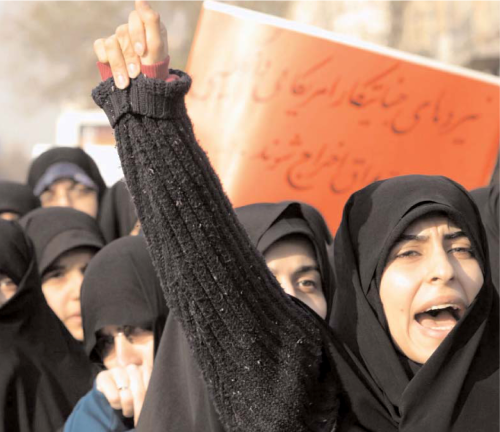
November 2004, Tehran: Iranian women show their support for Iran's nuclear program.
Alternate treaty futures
Consequently, the CTBT's prospects do not appear bright, even if the United States were to move toward ratification. Several other countries whose signatures and ratifications are required for entry into force show no sign of interest in doing so. Moreover, the PrepCom has yet to achieve consensus on a viable scheme for making effective use of the CTBT's technical monitoring capabilities in the absence of the treaty's entry into force. To some extent, the monitoring system is currently operating in a provisional mode, merely testing overall system capabilities as additional monitoring stations become operational. But this is far from the comprehensive monitoring envisioned in the treaty. And that is likely to remain the case until the holdouts make significant moves toward signature and ratification.
Even the most optimistic scenario regarding U.S. policy offers no guarantee that the treaty will ever enter into force and make the contribution to the international nuclear nonproliferation regime its authors and promoters had hoped. Given this reality, there are at least three ways that the treaty's future may unfold:
The implementation process continues to drift along until some significant event nudges the process in either a positive or negative direction. The Provisional Technical Secretariat would continue building and certifying monitoring stations, albeit at a slower pace, and the PrepCom would continue debating how and under what circumstances data from these stations may be given to treaty adherents to monitor test activity, earthquakes, and other natural phenomena. This is the most likely scenario, although it will be increasingly hard, without improved prospects for entry into force, to maintain the commitment of signatories to the treaty and motivate secretariat personnel to continue building and maintaining organizational and verification capabilities.
The implementation process stagnates due to lack of adequate funding and/or political support. Were the United States and/or other countries to decide to reduce or eliminate their PrepCom funding, the hiring and retention of key experts would become harder, and countries would begin to lose interest in the entire enterprise. Some countries and secretariat personnel would intensify efforts to conceive of a way to use monitoring data on a provisional basis. But without the legal obligations of the treaty in force, some countries (such as China and Iran) would strive to ensure that no international monitoring of testing takes place. They would likely argue that there is no requirement for any country to make itself more transparent through the treaty's International Monitoring System.
A positive turnaround in support for the CTBT infuses new life into the PrepCom and the implementation process, thereby reviving hope that entry into force is a real possibility. This is the scenario that most countries are still hoping will become reality. But it seems to be the least likely, especially given current U.S. policy toward the treaty and the attitudes of the other treaty holdouts.
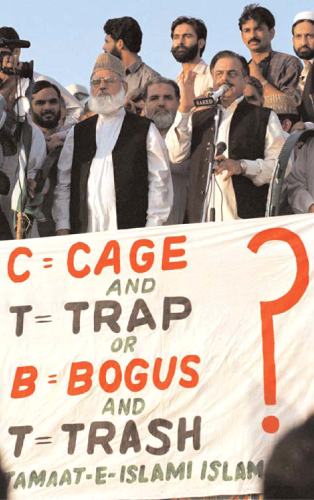
September 1998: An anti-CTBT rally in Islamabad. More than six years on, Pakistan has not signed or ratified the treaty.
Implications for the nuclear nonproliferation regime
A reinvigorated CTBT implementation process with brighter prospects for the treaty's eventual entry into force would certainly be considered by most observers a significant boost for the nuclear nonproliferation regime. It would put maximum focus on the remaining CTBT holdouts and perhaps lead to creative ways to help them feel more secure and therefore willing to take the risk of signing and ratifying the treaty. It might even improve prospects for checking the North Korean and Iranian nuclear weapons programs.
Positive movement on the CTBT would also undercut some of the non-nuclear weapon states' complaints that the nuclear weapon states, and the United States in particular, are ignoring their Article VI nuclear disarmament obligations under the NPT. Some of the more strident non-nuclear weapon states refuse to give the United States and Russia much credit for the dramatic reductions they have made in their operational strategic nuclear forces. In any case, positive movement toward entry into force would reduce the acrimony that is otherwise likely to characterize the upcoming NPT review. Finally, it might even create an atmosphere in which the Conference on Disarmament would be able to seriously consider the negotiation of a fissile material cutoff treaty, which along with the CTBT was requested by the non-nuclear weapon states in return for the indefinite extension of the NPT in 1995. 7
But one must not overstate the importance of the CTBT. The challenges to the nuclear nonproliferation regime transcend this treaty. It is the NPT, more than the CTBT, that is central to a solid international nuclear nonproliferation regime. However, as became apparent during the negotiation of the indefinite extension of the NPT, the CTBT does play a role in bolstering the non-nuclear weapon states' confidence that the nuclear weapon states will uphold their part of the NPT's “grand bargain”–to work for eventual nuclear disarmament. The non-nuclear weapon states had been calling for a comprehensive ban on nuclear testing since the negotiation of the NPT in the late 1960s. Despite its relatively minor contribution to the nuclear nonproliferation regime, the CTBT is a symbol of commitment and compliance with the NPT on the part of the nuclear weapon states. In that sense, its fate will influence the effectiveness of that regime.
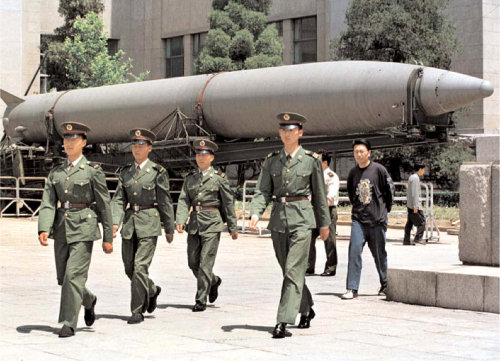
May 1999: Chinese soldiers walk past a missile on display at Beijing's Military Museum. Until the United States ratifies the CTBT, China is unlikely to do the same.
Motivations
Perhaps most important is the fact that the motivations for some countries to develop nuclear arsenals are in large measure independent of what the United States does or what happens to the CTBT. This has certainly been true for India. 8 It may also be true for Iran, which appears to be most concerned about Israel and the possibility of failing to achieve “greatness” if it does not possess its own nuclear arsenal. North Korea's actions appear to be a direct reflection of its weakness and isolation. The international community must do more to deal with the demand side of the nuclear nonproliferation equation.
The future effectiveness of the nuclear nonproliferation regime depends on multiple factors. It will take much more than the CTBT (and U.S. support for it) to ensure that the regime is effective and accepted over the long term as the international standard, both in terms of inhibiting and preventing future proliferation.
As others have persuasively argued, ultimately it will be a sense of security from perceived or actual threats that will deter proliferation efforts. 9 Most countries accept the importance of global adherence to international treaties, but these conventions are at best Band-Aids when applied to the feelings of insecurity and lack of trust resulting from regional threats and conflicts. The nuclear weapons states must do their part by continuing efforts to reduce their nuclear arsenals, including the destruction of warheads. But collective efforts also must continue in the search for bilateral and international arrangements to eliminate the anxieties that drive individual countries to acquire nuclear weapons.
From the CTBT experience it is obvious that national aspirations and policy objectives often override efforts to establish international norms. Ultimately, countries look inward and/or to their allies for security rather than to international organizations or agreements that are difficult to influence or control and are at times too slow to act. The one exception to this experience has been the negotiation of regional nuclear-weapon-free zones, which have been adopted by the countries of Latin America, Africa, Southeast Asia, and the South Pacific. These regional treaties create de facto nuclear test bans and appear to be a positive boost to the nuclear nonproliferation regime. Unfortunately, the two regions where such treaties would provide the biggest contribution–the Middle East and South Asia (particularly India and Pakistan)–are precisely where insecurities from regional tensions and suspicions have made these agreements unattainable.
Multiple approaches
A variety of approaches are needed to prevent and, where necessary, roll back nuclear proliferation. The contribution that large multilateral efforts like the NPT and the CTBT can make to international stability will continue to be appreciated by most countries. But international efforts can take various forms, and there is a growing trend toward more creative and focused counterproliferation efforts. This is most recently seen in the adoption of U.N. Security Council Resolution 1540, which requires U.N. member states to take certain measures and pass laws to prevent the proliferation of nuclear weapons technology to terrorist groups. This initiative, pushed by the United States, is a clear recognition that no one nation can meet this challenge alone. Implementation may be difficult, but the results could be significant.
In addition, Mohamed ElBaradei, the IAEA's director-general, advocates the multilateralization of the nuclear fuel cycle to rein in the non-nuclear weapon states' ability to produce fissile material suitable for use in weapons. As part of the NPT's grand bargain, non-nuclear weapon states were supposed to receive nuclear technology and expertise for peaceful purposes. However, some of that technology, particularly that used for enriching uranium, can be used to produce fissile material suitable for military purposes. Thus, as negotiated, the NPT essentially created a “breakout” potential for the development of nuclear weapons by non-nuclear weapon states. ElBaradei proposes to eliminate this proliferation loophole. 10
Finally, other multilateral approaches are being pursued in which like-minded countries band together to do what they believe is required for their security. The Proliferation Security Initiative, which was announced by President George W. Bush in 2003, is such an approach. More than a dozen countries are now formal participants, and the initiative may have contributed to Libya's disarmament. Perhaps some effort along these lines will help bear fruit in efforts to halt proliferation in North Korea and Iran.
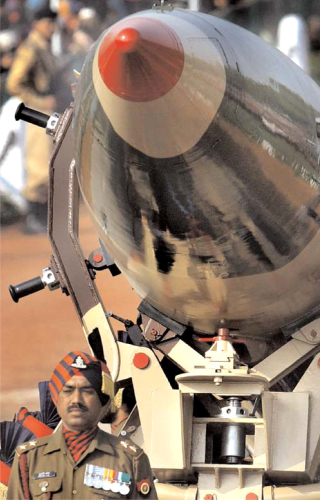
Outside the treaty: India's nuclear-capable Prithvi missile on display in a January 2004 parade.
At the end of the day, however, the most effective measures to ensure the viability and utility of the nuclear nonproliferation regime will be those that creatively resolve issues of insecurity that otherwise lead countries to believe that nuclear weapons are the best guarantee of their national security.
Footnotes
1.
Terry Deibel, “The Death of a Treaty,” Foreign Affairs, September/October 2002, pp. 149-150.
2.
John Broder, “Quietly and Dexterously, Senate Republicans Set a Trap,” New York Times, October 14, 1999, p. A16.
3.
Thom Shanker and David Sanger, “White House Wants to Bury Pact Banning Tests of Nuclear Arms,” New York Times, July 7, 2001, pp. A1, A4.
4.
Ben Mines, “The Comprehensive Nuclear Test Ban Treaty: Virtually Verifiable Now,” VERTIC, April 2004, p. 2.

6.
Joseph Cirincione, Deadly Arsenals: Tracking Weapons of Mass Destruction (Washington, D.C.: Carnegie Endowment for International Peace, 2002), pp. 143-144.
7.
Thomas Graham, Disarmament Sketches: Three Decades of Arms Control and International Law, (Seattle: University of Washington Press, 2002), p. 280.
8.
George Perkovich, “India's Nuclear Weapons Debate: Unlocking the Door to the CTBT,” Arms Control Today, May/June 1996, p. 14.
9.
Sidney Drell and James Goodby, The Gravest Danger: Nuclear Weapons (Stanford: Hoover Institution Press, 2003), pp. 74-77.
10.
Mohamed ElBaradei, “Curbing Nuclear Proliferation,” Arms Control Today, November 2003, p. 5.
∗
All statements of fact, opinion, or analysis expressed are those of the author and do not reflect official positions or views of any U.S. government agency or department. Nothing in the contents should be construed as asserting or implying U.S. government authentication of information or endorsement of the author's views. This material has been reviewed to prevent the disclosure of classified information.