



Abstract

War in space, as imagined in 1948.

Space war–now we're jammin'!
On December 14, 2004, Gen. Lance Lord, commander of U.S. Air Force Space Command, made a startling announcement: “The war in space,” he said, “began during Operation Iraqi Freedom.” The general has made similar proclamations for more than a year. Which raises an intriguing question: How did the Iraq War spill into the first-ever space conflict–without anyone noticing?
Space war, you might think, would certainly promise some real “shock and awe.” For years, scholars, science-fiction enthusiasts, and weaponeers have fantasized about it. “Small winged rocket missiles with atomic warheads could be launched from [a space] station in such a manner that they would strike their targets at supersonic speeds,” famed rocket scientist Wernher von Braun said in 1952. “By simultaneous radar tracking of both missile and target, these atomic-headed rockets could be accurately guided to any spot on the earth.”

Thankfully, General Lord and his fellow space warriors offer a far more tenuous idea of space war, claiming it began when Saddam Hussein attempted to jam the reception of radio-frequency signals from U.S. Global Positioning System (GPS) satellites, which serve as linchpins in the military's infotech-rich way of precision warfare. Hussein simply put a half-dozen or so jammers on the ground in and around Baghdad–no U.S. ground stations or satellites in space were threatened, much less touched.
Hussein's “space war”–his attempts to thwart the U.S. technological advantage–didn't last long. Within 72 hours, two B-1 bombers had destroyed the jammers with satellite-guided munitions. General Lord appreciated the irony. “It was both intellectually and operationally pleasing that we used GPS-guided munitions to eliminate the counterspace attack to our GPS constellation,” he told the Air Force Association's National Air and Space Conference in September 2004.
But the quick “space war” victory does not keep General Lord from worrying about the future. “If we find ourselves spending most of our time reacting to the actions of others,” he said in his December 14 speech, “it probably means we are losing our advantage.”
Losing our advantage? Don't bet on it. U.S. prowess in high-tech warfare makes difficult tasks look easy. The United States is the global leader in jamming and counter-jamming–U.S. armed forces first encountered radio-frequency jamming early in World War II and rapidly became proficient at these now-arcane electronic arts. The latest U.S. innovation: the “Counter-Communications System,” a transportable ground-based device designed to render enemy satellite communications useless.
In recent years, U.S. space warriors have formulated an aggressive, preemptive “defensive” and “offensive” counterspace posture. (Offensive counterspace ranges from simply jamming an adversary's radio frequencies to outright destruction of the offending satellites.) The air force released the first-ever public counterspace doctrine last August.
General Lord not only oversees a large and complex military organization, he doubles as the proselytizer-in-chief for U.S. space power. “We've enjoyed a period of unchallenged dominance in military space, enabling improvements since Desert Storm, and we certainly saw them demonstrated,” General Lord told the Air Force Association (AFA) National Symposium in 2003. “Now, our jobs as we face the future would be much easier if we could expect this trend to continue unchecked, but it won't. We must protect this advantage.”
Despite the huge U.S. lead in all phases of electronic warfare, space warriors talk endlessly of the perils the nation would face if GPS satellites could be jammed. Space warriors routinely equate jamming with space war. That's like comparing middle-school basketball with the NBA playoffs. It doesn't make sense, unless the underlying agenda is to persuade the rest of us that full-fledged space war is just over the horizon.
The man with the space plan: Gen. Lance Lord.

In Brief
A recreational vehicle said to be “the first high-line motor coach that can protect occupants against nuclear radiation from dirty bombs, nuclear accidents, as well as, biological and chemical agents that might leak into the environment or that could be used by terrorists” was introduced January 12 at the Tampa Super RV Show by two companies that specialize in customizing special-use vehicles. Parliament Coach Conversion of Clearwater, Florida, which adapts Prevost buses for luxury living on the road, along with partner Homeland Defense Vehicles, will offer their new weapons of mass destruction-resistant, custom-built RVs for $1.1 to $1.9 million. (A filtration system to protect against contaminated air kicks the price up another $100,000.)
A report from the Science and Technology Committee of Britain's House of Lords criticized the British government for instructing an advisory board on radioactive waste management to review every possible waste storage solution ever suggested–including blasting waste into space–as if no idea had ever been ruled out as impractical over the last 50 years (Nuclear Engineering International, December 10, 2004).
It's nice to know that a Defense Science Board task force met in closed session on November 18, 2004 to discuss what lessons potential adversaries might have learned from observing Operation Iraqi Freedom and Operation Enduring Freedom. The task force is apparently concerned that enemies may make “adjustments” that take U.S. capabilities into account. No word on whether the task force is concerned about adjustments in American public opinion in light of events in Afghanistan and Iraq–or whether the Defense Science Board has learned any lessons itself.
As Steven Aftergood of Secrecy News pointed out on November 8, 2004, the government is extending its control of information well beyond the established categories of “secret” and “classified” and their various permutations. Although a document's contents may not justify its being stamped “Secret,” its contents may be withheld on the theory that it is “For Official Use Only” (FOUO)–which surely must vary little from “Official Use Only” (OUO). Content may also be withheld if it constitutes “Sensitive Homeland Security Information” (SHSI, called “sushi,” we think), or “Safeguarding Information” (SGI), or is of “Limited Official Use” (LOU), or is “Law Enforcement Sensitive” (LES), or if it falls into an equally questionable category, but one with a clearer historical lineage, “Unclassified Controlled Nuclear Information” (UCNI). Aftergood noted that the Department of Homeland Security was taking these categories more seriously than ever before–and requiring employees and the department's contractors to sign legally binding nondisclosure agreements before gaining access to any such information. After an unusually negative public response, the signing requirement was withdrawn.
Those documents that cannot be released or talked about also include government regulations, or “secret laws,” as pointed out on CapitolHillBlue.com (December 20, 2004). For instance, writes author Lance Gay, if a U.S. citizen wants to read the Transportation Security Administration's regulations governing ID checks and searches of passengers boarding airplanes, that's just too bad–the regulation itself is secret. Even regulations authorizing government employees to carry out passenger searches are secret, Gay added.
Los Angeles-based Allerca, Inc. has a deal for the well-to-do but sensitive cat lover. The company is in the first stages of developing a gene-silencing technique that will result, if successful, in producing hypoallergenic kittens. A $500 refundable deposit is required to reserve the right to purchase one of the first “lifestyle pets”–scheduled for delivery in 2007–for $5,000 (www.allerca.com). Now that's nothing to sneeze at!

Last December, the World Future Society, publisher of The Futurist magazine, put out its annual compilation of “forecasts” for the coming year. What can one expect in 2005, according to the futurists? Along with some safe bets (soaring childhood obesity; debt woes for young Americans) and standard futuristic fare (robotic caregivers; new “super-foods”), there are some less-expected prognostications, such as a coming worm shortage due to too much fishing: “High-tech worm storage methods such as cryogenics will be needed to shore up dwindling supplies.”
As long ago as 1958, when the chief of staff of the air force declared that control of space “should be the goal of all Americans,” U.S. space hawks have said that conflict in space is inevitable and that the United States must develop the capability to claim the “high ground of space” first. Sadly for space warriors (but happily for the rest of us), they cannot point to any nation, friend or foe, that has the intention, expertise, or financial wherewithal to deploy a significant space-control capability. Where's the threat?
To get big-bucks congressional funding for space-control schemes, a threat to U.S. space assets must be manufactured, and Hussein's pathetic attempts to jam GPS signals seem to be the best (and only) evidence space warriors can produce to “prove” that space war is already under way.
Cue also China's nascent space program, which space warriors describe as a potential threat to national security. “[China's manned space flight] should give us cause to really be concerned about another space-faring nation involved in a competition that will seek to work against or maybe thwart our asymmetrical advantage,” General Lord told the 2003 AFA symposium during a question and answer session.
Lord surely believes his own rhetoric. Nevertheless, the relentless alarmism about jamming seems to be part of a sophisticated public relations campaign waged by the air force and Defense Department to persuade the public that space war is here–and that the United States had better get on with the business of preemptively deploying a space-control capability.
“The term ‘space superiority,’” Lord repeats time and again, “has to roll off our tongues just like air superiority. We would never try to engage an enemy without first establishing air superiority. And it's no different for space. Losing space superiority will mean losing American lives.”
So it would. But absent a significant threat to America's extraordinarily robust space superiority, the words border on fearmongering.
Mike Moore is the Bulletin's contributing editor. He can be reached at
Farewell and thank you
Dear Friends,
After more than six years as executive director and publisher of the Bulletin, I have decided to seek out new opportunities. I hope to focus more time and energy on analysis, writing, and public speaking on nuclear proliferation and disarmament issues–matters that I believe are now at a more critical stage than at any time during the last 20 years.
As someone whose interest in nuclear policy was kindled in part by the Bulletin, it has been a distinct privilege and honor to be associated with this venerable and influential publication during a time when our small magazine's independent, thoughtful, and authoritative voice is essential to stimulating an informed and healthy debate on global security.
From my first day at the Bulletin, it has been my steadfast goal to strengthen the organization, and I feel I have been successful. But the Bulletin's success rests on many shoulders. Thank you to our foundation partners and to our individual donors, whose very generous and consistent financial support makes possible everything we do. Thank you to our board of directors for supporting our efforts to rejuvenate the organization and the magazine. Thank you to our creative, hardworking, and dedicated staff, who never lose sight of our unique mission and ensure that each issue of the Bulletinis not only accurate, timely, and newsworthy but also reaches the widest possible audience in print and online. And thank you, not least, to you, the devoted reader, without whom our purpose would be lost.
I wish the Bulletinwell during its sixtieth anniversary year and look forward to contributing to future issues.
With gratitude,
Stephen I. Schwartz
The second coming of nuclear power?
A nuclear power revival could take the first steps from concept to reality as early as next year.
The Nuclear Regulatory Commission (NRC) has not authorized the construction of a new nuclear power plant since the 1970s. But three energy companies filed for early site permits in 2003 that, if granted, would lay the groundwork for new reactors at three existing nuclear power plants around the country: North Anna, Virginia; Clinton, Illinois; and Grand Gulf, Mississippi. The NRC could approve the applications in 2006; the companies would have 20 years to use the permits.
Anti-nuclear groups and activists have mobilized to fight the permit applications in each of the locations. In Illinois, a coalition of groups questioned, among other things, whether the applicant, Exelon Generation Company, had adequately evaluated alternative energy sources, as is required by the National Environmental Policy Act. The NRC's licensing panel accepted only a small part of the coalition's challenge, agreeing that Exelon had to take a closer look at whether using alternative energy, but not energy efficiency measures, could satisfy the need for more power.
Virginia's North Anna nuclear plant.

“The debate here is what is a reasonable alternative,” says Shannon Fisk, a staff attorney at the Environmental Law & Policy Center, one of the Illinois coalition members. “The only reason you are going to build a new power plant is to meet some hypothetical energy needs in the future. Well, there are two ways you can do that. You can build more power or you can implement energy efficiency programs.”
Opponents of the Clinton plant will have a chance to present their objections at a hearing after the NRC releases the final environmental impact statement, scheduled for October 2005.
The nuclear power plant in Clinton, Illinois, where Exelon wants another reactor.

Beside the site permits, energy companies would also need to acquire construction and operating licenses before building any new reactors. Both licenses can be obtained in a single, consolidated process that restricts the public from raising concerns that come up during reactor construction. In November 2004, the Energy Department decided to partially fund a consortium that includes Exelon to demonstrate the combined licensing process.
If it were up to the Nuclear Energy Institute (NEI), the industry lobby group, the road to new nuclear reactors would be even smoother. In September 2003, the NRC denied NEI's request to get rid of the requirement for energy companies to look into alternative energy sources and prove a new plant's power was necessary.
If NEI's request had been adopted, the NRC licensing panel would have accepted no objections to the Clinton application, Fisk says.
A game to end all games
Want to relax? Try nuclear war–the card game.
“[The game] is a wonderful opportunity to get rid of your frustrations and aggressions,” says Rick Loomis, creator of “Weapons of Mass Destruction,” a 110-card, multiplayer game that challenges you to attain world domination through WMD. “It is much better to imaginarily blow up 100 million people with an imaginary nuclear missile, than it is to slap your sister and hit your brother.”
Despite two pages of instructions that are nearly as complicated as international treaty fine print, the game is surprisingly simple. The goal is to rid all other players of their population cards, and the easiest way is through nuclear war. Put in play a delivery device card–a Coyote missile or a B-58 bomber, for example–follow it up with a proportionate warhead card–ranging in size from 10 to 60 megatons–pick a target country (the player against whom you hold the greatest grudge), and you're on your way to victory. It might take a bit of nerve to launch your first attack, but before long nuclear war becomes old hat.
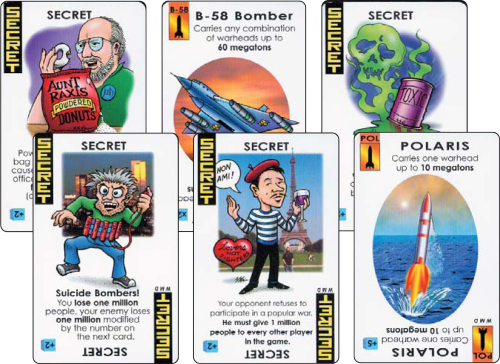
Players can also pursue the peaceful path, using “propaganda” cards against their foes, but that strategy only shifts population from country to country. Plus, war is much more fun. A little too fun, in fact. Players who have lost all their population and are on the brink of elimination can unload their remaining weapons as part of a “final retaliation.” The bottom line: There's rarely a player left standing–never mind a “winner”–when all is said and done.
In this game–the third update of a 1965 card game, “Nuclear War”–players must cope with a series of twenty-first century realities: suicide bombers, dirty bombs, anthrax scares, and uncooperative allies (see the “We hate the French” card, previous page).
Move over, Segway…

… here comes the “i-unit.” Toyota's one-passenger concept vehicle, to be unveiled in March, is being hyped as a “personal mobility device.” We just want to know–does it come with that outfit?
Loomis says he has sold about 1,500 “WMD” decks so far, mostly at game stores and through www.flyingbuffalo.com. He claims the game has been played in the Pentagon lunchroom and next to missile tubes on a nuclear submarine. British Prime Minister Tony Blair's office wrote to thank Loomis for a complimentary copy. Loomis says he gave a deck to a soldier redeploying to Iraq. Now, he jokes, there's definitely “WMD” there.
Robert Bacher
Robert Bacher, the Manhattan Project scientist who assembled the core of the Trinity test bomb with his hands, placed it in the backseat of his government car, and drove it to the Alamogordo test site, died November 18, 2004 of natural causes. He was 99.
Throughout the 1930s, Bacher and Hans Bethe wrote a number of papers on nuclear physics that famed physicist Sidney Drell termed collectively as “the bible.” With the outbreak of World War II, Bacher segued to more wartime-friendly research in radar technology at the Massachusetts Institute of Technology. He left in 1943 to continue his work in nuclear physics at Los Alamos, where he headed the experimental physics and bomb physics divisions. Bacher also doubled as J. Robert Oppenheimer's confidant, and at least once persuaded him not to quit the project.
Bacher came to Oppenheimer's aid once more in the mid-1950s. When red-baiters pushed to revoke Oppenheimer's security clearance and label him a communist, Bacher testified on Oppenheimer's behalf.
After serving as an original member of the Atomic Energy Commission and President Dwight Eisenhower's Science Advisory Committee, Bacher retreated to academia. As an educator and administrator, he helped build the California Institute of Technology into a formidable scientific academy.
Like many of his Los Alamos colleagues, Bacher loathed the monster he helped create in the New Mexico desert. On July 16, 1985, 40 years after the Trinity test, Bacher, Bethe, Victor Weisskopf, Cyril Smith, and Philip Morrison went to Washington, D.C., to offer their “Trinity Day Appeal” and speak of lessons learned.
Robert Bacher.

“I knew perfectly well it would be the president, not us at Los Alamos, who would make [the decision to bomb Japan],” Bacher told the Washington Post during the trip. “I feel it would have been better if it somehow could have been used by persuasion rather than by use. Good Lord, I certainly feel that! I don't know anyone who dealt with it who didn't feel that way.”