




Abstract
Energy's version of a cleanup at Rocky Flats hasn't measured up to local demands. But it's the neighbors who have to live with the consequences.
After the Rocky Flats nuclear facility cleanup is complete, most of the 6,500-acre site, located 16 miles from downtown Denver, will be handed over to the U.S. Fish and Wildlife Service to be maintained as a National Wildlife Refuge. Had the site been designated for future use as housing, farmland, or even park land, the cleanup would be more thorough–and more expensive. The “wildlife refuge” designation provides the excuse for a cheaper cleanup, but will it make for a safe cleanup, especially in the long term?
Risk-based end state
At Rocky Flats, where from 1952 to 1989 the Energy Department produced plutonium pits for the U.S. nuclear arsenal, Energy is using a “risk-based end state” approach to cleanup. By deciding on the site's future use or “end state”–a wildlife refuge in the case of Rocky Flats–Energy can tailor its remediation goals to meet legal requirements.
For Superfund sites like Rocky Flats, the law allows great latitude in compliance. Energy must protect what it and the regulators–the Environmental Protection Agency (EPA) and the Colorado Department of Public Health and Environment–have determined to be the “maximally exposed individual” for the site: a wildlife refuge worker.
The cleanup they are implementing is designed to protect that refuge worker at roughly the midpoint of the Superfund risk range of one in 10,000 cancers in excess of normal to one in 1,000,000.
In a recent Science article, F. Ward Whicker, a specialist in radioecology at Colorado State University, and researchers from the University of Georgia's Savannah River Ecology Laboratory and Argonne National Laboratory, applauded Energy's risk-based cleanup plan and cited Rocky Flats as a successful example of an approach that will protect public health, minimize environmental damage, and result in “huge cost savings.” 1 The Energy Department, too, touts the cleanup at Rocky Flats as a model for its other sites elsewhere in the country.
But an examination of certain features of the Rocky Flats cleanup, as well as various assumptions about the risk posed by contamination, shows Energy's risk-based approach to be seriously flawed.
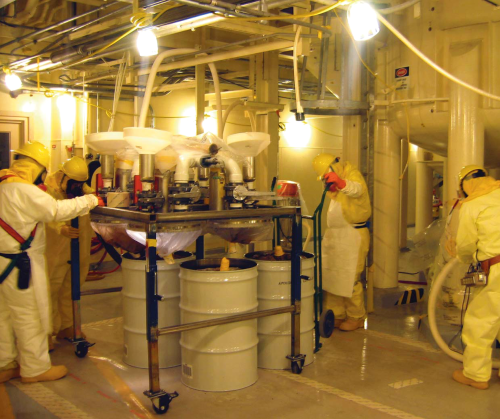
Rocky road: Workers use the “Sludge Daddy” to remove the final 95,000 gallons of sludge from a Rocky Flats building in February 2004.
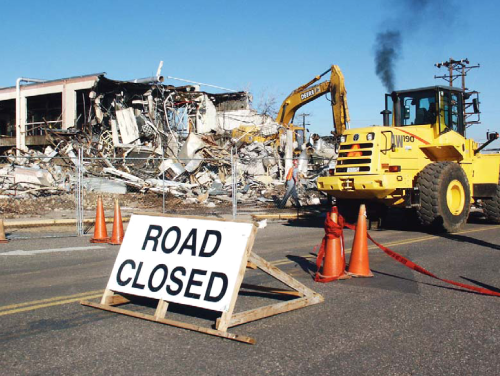
The November 2001 demolition of an administration building.
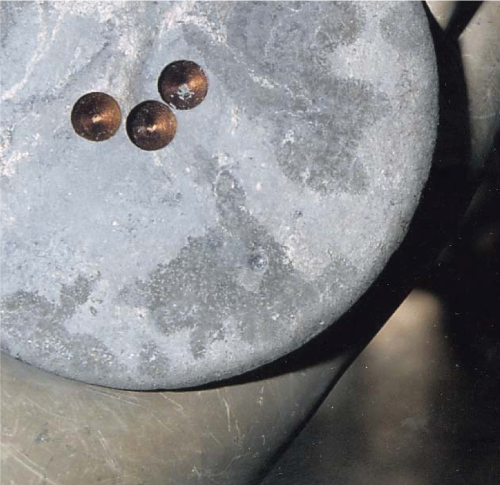
A plutonium button.
What the public said
There are a number of issues involved in turning a contaminated nuclear weapons production site into a wildlife refuge. While it seems wise to maintain federal control of the site, the Fish and Wildlife Service has no guidelines for managing the Superfund sites it is now inheriting. Setting aside Rocky Flats as open space is certainly preferable to opening it for development. But designating Rocky Flats as a wildlife refuge to avoid performing the best possible cleanup seems reckless. In the case of Rocky Flats, it also violates the public's will.
In 1994, the Rocky Flats Local Impacts Initiative, an Energy-funded advisory body, created the broadly representative Rocky Flats Future Site Use Working Group for the sole purpose of telling Energy what the local community wanted at Rocky Flats. In June 1995, the group recommended, by consensus, that the site be cleaned up so that only background levels of radiation remain. Mindful that the technology to attain this goal was not yet available, the group called for ongoing research to develop the requisite technology and for the creation of a trust fund to ensure coverage of the cleanup cost. “We are willing to wait as long as is necessary,” the group said, “but no longer than necessary, to see the site cleaned up, even if it takes generations to accomplish. When the technology allows cleanup to average background levels for Colorado in a cost-effective and environmentally sensitive manner, then cleanup should be done to this level.” 2
The Rocky Flats Citizens Advisory Board and the Local Impacts Initiative, the two local Energy-funded advisory bodies then in existence, promptly endorsed the working group's recommendations, as did various public interest groups and individuals. The working group's proposal quickly became the single most broadly supported cleanup recommendation ever made for Rocky Flats. But through the very contentious years that followed, it also became the public recommendation most maligned by government agencies.
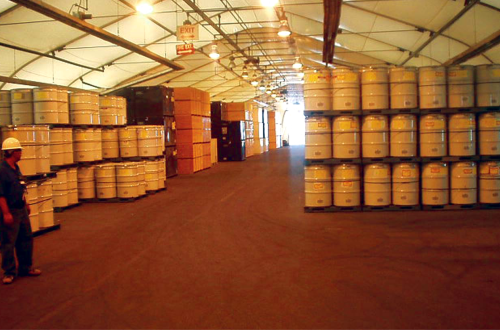
Waste drums awaiting shipment to a new home.
About a year after the working group's report, Energy and the federal and state regulators produced the Rocky Flats Cleanup Agreement (RFCA) without public input, and in October 1996, they adopted it against strong public opposition. The agreement allowed up to 651 picocuries of plutonium to remain in each gram of Rocky Flats soil after cleanup. Compared to cleanup standards at other plutonium-contaminated sites, the levels of permissible contamination for Rocky Flats were extraordinarily high (see “Plutonium Cleanup Standards,” opposite).
When the public protested, Energy allowed an independent review of the cleanup plan, resulting in a February 2000 recommendation that the standard for plutonium cleanup at Rocky Flats be changed from 651 picocuries per gram of soil to 35 picocuries–a 95 percent reduction.
Without formally rejecting this recommendation, Energy, the EPA, and the Colorado Department of Public Health and Environment initiated a new effort to revise the cleanup agreement, to achieve what they called a “risk-based end state” for the site. This new process, they said, would involve public participation. But they did not define what kind of collaboration they had in mind.
The public was not told that in 1995 Energy and the Kaiser-Hill Company, the principal contractor at Rocky Flats, had already made a deal with Congress to impose limits on the Rocky Flats cleanup. That agreement, renewed in 2000, set a deadline of December 2006, an arbitrary date, for the site to be cleaned and closed, and it mandated that all cleanup and closure activities be performed for a fixed sum. When the public learned of the first of these requirements, some questioned how the decision had been made without a clear understanding of what the cleanup would require. At the time, Energy had not determined the extent of contamination; whether the site has yet been adequately characterized remains a point of contention.
The second decision, the one imposing a fiscal cap, was still secret in summer 2000, when Energy created a focus group ostensibly to involve the public in revising and finalizing the cleanup agreement.
It seemed as if the public was at last being asked to help design the cleanup. The group met for three to four hours, twice each month for 22 months. It had been meeting for a full year, however, before an Energy official revealed that the cleanup was limited by predetermined fiscal restraints. The effect on some members of the focus group was like “throwing a dead rat on the table,” according to the same Energy official. 3
Another government official said that Congress had agreed to provide full funding for the Rocky Flats cleanup via a series of roughly equal annual appropriations, provided that the work was completed on time, no additional funds were sought, and conflict in the community was curtailed, according to a report on public participation at Rocky Flats. 4
Plutonium cleanup standards
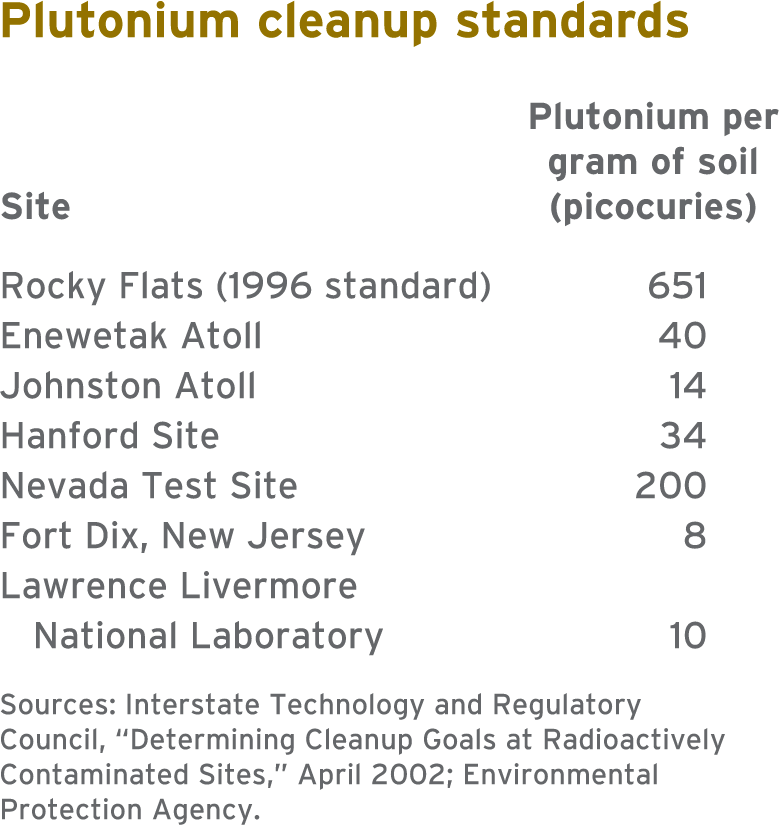
Sources: Interstate Technology and Regulatory Council, “Determining Cleanup Goals at Radioactively Contaminated Sites,” April 2002; Environmental Protection Agency.
As an active participant in all of these discussions, I saw repeatedly that anyone who questioned the fiscal cap and accompanying restrictions, or called for additional funding, was scornfully dismissed by Energy Department and regulatory officials. Several focus group members nevertheless continued to suggest that the way to get more cleanup funds was for the government agencies to spell out the cost of the public's original proposal and then to work with the public to make the case to Congress and the administration.
It was a lost cause. At a large public meeting, a scientist employed by one of the regulators took me aside to say that while regulators work closely with the public at most Energy sites, at Rocky Flats the EPA and the Colorado Department of Public Health and Environment were working closely with Energy in order to address the public with one voice.
A revised version of the RFCA was proposed in November 2002 and adopted with slight modifications by Energy and the regulators in June 2003. The revisions fit perfectly within the frame of what had been decided behind closed doors years earlier and ignored the focus groups' recommendations. During the revised plan's public comment period in late 2002 and early 2003, 86 percent of the individuals and organizations that commented rejected the plan outright. 5
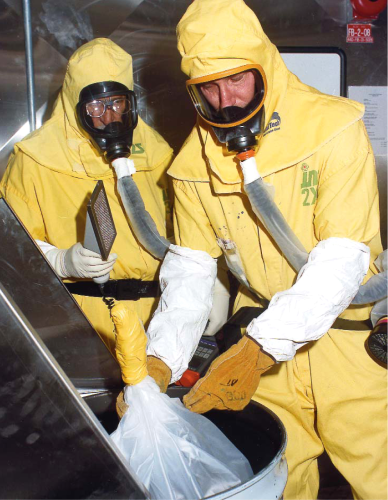
Fall 2002: Rocky Flats workers bag and repackage residues.
Below the surface
In order to limit cleanup costs, the revised RFCA created separate remediation standards for surface and subsurface soil. This arrangement differed from both the original 1996 RFCA and the independent proposal. The former set the standard for plutonium cleanup at 651 picocuries per gram of soil and the latter recommended reducing the level to 35, both without reference to depth.
Because the price of the cleanup and closure had been fixed, the plan mandated by the revised RFCA had to be done for no more than would have been spent under the original 1996 RFCA. Energy, Kaiser-Hill, and the regulators had to decide how they could provide the cleanup the public wanted without spending more. They came up with a trade-off. Their plan proposed a better surface cleanup in exchange for a less thorough subsurface cleanup. Kaiser-Hill would clean the surface enough to protect a wildlife refuge worker and put controls in place to contain the contamination left below the surface. This, the heart of the revised RFCA, could be done for the same sum as the rejected 1996 plan.
The revised RFCA allows a concentration of 50 picocuries of plutonium per gram of soil to remain in the top 3 feet of soil. At a depth of 3 to 6 feet, the level is allowed to rise to 1,000 picocuries per gram, though as much as 6,000 picocuries may be left in small areas of contamination. Below 6 feet, there is no limit on how much plutonium is allowed to remain. As a result of leaving the ground contaminated to these levels, future generations might someday face further remediation costs. It is impossible to assess the potential near- and long-term effects of these contamination levels on people, plants, and animals.
That the site will be cleaned only to the level required to protect a wildlife refuge worker–essentially a short-term fix–presents one of the fundamental shortcomings of the risk-based approach to cleanup.
A Washington-area think tank, the Institute for Energy and Environmental Research (IEER), proposed cleaning Rocky Flats to a level at which a subsistence farmer could occupy the site and eat food grown there–10 picocuries of plutonium per gram of soil or less. IEER recommended using these standards “even if the site is designated as a wildlife refuge, since it is not reasonable to assume that such a designation will endure for hundreds of years.” 6
Energy and the regulators dismissed IEER's proposal in favor of the revised RFCA, which will rely on institutional and engineered controls to contain the long-lived contaminants left in the environment at Rocky Flats. A National Academy of Sciences study calls such controls “inherently failure prone.” 7
Plutonium 239 has a half-life of 24,400 years. To allow high levels of it to remain in the site's soil, which will likely be stirred up by humans and animals in the long term, demonstrates a wanton disregard for the well-being of unsuspecting future generations.
Defining risk
Traditionally, workers and community members who have been or are likely to be exposed at contaminated sites are systematically excluded from deliberations aimed at establishing exposure standards. Accordingly, definitions of risk and the resultant standards are suspect. 8
From time to time, radiation exposure standards have been reduced as more has been learned about the dangers of exposure. 9 Yet there are still fundamental problems with the way standards are calculated. Since the 1950s, they have been based mainly on cancer incidence data from Japanese survivors of the atomic bomb attacks on Hiroshima and Nagasaki. This practice is problematic because the survivors come from healthier portions of the population, had their doses estimated long after exposure, and received only a single exposure to external penetrating radiation. On the basis of these calculations, researchers have extrapolated the effects of chronic exposure to radionuclides, such as plutonium, that have found their way inside the human body.
Some researchers have repeatedly decried this technique. In a 1999 New Solutions article, epidemiologists Steven Wing, David Richardson, and Alice Stewart observed that, “During the last two decades numerous studies on nuclear workers have suggested that radiation risk estimates based on A-bomb survivors could be substantially underestimating the cancer risks from protracted low-level exposure to radiation.” 10 Indeed, a 1987 study by Gregg S. Wilkinson, a scientist at Los Alamos National Laboratory, showed that some Rocky Flats workers with internal plutonium deposits as low as 5 percent of Energy's limit for lifetime exposure developed a variety of cancers in excess of the rate among un-exposed workers. 11 A 2003 study of Rocky Flats workers also found elevated levels of certain cancers. The study's principal author, A. James Ruttenber, said the results called into question whether current exposure standards are sufficiently protective. 12
Many early students of radiation health effects, including Karl Z. Morgan, the “father of health physics,” originally assumed that there was a threshold of exposure below which harm was nonexistent. By 1949, however, most specialists realized that there was no such thing as a safe level of exposure. They adopted the “linear no-threshold” assumption that any dose of radiation is potentially harmful and that risk of adverse effects increases in exact proportion to dose. This approach was adopted by the International Commission on Radiological Protection (ICRP) and the National Council on Radiation Protection and Measurements (NCRP), bodies that recommend exposure standards to government agencies.
Morgan, who headed the Health Physics Division at Energy's Oak Ridge National Laboratory for 29 years, later rejected the linear no-threshold orthodoxy when he became convinced that radiation at very low doses could be more harmful per unit than higher doses. He explained that higher doses were more likely to kill exposed cells while lower doses might only injure them, and the replication of injured cells could result in cancer. Morgan adopted a “supralinear” approach–that radiation might be more harmful per unit dose at very low doses than at higher doses and concluded that existing standards, based on the linear no-threshold model, were not nearly protective enough. By the time he died in 1999, numerous other researchers agreed. At the same time, there was an opposing effort under way to get the old idea of a safe threshold incorporated into existing exposure standards. 13 NCRP responded with a report reaffirming the validity of the linear no-threshold model. 14
A grand (jury) cover-up?
Documents from an investigation into environmental crimes committed at Rocky Flats could help the public and the government agencies responsible for cleanup learn valuable information about the level of contamination at the site–if they weren't locked away in the vault of a Denver courthouse.
On June 6, 1989, the FBI raided Rocky Flats to collect evidence of alleged environmental violations. Two and a half years later, a federal grand jury recommended the prosecution of specific criminal violations and the indictment of five high-level officials from the Energy Department and its then-contractor, Rockwell International. The Justice Department ignored the grand jury's findings, and in March 1992 it announced an out-of-court settlement in the case. All major charges were dropped, no individuals were indicted, Rockwell was fined for relatively minor misdeeds, and the grand jury's report was sealed. When limited portions of the report were leaked to the press weeks later, the federal judge in the case asked the FBI to investigate the jurors and threatened them with felony charges if they revealed what they knew.
In early 2004, a new book, The Ambushed Grand Jury, revisited the charges raised in the initial investigation. Authors Wes McKinley, the grand jury foreman, and attorney Caron Balkany assert that the government used the grand jury investigation not to prosecute the principal crimes committed at Rocky Flats but to cover them up. Worse yet, they say, information regarding the contamination discovered in the grand jury's investigation is being ignored in the site's ongoing cleanup.
McKinley and Balkany's claims are reinforced by a recent report by former Rocky Flats worker and whistle-blower Jacque Brever who charges that the Rocky Flats cleanup is based in part on incomplete and falsified data that was discredited during the grand jury investigation but was provided to regulators as the basis for cleanup nonetheless.
Jon Lipsky, the FBI agent who led the 1989 raid, was scheduled to speak at an August 18 news conference with Brever about why public recreation should not be allowed at Rocky Flats, but he showed up only to say that the Justice Department ordered him not to talk about Rocky Flats. Energy's response to Brever's paper made no mention of her charge that it had provided the regulators with falsified data.
On April 20 the Denver Post rebuked the regulators for violating the public trust by failing to seek access to the sealed grand jury documents, which might contain information pertinent to the cleanup. Attempts by the Rocky Mountain Peace and Justice Center to get the U.S. attorney to release the grand jury documents to the regulators and the public have been unsuccessful.
The public still does not know what crimes were committed at Rocky Flats or precisely what environmental contamination resulted. And it is not clear how the Environmental Protection Agency can certify the safety of the site if crucial information about contamination remains sealed in the grand jury vault.
The problem with alpha emitters
Looking at the way specialists calculate risk from alpha-radiation emitting particles lodged inside a person's body is central to understanding the inadequacies of the Rocky Flats cleanup. Because alpha emitters, such as plutonium, are much more harmful per unit dose than penetrating gamma or X-ray radiation, the ICRP and NCRP refer to the “relative biological effect” (RBE) of alpha emitters to compare the two types of radiation. Both organizations recommend that government agencies that calculate levels for permitted exposure employ 20 as the RBE “weighting factor,” because internal alpha emitters are, on average, 20 times more harmful than penetrating radiation of the same dose. For some body organs and for certain cancers, the RBE can be much higher than this average. The RBE for bone cancer can range as high as 400. 15 For chromosomal damage, a British research team concluded that the RBE for very low-dose plutonium exposure is “effectively infinite,” since the harm from the resultant genomic instability is incalculable. 16
The averaging approach advocated by ICRP and NCRP may protect “average people” from being harmed by low-dose exposure to alpha radiation. But this approach fails to protect the most vulnerable people–the very young, the very old, and the infirm. A British study just completed by the Committee Examining Radiation Risks of Internal Emitters, a body consisting of government and independent scientists, concludes that plutonium in very low doses could be at least 10 times more harmful than present radiation protection standards assume. 17
At Rocky Flats, the Energy Department and the regulators are following convention and using 20 as the RBE for plutonium in calculating risk to a future wildlife refuge worker, their “maximally exposed individual.” In theory, if the refuge worker is protected, all other users of the site will be protected. But what about those who are especially vulnerable? Even if the workforce of generally healthy refuge workers includes no infants, children, or old or sick people, what happens if they become site users?
The U.S. Fish and Wildlife Service said in its recent draft environmental impact statement that it hoped to open the Rocky Flats wildlife refuge for public recreation–hiking, biking, horseback riding, even hunting for young people and people with disabilities. 18 Activities of this sort, even in the less contaminated parts of Rocky Flats, might stir up particles of plutonium-laden dust that could be inhaled, ingested, or taken into the body through a wound. Since 1945, radiation specialists and the Energy Department have recognized that 1 microgram of plutonium (one-millionth of a gram), which is easily inhaled, is a potentially lethal dose. Fish and Wildlife officers say their decisions about public access depend on EPA certification that the site is “safe.” But will declaring it safe make it so?
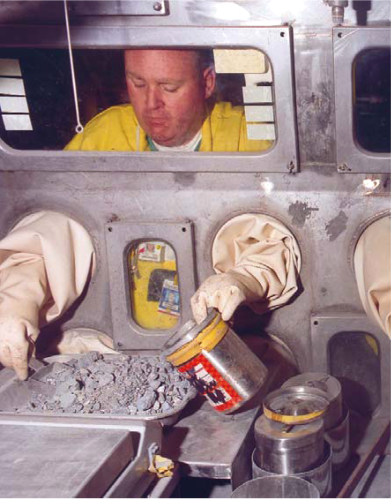
April 2000: A Rocky Flats worker repackages salts.
A cheap cleanup
In the deal Energy and Kaiser-Hill made with Congress, all closure activities at Rocky Flats are to be completed by December 2006 for the fixed sum of about $7 billion. Most of the $7 billion goes to site security, relocation of weapon-grade material, removal of bomb-production waste, and demolition of buildings. The actual soil and water cleanup will be done with what's left–$473 million, or about 7 percent of the total. The $473 million budgeted for cleanup is the maximum that can be spent for this purpose.
Energy now says the site will close several months early for a savings of perhaps as much as $1 billion. None of the savings, however, can be used to improve the cleanup, although Kaiser-Hill can pocket up to $560 million for finishing early and under budget.
The U.S. government is miserly when it comes to cleaning up its nuclear weapons production facilities, in comparison to the $5.5 trillion (in constant 1996 dollars) that it spent between 1940 and 1996 on nuclear weapons and related programs. 19 In Colorado, some of the same people who were subjected to essentially unknown health risks from contaminants released routinely and accidentally into the environment through all the years of production at Rocky Flats now have to deal with the effects of Energy's stinginess. This is a poor precedent to set.
Ecological responsibility
In their Science article, Whicker and his coauthors say that “natural attenuation” will lessen the impact of all but the most highly contaminated parts of sites like Rocky Flats. Smaller quantities of toxins should be left alone, they argue. This suggestion seems wrongheaded for a long-lived contaminant like plutonium that can be easily and inadvertently picked up and relocated in the environment, but which won't disappear. If buried, it might someday resurface. If dispersed, plutonium may do harm even in minuscule amounts.
Rocky Flats is a perfect setting for investigating how to remediate a plutonium-contaminated environment in an ecologically sensitive manner. Unfortunately, the revised RFCA includes no plan for such an effort, and Energy's Office of Legacy Management, which will maintain the controls left in place at Rocky Flats, lacks the funding, and seems to lack the will, to carry out this kind of activity.
Whicker and his colleagues also said that wildlife thrives at sites like Rocky Flats because the “areas have remained undisturbed and now support thriving ecosystems with no evidence of effects from radionuclides or chemicals.” However, genetic specialist Diethard Tautz believes it may take several generations for the effects of radiation exposure to be readily apparent in some species, by which time the damage may be irreversible. He calls this a “genetic uncertainty problem.” 20 His work suggests that wildlife at the Rocky Flats refuge could be harmed more than helped by conditions at the site and that the effects of the residual contamination could extend beyond the boundaries of the site.
Taking into consideration all the uncertainty associated with the Rocky Flats project, Energy's risk-based approach to site cleanup looks like an ill-conceived idea. Risk itself is a poorly understood concept and is fraught with progressively more uncertainty as it is projected into the distant future. As encoded in exposure standards, risk is inadequately sensitive to the needs of the most vulnerable parts of the population. The real driver for the Rocky Flats cleanup is cost, not risk.
Instead of holding up its flawed Rocky Flats cleanup as a positive example to be followed elsewhere, Energy should start anew. It should work closely with affected communities and forge a genuine commitment to the long-term health and safety of every person who may ever live near or use its former nuclear weapon sites, precisely what it failed to do at Rocky Flats.
Footnotes
1.
F. Ward Whicker et al., “Avoiding Destructive Remediation at DOE Sites,” Science, vol. 303, no. 5664 (March 12, 2004), p. 1615.
2.
“Rocky Flats Future Site Use Working Group Recommendations for Rocky Flats Environmental Technology Site,” a report prepared for Energy Department, Colorado Department of Public Health and Environment, Environmental Protection Agency (June 1995, pp. 18-19).
3.
Theresa Satterfield and Joshua Levin, “Risk Communication, Fugitive Values, and the Problem of Tradeoffs: Diagnosing the Breakdown of Deliberative Processes,” Decision Research (2002, p. 15).
4.
Ibid., p. 18.
5.
Energy Department, “Approved Modifications to the Rocky Flats Cleanup Agreement, with Response to Comments,” a report prepared with the Environmental Protection Agency, and the Colorado Department of Public Health and Environment (June 9, 2003).
6.
Arjun Makhijani and Sriram Gopal, “Setting Cleanup Standards to Protect Future Generations: The Scientific Basis of the Subsistence Farmer Scenario and Its Application in the Estimation of Radionuclide Soil Action Levels for Rocky Flats,” Institute for Energy and Environmental Research (December 2001). The report was prepared for the Rocky Mountain Peace and Justice Center, Boulder, Colo., and can be found at  as of October 20, 2004.
7.
National Research Council, Long-Term Stewardship of Department of Energy Legacy Waste Sites (Washington, D.C.: National Academies Press, 2000).
8.
Lisa Ledwidge, LeRoy Moore, and Lisa Crawford, “Stakeholder Perspectives on Radiation Protection,” Health Physics, vol. 87, no. 1 (September 2004), pp. 293-99.
9.
Catherine Caufield, Multiple Exposures (Chicago: University of Chicago Press, 1989); Energy Department, “Closing the Circle on the Splitting of the Atom,” 1995, p. 38.
10.
Steven Wing, David Richardson, and Alice Stewart, “The Relevance of Occupational Epidemiology to Radiation Protection Standards,” New Solutions, vol. 9, no. 2, p. 136 (1999).
11.
Gregg S. Wilkinson et al., “Mortality among Plutonium and Other Radiation Workers at a Plutonium Weapons Facility,” American Journal of Epidemiology, vol. 125, no. 2, pp. 231-250 (1987).
12.
Katy Human, “Flats Workers May Be at Risk,” Boulder Daily Camera, April 18, 2003; A. James Ruttenber et al., “Report of Epidemiologic Analyses Performed for Rocky Flats Production Workers Employed Between 1952-1989,” a report prepared for the Colorado Department of Public Health and Environment (2003) and available at as of October 20, 2004.
13.
LeRoy Moore, “Lowering the Bar,” Bulletin of the Atomic Scientists, May/June 2002, pp. 28-37.
14.
National Council on Radiation Protection and Measurements, Evaluation of the Linear-Nonthreshold Dose Response Model for Ionizing Radiation, publication 136, 2001.
15.
Colorado Department of Public Health and Environment, “Assessing Risks of Exposure to Plutonium,” a report completed by Radiological Assessment Corporation (February 2000, pp. 6.27-6.39).
16.
M. A. Khadim et al., “Transmission of Chromosomal Instability After Plutonium Alpha-Particle Irradiation,” Nature, vol. 355, no. 6362, pp. 738-740 (1992).
18.
The final environmental impact statement is expected to be released this winter.
19.
Stephen I. Schwartz, ed., Atomic Audit: The Costs and Consequences of U.S. Nuclear Weapons Since 1940 (Washington, D.C.: Brookings Institution Press, 1998), p. 4.
20.
Diethard Tautz, “A Genetic Uncertainty Problem,” Trends in Genetics, vol. 16, no. 11 (November 2000), p. 475.