




Abstract
As 1945 dawned, the scientists at the Metallurgical Laboratory in Chicago discovered their portion of the Manhattan Project coming to an end. While those at Los Alamos worked nonstop, the Chicago scientists' duties dwindled. Spare time became plentiful, but relaxation scarce.
Many Met Lab scientists had worried about the implications of atomic energy, but because of the workload and secrecy, discussing their concerns proved difficult. As rumors of an impending atomic test reached Chicago in the summer of 1945, however, debate about the bomb and the control of atomic energy finally surfaced.
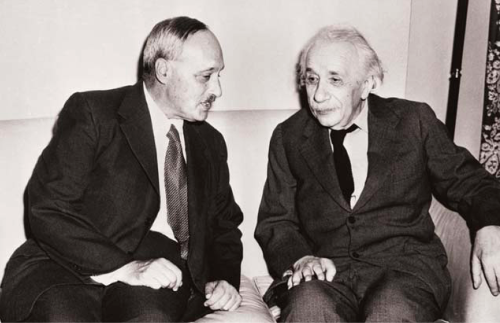
Nobel laureate and Met Lab scientist James Franck felt compelled to act. On June 4, 1945, he formed a committee to record and report the concerns of many Chicago scientists. Unable to articulate his ideas in his non-native language, the German-born Franck gave a page of notes to his longtime colleague Eugene Rabinowitch, a Renaissance man whose interests and talents transcended science and included writing. Rabinowitch formulated their concerns into the “Report of the Committee on Political and Social Problems, Manhattan Project-Metallurgical Laboratory,” which came to be known as the Franck report.
The Franck report's namesake, James Franck, with Albert Einstein in 1954.
Despite its elegant prose and lucid thinking, the report was ignored. U.S. officials shunned it, having decided two weeks earlier to use the bomb. Today the report remains largely unremembered, its concepts namelessly squeezed into a few sentences in most history texts.
But to those scientists who recognized the advent of the atomic age, the Franck report served as a manifesto. It spawned the scientists' movement and the Bulletin of the Atomic Scientists, which Rabinowitch founded as a newsletter for scientists and statesmen alike.
The call to action
Rabinowitch stated clearly in the Franck report's preamble that scientists needed to get involved in atomic age public affairs. “We found ourselves, by the force of events, the last five years in the position of a small group of citizens cognizant of a grave danger for the safety of this country as well as for the future of all the other nations, of which the rest of mankind is unaware,” he wrote. “We therefore felt it our duty to urge that the political problems, arising from the mastering of atomic power, be recognized in all gravity, and that appropriate steps be taken for their study and the preparation of necessary decisions.”
“Rabinowitch and Franck understood that the point was not that their scientific expertise gave them some special insight into political or policy questions,” says Notre Dame professor Don Howard, who teaches the Franck report in his moral responsibility and modern physics class each spring, “but that it was their standing as scientists that gave them a special citizen responsibility to insert themselves into the debate. They're inserting themselves into the debate [as] citizens who happen as scientists to know so much more about the issue than the ordinary citizen.”
The moral appeal
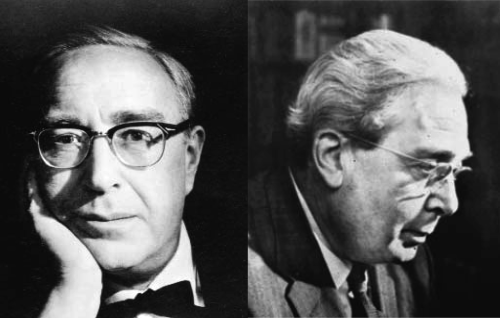
The report bears Franck's name and Rabinowitch's prose, but Leo Szilard provided its lasting historical significance. Until Szilard read early drafts, the report dealt almost exclusively with atomic energy control. Szilard encouraged Rabinowitch to include a section arguing for a demonstration of the bomb.
The idea of using the bomb repulsed Szilard, who suggested keeping it secret, hoping to slow the arms race and save lives. “I always said that what I wanted to do is save the world by education, and Szilard wanted to save the world by conspiracy,” Rabinowitch told the television newsmagazine NBC White Paper: Decision to Drop the Bomb.
Bulletin founder Eugene Rabinowitch (left), and Leo Szilard
Unsatisfied with the Franck report, which he wanted to send to President Harry Truman with the signatures of every Met Lab scientist, Szilard drew up a petition expressing his moral opposition to the bomb. Nearly 70 scientists signed the petition, but not Franck or Rabinowitch. They believed it would negate their report's impact. Like the Franck report, the petition had no effect. “By and large, governments are guided by considerations of expediency rather than by moral considerations,” Szilard said in an August 15, 1960 interview with U.S. News & World Report. “Prior to the war I had the illusion that up to a point the American government was different. This illusion was gone after Hiroshima.”
Prescience
The Franck report accurately predicted two major historical events: the nuclear arms race and the Soviet acquisition of the bomb. “Even if we can retain our leadership in basic knowledge of nucleonics for a certain time by maintaining the secrecy of all results achieved on this and associated projects, it would be foolish to hope that this can protect us for more than a few years,” it read.
Rabinowitch saw science as an international language and realized stringent security measures would not prevent proliferation, recognizing the inevitability of an arms race.
“If no efficient international agreement is achieved,” he reasoned, “the race of nuclear armaments will be on in earnest not later than the morning after our first demonstration of the existence of nuclear weapons.”
The Soviets tested their first nuclear device on August 29, 1949.
The legacy
Franck, Rabinowitch, and Szilard knew altering the prevailing political mood would be difficult. After the Franck report was completed on June 11, 1945, Franck boarded a train to Washington, D.C., to personally deliver it to Secretary of War Henry Stimson. Historians quibble over who read the report and whether it spurred serious dialogue, but political momentum buried it. When a scientific panel that included J. Robert Oppenheimer and Enrico Fermi submitted bomb recommendations to high-ranking government officials, the Franck report's arguments were dismissed.
In Chicago, Rabinowitch felt hopeless. “I remember very vividly the feeling which was certainly shared by Franck and by others that we were surrounded by a kind of soundproof wall so that you could write to Washington or talk to somebody but you never got any reaction back,” he told NBC White Paper. “We waited for some reaction [to the Franck report], and we waited and waited. We had the feeling we could have dropped the report into Lake Michigan.”
But nearly 60 years later, it is clear that the Franck report greatly influenced the arms control agenda during the Cold War. “It truly didn't make a difference in the summer of 1945,” says Howard. “But I've always thought that it made a huge difference if you take a longer historical perspective on things.”
Howard credits the Franck report for helping to create a community of people around the Bulletin. “No one can deny the hugely important role that the Bulletin and the community of scientists around the Bulletin played in shaping the debate later on,” he says. “The community of opinion that was being formed through the Bulletin was extraordinarily important in making possible the Limited Test Ban Treaty, the START negotiations, and the like.”