




Abstract
A bomb is a bomb. A chemical weapon is a chemical weapon. It won't matter to the victims whether their attacker's name is Ahmed or Bill.
On April 10, 2003, a team of federal agents armed with a search warrant entered a storage unit in a small Texas town and were stunned to find a homemade hydrogen cyanide device–a green metal military ammo box containing 800 grams of pure sodium cyanide and two glass vials of hydrochloric acid. The improvised weapon was the product of 62-year-old William Joseph Krar, an accomplished gunsmith, weapons dealer, and militia activist from New Hampshire who had moved his operations to east central Texas just 18 months earlier.
That same day the New York Times's Judith Miller reported from south of Baghdad that the U.S. Army Mobile Exploitation Team had “unearthed … precursors for a toxic agent … banned by chemical weapons treaties.” That turned out not to be the case. What the army team found was fewer than two dozen barrels of organophosphate used in pesticides.
In Chicago a month earlier, Joseph Konopka, a 26-year-old anarcho-terrorist had been sentenced on one count of possession of a chemical weapon. In March 2002, Konopka, who had appropriated an abandoned Chicago Transit Authority storage room under downtown Chicago, was found and arrested in a tunnel beneath the University of Illinois at Chicago. Konopka was a fugitive from federal charges in Wisconsin, where he had hit power substations, radio transmitters, and utility facilities in a 1999 firebombing campaign that caused 28 power outages.
An accomplished systems programmer and hacker, Konopka had assumed the online moniker of “Doc Chaos” and recruited bright teenage accomplices into a cadre he called the “Realm of Chaos.” One of these accomplices was arrested with him. In a search of Konopka's subterranean outpost, authorities found nearly a pound of sodium cyanide along with substantial amounts of potassium cyanide, mercuric sulfate, and potassium chlorate.
The young man never gave a reason for why he had stockpiled the deadly chemicals, except to say they were not for “peaceful purposes.” 1 He is now serving more than 21 years in federal prison for sabotage and possession of a chemical weapon.
By the time Krar pleaded guilty to one count of possession of a chemical weapon on November 11, 2003, two U.S. citizens–Krar and Konopka–were accountable for far more chemical weapons than have been found in post-war Iraq.
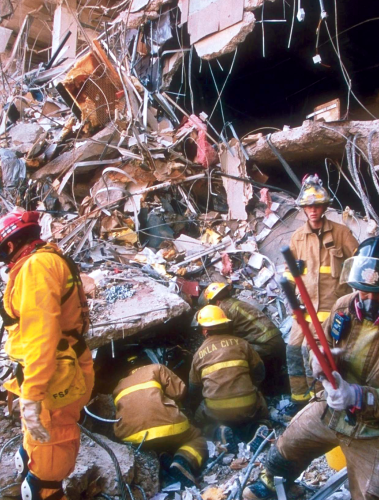
Chemical capers
Without diminishing the significance of Konopka's attacks on local infrastructure in Wisconsin, Krar's is the more disturbing case, given the size and capabilities of his arsenal, his history, his ideology, his discipline, and his expertise. Despite that, his case attracted little national media attention. There were no press conferences called by Attorney General John Ashcroft and FBI Director Robert Mueller, even though Krar presented the most demonstrably capable terrorist threat uncovered in the United States since September 11, 2001.
Krar's cyanide apparatus was only the most dramatic component of an extraordinary arsenal Krar and his common-law wife, Judith Bruey, had stashed in their Texas storage facility.
Although Krar presented the most capable terrorist threat since 9/11, there were no press conferences called by Attorney General John Ashcroft or FBI Director Robert Mueller.
Along with the sodium cyanide, hydrochloric acid, acetic acid, and glacial acetic acid, Krar and Bruey's armory included nearly 100 assorted firearms, three machine guns, silencers, 500,000 rounds of ammunition, 60 functional pipe bombs, a remote-controlled briefcase device ready for explosive insertion, a homemade landmine, grenades, 67 pounds of Kinepak solid binary explosives (ammonium nitrate), 66 tubes of Kinepak binary liquid explosives (nitromethane), military detonators, trip wire, electric and non-electric blasting caps, and cases of military atropine syringes. 2
The storage unit also contained an extensive library of required reading for the serious terrorist: U.S. military and CIA field manuals for improvised munitions, weapons, and unconventional warfare; handbooks on assault rifle conversions to full-auto and manufacturing silencers; formulas for poisons and chemical and biological weapons; descriptions of safety precautions in handling; and information on means of deployment. Many of the same easily acquired, open-source materials, translated into Arabic, were found in Al Qaeda terrorist manuals recovered in Afghanistan and Europe.
As for Krar's cyanide device, according to investigators, the blueprint and formula for the weapon were in the form of a computer printout and handwritten notes that Krar either took down from the internet or obtained from another source.
Margaret Kosal, an analyst of chemical and biological weapons at Stanford University's Center for International Security and Cooperation, determined that Krar had enough sodium cyanide, combined with hydrochloric acid, to produce enough hydrogen cyanide gas to kill more than 6,000 people under optimal conditions for attack.
According to Kosal, such a device, if employed in a 9 × 40 × 40-foot conference room, would probably kill half of the room's occupants within one minute of inhalation. If the room was crowded, immediate fatalities could number as many as 400. More fatalities would probably follow as a result of age or ill health.
If the cyanide gas were dispersed in a larger space, say an enclosed shopping mall, hotel lobby, or school, the number of deaths would be diminished. In any case, the psychological impact on the public of a successfully deployed improvised chemical weapon in the United States would be enormous.
Kosal observed that it was not that difficult to obtain substantial amounts of sodium cyanide and acid. “While [sodium cyanide] is a DEA [Drug Enforcement Administration]-controlled compound,” any notion that it “can only be acquired legally for specific agricultural or military projects is wrong,” Kosal pointed out. The price of 2.5 kilograms purchased over the web “is only $105 … without an educational discount.” 3
In statements made to the FBI after his arrest, Krar claimed he obtained his sodium cyanide and acids from a gold-plating supply house.
Found by a fluke
Krar's admission about how he acquired chemicals may be one of the few straightforward statements he has made to federal authorities since they stumbled upon him nearly two years ago.
On January 24, 2002, a UPS package was misdelivered to a family on Staten Island, New York. After inadvertently opening the packet, Michael Libecci discovered an array of identification documents with different names, all of which featured a photograph of the same man. Libecci turned over the packaging and its contents to the Middletown, New Jersey, police, who called the FBI in Newark.
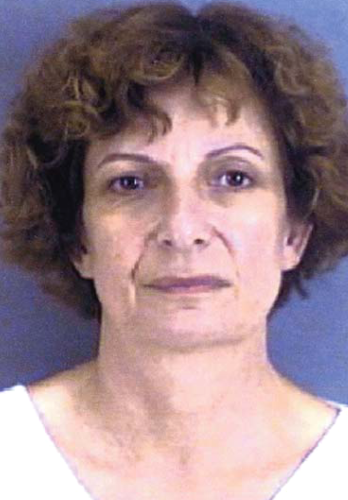
Bruey.
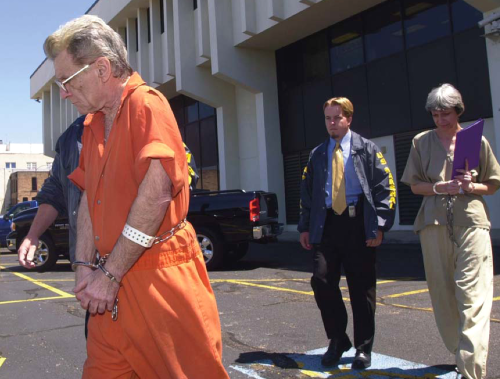
Krar (in orange jumpsuit) and Bruey (far right) are escorted by authorities after sentencing on May 4, 2004.
The documents included a North Dakota birth certificate for “Anthony Louis Brach,” a Social Security card for “Michael E. Brooks,” a Vermont birth certificate for Brooks, a West Virginia birth certificate for “Joseph A. Curry,” a Defense Intelligence Agency identification card, and a U.N. Multinational Force Observer identification card. The package was addressed to Edward S. Feltus in Old Bridge, New Jersey. The return address was for William J. Krar at a mailbox in Tyler, Texas. Along with the bogus IDs was a letter from Krar to Feltus.
“Hope this package gets to you O.K.,” wrote Krar. “We would hate to have this fall into the wrong hands.”
Seven months went by before FBI agents finally talked to Feltus, a 56-year-old employee of the Monmouth County Department of Human Services. On August 8, 2002, Feltus admitted that the forged documents were intended for him, saying he wanted “an ace in the hole” against some future “disaster” or government crackdown. The documents, he said, would allow him to travel “freely in the United States.”
Feltus told the agents that he was a member of the New Jersey Militia, an anti-government right-wing paramilitary group permeated with white nationalism. FBI agents later discovered that after he requested the false IDs from Krar, Feltus had stored more than 100 rifles and pistols at a fellow militia member's residence in Vermont. Seven months after the Oklahoma City bombing, leaders of the New Jersey Militia traveled to central New Hampshire on November 22, 1995, to meet with representatives from militias in Rhode Island, Massachusetts, Maine, Connecticut, and New Hampshire, to form the New England Regional Militia. Its purpose, according to the New Jersey Militia Newsletter, was to “establish an operational framework” to “develop and implement tactical contingency plans” that would include “supply, training, public relations, and intelligence gathering.” 4 A key player in the New Hampshire militia at the time was William J. Krar.
Nothing unusual?
Born in 1940, Bill Krar grew up in Connecticut, learning all about guns from his father, a gunsmith for Colt Firearms. Although he didn't serve in the military, weapons and militaria were his life's centerpiece and primary source of income. His formal education ended after a few semesters in community college. He married and had a son, but later divorced.
Exactly when Krar was drawn into the American radical-right constellation of illegal weapons dealing, shadowy paramilitaries, white nationalism, and anti-Semitic global conspiracies is unknown. According to some who knew him at the time, Krar was active in the movement by the mid-1980s. In 1984 he was dealing guns without a federal firearms license under the name of International Development Corporation (IDC) America, listed at his home address in Bedford, New Hampshire. Krar continued using IDC America as the front for his gun dealing for the next 18 years.
From 1984 to 1985, Krar was ostensibly working as a sales representative for a home-building distributorship in the nearby town of Hooksett, near Manchester. But a co-worker recalls Krar as a highly secretive man who always had a pistol at his side and stacks of Soldier of Fortune in his office–and who had almost no knowledge or experience of the construction business.
An FBI evidence photo taken at one of Krar's self-store units.
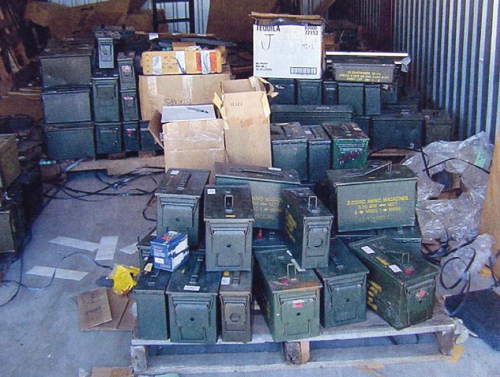
In an interview, this fellow employee remembered Krar and another colleague disappearing for weeks at a time, heading off to Costa Rica and other locations in Central America, even though the building supply company had no dealings beyond New England. Krar's mysterious travel activities and gun dealing occurred at the height of the Reagan administration's “private sector” paramilitary and weapons operations in support of the contras. 5
It was also in 1985 that Krar was arrested by New Hampshire state police and charged with impersonating a police officer. He entered a no-contest plea, paid a fine, and was released. Three years later, in 1988, the building supply company where Krar worked went out of business following a fire that destroyed its building. That same year, Krar stopped filing federal income taxes and effectively dropped out of the system.
Unusual suspects?
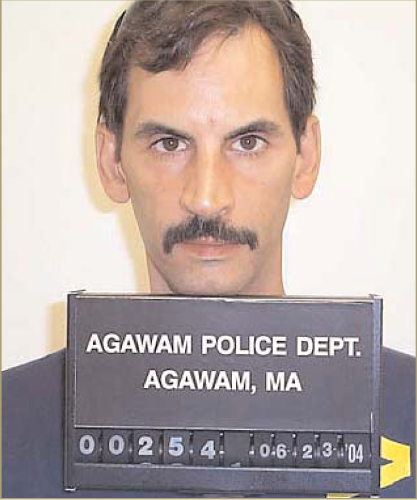
Michael Crooker.
Also in August, a 66-year-old convicted counterfeiter and anti-government activist, Gale Nettles, is charged with plotting to build an ammonium nitrate/fuel oil truck bomb and use it to attack the federal courthouse in Chicago. According to federal agents, Nettles had stored 500 pounds of ammonium nitrate in a Chicago-area storage facility and was seeking more from an FBI informant. The informant also stated that Nettles was looking to make contact with either Al Qaeda or Hamas.
In April 1995 Krar became the subject of an FBI-Bureau of Alcohol, Tobacco, and Firearms (ATF) investigation stemming from a thwarted kidnapping and bombing plot concocted by white supremacist paramilitaries in Tennessee.
Following the arrest of Timothy McVeigh, Sean Patrick Bottoms and his brother Brian became outraged by media coverage of the Oklahoma City bomber and plotted to kidnap or kill Nashville television newscaster John Siegenthaler, now with MSNBC. 6
After an informant tipped law enforcement to the plot, the Bottoms brothers fled to east Texas, where they were arrested on April 30, 1995. During a search of the brothers' residences, FBI and ATF agents found pipe bombs, large amounts of explosives, illegal weapons, thousands of rounds of ammunition, and a business card for “William J. Kaar” of IDC America. When questioned, Sean Bottoms told agents that “William Kaar” was in fact William J. Krar. Bottoms said he had lived in Manchester in late 1994 and early 1995 and had used Krar's IDC address on his driver's license.
After his indictment on explosives charges, Bottoms said that Krar, using the alias “Bill Franco,” was active in the militia movement and that Krar said he had known about the Oklahoma City bombing before it happened. Krar had also said there were more attacks to come.
In July 1995, ATF agents questioned Krar, who told them that all he had done was sell some ammo and military surplus to Bottoms. Bottoms was then given a polygraph examination, which he failed.
Krar continued his involvement with the militia movement in New England. He later told FBI agents that this was when he first obtained sodium cyanide and began working with it, though there is no evidence to support the claim.
In a separate but simultaneous FBI-ATF investigation in Boston, Krar was under scrutiny for his role in a militia with “strong/violent anti-government views.” According to an FBI affidavit, a federal law enforcement source advised that Krar was a “white supremacist due to the anti-Semitic and anti-black literature” seen at his IDC America business in Manchester, where Krar hosted militia meetings. The source went on to say that Krar was “a good source of covert weaponry for white supremacist and anti-government militia groups.”
Bruey, who was president of Krar's IDC operation at the time, told an undercover federal agent of her hatred of “U.S. government policies toward its citizens” and that she believed the government was afraid “military surplus would end up in the hands of citizens rejecting their government.”
Despite this report and evidence from the Bottoms case that Krar was illegally selling firearms without a federal license, Krar and Bruey were left free to soldier on until they ran afoul of federal agents in 2001. 7
Self-store stockpiles
For a decade Krar conducted his operations out of multiple mail drops and storage units. According to investigators, he had no permanent shop, but would work in the storage units, running in electrical cords to power his tools and run lights. In June 2001 there was a fire at one of the two self-storage facilities Krar and Bruey were using in New Hampshire. Firemen discovered that Krar's unit contained thousands of rounds of ammunition and numerous firearms. ATF agents were called in and found among the weapons an assault rifle converted to full-auto. Krar said the weapons and ammo were the property of his employer, Ed Cunningham of Eagle Eye Guns, who had a federal firearms license. Krar and Bruey packed up the weapons and ammo and left, moving their stockpiles to another self-storage unit.
The manager of the new storage facility, Jennifer Gionet, recalled Krar vividly, describing him as “wicked anti-American.”
According to an FBI affidavit, Gionet said that Krar told her “the U.S. government was corrupt” and that he “hated [it] and all of the cops.” Krar went on to say he “hated Americans because they are ‘money-hungry grubs.’” He also told Gionet he had several businesses in Costa Rica and offered to set her up with some “financial investments” down there. On September 11, 2001, Krar told Gionet that he knew the attacks in New York and Washington were going to happen and that there would be more in Los Angeles or Manchester. Gionet immediately reported this conversation to the local police, who notified the FBI.
Having drawn the ATF's attention in June, Bruey and Krar moved their operations to Flint, Texas, in October 2001. A young woman, Dawn Philbrick, who had become Krar's lover, accompanied them. Bruey rented two units at Noonday Storage, opened a mail drop at Mail Boxes Etc., and rented a secluded rural house. Krar was soon back at work in one of the storage units fabricating explosive devices and silencers and converting assault rifles to machine guns. He was also fabricating hundreds of magazines and receivers for Bushmaster Firearms in Maine, manufacturer of the civilian models of the AR-15 assault rifle, one of whose weapons was used by John Mohammed and Lee Malvo, the D.C. sniper team. Krar had done similar work for Bushmaster since at least 1998.
On his home computer, Krar was applying another of his skills–counterfeiting identification documents for his compatriots in the anti-government paramilitary underground. He was as accomplished with counterfeiting as he was with guns and bombs. Over the years Krar used at least seven aliases with four different Social Security numbers and numerous business fronts. Some he used in the gun trade, some within the anti-government movement or offshore. According to investigators, Krar didn't sell counterfeit documents on the open market but gave them away to others in the white supremacist and anti-government movements. It is not known how many sets of documents Krar distributed.
The investigation into Krar and his bogus IDs was slow in developing. It took the FBI until November 2002, 10 months after opening the case, to begin surveillance on Krar, even though they had his address.
Busted … for drugs
His activities were being monitored when, on January 11, 2003, Krar was arrested by a Tennessee state trooper in the course of a routine traffic stop on the outskirts of Nashville. Searching Krar's rental car, Trooper William Gregory found a plastic bag containing “seven marijuana cigarettes, one syringe of unknown substance, one white bottle with an unknown white substance, 40 wine-like bottles of unknown liquid,” as well as two pistols, 16 knives, a stun gun, a smoke grenade, three military-style atropine injections, 260 rounds of ammunition, handcuffs, thumb cuffs, fuse ropes, binoculars, and “other various close hand-to-hand combat items.” Gregory also found Krar's passport, a birth certificate, a California credit union card for “William Fritz Hoffner,” and a Christian missionary identification card with Krar's photo and the name “W. F. Hoffner.” There were also other documents, letters to IDC America, and four pages of what appeared to be a clandestine operations plan for crosscountry travel and communications. Gregory busted Krar on marijuana possession, took him into custody, and impounded the car.
The Tennessee state police then called the local FBI, which in turn contacted its Tyler, Texas officer to inform him that Krar had been arrested. Nashville FBI Special Agent David McIntosh, who interviewed Krar that day in the local jail, said that Krar told the FBI that the weapons and ammo were his and that the other material was part of his stock as a gun dealer who worked gun shows. Krar said he was moving back to New Hampshire to help his girlfriend get out of a bad divorce, and that he didn't know that the bag contained marijuana–that it was something a waitress had left beside his plate that he had just stuffed into his pocket. 8
FBI photos of Krar's arsenal, which was found in a storage locker in Noonday, Texas.
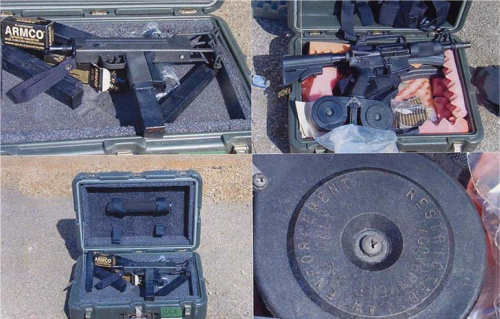
Krar bonded out of jail the next day, leaving his property behind, and drove west out of Nashville. Trooper Gregory opened the jar of white powder, took a whiff, assumed it was cocaine, and threw it into an evidence locker. After the discovery of Krar's chemical weapon four months later, the powder was brought to the FBI lab, where it tested positive as sodium cyanide. Federal authorities have not released information as to what liquid was found in the 40 wine bottles.
Neither Krar nor Bruey gave up any information following their arrest. Krar accepted a plea agreement on possession of a chemical weapon in exchange for Bruey getting a lighter sentence–five years. Otherwise, all the leads federal agents were able to generate were through documents obtained in the searches of Krar and Bruey's storage units, house, and vehicles. The FBI and Justice Department say the case is still under investigation.
The face of terror
Krar was no mere “yarn-spinner,” as his defense attorney once portrayed him. The federal agents and prosecutors who interviewed Krar described him as highly intelligent, dedicated, well organized, extremely manipulative, and very dangerous. His radical right, anti-government commitment clearly grew out of the gun and paramilitary culture that spread rapidly following the Gun Control Act of 1968 and the white backlash to civil rights that arose the same year.
Krar carried copies of Hunter and The Turner Diaries, the fictional ur-texts for white American revolution and terrorism written by the late neoNazi William L. Pierce under the pseudonym Andrew McDonald. The books have been favorites of white nationalist and anti-government terrorists for more than two decades. McVeigh carried stacks of the Diaries with him during his army days and later sold them at gun shows, pressing copies into the hands of potential allies in the years running up to the Oklahoma City bombing. When federal agents searched McVeigh accomplice Terry Nichols's home in Kansas after the bombing, they found copies of the Diaries and Hunter.
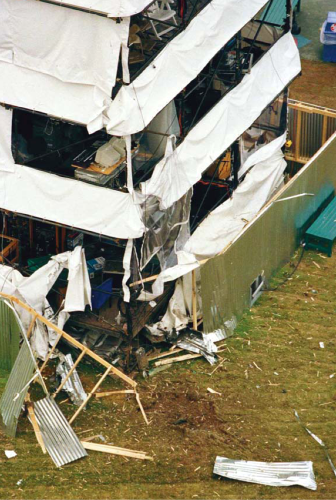
A broadcast tower damaged by the bomb blast at Atlanta's Olympic Park, July 27, 1996.
Krar had a copy of Hunter with him when he was stopped in Nashville. The Turner Diaries was found in his Texas storage unit along with all four volumes of Henry Ford's classic anti-Semitic conspiracy text, The International Jew, and Holly Sklar's left-wing exposé of the “new world order,” Trilateralism. Like McVeigh, Krar drew his anti-government worldview from across the spectrum of right and left.
A terrorist with limited resources would probably consider Krar's chemical weapon an attractive tool. The equipment needed is simple, and the chemicals are readily available from chemical supply houses. Procedures are easily obtained in the open literature, including on the internet. Unlike the more stringent requirements for production of sarin or other nerve agents, fabricating hydrogen cyanide devices demands no greater skills beyond those needed to construct an ammonium nitrate-anhydrous hydrazine truck bomb like that used in Oklahoma City.
There is no doubt that Krar was capable of producing such devices. He had the means and technical information to do so. He was well organized, disciplined, highly skilled, and comfortable in the production of improvised explosive devices.
Would he have used such a weapon? FBI agents and Justice officials who interviewed Krar don't think so. But their assessment is not reassuring.
“I don't believe Krar would've used this himself,” said Brit Featherston, assistant U.S. attorney and Justice's anti-terrorism coordinator for the Eastern District of Texas. But, “If Krar came across a Tim McVeigh or an Eric Rudolph [now facing trial for fatal bombings at the Atlanta Olympics and an abortion clinic] it would be a disaster. I don't believe he'd have a problem with putting this into their hands and sending them on their way.” 9
FBI Special Agent Bart LaRocca, lead agent in the Krar investigation, agrees. “Krar was a facilitator and a provider,” said LaRocca. “There was no indication that he was marketing his bombs or chemical devices. They were intended to be used against the government or in the event of ‘martial law.’ They were for those willing to use them or those he could manipulate into using them.” 10
An attack with such a weapon on an office building, an abortion clinic, a large auditorium, or a shopping mall could be managed by a single, disciplined individual. A terrorist cell armed with several devices could deliver a coordinated attack at different locations. Either scenario would have a tremendous psychological impact that would go far beyond immediate casualties. The bombings in Oklahoma City and during the Atlanta Olympics are stark examples of how homegrown terrorists are just as willing to indiscriminately kill men, women, and children as are their radical Islamic counterparts elsewhere in the world.
Ashcroft's Justice Department has shown almost no interest in what was, until the calamitous events of September 11, the primary domestic terrorism threat–the white nationalist, anti-government militia movement and its corollaries with theocratically driven terrorism, primarily abortion-related assassinations and bombings.
The upheavals in U.S. counterterrorism and anti-terrorist intelligence agencies after the 2001 attacks on the World Trade Center and the Pentagon have not resulted in more nimble thinking about domestic terrorist threats. Apart from the FBI's longtime obsession with environmental and animal rights extremists, the Bureau's primary target for surveillance, investigation, and detention seems to be either immigrants of Arab descent or those who profess Islam as their religion. Although this focus is understandable, it is not commendable.
Had a similar sodium cyanide device been found in a storage unit rented by someone named Khalid or Omar, there is little doubt that Ashcroft and Mueller would have conducted a press conference and that it would have been the story of the week. For some reason, the Krar case was not deemed important–even though the facts of the case show that no other case has demonstrated a comparable and immediate threat. Certainly not the case of Jose Padilla, the small-time thug who merely talked in vague terms about a radiological bomb, or that of the young Muslims who thought it might be a good idea to travel to Pakistan for jihad training. Those incidents have been front-page fodder, touted by the FBI as cases involving “significant” terrorism. Homegrown terrorists with functional cyanide-gas devices are surely as serious a threat.
While Al Qaeda has no need to reach out to indigenous terrorist cells within the United States–or vice versa–a tactical confluence between them would not be surprising. Many anti-government extremists hold beliefs compatible with Islamic terrorist factions worldwide. They are violently against the “new world order,” especially with regard to U.S. government and corporate policies. They are uniformly anti-Semitic or anti-Israel and are totally opposed to the war in Iraq. 11
Apart from the one-off attack in September 2001 by 19 young foreigners, most of them Saudis, the country's most deeply entrenched and most persistent domestic terrorist threat has come from within its own borders and at the hands of its own citizens. It would be folly to believe that the American terrorist underground, after 15 years of sustained and bloody action, has somehow just given up and disappeared.
Perhaps Ashcroft and Mueller called no press conferences because the discovery of Krar's arsenal was a fluke. It was not the result of a proactive federal anti-terrorism intelligence effort targeting the American right-wing paramilitary movement.
Just like Ashcroft and the FBI, the press thinks of “angry white guys” like McVeigh, Nichols, and Rudolph as old news.
Well, maybe Bill Krar and his compatriots don't fit the politically marketable paradigm, the post-9/11 face and faith of terrorism–non-white and Muslim. But such thinking may prove unnecessarily fatal in times to come. Consider the Krar case fair warning.
Footnotes
1.
Affidavit of FBI Special Agent Leslie Lahr, United States of America v. Joseph Konopka, Case No. 02CR, March 9, 2002.
2.
Plea Agreement, United States of America v. William J. Krar, Case No. 6:03CR36, November 13, 2003; Plea Agreement, United States of America v. Judith L. Bruey, Case No. 6:03CR36 (02), November 7, 2003.
3.
Interview and e-mail exchanges with Margaret E. Kosal, July 6, 2004.
4.
New Jersey Militia Newsletter, January 1996.
5.
Interview with former co-worker of William Krar, August 26, 2004.
6.
Interview with John Siegenthaler, August 20, 2004.
7.
Affidavit of FBI Special Agent Bart LaRocca, United States of America v. William J. Krar, Case No. 6:03M12, April 3, 2003.
8.
Interview with FBI Special Agent David McIntosh, Nashville, Tennessee, July 20, 2004.
9.
Interview with Brit Featherston, assistant U.S. attorney, Tyler, Texas, August 4, 2004.
10.
Interviews with FBI Special Agent Bart LaRocca, Tyler, Texas, July 7, July 22, 2004.
11.
Michael Reynolds, “Virtual Reich,” Playboy, February 2002.