




Abstract
An expedition to the crash site of the first U.S. “broken arrow” sorts through lingering questions about the fate of an atomic practice flight.
Two-thousand meters up Mount Kologet in the Kispiox Valley of northern British Columbia, exposed rock and snowfields cover the treeless mountainside; the only evidence of life is the occasional weasel. It is here that the mangled and charred remains of a U.S. B-36 bomber have sat since February 14, 1950, when the aircraft crashed after experiencing three catastrophic engine failures while flying a practice mission.
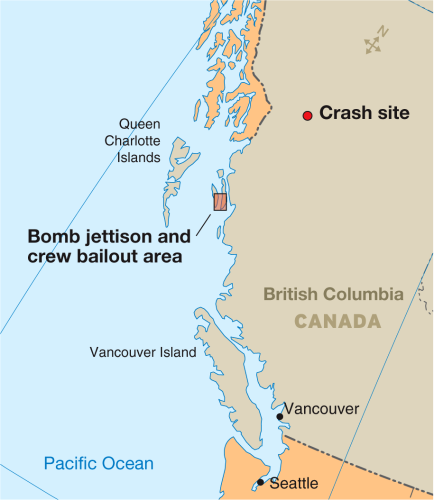
It was no ordinary practice–the B-36 was carrying one Mk-4 atomic bomb. To save the secrets of the unarmed bomb, the crew had to destroy it. They flew the B-36 out over the Pacific Ocean, opened the doors to the bomb bay, and released the bomb. Moments later, the bomb lit up the northwestern sky above Princess Royal Island.
Capt. Harold Barry steered the plane over land, then set the plane's course to fly southwest for an ocean crash. While losing altitude, the crew parachuted toward Princess Royal Island. Five members of the crew were never found. And for a few years, neither was the plane. This was the first U.S. “broken arrow.”
Mission: Bomb San Francisco
By 1950, the United States had about 235 fully functional atomic bombs, and the Soviet Union might have had two. American bases and airfields encircled the Soviet Union, and under the nuclear war plan Operation Dropshot, U.S. Strategic Air Command (SAC) was training to drop 300 atomic weapons on 200 Soviet and Chinese cities.
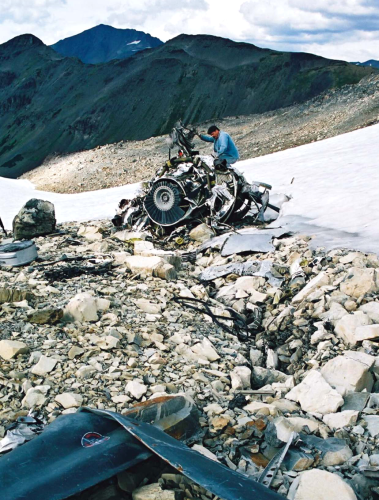
Expedition member Jim Laird inspects one of the B-36 bomber engines.
The B-36 had just become the new “big stick” in the U.S. arsenal. It was the world's first true intercontinental bomber, capable of carrying conventional or nuclear bombs from the United States to Europe and beyond.
The SAC commander, Gen. Curtis LeMay, put his men through rigorous training and pushed constantly to get access to actual nuclear weapons for practice, which was denied by the Atomic Energy Commission (AEC). LeMay's persistence paid off in February 1950, when the AEC loaned a nuclear weapon–without its fissile core–to SAC for a combat training mission, according to nuclear weapons experts and correspondence between then-Executive Director of the Joint Congressional Committee on Atomic Energy William Borden and congressional officials. The training assignment called for the crew to fly from Eielson Air Force Base, Alaska, on a 24-hour bombing mission to San Francisco; they would do everything except actually drop the weapon on the city. The nearly 9,000 kilometer route would take the bomber from Eielson to Fort Peck, Montana, to southern California, to San Francisco for the “bombing,” and then finally to Carswell Air Force Base, in Texas.
Expedition member Jim Laird inspects one of the B-36 bomber engines.
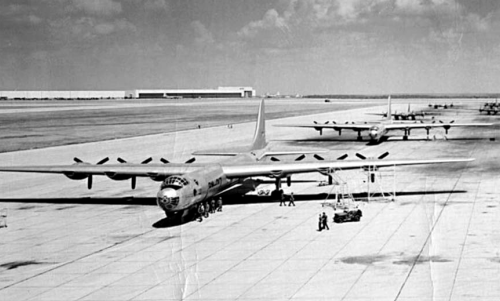
B-36 bombers on the tarmac.
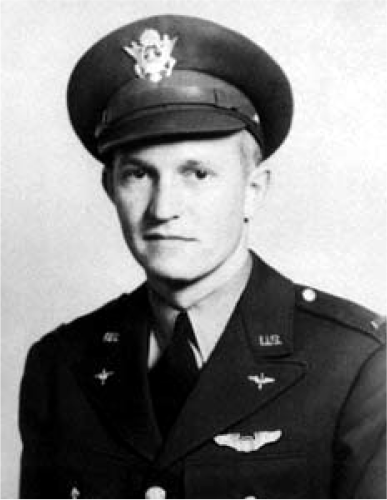
Capt. Theodore Schreier.
Shortly after taking off on February 13, the B-36 encountered bad weather, and ice started building up on the aircraft's exterior. Struggling to keep the plane aloft, the crew gave the engines more power. But three of the bomber's six engines caught fire and had to be shut down. The crew directed the emergency power supply to the remaining three engines, but the aircraft was already dropping toward the sea.
To protect U.S. atomic secrets, the crew prepared to release the Mk-4 bomb, setting its fuze to detonate at 1,400 meters. With the plane less than 90 kilometers northwest of Bella Bella, a British Columbia island town, the bomb was jettisoned. Crewmen said they saw it explode above the water.
In secret testimony to the U.S. Air Force board of inquiry into the loss of the aircraft, Barry described the final minutes of the flight: “We were losing altitude quite rapidly in excess of 500 feet a minute [150 meters per minute], and I asked the radar operator to give me a heading to take me out over water. We kept our rapid rate of descent, and we got out over the water just about 9,000 feet [2,700 meters], and the copilot hit the salvo switch, and at first nothing happened, so he hit it again and this time it opened. The radar operator gave me a heading to take me back over land, the engineer gave me emergency power to try to hold our altitude. We still descended quite rapidly, and by the time we got over land we were at 5,000 feet [1,500 meters]. So, I rang the alarm bell, and told them to leave.”
As the aircraft flew over the mountainous Princess Royal Island, the crew bailed out into the darkness. It was five minutes past midnight on February 14. The bomber, without crew or weapon, proceeded to fly on autopilot for 350 kilometers and finally crashed into the side of Mount Kologet, almost directly north of the bailout point.
The Canadian and U.S. militaries conducted what was probably, to this day, the largest ever search effort. More than 40 aircraft were involved, and more were on standby. The last survivor found, Lt. C. G. Pooler, was spotted hanging by his parachute upside down in a tree with a broken ankle. It took rescuers seven hours to carry Pooler 2 kilometers through the snow to the edge of the island.
The fate of the five missing crewmen, among them the weaponeer and two other pilots, has never been verified, but it is known that they were not dressed to endure the conditions they would have encountered outside of the plane. Some crew members did not wear or carry “Mae West” inflatable life jackets, and none wore exposure suits. Dressed only in arctic clothing and mukluks, the missing men are thought to have died in the icy waters between Gil and Princess Royal islands.
That some of the crewmen have never been found has only raised questions about the fate of the bomb on board Flight 2075. Those questions have centered on the flight's atomic weaponeer, Capt. Theodore Schreier. Since there is no direct testimony that he bailed out of the bomber with the rest of the crew, some observers have suspected that, as a former airline pilot, he stayed with the bomber and tried to fly it back to Alaska. Contributing to this theory, Barry is reported to have said that he saw the bomber turn soon after he bailed out, and unsubstantiated reports claim that a body had been found in the wreckage. (The U.S. military is currently testing DNA taken from a body part found at sea in 1950 that may yield more information about the whereabouts of the missing crew.)
The only reasonable explanation for why Schreier would have stayed inside the plane as it went down is that the atomic bomb was still on board. Yet all evidence points to its having been jettisoned.
A tale of two expeditions
Members of the U.S. Air Force search team concentrated on the area southwest of the bailout point in their efforts to find the abandoned bomber. They found nothing and assumed that the plane had vanished into the Pacific Ocean without a trace. But three years later, in 1953, the wreckage of the plane was discovered serendipitously during a Royal Canadian Air Force search for a missing oil prospector.
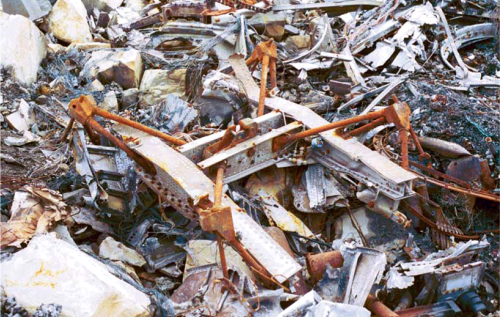
The August 2003 expedition to the crash site on Mount Kologet examined the remains of the bomb shackle's H-frame.
The U.S. Air Force immediately sent three teams to try to reach the bomber. Their task was to ensure that none of the B-36's secrets could be exploited by the Soviet Union, which had already managed to copy the B-29 bomber. But each attempt to access the crash site failed. In 1954, a small demolition team managed to get to the site after a massive effort. They spent nine days gathering equipment and destroying classified parts of the bomber.
The demolition team focused its efforts on the forward crew compartment and the bomb bay, which still contained valuable flight and bombing equipment. The explosive the team used to destroy the plane blasted a giant pit in the rock beneath the forward bomb bay. Fires started by the explosions consumed most of the aircraft; in some places only puddles of melted metal remained.
Since 1954, a number of adventurers and investigative teams have visited the crash site, but none has answered fundamental questions about the crash: How did the plane come to be in its present position? Which direction had the plane been flying before it crashed? And are there any signs that the bomb wasn't jettisoned as the crew claimed?
In August 2003, I led a research team, which together with a camera crew led by Michael Jorgensen, flew to the crash site to examine the wreckage, collect artifacts, and search for answers to these questions.
Getting to the site was much easier than it had been for the original search team. A helicopter flight from a small nearby logging camp took a mere 20 minutes. The 1954 demolition expedition had left the aircraft virtually unrecognizable and consisting mostly of tiny, burnt pieces. Among the only recognizable sections were the aft crew compartment, the rear bomb bay, and one section of the outer wing bearing the marking “USAF.” The wing now sits up the mountain, far from the ruined body and engines.
When it crashed in February 1950, the aircraft landed on snow more than 20 meters deep, but it now rests on exposed rocks. In August there was still a snowfield on the edge of the site, and some parts of the aircraft were still encased in snow and ice.
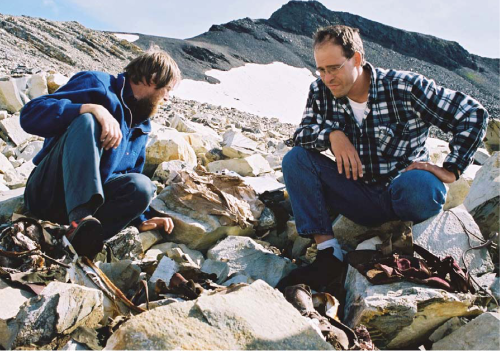
Dirk Septer (left) and author John M. Clearwater examine the wreckage.
Arrow dynamics
Nine months after the B-36 crash in British Columbia, another U.S. bomber was forced to drop an atomic bomb, without its nuclear core, in Canada. It was the fifth U.S. “broken arrow,” and the second abandoned in Canada.
On November 10, 1950, a B-50A bomber transporting one of 11 “special weapons” from Goose Bay, Newfoundland, to Arizona lost power in two of its four engines and discarded its payload over the St. Lawrence River in Quebec.
Just before 4 p.m., the bomb's more than two tons of high explosives detonated in the air, startling hundreds of Quebecers. Witnesses thought war had begun. The Pentagon issued a cover story stating that a bomber with engine trouble had dropped its entire load of conventional practice bombs.
We recovered several personal items, including clothing and survival gear, from the rear compartment. In the rocks behind the compartment, the team found the oak leaf cluster badges of one survivor, Lt. Col. Daniel V. MacDonald, and his toiletry kit. An intact and never-used white silk parachute was still in the crew compartment. Another orange parachute, which had been attached to one of the many unused survival kits, was found still clipped into the rear bomb bay.
Our six-man team spent a week investigating and filming the wreckage of Flight 2075, and we were able to make several conclusions about the accident–although these conclusions sparked new questions. The bailout site is almost directly south of the crash site, so the team expected the aircraft to be heading directly north when it crashed. But by examining the orientation of the plane's engines on the mountainside and by identifying the position of each engine on the plane's wings, team members Jim Laird and Dirk Septer calculated that the bomber was flying at a heading of 75 degrees east/northeast when it crashed.
Two theories attempt to explain how the aircraft ended up so far from the bailout point. One theory involves Schreier staying on board the plane, and the other suggests that after the crew bailed out, the ice broke off the wings and the plane gained altitude. An autopilot error could have caused the change of direction.
Remnants of the bomb shackle and other bomb equipment were found in the large hole under what was once the bomb bay. The bomb shackle survived the explosions and fires in extremely good condition (all things considered), but the steel sway braces are badly rusted. The attachment on the forward end of the shackle that held the in-flight insertion equipment was melted in the fire, but there is no evidence that the bomb was in the aircraft when it crashed. It is unknown why the demolition team left the bomb shackle partially intact, as it is a vital clue to what happened on the mountain more than 50 years ago.
Our most troubling discovery was that many significant artifacts have been looted from the crash site and are now lost to history. Early photographs of the wreckage show items that have now disappeared. Some of the looters, which have included both locals and visitors from far away, even provided photographs of other looters taking items, but Canada's national and provincial governments refuse to prosecute those involved.
The most valuable artifact, which until recently remained at the crash site, is the “birdcage” that was designed to hold the bomb's nuclear core. After looting this item from the crash site, an American treasure hunter gave it to the Defense Threat Reduction Agency, which in turn handed it over to the U.S. Air Force. The air force now refuses to release the birdcage to our research team, the only group with a Canadian government permit, which has been recognized by U.S. authorities, to collect and display it.
What about the bomb?
Despite the questions that have been raised about whether the bomb was actually jettisoned, testimony from the crew and secret U.S. Air Force documents that have been made public under the Freedom of Information Act all lead to the same conclusion: The crew fuzed the bomb to explode at a preset altitude, dropped it out of its bay, and watched it detonate above the water.
The findings from the recent investigation of the crash site bolster crew testimony. The plane's bomb shackle shows no evidence of holding a bomb upon impact. Additionally, evidence suggests that there was never a real nuclear core on board the B-36; the crew was using a lead-weight practice core, according to a top-secret memo from the Pentagon to the Joint Committee on Atomic Energy one month after the incident, in which Maj. Gen. Thomas D. White wrote, “the airplane carried an atomic bomb, less nuclear component.”
The bomb's nuclear core was probably still in the custody of the AEC, as its release would have required the permission of the president. It was not until April 1951 that President Harry Truman authorized the transfer of nine nuclear cores to the Pentagon.
Like many of the 23 other atomic weapons that were jettisoned or inadvertently released from aircraft or ships during the first 24 years of the atomic age, an aura of mystery has surrounded the crash that became known as the first U.S. broken arrow.
Our investigation of the Mount Kologet crash site, however, seems to contradict any notion that the Mk-4 atomic bomb survived the accident.