



Abstract
Nanotechnology seems to offer much the same promise–and danger–as biotechnology seemed to have in its early days. And it has attracted many of the same friends and foes.
Addressing the fourth annual Foresight Conference on Molecular Nanotechnology in 1995, Adm. David Jeremiah, a former vice chairman of the Joint Chiefs of Staff, made a bold prediction. The “military applications of molecular manufacturing have even greater potential than nuclear weapons to radically change the [world] balance of power,” he said.
The risk in trying to stop others from using the technology to gain a strategic advantage, Jeremiah continued, was that “the uninformed policy maker is likely to impose restrictions on [the] development of technology in such a way as to inhibit commercial development, ultimately beneficial to mankind, while permitting those operating outside the restrictive bounds to gain an irrevocable advantage.”
It was an ominous, if not unfamiliar, statement to the assembled crowd, some of whom were undoubtedly excited by the potential of exploring the area of science Jeremiah was referring to, an area physicist Richard Feynman had labeled the “room at the bottom.”
The “bottom” of which Feynman spoke and later wrote is the low end of the scale of matter–atoms and molecules. Twenty years later, researcher Eric Drexler coined the term “nanotechnology” for the science Feynman envisioned–building materials, structures, and machinery from the molecule up.
Absent the kind of regulation Jeremiah feared, scientists and businessmen have taken research into the construction and potential application of nanoscale materials and run with it. The consequence has been a growing diversity of products and processes integrated into both consumer and military realms.
Nanocrystals, or quantum dots, here suspended in fluid in laboratory droppers, emit different colors depending on their size.

Matthew Pelton conducts nanoresearch at the University of Chicago.

As part of Pelton's work, a green laser excites quantum dots.

Although the general public has begun to more broadly feel the impact of nanotechnology, researchers are just beginning to explore the potential for early nanotech developments and applications to harm human and animal health and the environment. In the age of terrorism, the potential of certain nanotechnologies and nanomaterials to be used to do both good and bad requires not just the exploration of the possibilities of this mushrooming field of science but also broad anticipation of possible threats.
The science of small
To understand the potential of all things nano it is necessary to look at the special properties that scientists have observed when investigating this tiniest of scales. And when scientists say tiny, they mean tiny.
Self-replicating nanomachines remain the stuff of science fiction, and leading figures, including Nobelist Richard Smalley, have been arguing against their feasibility.
When talking about the nanoscale, scientists are most commonly referring to science measured at lengths less than 100 nanometers (one-ten-millionth of a meter) in at least one dimension. To give a sense of scale, a single water molecule is approximately one-tenth of a nanometer at its widest. By comparison, hemoglobin–the globular protein responsible for carrying oxygen from the lungs to the body's tissues–is 5 nanometers wide; the polio virus, among the smallest viruses, is 20 nanometers wide and long; and the smallpox virus is approximately 200 nanometers by 300 nanometers; most bacteria are a thousand nanometers wide or larger.
The term nanoscience really refers to more than working with a lone atom or single small molecule. In biology, for example, nanoscience deals with the scale at which biochemical processes inside cells take place or at which nerve transmissions occur. Synaptic junctions between nerve cells in the brain are 20-40 nanometers wide and between nerve cells and muscles 3-4 nanometers wide.
To date, nanoscience most commonly refers to the manipulation of individual atoms and molecules to create larger structures. Because these masses are so small, gravity's effect is greatly diminished and the conventions of friction are altered. Known to biophysicists as “life at low Reynolds number,” the nanoscale is the realm where viscous forces dominate: Moving through water is like swimming through molasses. What are normally perceived to be weak forces between molecules dominate on the nanoscale. This is what allows geckos, which have millions of 2-nanometer-wide hairs lining their feet, to adhere to glassy, smooth surfaces. This same property would also theoretically limit the movement of nanoscale robots–they could easily stick to each other or to the first surface they run into.
On the nanoscale, the wave properties of electrons dominate over the usual particle-like properties; quantum properties are observable. One consequence of this is that particles of the same material appear to have different colors according to their size and shape.
Many current applications of nanoscience have exploited these nanoscale characteristics and incorporated them into traditional technologies and consumer items, giving them value-added features–creating fabrics that repel stains, super-strong armor and tennis rackets, better sunscreens, and nanostructured fuel catalysts. More efficient alternative fuel cells, more effective biological and chemical sensors, more sensitive optics, and lighter, more powerful electronics (sub-microelectronics) round out a growing list of products.
In particular, researchers have advocated using nanotechnology in biotech applications. A November 2002 Energy Department-sponsored report by the JASONs, a group of eminent scientists from a variety of disciplines, identified the goal of developing “artificial nanosystems with biomimetic functionality but without fragility.” Research like this could lead to the development of enhanced medical therapies like cancer-targeting dendrimers (multi-pointed, star-like molecules) or implanted nanodevices that would regulate physiological or neurological functions, such as the release of adrenaline.
Current research is not so much focused on creating nanodevices that replace biological enzymes but rather on using genetically engineered viruses, proteins, DNA, and other biological components as templates to assemble nanostructures. For example, by combining a genetically engineered protein with nanoscale particles, researchers have created a new kind of solar cell. 1
Concerns, real and imagined
All of these applications of nanoscience, however, fall short of how Eric Drexler envisioned nanotechnology in his 1986 book Engines of Creation. Drexler imagined nanomachines capable of repetitively, precisely, and progressively manipulating molecules in order to obtain specific chemical reactions. These nanomachines would assemble themselves, either spontaneously or in response to a designated signal, by mimicking the synthesis of enzymes, DNA, and other biochemical components.
Self-replicating nanomachines were science fiction when Drexler first described them in 1981, and self-replication remains only in fictional accounts (like Michael Crichton's novel, Prey). But some leading figures in nanotechnology, including Nobelist Richard Smalley, have been arguing passionately and publicly against the feasibility of such molecular-scale mechanics.
The probability of self-replicating nanomachines and self-improving “nanobots” with artificial intelligence coming into existence seems low. And the probability of uncontrollable (not uncontrolled) replication–the so-called gray goo phenomenon–seems very low. Most recently, in the journal Nanotechnology, Drexler and coauthor Chris Phoenix sought to downplay concern about runaway self-replication by insisting that “all risk of accidental runaway replication can be avoided.”
But, to say that nanotechnology could never lead to self-replication, or that uncontrolled self-assembly would not have unintended consequences, would be presumptive.
Kevin Ausman of Rice University's nanotech center holds a bottle of carbon nanotubes.

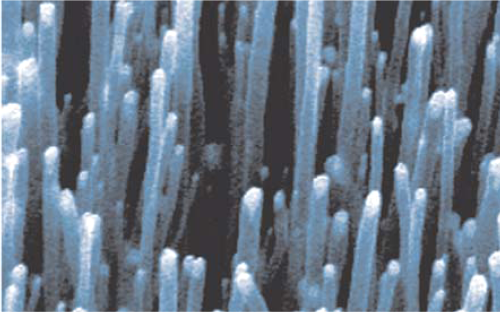
A closeup look at carbon nanotubes, each of which is about 100 nanometers in diameter.
The effects of uncontrolled self-replication can be regularly seen in the environment. Kudzu plants in the Deep South grow wildly; exploding deer populations create hazards on airport runways. Such phenomena are controllable, however, in that it is possible to contain them by returning natural predators or implementing long-term herbicide treatment.
Supramolecular chemists have developed systems of molecules that self-assemble in such a way as to resemble interlocking ring molecules, called catenanes, and other geometric shapes. 2 These systems don't currently replicate, but if this fundamental work is expanded it might eventually make self-replication possible.
Even as the debate about self-replication simmers, nanotechnology as it exists today could cause harm in the nearer term. Concerns about nanotechnology typically fall into three broad areas: health and environment, privacy and security, and artificial intelligence.
A limited number of animal studies have shown that inhaled nanoparticles akin to asbestos are more toxic than micro-sized particles of the same basic chemical composition. 3 That such particles (less than 5,000 nanometers in size) would generate a toxic reaction if they reach the lower respiratory tract is not surprising. When microorganisms such as aerosolized anthrax spores or the particles that make up smog infiltrate, they cause irritations or infections. In certain circumstances infections caused by microorganisms can be life threatening.
December 3, 2003: President Bush signs the 21st Century Nanotechnology Research and Development Act. Richard Smalley, third from left, and others look on.

There is also the risk that the manufacture and use of nanomaterials will contribute to increased pollution and adversely affect the food chain. 4 But just as macroscale items–copper tubing and, say, high-potency organic pesticides–do not pose the same environmental risks, single- and multi-walled carbon nanotubes may share toxic traits with asbestos, but gold nanoparticles or “quantum dots” may not.
The Environmental Protection Agency (EPA) has shown some interest in answering questions about the impact of nanomaterials on the environment during their “full life cycle,” but research sponsored by the EPA has thus far drawn few conclusions. 5
Then there are concerns that nanotechnology may threaten privacy. Those concerns stem from the possible development of miniaturized lens and camera systems, which could transfer images and sound without an individual's consent. They might be so small as to be virtually invisible.
No-no technology
In testimony to Congress on April 9, 2003, leading nanotech scientists tempered enthusiasm about the technical applications of research in their field with the notion that little had been done to study its broad impact.
Vicki Colvin, director of the Center for Biological and Environmental Nanotechnology at Rice University, acknowledged how challenging it would be to place technical progress in a social context–considering the difficulty of asking questions of a “future technological reality”–but nonetheless recommended that between 3 and 5 percent of federal funding for nanotech research be dedicated to examining possible pitfalls.
Christine Peterson, president and cofounder (along with Eric Drexler) of the Foresight Institute, encouraged “an open, international R & D program … including a parallel arms control verification project” to address potential deliberate abuse of new technologies and the potential for “smart” chemical weapons.
But Congress and the president balked on nearly every oversight-related proposal. This was not surprising to some activists who have called for a “cautionary” approach to nanotechnology.
The Action Group on Erosion, Technology, and Concentration (ETC Group), which focuses on the social and economic impacts of emerging technologies, has pushed for a moratorium on the use of synthetic nanoparticles in the lab and in commercial products–paint, skin lotions, and fabrics, to name a few–since 2002. Only after research on the health and environmental effects of the particles is complete, should best practices in laboratory and manufacturing processes be implemented, ETC argues.
“For years the nano-size stuff was below the radar screen and [industry] just thought that they could get away with it,” says Gregor Wolbring, a research scientist at the University of Calgary and a member of ETC's board of directors.
Following the recent increase in funding that came with the passage of the 21st Century Nanotechnology Research and Development Act, the federal government is playing catch-up. In a presentation at an April 2 National Nanotechnology Initiative (NNI) meeting, E. Clayton Teague, the director of the National Nanotechnology Coordination Office (NNCO), pointed out the need to adapt current safety and health regulations to cover “nanotechnology based materials,” and to adopt best practices, through the National Institute for Occupational Safety and Health, for working with nanomaterials. On June 17-18, representatives from 26 countries gathered to participate in a “dialogue” on responsible nanotech research and development.
Nearly 11 percent of NNI funding for 2004 (approximately $105 million) is estimated to go to fund studies on the health and environmental impact of nanotechnology, according to NNCO figures. But compared to the amount of money dedicated to funding government and industry research this funding is still “tiny,” says Hope Shand, the research director for the ETC Group. Throwing money at the issue isn't enough either, she says.
“There are no comprehensive regulations in place–anywhere–to oversee the research and commercial introduction of nanotech products that are already under way,” says Shand.
That is to say nothing of the potential for nanotechnology to be integrated into biological and chemical weapons. “It is not like all of a sudden you are going to see hundreds of millions of people trying to develop nanoweapons,” says Wolbring. But those technologies that have potential uses as weapons “should be placed in the same category as bioweapons and chemical weapons and should be put within the same monitoring framework,” he says.
An additional concern is that terrorists may somehow exploit these potential hazards as a weapon or means to cause harm, even using legitimate, beneficial properties of nanotechnologies for destructive purposes.
Uncle Sam's role
The U.S. government has been accelerating the pace of domestic nanotech research with a significant influx of cash. The National Nanotechnology Initiative was launched in January 2000 with an initial $497 million in government funding. By 2003, the government had committed $710 million. Cementing the government's commitment, President George W. Bush signed the 21st Century Nanotechnology Research and Development Act into law in December 2003. Passed with bipartisan support, the legislation committed $3.7 billion in nanotech funding through 2008.
The major recipients of the funds are the National Science Foundation and the Energy Department, each of which is set to receive more than $1.5 billion over four years. Other recipients include the National Institute of Standards and Technology, the National Aeronautics and Space Administration, and the Environmental Protection Agency.
Not surprisingly, the military and defense industries are very interested. The Defense Department has invested more than $50 million in its Institute for Soldier Nanotechnologies at the Massachusetts Institute of Technology. A major project is investigating enhanced sensors for use as defensive weapons. Semiconducting nanocrystals (often called quantum dots or nanodots) are essentially very small transistors that have unique optical properties only observed on the nanoscale–the addition or removal of an electron changes a dot's characteristics. By incorporating nanodots into sensors, researchers believe it will be possible to recognize the presence of a single molecule of a substance. A sensor as sensitive as this is critical for detecting solids and liquids with low vapor pressure, such as high explosives and VX nerve agent.
Researchers are also exploring the use of nanodots to detect biological agents, which may lead to the development of new ways to detect infectious diseases or anthrax spores, displacing today's state-of-the-art immunoassay and polymerase chain reaction-based DNA detectors. 6 The use of nanostructured materials for remote long-distance detection of chemical and biological agents and explosives is also being investigated.
Other applications of interest include the development of smart materials, like super-strong armaments or “energy-absorbing materials,” which are lighter than anything currently available, and nanolithography (very small writing) that could be used for encryption purposes. 7
Researchers are looking for ways to use nano-means to treat exposure to biological, chemical, and radiological weapons. Researchers funded by the Defense Advanced Research Projects Agency (DARPA) think they may be able to use iron-containing nanoparticles covered with surface proteins to detoxify blood. 8 The particles would bind to biohazardous toxins and then be removed from the blood magnetically. The detoxified blood could then, hypothetically, be returned to a patient, victim, or soldier, in a manner similar to the process of kidney dialysis.
Malevolent applications
Like most of biotechnology, the intent of nanotech research is what separates legitimate, beneficial contributions to humanity from potential tools of terror.
Recent work has shown that single-walled carbon nanotubes (engineered pipe-like structures) containing dyed peptides can penetrate cell walls and accumulate in a cell's interior. 9 (It is not understood how the nanotubes cross the cell membrane.) One can imagine this process being harnessed to produce more harmful forms of already dangerous organisms.
For example, if anthrax's lethal and edema factors were escorted by nanotubes, it would be easier for the bacterium's toxic components to enter the cell. Even vaccinated people would become more susceptible to the toxic effects of anthrax. Yet, how nanotechnology might affect the pathogenicity of an organism has not been studied.
Cancer and heart disease, along with many other long-term illnesses, are caused by molecular-level damage to DNA or cells. Targeted chemical therapies may be able to selectively kill cancer cells, while working around healthy cells. Similarly, designs for nanomachines are being developed to precisely cull malignant tumors or clean clogged arteries. 10 The same sort of research may have other, unwelcome applications.
January 23, 2004: A technician at Bell Labs' New Jersey nanotech center operates a silicon lithography machine in the “nanofabrication room.”

An experiment might result in a nano-delivery device that would attack healthy rather than cancerous tissues. Or a device might cause an uncontrollable autoimmune response. Experiments gone wrong might benefit future research, but they could also be used by someone with malicious intent.
Most bioweapons need damp environments, with moderate temperatures and pressures. But nanotechnology could allow the development of weapons that would be functional along the entire spectrum of possible conditions, from the harshest extremes of cold and wet to hot and dry, and even in atmospheres lacking oxygen.
Nanotech breakthroughs may also contribute to the proliferation of anti-material agents, substances that decompose infrastructure and destroy common materials, like plastics and metal. Natural bacteria are used for beneficial bioremediation and also play a role in the routine anti-material processes that civil and mechanical engineers fight every year on highways and bridges.
Through the integration of nanotechnology with bacteria, an extensive assortment of highly efficient catalysts have been developed. 11 While an engineered catalyst could provide a super-efficient means to clean up sites contaminated with heavy metals or radioactive materials, in the hands of terrorists it could serve as an anti-material agent, capable of accelerating the oxidation of metals, leading to embrittlement and loss of structural integrity.
The iron found in rail lines, pipes, and fittings could be attacked and targeted to corrode. Agents that target petroleum-based fuels could substantially increase fuel viscosity, potentially changing its characteristics in such a way as to interfere with combustion or cause mechanical failure. A terrorist might target the fuel used for transcontinental or international flights. Alternatively, petroleum-degrading nanomaterials could be used as embrittlement agents on roads or runways.
Regulating influences
The high level of scientific and engineering training required to master and manipulate biotechnology has operated as a bar to its use by terrorists; the same limitations apply to their possible acquisition of nanotechnology.
Nanotech research requires expensive, sophisticated, and large equipment. To move molecules into desired positions, scanning electron microscopes or atomic force microscopes are often required. Such equipment requires vibration-dampening laser tables (think giant black monolith à la 2001: A Space Odyssey turned horizontal), and most of the equipment would neither travel nor hide well. Additional equipment is necessary if research requires a controlled atmosphere with a certain level of humidity or a specific composition, like an inert, non-oxygen atmosphere. Such facilities are typically only available at industrial, military, or research facilities and national laboratories, where there is sufficient power to support the machines' operation.
While the quantity of the rather simple materials used to manufacture nanoparticles is small and the cost for the materials is low, the cost of controlling synthetic processes and verifying that a material has the desired properties might prove prohibitive. In contrast to biological agents, where, for example, the mere possession of smallpox could be a significant hazard, the materials necessary for developing certain nanotechnologies are harmless on their own. The situation can be compared to building a computer. Without silicon dioxide it would be difficult to build a computer chip (or microprocessor). But just having a bucket of sand (which contains an abundance of silicon dioxide) is a long way from a functional computer.
Current export controls and the State Department's International Traffic in Arms Regulations limit the free flow of nanotechnology considered to have defense applications, but given the difficulty of detecting macroscale biological, chemical, and radiological materials, it is doubtful that export control officers would recognize nanotech materials.
Beyond transfer of physical materials, knowledge transfer is often more critical for dual-use technology. The primary means for disseminating technical knowledge is scholarly publication. There are currently at least 16 peer-reviewed journals devoted to nanotechnology, from the American Chemical Society's Nano Letters to the Institute of Electrical and Electronics Engineers' IEEE Transactions on Nanobioscience. Hundreds of nonspecialized journals print articles describing nanotech research. Not all of these scholarly, scientific publications are widely available or easy to understand. Many have limited circulation and require subscriptions for online access. Most require an intimate knowledge of sophisticated chemistry, physics, biology, and engineering that is rare among those without doctoral-level training. These factors make it more difficult for a terrorist to employ nanotechnology but might not impede a disgruntled, deranged, or lone-acting scientist.
For now, nanotechnology is in its infancy. Even as more scientific and commercial interests engage in research, the laws of physics will remain the final regulating influence on nanotechnology. Nanobots are unlikely ever to propel themselves through the air like insects–the fluid mechanics of air resistance on the nanoscale will prevent that. The second law of thermodynamics will still apply; nanobots would have to obtain energy and raw materials somehow, and the amount of energy they could obtain from solar sources is limited based on their size.
Nanotechnology could be used to remediate mining sites like this one in Ouray, Colorado.

Limited safeguards
The current threat of nanotechnology being applied to chemical and biological weapons is limited, but that is not a reason to ignore the possibility. The time to develop and establish policy to deal with potential terrorist uses–threat anticipation–is not when research applications appear inevitable. Speaking to a December 2003 National Science Foundation (NSF) Conference on the Societal Implications of Nanoscience, NSF director Rita Colwell warned: “We can't risk making the mistakes that were made with the introduction of biotechnology. It's much too important.”
With the number of terrorist threats growing, it is necessary to guard against the potential malicious co-option of technical research. But it will be a challenge to do so without stifling the pursuit and dissemination of scientific results, whether in technical publications or as consumer products.
Effective self-governance, based on a model from the early years of genetic engineering, is usually suggested as the ideal moderating factor. Asilomar, the small conference of scientists, lawyers, and journalists that convened in 1975 to discuss the safety of recombinant DNA research, yielded a policy of self-governance in an attempt to insure that genetically engineered material not be able to reproduce outside the laboratory environment.
The research environment has changed since then. The Bayh-Dole Act of 1980 freed U.S. universities to obtain patents on the products of federally funded research, which has lead to the birth of thousands of spin-off companies. The original Asilomar participants were overwhelmingly American and British (whereas today, nanotechnology research is conducted throughout the world), and there seemed little reason to worry about a terrorist threat at the time. The Asilomar model offers a way to begin thinking about the self-governance of nanotechnology, but it must yield to the demands of the twenty-first century.
At least one nonproliferation expert, Sean Howard, has drawn an analogy to the debate about placing weapons in outer space, suggesting the need for an “inner space treaty.” There is a need to evaluate whether nanotechnology might fall under the auspices of the U.N. Conference on Disarmament's category of “New Types of Weapons of Mass Destruction and New Systems of Such Weapons.”
Further, nanotech research policy must be international, as twenty-first century science and technology quickly traverses national borders. Some would argue that other nations have shown more interest than the United States in nanotech research and development. Japan invested more than $1 billion in 2002 alone for nanotech research; China is estimated to be putting $300-400 million per year toward nanotech research; the European Union has committed $3.3 billion over the next two years.
To have a margin of success and relevance, any policy effort must involve scientists. Bridges need to be built between technically trained individuals, especially those with recent experience in modern research settings, and those who make and implement policy, on both the national and international stage.
Any constructive policy must also engage the private sector, particularly the small, high-tech companies that start up near major research universities. With sales of nanotechnology-related products predicted to reach $1 trillion by 2015, research and development will only become harder to control–if control is what we really want. A joint effort of leading chemical manufacturers was initiated in 2003 to explore the consequences of incorporating nanotechnology into the chemical industry. Competitors in the marketplace, the companies seek to establish a pre-competitive fundamental knowledge base with respect to nanotechnology and nanomaterials. Fostering a safe, open, and aware environment for nanotech research in the private sector will be more beneficial than attempts to control intellectual property and trade secrets.
Academic and industrial scientists need to participate in a meaningful dialogue and implement policies and protocols from within their ranks. If scientists ignore the ways research might need to be regulated or react purely defensively to an enjoinder to their scientific or proprietary territory, a regulatory policy will develop and be implemented from outside the scientific and technical community, or worse–a prohibition on development could be instituted, as has been proposed by one non-governmental organization.
The fear that scientific research may be squelched by a regulatory Big Brother should be acknowledged and addressed. Right now, the technical community controls the pace of development, and policy should focus on how to prevent malevolent actors from achieving access to operational know-how, not on suppressing information about the latest innovations emerging from research labs.
While one can imagine outcomes of nanotech research both beneficial and detrimental to humanity, Admiral Jeremiah's speculation is dire. The risk of terrorists co-opting biotech research has recently been addressed in numerous symposia at major science and policy meetings, but developments in nanotechnology are not getting the same attention. Rather than couching our policy solely in terms of responding to threats, more work needs to be done to anticipate them.
If this is not done, we will be playing catch-up 10 years down the road, grappling with nanotechnology in the age of terrorism.
Footnotes
1.
S. Y. Ding et al., “Quantum Dot Molecules Assembled with Genetically Engineered Proteins,” Nano Letters, vol. 3, no. 11, pp. 1,581-85 (2003).
2.
Jean-Marie Lehn, “Toward Complex Matter: Supramolecular Chemistry and Self-organization,” Proceedings of the National Academy of Science, vol. 99, no. 8, pp. 4,763-68 (2002); George M. Whitesides and Mila Boncheva, “Beyond Molecules: Self-Assembly of Mesoscopic and Macroscopic Components,” Proceedings of the National Academy of Sciences, vol. 99, no. 8, pp. 4,769-74 (2002).
3.
Robert F. Service, “Nanomaterials Show Signs of Toxicity,” Science, vol. 300, no. 5617, p. 243 (2003); David B. Warheit, “Nanoparticles: Health Impacts?” Materials Today, February 2004, pp. 32-35.

5.
Ibid.
6.
Warren C. W. Chan et al., “Quantum Dot Bioconjugates for Ultrasensitive Noniso-topic Detection,” Science, vol. 281, no. 5385, pp. 2,016-18 (1998); Paul Alivisatos, “The Use of Nanocrystals in Biological Detection,” Nature Biotechnology, vol. 22, no. 1, pp. 47-52 (2004).
7.
Doug Tsurouka, “Nanotech Armor Could Help Protect Troops,” Investor's Business Daily, November 14, 2003, p. A4; Richard D. Piner et al., “‘Dip-Pen’ Nanolithography,” Science, vol. 283, no. 5402, pp. 661-63 (1999).
8.
9.
Davide Pantarotto et al., “Translocation of Bioactive Peptides Across Cell Membranes by Carbon Nanotubes,” Chemical Communication, no. 1, pp. 16-17 (2004).
10.
James R. Baker et al., “The Synthesis and Testing of Anti-Cancer Therapeutic Nanodevices,” Biomedical Microdevices, vol. 3, no. 1, pp. 61-69 (2001); Robert A. Freitas, Nano-medicine: Basic Capabilities (Georgetown, Texas: Landes Bioscience, 1999), chap. 1.
11.
V. Kesavan et al., “Nanostructured Amorphous Metals, Alloys, and Metal Oxides as New Catalysts for Oxidation,” Pure and Applied Chemistry, vol. 73, no. 1, pp. 85-91 (2001). Susannah L. Scott et al., eds., Nano-structured Catalysts (New York: Plenum Publishing, 2003).