




Abstract
On May 22, 2003 both the House and Senate passed separate versions of the 2004 defense bill. The $400.5 billion bill repealed the Spratt-Furse Amendment, adopted in 1993, which prohibited research and development on low-yield nuclear weapons (less than 5 kilotons). The Bush administration has recently denied that work is being done on any new low-yield nuclear weapons but did not rule out future work.
If President George W. Bush is re-elected in November, such weapons may well be developed and eventually deployed. But what lies beyond the mini-nuke? What kind of weapons will enter the U.S. arsenal in the next five to 25 years? An array of esoteric and seemingly farfetched ideas for weapons is already brewing in the imaginations of scientists and military officials, and these ideas are starting to gain acceptance in government and commercial research laboratories.
Some of these developments could create a new generation of weapons–from miniaturized hydrogen bombs to enormously powerful explosives that lie in a gray area between nuclear and conventional categories. No treaty exists to control the development and deployment of such weapons. Some of them, like hafnium weapons, could circumvent existing bans on testing.
Low-yield nuclear weapons are part of the Pentagon's plan to enable the United States to destroy hardened bunkers it says could conceal the chemical and biological weapons of “rogue” states or terrorists. However, the impetus for developing less powerful nukes is nothing new. Hawks have long wanted more “usable” nuclear weapons, claiming that low-yield weapons could improve U.S. deterrence capabilities because tactical nukes could be less destructive and therefore more likely to be considered as a military option. The national laboratories, where weapons designers are eager for fresh challenges, are exerting tremendous pressure for a renewed mission complete with new weapons and programs.
Microfusion weapons
That the most powerful weapons ever invented–nuclear fusion bombs–could be made with low yields may sound fanciful enough. But nanotechnology, the science of designing useful microscopic structures, may lead to further miniaturization of nuclear weapons, even fusion weapons. The field of nano-technology was born in the weapons laboratories 30 years ago as “micromechanical engineering” and “microelectromechanical systems,” which arose out of the need for extremely rugged and safe arming and triggering mechanisms for small nuclear weapons, such as atomic artillery shells. Making detonators and locking mechanisms as small and survivable as possible is a primary goal in new nuclear weapon designs.
In order to destroy deeply buried targets, a warhead needs to detonate after penetrating the ground by 30 meters or more. Today's gravity bombs or rocket-driven missiles will not penetrate the surface by more than about 10 meters, so some kind of active penetration mechanism will be necessary if “bunker-busters” are ever to become a reality. This also implies that the nuclear package and its ancillary components will have to survive extreme stress until the warhead reaches its subterranean target and detonates. Breakthroughs in nanotechnology may allow further miniaturization of the ancillary components of fourth-generation nuclear weapons and may make warheads significantly more robust.
It is difficult to predict whether these fourth-generation nuclear weapons can be made to work, but in theory at least they differ from their ancestors because their physics packages would be based solely on a pure-fusion design (fueled by tritium) without the need for a fission-based triggering mechanism (fueled by enriched uranium or plutonium). Because a microfusion bomb would not use fissile material, it may produce less radioactive fallout than a microfission device of the same yield. Proponents of these weapons could therefore define them as “clean.”
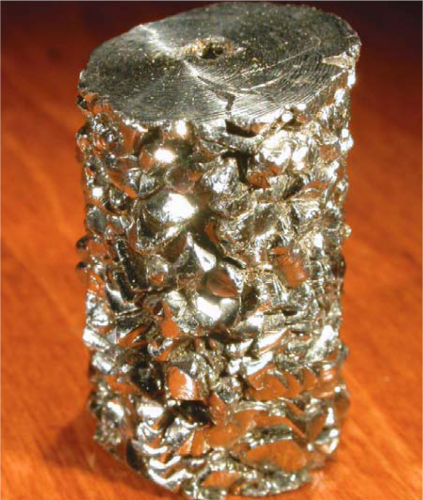
A small amount of rare hafnium metal.
Swiss physicist André Gsponer of the Independent Scientific Research Institute has pointed out that such explosives could also be used to generate nuclear energy if the energy from a series of controlled microexplosions–with yields in the range of a few kilograms to a few tons–could be captured (Disarmament Diplomacy, November 2002). In a nuclear energy application these explosions in principle would be contained, and the triggering mechanism's size would be unimportant. However, if suitable compact triggers were developed, a pure microfusion device could be weaponized and would be considerably smaller than a conventional bomb.
A pure-fusion physics package would produce energy equivalent to 133 tons of high explosive for each gram of tritium consumed. Such weapons are envisaged as providing the deep penetration and high energy needed to destroy deeply buried targets (Security Innovator, November 25, 2003). Advanced weapons research on microfusion bombs has now become a leading activity in the nuclear labs, using gigantic tools like Lawrence Livermore's National Ignition Facility (NIF) and France's Laser Mégajoule. One idea is to use inertial confinement fusion to explode tiny pellets of thermonuclear fuel.
The controlled release of thermonuclear energy, equivalent to a few kilograms of high explosives, at a facility like NIF is expected to succeed in the next 10 to 15 years. A very localized and brief light pulse can contain huge amounts of energy–so large that in the future a miniaturized superlaser might initiate nuclear reactions such as fission or fusion. Today's “superlaser”–an unwieldy contraption the size of a football field–is 1,000,000 times more powerful than a tabletop laser.
Since the yield of microfusion warheads could range from less than a ton to tens of tons, the warhead's delivery by precision-guided munitions or other means will bridge the gap between conventional weapons and current nuclear warheads. But could the United States deploy a new low-yield, earth-penetrating nuclear weapon without testing it? According to a January 2001 Federation of American Scientists Public Interest Report, it seems unlikely that a warhead capable of destroying a deeply buried and hardened bunker (a completely new role for any weapon) could be deployed without full-scale testing. The current administration regards the Comprehensive Test Ban Treaty–which forbids nuclear tests–as a relic of the Cold War and is ready to resume testing. Congress has earmarked $25 million for improvements to the Energy Department's Nevada Test Site, which would allow the United States to resume underground nuclear tests within 18 months of a presidential order, as opposed to the current 36 months.
Isomer bombs
The Pentagon is looking at an even more exotic energy source, hafnium, which could produce explosions with power approaching that of nuclear fission weapons. Scientists know that the nuclei of some elements, such as the rare metal hafnium, can exist in an excited, high-energy state as a nuclear isomer. The hafnium isomer (hafnium 178m2) decays to a low-energy state by emitting gamma rays slowly over time. Some scientists believe that by quickly releasing a flood of high-energy gamma rays from the nuclei of these atoms they can create variable-yield explosions ranging in size from that of a large conventional explosion up to yields comparable with today's small fission weapons.
An isotope of the element hafnium, hafnium 178, retains vast amounts of energy and has a half-life of 31 years. One ounce of pure hafnium, with its excitation energy of 2.5 million electron volts, has, in principle, enough energy to heat 120 tons of water at room temperature to boiling, according to Kurt Gottfried of the Union of Concerned Scientists.
Before hafnium 178 can be used as an explosive, however, energy would have to be “pumped” into its nuclei. Just as the electrons in atoms can be excited when the atom absorbs a photon, hafnium nuclei can become excited by absorbing high-energy photons. When nuclei later return to their lowest energy states, they react by emitting gamma-ray photons.
Hafnium 178's explosive potential is vastly greater than that of chemical explosives. One gram of the material would have up to 50,000 times the explosive power of a gram of TNT. Gamma rays are at least 10 times more energetic than X-ray photons, and in extremely high doses could vaporize living tissue. A nuclear isomer explosion would release high-energy gamma rays capable of destroying all life in the immediate area of the explosion and could penetrate bunkers–killing humans and destroying biological weapons stockpiles inside.
There are other military applications for nuclear isomers. For example, they could be packed into a radiological dispersal device–or dirty bomb–which could be exploded conventionally in a terror attack. And Gsponer envisions them as a potential substitute for the fission bombs currently used to trigger the thermonuclear stage of fusion bombs. He also believes that extremely powerful lasers are the most promising technique for releasing the stored energy from nuclear isomers. Although current superlasers operate in the visible range of the electromagnetic spectrum, a yet-to-be-invented X-ray superlaser could provide radiation 10 billion times more powerful than any existing X-ray source.
Will they work?
Such weapons are a long way off. First, although only a tiny amount of nuclear isomer is needed for an explosion (even a “pit” the size of a golf ball would yield an impressive bang), the apparatus needed to excite the isomer would, with today's technology, have to be enormous. Second, critics point out that the amount of material needed to fuel a hafnium bomb would require so much shielding that it would defeat the idea of having a small bomb.
Scientists also do not agree that hafnium 178 will work practically in weapons. The initial experiment to release energy from a sample of hafnium 178 was conducted by a research team led by Carl Collins at the University of Texas at Dallas in 1998. Collins claims that he artificially triggered the decay of the hafnium isomer by bombarding it with low-energy X-rays using a dental X-ray source. The experiment released 60 times as much energy as was put in, and in theory a much greater energy release could be achieved. But his results were met with widespread skepticism–mainly because his team appeared to have produced near-nuclear-level energy without splitting any atoms.
Other experiments have failed to duplicate Collins's results. A team at Argonne National Laboratory near Chicago using the Advanced Photon Source, a sophisticated electron accelerator designed to produce very intense X-ray beams, was unable to reproduce the phenomenon reported by Collins. The team also set limits on the effect more than a thousand times below the magnitudes reported by Collins. The Texas group argues that Argonne's intense beams damaged the target and produced background levels of radiation that masked the effect. Argonne scientists counter that their results are valid despite these problems.
Enter the military
Nuclear isomers have been traditionally viewed as a means of storing energy, but the possibility that their decay might be accelerated–resulting in explosive potential–now has the interest of the Defense Department, which is investigating other candidate materials such as thorium and niobium.
A significant hurdle is how to make enough of an isomer for it to become deployable as a weapon system. Producing hafnium in sufficient quantities to give it any military use is an expensive process–on par with uranium enrichment. But unlike uranium, hafnium can be used in any quantity, as it does not require critical mass to maintain a nuclear reaction. To assess how it can be manufactured, in 2002 Defense set up the Hafnium Isomer Production Panel, which estimated that the hafnium isomer would cost around $1 million a gram to produce, with $30-$50 billion needed to build the specialized facilities for its production.
Serious doubts remain in the scientific community about this research, and the Institute for Defense Analyses originally concluded only reluctantly that it should continue. And the Defense Advanced Research Projects Agency, having shown considerable interest in devoting resources to isomer research, decided in June to cancel funding. But the fact that eight countries other than the United States are conducting research into nuclear isomers may reinstate interest and funding in the future.
Centers currently researching isomers, such as the cyclotron facility at Michigan State University, could be used for hafnium production. The Air Force Research Laboratory at Kirtland Air Force Base in New Mexico obtains its hafnium 178 from SRS Technologies, a research and development company in Huntsville, Alabama, which refines the hafnium from nuclear material left over from other experiments. SRS Technologies is under contract to produce experimental sources of hafnium 178, but only in amounts less than one ten-thousandth of a gram. Hill Roberts, chief scientist at the company, believes that technology to produce gram quantities will exist within five years.
The cost of producing any, or all, of these weapons would be vastly expensive, but military spending is set to rise: By 2009 the United States will have a defense budget exceeding $500 billion–at least half of the military expenditures worldwide. And as is often the case with scientific discovery, if enough money and scientific expertise are invested, the technological obstacles may be overcome. Of course, much depends on whether the political will to commit the United States to a new generation of nuclear weapons will continue to spur their development.