



Abstract
Leaner and meaner? France is trying to do more with less–and that includes its smaller, but more flexible, nuclear arsenal.
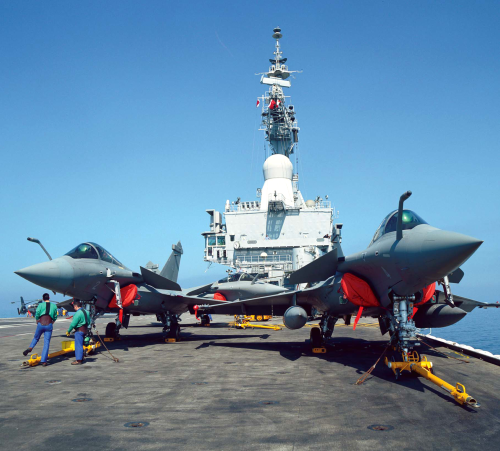
France's nuclear-capable Rafale aircraft aboard the Charles de Gaulle.
In the fall of 2003, the French media reported that a major shift in the country's nuclear policy was under way. On October 27, the headline of the daily Libération screamed, “Chirac's Small Bombshell: France Will Soon Revise its Deterrence Strategy in Order to Be Able to Strike ‘Rogue States,’ Even Preventively.” The newspaper reported that France would announce a new nuclear doctrine that would take into account “rogue states” with weapons of mass destruction, and that new weapons were being considered to deal with such threats. A few days later, Jean Guisnel suggested in the weekly Le Point that several major adjustments to the doctrine had been secretly decided in 2001 (October 31, 2003). But President Jacques Chirac and his government denied that there had been any change in French nuclear doctrine and maintained that no change was forthcoming. 1
May 8: French President Jacques Chirac (center) with Defense Minister Michèle Alliot-Marie (left) and Prime Minister Jean-Pierre Raffarin (right) in Paris.

The confusion was understandable. Nuclear policy in France is shrouded in secrecy–even more so than in other Western nuclear weapon states–and transparency has long been anathema in Paris. Few public pronouncements or official documents are available for analysts and media to comment on, so journalists are frequently tempted to exaggerate the importance of tidbits of information and may easily misinterpret senior officials' off-the-record comments.
The episode revealed a tension in French nuclear policy that has existed since the end of the Cold War. On one hand, France still clings to the concepts of nuclear sufficiency and deterrence–deterring major powers is still the first mission of French nuclear forces. On the other hand, since Chirac's election in 1995, French authorities have insisted on the diversity of conceivable deterrence scenarios and on the need for greater nuclear “flexibility”–including options to reduce collateral damage.
In a 2000 interview in Armées d'Aujourd'hui, Chirac said his arsenal had been “reduced to a level of strict sufficiency,” but that “France must have a credible and adequate nuclear arsenal, offering a maximum of flexibility.” This seeming contradiction is hardly the only challenge that France's post-Cold War nuclear policy faces. Others include the credibility of deterrence regarding new threats and the reconciliation of France's drive toward European integration with the continuation of a strictly national nuclear deterrent. Most importantly, it is by no means certain that France can afford to finance its nuclear ambitions. In many respects, French nuclear policy is at a crossroads.
A quiet revolution
Without much publicity or fanfare, there has been a revolution in French strategic thinking in the past decade. 2 Starting with its 1994 Defense White Paper, Paris acknowledged that its “vital interests” could be threatened by regional powers–that is, by countries that would have the ability to seriously harm France, but not threaten its survival. (In French strategic language, nuclear deterrence comes into play when vital interests are threatened.) Chirac confirmed the transformation, saying in a speech on August 31, 1995: “Being responsible to the nation for the future and safety of the country, it is my duty to remind French men and women that only its deterrence force shields France from the possible use of weapons of mass destruction of whatever type.” Officials worry about the kind of scenario in which a country tries to block French military intervention by threatening to strike French territory. Paris does not identify specific countries of concern regarding this situation, but in November 2003 French Defense Minister Michèle Alliot-Marie said, “At the time when we see countries with non-democratic and sometimes uncontrollable governments–one could mention North Korea, Iran, Pakistan–at the time when we see a whole bunch of countries acquiring nuclear weapons, should we let our guard down?”
France has also broadened its notion of “vital interests.” In its 1994 Defense White Paper, France defined its “core” vital interests as “the integrity of the national territory, including the mainland as well as the overseas departments and territories, the free exercise of our sovereignty, and the protection of the population.” The mention of “sovereignty” is noteworthy; it suggests that Paris believes that nuclear deterrence can help prevent blackmail or political pressure from another nation.
The limits of vital interests remain vague. Because of the ambiguity, an adversary cannot be sure of the risks of aggression. The limits are also kept blurry because France's scope of vital interests is subject to change, and because it is a presidential decision as to whether or not such interests are at stake. According to French doctrine, an attack on its vital interests would provoke a nuclear response in the form of “unacceptable damage,” regardless of the nature of the threat, the identity of the state concerned, or the type of weapons used.
France has consistently rejected the adoption of a “no first-use” posture. Paris sees nuclear retaliation as consistent with the right to self-defense recognized by Article 51 of the U.N. Charter. It also asserts that countries that do not respect their own nonproliferation commitments should not expect negative security assurances (granted in 1995 by nuclear weapons states to non-nuclear members of the Non-Proliferation Treaty) to apply to them, thus implicitly subscribing to the norms of “belligerent reprisals” that also underpin U.S. and British nuclear doctrines.
In 1996, France dismantled its land-based missiles located on the Plateau d'Albion and in September 1997 declared that none of its nuclear assets remained targeted. To borrow an expression from the de Gaulle years, one could say that French nuclear strategy has again become tous azimuts–that is, deterrence is general, with no designated enemy.
French politicians insist that a major threat could one day come from far away. In October 1999, then-Prime Minister Lionel Jospin said in a speech at Paris's Institute for Higher Defense Studies that France's deterrent should be able to counter any threat, “even a distant one.” This was widely interpreted as signifying that the buildup of nuclear arsenals in Asia was deemed a matter of concern for Europe. In particular, some analysts saw China's nuclear ascension as worrisome. No one expects a French-Chinese war, but some in France believe that the capability to deter China could someday be necessary, if, for example, Beijing ever tried to prevent European support for the United States during a crisis in Asia.
Cherbourg: The Le Triomphant nuclear-powered ballistic missile submarine in 1993, several years before it entered service.

France performed a full nuclear review from 1999 to 2001. Conducted in the context of cohabitation (when the prime minister and president are of opposing parties), it was in effect a bipartisan process that confirmed that the national political consensus for deterrence was still strong. Chirac presented some of the conclusions in a landmark June 8, 2001 speech at the Institute for Higher Defense Studies. He listed three roles for the French deterrent: to guarantee the survival of the country if faced with a major threat; to preserve France from exposure to blackmail by a smaller power armed with weapons of mass destruction; and to contribute to the security of Europe and the Atlantic alliance.
The main elements of French deterrence emerged from the review unchanged; there was, however, one spectacular innovation. Chirac announced that, when facing a regional power threatening its vital interests, France's nuclear arsenal would target “in priority its political, economic, and military centers of power.” Gen. Henri Bentegeat, France's chief of defense, expounded, “Each dictator possessing [weapons of mass destruction] must realize that, should he choose to strike France's vital interests, he would be immediately exposed to the destruction of all his centers of power and of all his military centers with sufficiently accurate weapons with an adequately limited yield.” Such a “more targeted” nuclear deterrence is judged necessary to “threaten dictators for whom human life does not count and who would be ready to sacrifice their countries.” 3
October 1996: Destruction of France's nuclear testing site at Mururoa in Polynesia.

In a matter of a few years, two foundations of French nuclear strategy have been discarded. It is no longer possible to refer to France's posture as a “deterrent of the strong by the weak”–now deterrence is judged valid when dealing with regional powers. Nor can French deterrence strategy be called “anti-cities,” as it once was, because if a regional power were the adversary, centers of power would be targeted by French nuclear weapons. (The targets that would be threatened if a major power were the adversary have not been made public, but references to counter-city targeting have disappeared from French official language after the early 1990s.)
Allied convergences and divergences
Many elements of the revised French policy are similar to those of its allies Britain and the United States. The French concept is particularly close to the British one. Both France and Britain reject counterforce doctrines and maintain a rather traditional outlook on deterrence.
But several features distinguish the French concept from those of its allies. A true French original is the idea of “final warning,” or ultime avertissement. The idea is to demonstrate French resolve with a single, limited strike on military targets. If an adversary persisted, the final warning would be followed by a massive strike. Devised in the 1970s, the final warning was a compromise between the desire to avoid an “all or nothing” dilemma and the equally pressing need, in French minds, to stay away from a policy of flexible response. Chirac alluded to this concept in his June 8, 2001 speech when he said that France maintained “the capability to signal, when the time comes, to a potential adversary, both that our vital interests are at stake and that we are determined to safeguard them.”
Another idea unique to France is that since 1996 it has considered all its nuclear weapons “strategic.” The notion is that any use of nuclear weapons would be a sea change in the nature of the conflict, and therefore would be of a strategic nature. (France's arsenal used to include a distinct category of “final warning weapons,” previously called “pre-strategic weapons.”)
It is also noteworthy that the country has gone much further than other nuclear powers in terms of irreversible unilateral disarmament gestures. France destroyed all its land-based systems and reduced its overall number of launchers by 50 percent. 4 It has also dismantled its weapons test site in Polynesia and begun dismantling its fissile material production facilities at Pierrelatte and Marcoule.
France's deterrent remains fully independent both in terms of planning and in terms of operations. Britain, in contrast, places its nuclear forces within a NATO context, buys U.S. Trident II missiles, and cooperates strongly with the United States in all nuclear matters.
A reduced, more flexible arsenal
The current format of French nuclear forces was set in 1996, following a complete defense review ordered by Chirac when he came to power. Since the end of 1996, France has possessed only four nuclear-powered ballistic missile submarines (SSBNs)–two Le Redoutable-class and two new-generation Le Triomphant-class subs, which carry M4 and M45 submarine-launched ballistic missiles (SLBMs). Three of the subs are in the “operational cycle,” making it possible to maintain two vessels at sea at all times. If the SSBN force were fully deployed, with three boats at sea, a total of 48 missiles and 288 warheads would be available, assuming that each missile carries six warheads. The successor to the M45 will be the M51 ballistic missile, which will be equipped with TN75 warheads in the M51.1 version, and with Tête Nucléaire Océanique (TNO) warheads in the later M51.2 version.
France has three squadrons of Mirage 2000N bombers (with about 20 aircraft each), and a small carrier-based fleet of Super Étendard aircraft–a feature that distinguishes the French posture from those of its NATO allies. 5 France has only one aircraft carrier; thus, its carrier-based nuclear capability will not be permanent until a second carrier enters service early in the next decade.
The Mirage 2000N and Super Étendard aircraft carry the Air-Sol-Moyenne Portée (ASMP) supersonic missile. The successor to the ASMP will be the “improved” ASMP-A (for ASMP-Amélioré), identical in design but with better performance and equipped with Tête Nucléaire Aéroportée (TNA) warheads. The Rafale will replace both the Mirage 2000N and Super Étendard.
The TNA and TNO are so-called “robust” warheads; they are less sensitive, for example, to the aging of components. The concept for the TNA and TNO was tested during France's 1995-1996 final nuclear testing campaign; it represents the new generation of French nuclear weapons in a test-ban context.
French nuclear modernization, scheduled timetable

Sources: Antoine Carré, opinion presented in the name of the Armed Forces and National Defense Committee on the Draft Budget Law for 2004, vol. 2, Defense—Nuclear Deterrence, Assemblée nationale, October 9, 2003; and Yves Boiffin, “La Loi de programmation militaire 2003–2008: Adapter les forces nucléaires,” Les Cahiers de Mars, no. 178 (2003).
Evolution of the French SSBN program
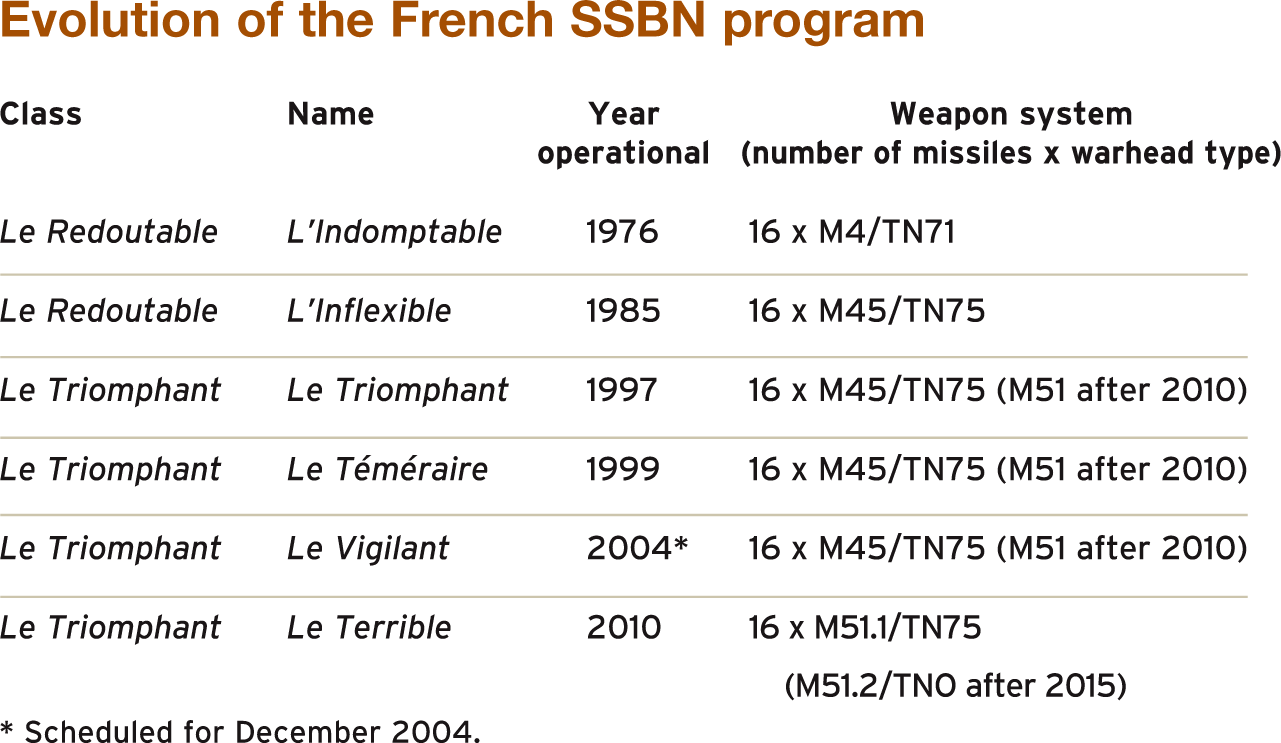
Scheduled for December 2004.
French nuclear modernization
The M4 missile, with a range of at least 4,000 kilometers, carries six TN71 warheads, each in the 100-150 kiloton range. The characteristics of the M45/TN75 weapon system are reported to be similar. The ASMP, which has a range of about 300 kilometers, carries a 300-kiloton TN81 warhead. 6 Official documents suggest that in 2000, France possessed 48 SLBMs and about 60 nuclear-capable aircraft. 7 The current total number of nuclear weapons is not known, though most estimates put it around 350. 8 Through the SSBN force and the carrier-based force, the French Navy operates about 80 percent of the French arsenal. 9
Few official announcements have been made about future systems, but it is clear that they will have increased range and greater precision. The range of the M51 with a full payload of warheads and penetration aids is said to be about 6,000 kilometers. 10 However, according to a renowned defense commentator, its range with a single warhead will be much greater. 11 The range of the ASMP-A is reported to be 300-400 kilometers and its precision within 10 meters. 12 Officials have suggested that the M51.2 version will have a greater range than the M51.1, and that both the M51 and ASMP-A will have in-flight trajectory correction abilities, giving them increased precision to limit collateral damage. 13
Lumping together all French nuclear weapons in a single category of “strategic” systems gives France increased flexibility in nuclear planning and operations. For instance, depending on circumstances, airborne weapons could supplement SSBNs for executing “unacceptable damage,” or perhaps a single SLBM shot could be used as a “final warning.” (News reports indicate that it will be possible to tailor the M51 strike by firing any number of missiles loaded on new-generation submarines, and that retargeting at sea will also be an option. 14 ) With a much-reduced arsenal, this is surely considered an asset by French nuclear planners.
Emerging challenges
France's nuclear program is ambitious. Paris prides itself in having a very strict definition of what an “independent” nuclear program is. The existence of a two-way technical cooperation channel on nuclear safety and security with the United States is a matter of public record, but otherwise, unlike Britain, France has sought to build and maintain autonomously all the necessary components of its nuclear arsenal. It is now setting up a costly simulation program aimed at maintaining an enduring stockpile without live nuclear testing. The program will include a high-power laser, a powerful radiography machine (AIRIX), and a massive parallel computing architecture.
Besides its development of two successor missiles and warheads, France also wants to diversify its deterrent to counter new threats; increased precision and/or adapted warheads might be needed to target “centers of power” of regional adversaries.
France also has some missile defense ambitions. In June 2001, Chirac confirmed that the country's forces abroad should be protected against the threat of tactical missiles. To that effect, the Aster family of weapon systems will provide the basis for short-range ballistic and cruise missile defense. In addition, at the NATO Prague Summit of November 2002, Paris confirmed its participation in feasibility studies for a European missile defense.
But these goals might not be compatible with France's current and projected resources.
The simulation program, a scientific and technical challenge, is a oneway street–there is no turning back. While it is not tantamount to a “technological freeze,” it will not allow for the conception of new designs or the development of entirely new types of warheads. France would not be able to independently test nuclear weapons any more if, for warhead safety or reliability reasons, it needed to do live nuclear testing again and withdraw from the Comprehensive Test Ban Treaty; the only realistic option would be to use another country's test facilities. France also would not be able to produce additional quantities of fissile material if someday it wanted to increase its number of nuclear weapons.
France must also face the fact that the expertise needed to maintain and adapt its deterrent is weakening. In the post-Cold War context, the Commissariat à l'Énergie Atomique and the French Navy have found it difficult to attract “the best and the brightest.” And France's missile expertise is now in the hands of a private multinational company, EADS, for whom nuclear deterrence is more a business than a mission. With fewer contracts, even the company will not maintain as much technical expertise as in the past.
But France's biggest challenge may be financial. Its deficits have dramatically increased in recent years, and severe budgetary restrictions are expected, notably under EU pressure. And the growing social demands of an aging population are expected to limit future governments' ability to maintain high levels of defense investment.
Even though French defense expenditures, which have increased since the reelection of Chirac, remain substantial (32.4 billion euros in 2004, not including payouts for military pensions), there are now strong financial constraints on nuclear programs. Between 1990 and 2000, Paris scaled back nuclear appropriations by 58 percent. The nuclear budget for 2004 is 3.11 billion euros. This is less than 10 percent of the total defense budget, a historical low. The planned yearly nuclear budgets for 2003-2008 average only 2.82 billion euros per year. It remains to be seen whether France can accomplish its nuclear goals within this budget. Despite the cuts, the cost of nuclear programs is increasingly criticized by a large segment of the military community and by many across the political spectrum, particularly on the left.
The road ahead
France prides itself on its policy of nuclear sufficiency and continues to emphasize that its nuclear arms are weapons of “non-use.” At the same time, it seeks a more flexible deterrent, able to confront a wider range of threats with a wider range of targeting options. It is by no means certain that the French public, allies, and potential adversaries understand France's nuclear policies.
And although all nuclear doctrines retain a measure of ambiguity, nuclear policies regarding some emerging threats have yet to be addressed. For instance, would the threat of a conventional ballistic strike on French territory be covered by nuclear deterrence? Or would France expect a NATO missile defense to cover this risk–and in that case, does Paris have the will and the means to be a significant partner in such a system? Generally speaking, France does not seem to have reexamined the meaning of deterrence in an increasingly complex security environment. The notion of non-nuclear deterrence in terms of terrorism and weapons of mass destruction seems entirely foreign to the French official language on security affairs.
France's independent nuclear stance will be harder and harder to reconcile with its drive for a more integrated European Union. This challenge has been recognized since the early 1990s by successive French governments, but so far none of them has been able to give a satisfying answer to this dilemma. One of the foundations of French nuclear policy was the idea that “the nuclear risk cannot be shared.” Extended deterrence such as the one provided by the United States to the rest of NATO was judged not credible. But the European Union, which includes contiguous countries bound by increasing political, economic, and cultural ties, is of a different nature from NATO. Thus France, in its 1994 Defense White Paper, welcomed the idea of a nuclear component in European defense policy–suggesting that Europe will not be fully autonomous without taking into account the nuclear dimension.
French leaders have suggested that the country's nuclear deterrent already plays an implicit role in the protection of Europe. In 1995, Paris and London declared that they “could not imagine a situation in which the vital interests of either of our two nations, France and the United Kingdom, could be threatened without the vital interests of the other also being threatened,” and decided to increase nuclear cooperation between the two countries. 15 In his June 8, 2001 speech, Chirac stated that any decision by France to use nuclear weapons “would naturally take into account the growing solidarity of European Union countries.” But despite some occasional hints, France has fallen short of declaring that its nuclear deterrent explicitly covers its EU partners. 16 The way France interprets the mutual security guarantee that member states have agreed to include in the EU Constitution will be an interesting test of French nuclear policy.
Footnotes
1.
Reuters, “L'Elysée dément toute inflexion de sa doctrine nucléaire,” Oct. 27, 2003; and Defense Minister Michèle Alliot-Marie in Assemblée nationale, debate proceedings, October 28, 2003.
2.
See Bruno Tertrais, The French Nuclear Deterrent After the Cold War, P-8012, Rand Corporation (1998).
3.
“Des Français en Irak? ‘Pas à l'ordre du jour,’” Le Journal du Dimanche, July 13, 2003, p. 2.
4.
See: Report by France on the Implementation of Article 6 and Paragraph 4 of the 1995 Decision on Principles and Objectives of Nuclear Non-Proliferation and Disarmament, Second Session of the Preparatory Committee of the 2005 Nuclear Non-Proliferation Treaty Review Conference, Geneva, April 30, 2003.
5.
U.S. surface ships no longer carry nuclear weapons.
6.
Data on France's nuclear forces from: François Mitterrand, Statement on French deterrence policy, Paris, May 5, 1994; René Galy-Dejean, opinion presented in the name of the Armed Forces and National Defense Committee on the Draft Budget Law for 2002, vol. 2, Defense–Nuclear Deterrence, Assemblée nationale, October 11, 2001; Antoine Carré, opinion presented in the name of the Armed Forces and National Defense Committee on the Draft Budget Law for 2003, vol. 2, Defense–Nuclear Deterrence, Assemblée nationale, October 10, 2002; Guy Teissier, report made in the name of the Armed Forces and National Defense Committee on the Draft Military Program Law for the Years 2003-2008, Assemblée nationale, November 20, 2002; SIPRI Year-book, p. 619 (2003).
7.
See Arms Control, Disarmament and Non-Proliferation: French Policy (Paris: La Documentation Française, 2000), p. 39. According to a parliamentary source, 50 aircraft will be adapted to carry the ASMP-A (Antoine Carré, opinion presented in the name of the Armed Forces and National Defense Committee on the Draft Budget Law for 2004, vol. 2, Defense–Nuclear Deterrence, Assemblée nationale, October 9, 2003, p. 27).
8.
Such totals assume the M45 missile carries six warheads (a total of 288 warheads for three boatloads) and that about 60 aircraft could each carry one ASMP missile.
9.
Defense Ministry, La défense et les forces armées de la France, undated [Internet version].
10.
Carré 2003, p. 20; Teissier, p. 11.
11.
Jacques Isnard, “La France s'arme face aux puissances régionales ‘proliférantes,’” Le Monde [Internet version], November 7, 2003.
12.
Ibid.
13.
Yves Boiffin, “La Loi de programmation militaire 2003-2008: Adapter les forces nucléaires,” Les Cahiers de Mars, no. 178 (2003), pp. 122-123.
14.
Isnard, “La France s'arme face”; Jean Guisnel, “Dissuasion: le plan secret de Chirac,” Le Point [Internet version], October 31, 2003.
15.
Agence France Presse, Texte de la déclaration commune franco-britannique sur le nucléaire, Oct. 30, 1995.
16.
Alliot-Marie declared, “Our deterrent protects us and protects a large part of Europe,” (France-Inter Radio, November 2, 2003).