



Abstract

On the twentieth anniversary of the Sarajevo Winter Olympics, I found myself at the top of Mount Bjelasnica, site of the men's downhill competition, standing next to the war-ravaged remains of the summit observatory. The ski lift to the observatory was destroyed during Bosnia's long civil war, and its cables could be seen snaking downward, through 10 years of forest growth, toward the collapsed concrete hotel at the base of the run. There were rumors of mines in the forest, but Sarajevans–long accustomed to minefields and burned-out buildings–were out on the mountain in force, braving long lines, bitter winds, and a treacherously steep rope-tow for a chance to carve some turns on the old Olympic run.
About half the buildings have been rebuilt in this Sarajevo neighborhood.

Getting to the mountain was another matter. Bjelasnica–and the remains of the Olympic ski-jump run on Mount Igman–are a short 20-minute drive out of Sarajevo. But the direct road runs through Ilidza, a Bosnian Serb-controlled suburb. Although there is no particular danger there for Sarajevans, the city bus to Bjelasnica avoids Ilidza altogether, taking a meandering, 50-minute route around Bosnian Serb territory to reach the resort. Nevertheless, the bus was packed on that February morning largely because few Sarajevans are willing to go to the area's other Olympic ski resort. Mount Jahorina, built for the women's Alpine events, is much closer to the city and is said to have better runs, snow, and amenities. But it too belongs to the Bosnian Serbs, whose four-year siege of Sarajevo killed 10,000, including 1,500 children. “It's not that we would have any problems if we went there,” a Sarajevan friend explained. “We just don't want to give them our money when we have a resort of our own we can support.”
While the rest of the world has been focused on events in the Middle East, the international effort to build a peaceful, unified, and democratic Bosnia has made some modest gains, even if the country's three nationalities don't entirely trust one another.
Outwardly, Sarajevo no longer looks like a war-ravaged city, as damaged buildings have been repaired and devastated ones knocked down and replaced. The European Union has almost finished rebuilding Mostar's famous sixteenth-century bridge, which Bosnian Croats destroyed during the war. Hundreds of thousands of refugees have been able to move back to towns and villages controlled by their former nemeses. And after years of resistance, the country's ethnically divided political leaders have acquiesced to the formation of a handful of nationwide political institutions, including a military command and border patrol.
Two years ago, Bosnian authorities even launched a bid to bring the Winter Olympics back to Sarajevo in 2010. The Zetra ice rink was rehabilitated, new recreational facilities were installed at Jahorina, and an Austrian-built ski lift opened on Bjelasnica. Not surprisingly, Bosnia lost the bid. But Croats, Serbs, and Bosniaks (Bosnian Muslims) found themselves agreeing on something for a change, and the city plans to try again for 2014.
While Bosnia may not be peaceful enough to host the world's athletes, experts say it has normalized enough to be increasingly unattractive to global terrorist networks.
Groups like Al Qaeda are thought to seek out “weak states” like Bosnia, a country with an ineffective central government and porous borders, which was once home to hundreds of foreign Islamic mercenaries. During the war, hundreds of mujahideen from the Middle East and North Africa helped defend Sarajevo and other Bosniak-held cities when nobody else would. After the war, some 200 of them stayed in Bosnia, as did a number of questionable Islamic charities that U.S. officials say are linked to international terrorist networks. In the aftermath of September 11, 2001, Bosnian police raids on the offices of suspect charities reportedly turned up weapons, explosives, forged passports, and, in one case, letters from Osama bin Laden.
Western officials in Sarajevo say that Bosnian officials of all nationalities have been extremely cooperative in monitoring and investigating individuals and groups suspected of terrorist links. Most of the suspicious charities have been shut down, a senior diplomat told me, while Bosnian authorities and NATO peacekeepers keep close tabs on resident mujahideen, many of whom have married Bosnian women and settled in rural areas.
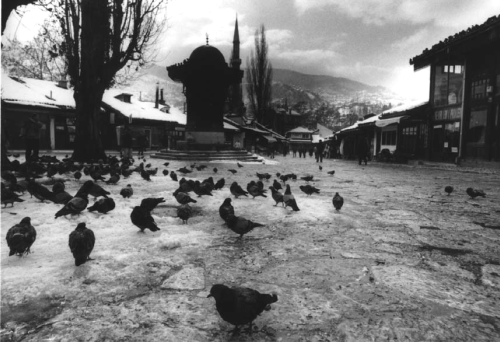
A community square in Sarajevo.
“There is no evidence that there are or were Al Qaeda camps in Bosnia,” the diplomat says, adding that many mujahideen had been urged to “move on” by Bosnian and NATO peacekeeping forces. “Al Qaeda is not here now, but it certainly could be here if we don't keep our eyes on it.”
Senad Slatina, a Bosnian journalist who is now the local analyst for the International Crisis Group, says concerns about international terrorism taking root in his country have been overblown. Bosnia's Muslims “are so European that the radical form of Islam has absolutely no chance of spreading here,” he says. “It's just not a thing that could attract the young set here.”
The head of Bosnia's Muslim community, Grand Mufti Mustafa Ceric, is a case in point. The 54-year-old spiritual leader has a resumé that includes a doctorate from the University of Chicago, several years as an academic theologian, and a job as his country's first diplomatic representative to Malaysia. “When the history of the Bosnian war is written, he will be seen as a major constructive force,” a senior Western official says of Ceric. “He managed to keep his flock together without radicalizing them, and that's a major contribution.”
“I want to assure each and every American that as far as Bosnia is concerned they can sleep safely,” Ceric tells me in fluent English. Seated in the audience chamber of the sixteenth-century mosque that serves as his headquarters, he continues, “Believe me, Bosnia and Herzegovina is free from Al Qaeda, which is something that has no business here.”
But there has been unease among Western officials that Wahhabism, the more radical version of Islam practiced in Saudi Arabia, might take root among Bosniaks, who follow the tolerant Hanafi tradition of Turkey and the Balkans. Saudi money built the enormous King Fahd mosque on the edge of Sarajevo, and there has been a noticeable increase in the number of young people wearing long beards or headscarves since the end of the war. Two years ago, a local convert to Wahhabism, Muamar Topalovic, opened fire on a family of Catholic Croats while they put up Christmas decorations, killing three and shaking up the country.
“Hello? Is this where I apply for the behavioral research grant?”
But Ceric, who meets regularly with his Catholic, Orthodox, and Jewish counterparts in Sarajevo, downplays concerns that Wahhabism will spread among Bosnian Muslims who have lived among a Christian majority for centuries. “Some young people have been influenced by this way of thinking or interpretation of Islam, but the mainstream of Muslims here remain loyal to our traditions,” he says. “I have never doubted that my people will stay the way they are.”
Religious extremism may also be kept in check by the slow but noticeable progress the country has made recently in implementing the Dayton peace agreements, which ended Bosnia's war. Over the past few years large numbers of victims of ethnic cleansing have been able to return to their former homes, even those in areas where another ethnic group formed a majority after the war. Of the approximately 2.2 million people forcibly displaced in the conflict, about one million have been able to return to their pre-war homes. Almost half returned to places where their ethnic group was a minority, according to the U.N. High Commissioner for Refugees (UNHCR).
“People have voted with their feet,” says Udo Janz, the head of the UNHCR mission in Sarajevo, who notes that Bosniaks are even returning to Srebrenica, where Bosnian Serbs massacred more than 7,000 Bosniak men and boys in 1995. “There's a genuine will to return to their homes and prove the politics of the wartime period to be wrong.”
Meanwhile, Bosnia's national governing institutions are starting to show signs of life, prompted by Bosnians' shared desire to eventually join the European Union and other Western institutions. “Certainly the idea of becoming a member of NATO or the European Union one day is the driving force behind many of these changes,” says Oleg Milisic, a spokesman for High Representative Paddy Ashdown, the highest-ranking international official here. “They don't want to be left behind.”
Despite the hopeful signs, Bosnia is falling behind its neighbors, Serbia and Croatia. The economy–with 40 percent unemployment, extremely slow growth, and a massive trade deficit–remains almost entirely dependent on foreign aid and smuggling. “Those economic indicators are not the basis of an optimistic forecast,” says economist Boris Tihi, rector of the University of Sarajevo. “Without direct foreign investment, it is impossible to solve this country's problems, that's clear to everybody.”
“We're definitely moving forward, but the progress is too slow,” says Jakob Finci, head of Bosnia's Jewish community, who offers a sobering historical parallel. “Just three years after the end of World War II, Yugoslavia's gross national product had reached its pre-war level without large-scale assistance from the United States or the [Soviet Union],” he says. “Now it's eight years since our war ended and Bosnia has received huge international assistance and we haven't even reached one half of our pre-war GNP.”
“The problem is that we're all still not pulling in the same direction,” he says. “I don't think that everybody has given up on the idea of splitting Bosnia into two or three parts.”
Ceric, the Muslim leader, believes Bosnia will make quick progress once prominent war criminals like Bosnian Serb leader Radovan Karadzic and Bosnian Serb military commander Ratko Mladic are brought to justice. “Let me make a small appeal from a small mufti of a small country to the United States: Please continue the job of capturing the war criminals in the Balkans for the future of your children and ours,” he says. “Believe me, if Karadzic and Mladic are in [the criminal tribunal at] The Hague, the process of integration here will move extremely fast.”
He pauses for a moment, a smile breaking across his face. “Then every American can be proud,” he says, “because one day they will come here to Bjelasnica and Ingman and the Zetra arena and earn some Olympic medals.”