



Abstract

Scaled Composites's White Knight carries the rocket-propelled SpaceShipOne on its underside.

Up and away
Privatizing space isn't new. Commercial satellites circle the globe, companies pay governments to conduct research in orbit, and rich folks even hitch rides aboard Russian spacecraft. But private interests have always taken a backseat to national interests since space flight equipment is all owned by or dependent on government programs. To date, no private company has gone where only nations have gone before.
But that could have changed by the time you read this.
Since 1997, when the St. Louis-based X Prize Foundation announced its $10 million prize to be given to the first privately funded team to fly a three-person ship into orbit, 26 teams from seven countries have had their eyes on the X Prize. (See “Major Tom to Prize Control,” November/December 1999 Bulletin.)
On May 5, the X Prize was renamed the Ansari X Prize when entrepreneurs Anousheh Ansari and her brother-in-law Amir Ansari, both of whom grew up in Iran, announced a multimillion dollar contribution to the X Prize Foundation. The Ansari X Prize is modeled after the $25,000 Orteig Prize won by Charles Lindbergh in 1927 for his historic transatlantic flight.
An illustration depicting a privately owned spacecraft in orbit.

The team currently in the lead is Scaled Composites, headed by Burt Rutan, who is best known for designing the Voyager airplane that made the first nonstop, un-refueled flight around the world in 1986.
The Federal Aviation Administration (FAA) announced on April 7 that it would license Rutan's latest craft for manned suborbital flight. This is the first license for space flight ever issued by the FAA.
The Scaled Composites craft consists of two parts: SpaceShipOne, a rocket-propelled aircraft; and White Knight, the jet that carries SpaceShipOne aloft for high-altitude launches.
In a May 13 test, Space-ShipOne demonstrated for the third time that it is capable of self-powered, high-altitude, supersonic flight. After being dropped from White Knight at an altitude of 46,000 feet, SpaceShipOne pilot Mike Melvill ignited the engines and pulled into a 55-second vertical climb that took the craft to an altitude of 211,400 feet–the edge of space.
As it fell, the rocket descended at twice the speed of sound. The duration of ascent, altitude reached, and the Mach-2 descent were all firsts for a private endeavor (Los Angeles Times, May 14).
To capture the prize, a team will have to do better than that. Winning requires two launches to an altitude of 62.5 miles (328,000 feet) above the Earth's surface within a two-week period, including safe landings. Prize organizers and observers expect Rutan's team to make the first attempt at reaching space within weeks (BBC News, May 14).
Close on the heels of Rutan is Canada's da Vinci Project, which will announce a launch date for its Wildfire capsule later this year (Globe and Mail, April 5).
Like SpaceShipOne, Wildfire will be lifted to high altitude before firing its rockets and flying into low orbit. Unlike Space-ShipOne, Wildfire will be hoisted skyward by the world's largest helium balloon. The balloon launch will take place from the world's first designated “spaceport,” a rural airport in Kindersley, a community of 5,000 located southwest of Saskatoon. Would-be astronaut Brian Feeney plans to fly Wildfire to an altitude of about 75 miles and remain there for five minutes. A parachute will return his craft back to Earth.
The da Vinci Project's budget of $5 million is a fraction of Scaled Composites's $25 million–provided to it by Microsoft cofounder Paul Allen. “It's the Canadian team with no money against the American team with unlimited resources,” da Vinci spokesperson Melanie Wildman told the Globe and Mail, but “we feel like we have the edge.”
Rutan and others vying for the Ansari X Prize are opening the way for commercial space flights in which the public could fly into space for about $100,000 by 2020. It's not cheap, reports Peter Pae in the May 14 Los Angeles Times, but it's a fraction of the $60 million it currently costs NASA to send a single astronaut into space.
Imagining an air and space show of the future. The sign reads “X Prize: The New Race to Space.”

The possibility of a flight in space may be one motivation for the Ansari family's May 5 donation. Both Anousheh and Amir say they grew up dreaming of being able to travel into space. The only way for this dream to become a reality, Anousheh Ansari told the press, is with the imagination and passion of private industry and creative entrepreneurs.
Disposal in the doldrums
April 29 came and went with little fanfare for the federal agencies responsible for destroying the U.S. stockpile of chemical weapons. It was supposed to be the day they met the latest deadline imposed by the Chemical Weapons Convention (CWC) to destroy 45 percent of the country's vast stores of deadly chemical agents. But delays in funding, constructing, and safely operating disposal facilities have stalled destruction efforts for so long that the United States risks missing the extended 2007 deadline for the 45 percent goal, according to a recent General Accounting Office (GAO) report.
Defense Department officials say they want the deadline for the total eradication of the stockpile pushed back too, but according to the GAO, “unless the program resolves the problems causing program delays,” the United States risks missing this extended deadline, too.
Mismanagement has been the most frequent critique of the disposal program, but at least one observer questions whether government officials feel any urgency to get rid of weapons stockpiles, considering the abysmal disposal efforts in Russia. Russia possesses the world's largest stockpile of chemical weapons and is running far behind in meeting its CWC goals. (As of September 2003, Russia had destroyed only 1 percent of its 40,000 metric tons of chemical weapons.)
“I see no reason for the United States to destroy their stockpiles three or four years ahead of Russia,” says Igor Khripunov, associate director of the Center for International Trade and Security at the University of Georgia in Athens.
Workers unload canisters of chemical weapons from larger containers at the Tooele chemical agent disposal facility.

New leadership with close ties to the military, as well as ongoing administrative reform in Russia, is slowing down the progress of the destruction program, according to Khripunov. The U.S. Defense Department has so far committed more than $460 million to the construction of the disposal facility at Shchuchye–what would arguably be the most important disposal facility in Russia–according to the GAO. Funding has been delayed as Russia repeatedly fails to meet conditions set by Congress. In the meantime, costs for the project are expected to balloon from $888 million to more than $1 billion. The GAO estimates that all chemical agents located at Shchuchye will be destroyed, at the earliest, by 2016.
The status of disposal at certain U.S. locations:
U.S. chemical weapons: How much is left?

Source: Defense Department, Chemical Weapons Working Group. Data as of April 2004.
In March, army officials also reprimanded a contractor at Tooele for a series of safety lapses. At the site, “performance is regressing back toward the pre-July 2002” level, when a worker came in contact with a nerve agent during routine maintenance, army officials told the contractor. Operations at the site were suspended from July 2002 to March 2003 following the incident.
Further delays are possible as the army finalizes its plans to treat the byproducts of neutralization at a Dupont treatment facility in New Jersey. Local officials and communities have opposed the plan to dump the treated by-products into the Delaware River. Army officials have said they plan to start neutralizing the agent this summer, even if plans to ship the waste to New Jersey are not complete.
Soon to be playing in the West Wing?
Ever wonder what the president watches on television? A safe bet this fall might be a new show called D.H.S.: The Series. That's DHS, as in Department of Homeland Security, and the show's producers are hoping that protecting the homeland from terrorists will also make for prime time entertainment. CBS is considering the show for its upcoming season, with some in the industry calling it “The West Wing, Bush style: more buttkicking, less hand-wringing” (USNews.com, April 12). Eight episodes are currently in production.
The series' producers claim that both the president and Homeland Security Secretary Tom Ridge have provided unheard of support for the show, including an arrangement allowing for the president's voice and image to be used in the opening credits and trailer (E! Online, February 26).
It's no wonder: The “reality fiction” show will glorify Homeland Security and President Bush's counterterrorism efforts, a central theme of the president's election campaign. With the show's premier scheduled to coincide with the final weeks of the presidential election, some observers are crying foul.
“Mind you, Bush is having a hard time convincing people that the country is actually still at war, though it's a central element of his campaign for reelection as the ‘war president,’” Dan Froomkin wrote on washingtonpost.com (February 27). “This show is based on exploiting that very premise.”
In Brief
Of 28 high-ranking government officials found by the General Accounting Office to have listed fake degrees on their resumes, three were employed by the Energy Department's National Nuclear Security Administration, held top-secret security clearances, and performed “emergency operations responsibilities” (Wired.com, May 13).
A mock guidebook to the fictional East European country of “Molvania” describes it as the birthplace of whooping cough and the owner of Europe's oldest nuclear reactor. Co-author Tom Gleisner told BBC Today, “It's a very beautiful country now that radiation levels have dropped to acceptable standards.” The book, a spoof of the travel guide genre, has been criticized for reinforcing stereotypes of Europe's less-developed states (BBC News, April 2).
The May 2004 edition of Harper's reprinted this gem from the “frequently asked questions” Web page of the U.S. government's Hurricane Research Division: [Question:] “Why don't we try to destroy tropical cyclones by nuking them? [Answer:] During each hurricane season there always appear suggestions that one should simply use nuclear weapons to try and destroy the storms. Apart from the fact that this might not even alter the storm, this approach neglects the problem that the released radioactive fallout would fairly quickly move with the trade winds to affect land areas and cause devastating environmental problems.”
In early April the American Civil Liberties Union (ACLU) filed a lawsuit challenging a provision of the USA Patriot Act that permits the FBI to engage in secret search and seizure activities. Because of the Patriot Act, though, the ACLU could not even reveal the fact that it had filed the case. After three weeks of negotiations with the government, the organization was finally permitted to release an edited version of the suit. But government censors continued to insist that the name of a second plaintiff in the case remain secret (Washington Post, April 29).
Nuclear Power 2010, a Bush administration program designed to revitalize nuclear power plant construction in the United States, has energy companies lining up to take advantage of its provisions: namely, to get their dukes on the millions of dollars the government is offering just to help them fill out application forms to build new reactors. For instance, NuStart, a consortium that includes well-to-do companies like Exelon, Entergy, the Tennessee Valley Authority, and even the North American subsidiary of the French government-owned Electricité de France, is asking for $400 million even though it has not yet picked a site or a design, or actually committed itself to building a plant (New York Times, April 26).
The Environmental Protection Agency's annual SO2 Allowance Auctions were originally intended to allow sulfur dioxide-spewing utilities to purchase other power companies' unneeded “rights to pollute.” The idea was that if more heavily polluting companies could not purchase enough rights they would eventually have to reduce their emissions. But there is another way to force the speed-up of the cleaner-air process, as demonstrated by an environmental economics class at Bates College in Lewiston, Maine (Wired.com, April 7). Taking advantage of the fact that the auctions are open not only to utilities, but to brokers and the public as well, the class purchased the right to emit nine tons of sulfur dioxide. Instructor Lynne Lewis explained that the right would be retired unused.
Who would have thought kitty litter would cause such a fuss? But it is one of an odd assortment of benign objects and materials that has been triggering radiation detectors throughout the country. With screening programs now in place to support law enforcement agents, first responders, and customs officials, scientists from national laboratories are being called on to identify “mysterious” objects that set off radiation detectors. Offending items include cocoa powder and bananas, which contain potassium; types of pottery and porcelain, and granite, which contain thorium and uranium. The offending kitty litter contains thorium and potassium (Los Angeles Times, April 1).
British scientists believe there is at least one area in which they can lead the world–scouring the skies for dangerous Near Earth Objects that could come crashing down (BBC News Online, March 12). But, they say, the British government has stopped worrying about rocks from space and gone back on its 14 space-rock surveillance recommendations. Says Jay Tate, director of the Spaceguard Centre, “All we really have is a Web site about NEOs sponsored by the government, and even the funding for that is not secure after this year.”
Critics have also noticed the show's religious elements. One promotional poster features an image of Bush and his cabinet with their heads bowed in prayer. Show producer Joseph Medewar says that Christianity will be a central element of the show. Indeed, in the trailer the main character says, “Hey Johnny, do me a favor: Say a prayer,” as he runs off to rescue a group of hostages.
Although the White House originally denied having talked with the show's producers, show execs are now meeting with Homeland Security officials, and actors have visited government facilities to get a feel for the environment in which agents work (Boston Globe, February 28).
In California, action-hero governor Arnold Schwarzenegger gave the show a thumbs-up by allowing it to be filmed in state emergency facilities.
The Bush administration has called on Hollywood to produce homeland security-themed shows, and this show fits the bill, says a White House spokesperson. According to the D.H.S. series Web site, the show is a drama about an executive action group within the Homeland Security Department: “Behind the politics, the press, and the debate over how homeland security should be handled are the men and women who risk their lives every day to keep us safe.”

The fictional group leaders, Agents Jack Callahan and Andrea Bacall, will do whatever is necessary to “identify, track, and eliminate” potential threats to the homeland.
Callahan and Bacall's cohorts include a disgruntled former agent called back to service, the wife of a missing-in-action government agent, a Navy SEAL, a nightclub singer turned operative, and a terrorism expert turned recluse.
There's even what the show's producers call their “token Arab”; he's the technology guru.
And in this corner, the state of Nevada…
Several long-festering disagreements are still preventing the federal government and the state of Nevada from playing nice with each other. Here's an update:
The Energy Department is paying the law firm of Hunton & Williams $12 million this year to begin to prepare the license application for the nuclear waste repository at Yucca Mountain (Las Vegas Sun, April 9). Energy has agreed to pay $45 million through 2008 for the law firm to act as main legal counsel for the licensing process, with an additional $20 million in fees possible through 2013.
Meanwhile, the state of Nevada has awarded $6 million to Egan, Fitzpatrick, Malsch & Cynkar to argue against the licensing of the waste site.
Under the Waste Policy Act, the Energy Department is required to provide Nevada with enough money for state oversight of the Yucca project–in other words, for funds to try to block it. But it has so far offered only $1 million to meet the state's anti-licensing needs. The state is suing for an additional $4 million, and the Nevada legislature has stepped in with an emergency fund of $2 million to fight the license.
Nevada is also threatening to sue the Energy Department to keep radioactive waste from the Fernald, Ohio, uranium plant from being buried at the Nevada Test Site's low-level nuclear waste repository.
State Attorney General Brian Sandoval says the material from Fernald, a by-product of the extraction of uranium from ore, was falsely reclassified as low-level waste to become eligible for burial at the test site (Cincinnati Enquirer, April 15). Energy's plan to ship the waste to Nevada “is reckless and unsafe, and it flagrantly violates the law,” says Sandoval. (The same material was previously rejected by a private landfill in Utah.)
On a third front, in March the National Park Service objected to applications for the pumping of additional groundwater to meet the needs of Las Vegas's growing population, saying lowered water levels might threaten the rare pupfish at Devil's Hole, Nevada. At a hearing on the matter, Paul Taggart, a Southern Nevada Water Authority attorney, suggested that the Park Service's water rights branch might not be treating Las Vegas fairly. “I'm wondering,” he asked water rights chief Chuck Pettee, “why it is that you wouldn't be concerned about the pumping in the Test Site at Yucca Mountain, yet you are concerned about the pumping in this application?”
The little fish at the center of one of several disputes between Nevada and the feds.
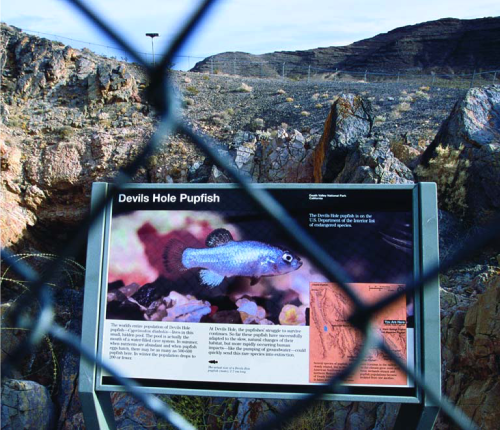
Taggart was referring to the federal government's considerable groundwater demands for the Yucca Mountain nuclear waste project.
In this last case, Nevada had the opportunity to turn the tables on the feds. Last November, when Energy requested additional water for Yucca Mountain, it may have gotten the okay from the Park Service–but the state of Nevada denied the request.