




Abstract
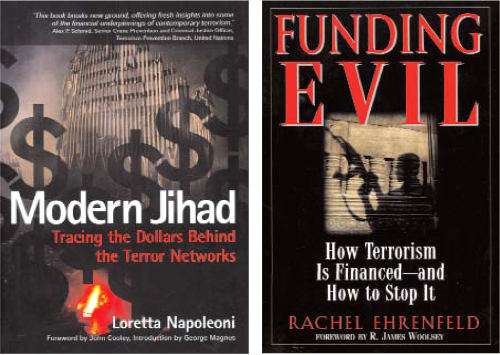
Modern Jihad: Tracing the Dollars Behind the Terror Networks By Loretta Napoleoni, Pluto Press, 2003, 295 pages; $24.95
Funding Evil: How Terrorism Is Financed–and How to Stop It By Rachel Ehrenfeld, Bonus Books, 2003, 267 pages; $24.95
Osama bin Laden is commonly thought of as a radical Islamic propagandist, recruiter, and advocate. What is less considered is that bin Laden is a master financier and entrepreneur. He has created a redundant, multi-layered, global financial network that sustains thousands of radical Muslims, many bent on attacking the United States. Terrorist groups view bin Laden as a central bank; they propose attacks on videotape or in person in hopes of achieving his financial support.
Bin Laden learned the importance of managing people and money early in life. As a boy he worked in the family construction company, where he was first exposed to business dealings. After attending university, where he studied management and economics, bin Laden built tunnels, bridges, and trenches for the mujahideen in Pakistan in what amounted to an international construction effort. He also co-founded and managed the Services Bureau, a charity in Peshawar, Pakistan, that funneled guns, money, and volunteers to the mujahideen.
After the Soviet war in Afghanistan, bin Laden moved to Sudan, where his vast financial portfolio allowed him to invest in scores of state companies and to revitalize Sudan's infrastructure by helping establish a modern airport and Islamic bank. Bin Laden eventually returned to Afghanistan to help supply and support the Taliban.
During these years, bin Laden developed the relationships and financial expertise that have helped him create a formidable financial empire. He receives money from Islamic charities and wealthy benefactors, from profitable legitimate businesses, and from participation in illegal criminal activities–including drug trafficking and gem smuggling. From bin Laden-owned honey stores in Yemen that launder money, to vessels seized in the Persian Gulf that were smuggling heroin and hashish, to more than $20 million laundered by buying conflict diamonds–the extent of Al Qaeda's holdings is unknown. Al Qaeda uses charities to receive and launder money, act as safe houses, and hide arms, explosives, and other contraband.
Few books have addressed how terrorism is financed, despite the tremendous importance of the subject. In 2003, however, two notable scholars took on the task. Loretta Napoleoni and Rachel Ehrenfeld, both of whom have written extensively about terrorism, illuminate the murky world of terrorist financing in two new books.
Napoleoni, an economist, takes a deductive approach to understanding how terrorists receive, launder, and disburse funds. She breaks down the components of what she estimates to be a $1.5 trillion dollar market–5 percent of the world's GDP–that supports and promotes terrorism.
Napoleoni argues that Islamic financial institutions filled the economic vacuum that followed the Soviet withdrawal from Central Asia and the Caucuses–areas with large Muslim populations. These institutions, largely unregulated and adept at participating in the black market, fueled the proliferation of Islamic armed groups. Unlike Western capitalists, Napoleoni says, many Islamic businessmen do not view banks as profit-making ventures but as instruments to spread Islam. Napoleoni maintains that terrorists use Islamic financial institutions to bolster their economic independence so they can set their own goals and not be forced to do the bidding of their benefactor. She describes how the Palestinian Liberation Organization (PLO), when expelled to Lebanon, took control of the country's ports so it could levy taxes and fees on traders, thereby developing an independent source of income. Napoleoni categorizes the markets that terrorists or insurgent groups create to sustain their independence: Illegal armed groups operating in lawless areas benefit from a “war economy,” engaging in illegal economic and criminal activity without fear of legal repercussions; other groups, like the Basque separatist ETA, create “predatory economies” where they extort, kidnap, rob, and otherwise steal money from an economically vibrant host.
Napoleoni's most controversial conclusion is that the struggle between Islamic radicals and the West is a clash between dominant (the West) and insurgent (Muslim) economies. She further argues that similarly, the Crusades were motivated by the West's desire to challenge the economic supremacy of the East, which was “blocking the development of Western European commerce.” She contends that most Islamic radicals want to overthrow their own oligarchic governments, which the radicals believe are profiting from relationships with Western businessmen and governments. The only drawback of the book is that, as with this assertion, Napoleoni's desire to portray terrorism in an economic light often ignores other variables that motivate terrorists. Economics is just one tool in bin Laden's inventory, rather than an end itself. Nevertheless, Modern Jihad is an engaging read and provides a unique look at terrorism.
“Our problem is we're too polite to say anything.”
In her first chapters Napoleoni describes how today's terrorist leaders are entrepreneurs who keep their organizations financially healthy and effective–more Donald Trump than Che Guevara. She believes such terrorists are more prone to corruption than their state-sponsored predecessors because they lose their political focus and become mercenaries seeking money from any activity.
In Funding Evil, Rachel Ehrenfeld asks: If business-minded terrorists are prone to corruption, which terrorists today are clearly corrupt? Ehrenfeld, director of the American Center for Democracy and author of many articles and op-eds on corruption, details how PLO leader Yasser Arafat used his position of authority to fill his own coffers. Ehrenfeld paints a bleak picture of Arafat: He uses economic coercion, crime, and international aid to make money for himself and his cronies, she says. Arafat's wealth in 2002 was estimated to be $1.3 billion, with $500 million being part of the PLO's money. According to Ehrenfeld, the PLO leader channels international aid to fund terrorist operations, pay off the families of suicide bombers, and spread Islamic radicalism. She obtained access to seized Palestinian documents that show Arafat approving, in his own handwriting, a Fatah (the PLO's terrorist arm) activist's request for funds for terrorist activities.
Ehrenfeld also shows how European Union aid apparently ended up in the hands of Fatah terrorists. The EU gave 10 million euros for Palestinian Authority salaries, which Arafat, by double-reporting salary amounts, instead directed to his military operations, Ehrenfeld claims.
Ehrenfeld also examines funding sources for other terrorist groups, like Hezbollah and Al Qaeda. She unravels an astonishing list of activities in which Al Qaeda has been involved: taxing Afghanistan poppy growers and heroin refiners; laundering money for the Taliban; purchasing poppy crops directly; distributing refined heroin through the Balkans to Europe; and smuggling arms and uranium. Ehrenfeld also describes how Al Qaeda took control of most of the diamond markets of Sierra Leone and Liberia by hiring unemployed Revolutionary United Front rebels.
Both books raise a difficult question: How can governments attack such an extensive and redundant funding network? In 2001, more than $267 million was donated by Saudi Arabia to Islamic charities, some of whose funds went to legitimate social and economic causes, but much of which was diverted to terrorists and Islamic insurgents. In January, Saudi and U.S. officials announced they would freeze the assets of four Al Haramain Islamic Foundation offices that allegedly channeled money to terrorists. These legal moves are the equivalent of a pinprick on bin Laden's financial network. As long as the Saudi pipeline continues to flow, thousands of other charities, Islamic schools, and banks will divert money to terrorists.
How might the United States shut off the Saudi spigot? In a recent article in Foreign Affairs, Michael Doran argues that Saudi support of Islamic radicals is an extension of the internal political jockeying between reformers and conservatives. Saudi clerics and rulers do not want Shiite Muslims, secularists, or Western-allied Sunni Muslims to gain a political foothold in the country, afraid that the political involvement of any of these groups would reduce their power, import Western culture, and de-Wahhabize the country. As Doran points out, if the United States tries to move the Saudis toward a more democratic, liberally religious state, it will be at least as difficult a task as getting the Soviets to renounce communism. Is the United States ready to undertake a Cold War-like commitment to defeating Islamic radicalism?