




Abstract
It would take some doing, including the imposition of an effective enforcement mechanism, but a nuclear-free zone could be the best answer to proliferation in the Middle East.
An Israeli soldier patrols the border with Lebanon, March 2, 2003.
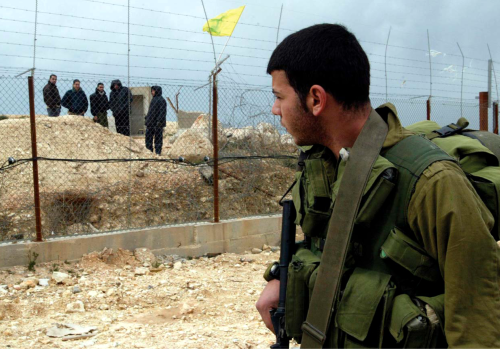
Imagine the following: Despite having agreed to additional inspections of its nuclear-related facilities, Iran continues to hide and build its nuclear weapons program. The United States continues to raise objections, but the international community, in its deliberations, reaches an impasse. As a reflection of its military and political exhaustion in Iraq, the United States hesitates to act militarily. Meanwhile, Tehran silently progresses toward the bomb. Recognizing the threat to its security, Israel decides to respond with force. A regional political, military, and economic earthquake follows.
More than a few assumptions factor into this hypothetical sequence of events, but the fundamental conditions reflect the lessons of recent history and an imposing reality. The Middle East is at a nuclear crossroads.
Iran's growing capacity to break out of the Nuclear Non-Proliferation Treaty (NPT) continues to test the world's tolerance. Despite Libya's decision to abandon its nuclear weapons program, tensions are high in Washington, Jerusalem, and elsewhere.
By pocketing Iran's tentative commitment to transparency, the international community might be able to leverage Tehran's veiled nuclear ambitions to transform the Middle East.
A new nonproliferation architecture would emerge. Elements could include a Middle East nuclear-weapon-free zone enforced by a nuclear contraband elimination authority. NATO and the United States would provide Israel with distinct security guarantees. A separate international action template would provide additional insurance. Collectively, these redundant safeguards would both reduce the risk of nuclear violence and ease underlying political tensions.
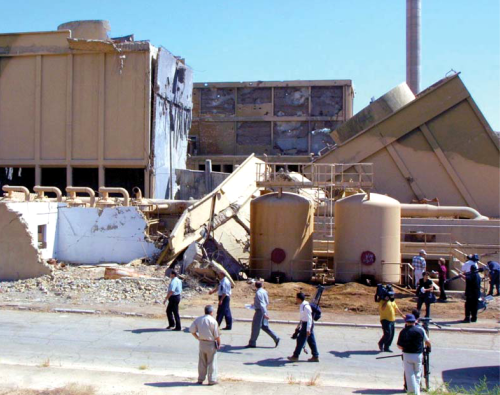
The Iraqi nuclear reactor, first bombed by Israel in 1981 and again during the 1991 Gulf War.
In this sense, Tehran's posture opens a rare opportunity to fashion a grand bargain that will leap over deficient nonproliferation remedies.
Iran's nuclear progress
What is striking about Iran's nuclear journey is how similar it is to the course others pursued to attain the bomb. India, Pakistan, North Korea, South Africa, Libya, Israel, and Iraq all went down the same road.
Each country misrepresented its program as solely for peaceful purposes, while developing domestic human and material resources, and importing dual-use technology. Nuclear activities were secreted to prevent international snooping and impede international inspection.
In Iran, political leaders, including President Mohammad Khatami, repeatedly declared their country's commitment to the peaceful atom even as it violated NPT safeguards.
Only after the International Atomic Energy Agency (IAEA) issued several non-compliance reports and exposed Tehran's duplicity did diplomatic coaxing make progress. In an unprecedented October 2003 collective visit by the foreign ministers of Britain, France, and Germany, Iran agreed to open its nuclear activities to international inspection and “voluntarily to suspend” its nuclear enrichment activities. 1
Then in December 2003, Iran signed the Additional Protocol, which gives IAEA personnel the right to inspect both undeclared and declared nuclear sites in a timely fashion. In coming to its decision, Tehran conceded that it had made mistakes in its reporting.
Hopes that Tehran had turned the corner were dashed in February, when the IAEA revealed more discrepancies in Iran's reporting. 2 Despite the evidence that it was not complying with its obligations under the NPT–the IAEA's March statement “deplored” Iran's actions–the agency's board of governors gave the mullahs yet another chance to take “pro-active steps” toward resolving outstanding issues. 3
Critics were not mollified and suspect that Iran is simply buying time. Tehran's reluctance to reveal its activities in the first place, its resistance to “coming clean” once questions arose, and its insistence on keeping certain details of its nuclear program off limits cloud its commitment to nuclear nonproliferation.
Some fear that the commencement of power generation at the Bushehr nuclear reactor is Iran's next step toward building nuclear weapons. Although Tehran will be obligated to return the spent fuel to Russia, should it begin domestic enrichment–which could provide fuel as well as weapons-grade material–the repatriation obligation would cease. And, should Tehran go forward with its proposed natural uranium reactor, it could extract plutonium from that plant.
As Iran and the IAEA declared a truce, Tehran's neighbors watched anxiously. Jerusalem is on record that it will not allow Iran to become a nuclear weapons state. 4 Saudi Arabia has reportedly explored Pakistani assistance to get the bomb, and new concerns have emerged about Syria. If this were not enough, some believe that Al Qaeda and its sympathizers will seek to take advantage of imperfections in nuclear safeguards to get their hands on the materials necessary to make nuclear weapons.
A mix of remedies
The fact is Iran's behavior has put the NPT in jeopardy by exposing the difficulties in applying traditional remedies.
With more than 180 parties, the NPT is one of the most widely adhered-to of international agreements. Enforcement, however, is weak. The IAEA can monitor activities at declared nuclear sites, and, under the 1997 Additional Protocol, it can attempt to ferret out undeclared sites. Once it uncovers violations, however, it relies on publication to embarrass the transgressor. The IAEA does not have the ability to force a violator to change its ways, although the next step is to refer the matter to the U.N. Security Council for action. But the council has been reluctant to grapple with proliferation and will continue to flounder in the absence of agreed guidelines.
Historically, given the Security Council's weakness, nations combating proliferation have utilized other methods and forums. Each of the strategies has generated its own dilemmas and none alone, or even several collectively, will resolve Tehran's nuclear weapons ambitions.
Diplomatic pressure coupled to economic and military “carrots and sticks” have a mixed record. Applied or mobilized largely by the United States, these measures succeeded in holding down the nuclear aspirations of West Germany, Japan, South Korea, Taiwan, Argentina, Brazil, and now Libya. This strategy failed in Israel, Pakistan, and apartheid South Africa, because security concerns were so great. North Korea and 1980s Iraq were isolated and led by megalomaniacal leaders who sought nuclear weapons to enhance their prowess. In both countries, diplomacy bought the regimes time to further their nuclear aspirations.
In regions characterized by the absence of international conflict or a scientific core to support nuclear technology, nuclear-free zones emerged. In addition to multilateral zones in Latin America, the South Pacific, Southeast Asia, Africa, and those proposed for central Asia and the southern hemisphere, the international community prohibited nuclear weapons in the rather pristine environments of the seabed, Antarctica, and outer space. Other nations acted unilaterally, with New Zealand and Mongolia declaring themselves nuclear free.
Nonproliferation enforcement clearly is the objective of military action, the third approach. Israel's bombing of Iraq's Osirak reactor marks the sole attack on the nuclear war-making potential of an adversary. Despite its success, the attack provided a cautionary note, as the results were short lived. Military action, like a vaccination, needs a booster shot or the support of some other means to eradicate threats. Saddam Hussein reconstituted his nuclear program, as inspections revealed following his defeat in the 1991 Persian Gulf War. But for that conflict, Baghdad might have the bomb.
Nuclear deterrence marked the Cold War and continues to ensure tranquil relations between Washington, Moscow, and Beijing. But it runs up against an uncertain history, because crises happen. The Cuban missile crisis, the Sino-Soviet border dispute, the 1973 nuclear alert, and the recent Indo-Pakistani confrontations provide cold comfort that events will always work out. Then there is the new ingredient–terrorism–against which deterrence has no impact.
Regime change promises a more reliable option, assuming that the new regime's nuclear weapons policies also change. 5 Peaceful transformation worked in Belarus, Ukraine, Kazakhstan, and South Africa to eliminate nuclear weapons. War worked in Iraq and also stopped Nazi Germany. But in general, peaceful regime change is difficult to anticipate, while forceful change is difficult to execute. No doubt, the latest Iraq experience will discourage the latter.
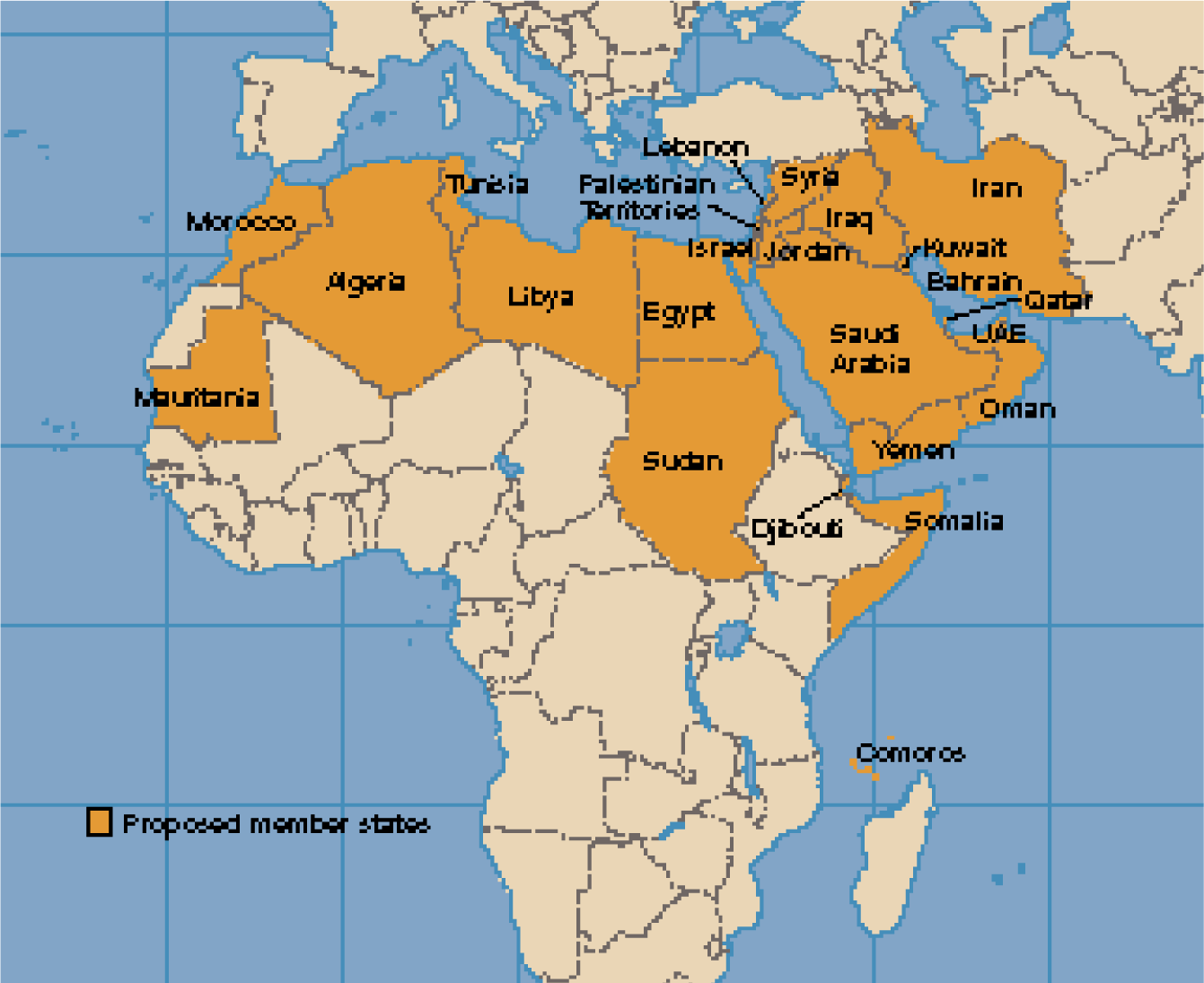
The proposed Mideast nuclear-weapon-free zone.
There is one final option, for which precedent exists: sit tight, do nothing, and hope for the best. Despite concerns about a Chinese bomb, the United States and the Soviet Union accommodated, as they did in the case of France and Britain. Similarly, India and Pakistan may be moving toward a permanent, stable nuclear standoff.
These traditional nonproliferation strategies provide important insights for the Middle East generally and Iran specifically. Diplomatic leverage and economic incentives prompted Iran to be more cooperative and may work in the long run. A nuclear-free zone would be an attractive option for the Middle East if effective enforcement mechanisms were in place. The most dramatic remedy, military action, could set back Iran's program, but it risks a conventional war in response and would not halt nuclear reconstruction. Doing nothing may work only as long as Israel remains the sole nuclear power in the region.
Denuclearization of the region is not a new concept. Egypt has long championed the cause–and it is the only foolproof solution.
Despite their imperfections, elements of these remedies woven with new approaches may provide a viable nonproliferation path for the Middle East. Fabricating this matrix is the challenge.
A nuclear-free Middle East
By declaring that it would never be the first to introduce nuclear weapons into the Middle East, Israel cast the onus on other states to “throw the first stone” and be subject to the opprobrium of the international community. Its immediate neighbors never took up the challenge. In Egypt, historically Israel's most significant adversary, there were economic and technical barriers to development. Egypt's leaders also concluded that nuclear weapons would decrease their own security by inviting nuclear attack from their uneasy neighbor. There is no evidence that Jordan seriously considered the bomb. Syria may toy with the idea, but to date there is little evidence that it has made important progress.
Geographic separation from Israel may have encouraged Libya, Iraq, and Iran to take another course. Libya led the way, attempting to acquire a bomb from China and, once it failed, to seek component parts. Iraq–clearly a nuclear aspirant from the 1970s through the 1980s–is now no longer a player. Then there is Iran.
The proliferation repercussions of an Iranian nuclear program could be serious. Beyond stimulating Israel to respond, it is uncertain whether other Arab states or Turkey would follow suit and build their own nuclear weapons program. Were these countries to act, the risk of nuclear materials being diverted to terrorists would increase.
As international attention has focused on Iran, Arab states have called for “fairness” in the battle to halt proliferation. Led by Egypt, they have urged the international community to pressure Israel to abandon its nuclear weapons program. Mohamed El Baradei, pointing to the risk of regional proliferation, joined the chorus in his December 2003 visit to Israel. 6 Washington, being the only government with clout over Jerusalem, has turned a blind eye. At the same time, it is only too cognizant of the implications of a nuclear Middle East for regional security, and, after 9/11, its own.
Only one foolproof solution resolves the challenge, namely denuclearization. As historically crafted, existing nuclear-weapon-free zones (NWZ) lack the necessary safeguards that would satisfy the volatile Middle East. Unprecedented multi-tiered measures could be the answer.
Mideast denuclearization is not a new concept. Ironically, Iran initiated the idea in the 1970s. On December 9, 1974, Egypt and Iran cosponsored a resolution in the U.N. General Assembly that called upon all nations in the region to reciprocally agree not to produce or acquire nuclear weapons. 7 It also called for adherence to the NPT as a prerequisite for a Mideast NWZ.
In the period that followed, Cairo annually led the drumbeat for the zone in the General Assembly. Early on, Israel attempted to use the initiative for another purpose, recognition. It called upon its neighbors to sit down and negotiate. Arab states declined, arguing that the political relationship with Israel had to be resolved first. In subsequent years, Jerusalem turned the tables. It proclaimed that denuclearization could not advance apart from the peace process and the end of the “active state of war.” 8 Israel reiterated these sentiments, as Egypt led the Arab world in calling on the Jewish state to abandon its nuclear program and join a NWZ in the aftermath of Libya's announcement. 9
A Mideast NWZ would require the resolution of at least seven issues: geography, prohibitions, verification, the role of outside powers, duration and withdrawal, relationship to other agreements, and requirements for entry into force. Envisioned here, the zone would include the 22 members of the Arab League plus Iran and Israel. [See map on page 47.]
All nuclear weapons, weapons technology, weapons-usable material, and machinery that could produce such material would be prohibited. Outside powers would be prohibited from introducing weapons into the zone, and dual-use technology would be subject to IAEA safeguards. Nuclear power would not be excluded from the region, but each plant would have a resident international inspector who also could assume responsibility for monitoring the safe operation of the plant. Custodial responsibility for fresh fuel would rest with the provider country, which would repatriate the spent nuclear fuel.
The IAEA would furnish first-tier enforcement through a new nuclear contraband elimination authority. In order to build confidence in the zone, inspectors' responsibilities would be broadened. Each country or cluster of countries would be assigned resident inspectors, who would be free to visit declared, undeclared, or suspected nuclear sites and also sites containing dual-use technology. They would be granted the right to interview a country's nuclear scientists as well. The authority would command its own fleet of surveillance aircraft modeled after the planes dedicated to the Open Skies regime, which the former Soviet Union and NATO negotiated, or the aerial surveillance that flew over Iraq. This surveillance would supplement intelligence provided by IAEA member states. These aircraft would have sensors capable of ferreting out suspect activity, which ground inspectors could then verify. Inspectors would have the authority to destroy or export contraband to disposal sites in the United States, Europe, or Russia.
The NWZ's duration would be indefinite and there would be no withdrawal right. Although freestanding, all parties in the zone would be subject to the NPT. Before the NWZ would enter into force, all parties in the zone would be required to adopt and ratify the agreement. To add to the zone's luster, the United States or Europe could include economic and diplomatic incentives that would normalize Iran's position in the international community.
A role for NATO
As the Middle East's sole nuclear weapon state, Israel would assume the largest sacrifice under the NWZ. Its nuclear program would be dismantled and it would be expected to be a party to the zone and the NPT. The South African, Ukrainian, and Libyan experiences may provide a model for the disassembly of its program.
But why should Israel bear the burden of Iran's violation of the NPT? The sacrifice only makes sense if it is compensated appropriately. The challenge is to fashion a strategy to supplement the NWZ with compensation that will benefit all parties.
NATO membership would offer Israel a key. For the first time in the Jewish state's history, it would find itself under the strategic umbrella of a family of nations formally dedicated to its survival, an ambition that goes back to the founding of the state. 10 This, in turn, would ease the way for Israel to make territorial concessions with the Palestinians and Syrians and end the state of war.
October 2001: A NATO soldier from Greece participates in an exercise in Turkey.
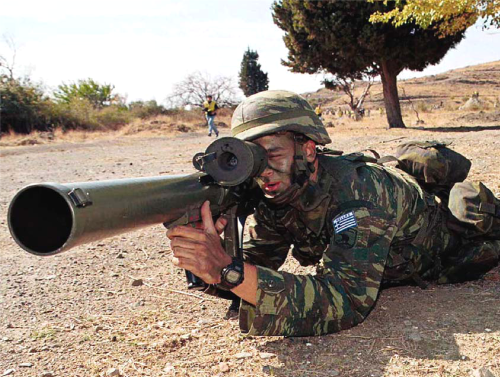
At first blush the merits of this proposal are obvious. The parties, however, would have to overcome significant hurdles. NATO must be convinced that a permanent out-of-theater responsibility in the volatile Middle East serves its interests, and Israel must learn to trust NATO members.
There is nothing in NATO's charter that prevents Israel's membership. Turkey, a Muslim state residing outside the North Atlantic theater, entered the alliance in 1951. Largely forgotten was the membership of another Muslim state, Algeria, also located outside the traditional boundaries of the alliance. Throughout the Cold War the alliance considered extending its reach to other areas, but as long as the Soviet threat dominated Europe's concerns, NATO was stuck on the continent. 11
The alliance morphed in a new direction as events unfolded. The demise of the Soviet Union prompted concerns that NATO had lost its raison d'être. Its involvement in the former Yugoslavia reinvigorated the alliance, as did its expansion into Eastern Europe. Then 9/11 sent a shockwave through the membership. NATO provided aerial surveillance of the United States and in August 2003 it deployed its first out-of-theater contingent to Afghanistan. Concern about events in the Middle East generated public discussion about the expanded role NATO could have in the region. 12
Protecting national security propels both Israel and NATO to suppress nuclear proliferation and Mideast terrorism. 13 Israel's continuing conflict with its Arab neighbors–and Iran–is an open sore that risks nuclear metastasis. Washington's nuclear alert during the 1973 war in Israel serves as a precedent for nuclear spillover. Prudence won out then, but the oil embargo that followed demonstrated how events in the Middle East are capable of impacting the world.
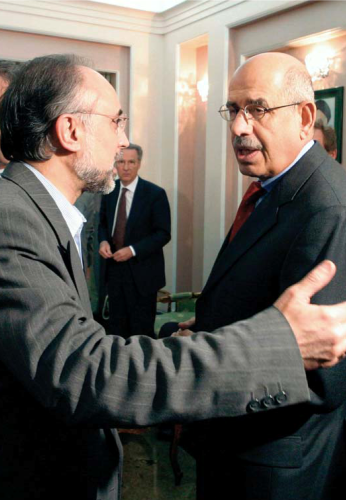
Tehran, October 15, 2001: Mohammad El Baradei (right), head of the International Atomic Energy Agency (IAEA), confers with IAEA envoy Ali-Akbar Salehi.
The events of September 11, 2001 demonstrated yet a different sort of spillover. Speculation about what motivated the attack centers on Muslim rage toward globalization, culture shock, regional political corruption, and economic discontent. But the Arab-Israeli conflict, always casting a shadow, nourishes the motivation to terrorize. The November 2003 terrorist bombings in Istanbul and the March attacks in Madrid further demonstrated that no NATO partner is safe.
Assuring Israel, motivating Iran
For the Mideast NWZ to work, Israel must be reassured. Under this proposal, NATO's commitment to Israel's nuclear defense would precede full membership, and provide a nuclear deterrent. NATO-manned aircraft and ballistic missile defenses could counter Iran's growing capacity. Full membership would add ground forces to assist in the defense of Israel's permanent borders, once they were established as part of the Israeli-Palestinian peace process. The lure of full membership would encourage this achievement. Following the precedent of excluding nuclear weapons on the territory of NATO's new central European membership, the alliance would not place nuclear weapons on Israeli soil or territorial waters, hence preserving the NWZ.
Mindful of the alliance's reluctance to defend Turkey before the 2003 Iraq war, NATO's commitment must be detailed and iron clad. Still, Israel may not be assured by this, or by Article 3 of the NATO charter, which preserves a member nation's right to self-defense without alliance encumbrances. A formal American security guarantee to respond in the event the alliance fails could tip the balance.
Of course, Israel will continue to maintain the Middle East's most robust conventional forces and is the strategic beneficiary of recent history. The collapse of the Soviet Union left Israel's adversaries without a military benefactor. Then came the end of Saddam Hussein's regime in Iraq, followed by Syria's increasing political isolation. Of course, history is dynamic. Syria remains hostile, and the pacific relationship with Egypt and Jordan could change dramatically as a result of political upset. All the more reason Israel's integration into NATO makes sense.
Because Israel cannot comfortably deter a nuclear Iran or nuclear-armed terrorists, its atomic program would best serve as a bargaining chip to eliminate the threat.
What could motivate Iran to go along? The U.S. invasion of Iraq and collapse of Saddam Hussein's regime presents the mullahs with the unexpected presence of U.S. forces on their borders. The Bush administration does not flinch from preemption and has made it clear to Tehran that it will meet its continued violation of the NPT with all resources at its disposal, including military force. Israel has taken a similar position.
The situation in North Korea adds impetus. It demonstrates the imprudence of waiting too long to prevent a rogue challenger from getting the bomb. The implications for Tehran should be clear. Iran would have much to benefit from a NWZ sweetened by incentives–assistance in building its nuclear power plants, repatriation of nuclear fuel, and better access to international commerce generally.
Punishing violators
New international standards that enforce nonproliferation would provide another layer of insurance and further legitimize a Mideast NWZ. The failure of the NPT to include a compliance mechanism gives cheaters license to “game the system.” Once caught, cheaters hope to use international diplomatic inertia to buy time. Knowing that there are no enforcement standards in place, they will use the time to better secrete their nuclear activities.
A template of enforcement mechanisms would help resolve the problem and would deter a violator by placing it on notice that its action would be met by a fair, sure, and swift response. This principal was first introduced in the 1946 Baruch Plan. 14
Implementation would require an IAEA declaration of safeguards non-compliance. Upon receipt, for example, the Security Council would have two weeks to green-light the template. Approval would require the consent or abstention of permanent members plus a majority of the remainder.
The template would include a set of increasingly severe sanctions with a strict timetable for implementation: suspension of international commerce (week 3), cessation of all commercial air travel (week 5), naval blockade (week 7), military action (week 9). Parties to the Proliferation Security Initiative (PSI), George W. Bush's program to interdict the illicit trade of weapons technologies, would be responsible for blockades, and NATO's rapid reaction force would engage in additional military support. An NPT violator could halt these measures by allowing thorough international inspection and destroying its contraband–the route recently taken by Libya.
No doubt the negotiation of such a template would be difficult. Some may argue that the U.N. Security Council must reserve the right to modulate its response to circumstances. This would defeat the template's deterrent impact and fail to combat nuclear proliferation. Furthermore, it would undermine the template's potential to enhance the NPT. One option would be to place the template's enforcement responsibilities directly into the hands of the PSI and NATO.
A necessary step
The fraying of the nonproliferation regime calls for an ambitious proposal. Given the political instability of the Middle East, the proliferation of nuclear weapons in the region risks unleashing the armageddon the Soviet Union and the United States avoided during the Cold War. The proximity of adversaries, the intensity of political differences, and a growing tendency toward unconstrained terrorism makes the abolition of nuclear weapons–along with the means to fabricate them–a regional imperative. Multilayered safeguards are a sine qua non.
This proposal will no doubt prompt objections. Let's consider six:
Iran can't be trusted; Israel will never give up the bomb; NATO, already stretched thin, will balk; Israel's NATO membership would discriminate against others in the region; and the U.N. Security Council is not up to the task of providing insurance. All are valid, but beside the point.
The NWZ would not rely on trust. Rather, it would build on unprecedented intrusive safeguards and multiple layers of insurance, establishing a new benchmark to reinforce the NPT. No longer concerned with Iraq as a lethal adversary but confronted by the portent of nuclear terror and proliferation in Iran, Israel would be motivated to turn its nuclear arsenal into a bargaining chip to combat a risk that it cannot fully deter.
NATO's military thinness reflects the absence of political will, not a lack of resources. The prospect of Mideast nuclear terrorism and proliferation presents a clear and present danger that the alliance–in conjunction with a vigorously enforced NWZ–can reduce by granting Israel membership. Finally, the U.N. Security Council's dithering over Iraq provides the rationale for an action template that can deter proliferation by mapping a strategy to defeat it. If this rationalization appears unduly optimistic, consider the plausible alternatives.
Footnotes
1.
“The Declaration,” Arms Control Today, November 2003, p. 25.
2.
Director General, IAEA, “Implementation of the NPT Safeguards Agreement in the Islamic Republic of Iran,” GOV/2004/11 (Vienna, February 24, 2004).
3.
Board of Governors, IAEA, “Implementation of the NPT Safeguards Agreement in the Islamic Republic of Iran,” GOV/2004/21 (Vienna, March 24, 2004).
4.
Bennett Ramberg, “Iran May Hide Its Nuclear Ambitions from Some, But Not from Israel,” Los Angeles Times, Dec. 10, 2003; Conal Urquhart, “Israel Warns Iran on N-Weapons,” The Guardian, Dec. 22, 2003.
5.
Robert S. Litwak, “Nonproliferation and the Dilemmas of Regime Change,” Survival, Winter 2003-2004, p. 11.
6.
“‘Scrap Nuclear Arms,’ Israel Urged,” BBC News, December 12, 2003.
7.
United Nations, Resolution 2373 (XXII, 1974).
8.
U.N. General Assembly; the subject was addressed in document A/58/137 (Part I) July 11, 2003.
9.
“Mid-East Call on Israel to Disarm,” BBC News, December 21, 2003.
10.
Michael Bar-Zohar, Ben Gurion: A Biography (New York: Adama Books, 1978), pp. 193-195; see also Avner Cohen, Israel and the Bomb (New York: Columbia University Press, 1998), p. 123.
11.
Marc Bentinck, “NATO's Out-of-Area Problem,” Adelphi Papers, no. 211 (London: International Institute for Strategic Studies, Autumn 1986).
12.
Jim Hoagland, “Fences and Fairness,” Washington Post, Oct. 16, 2003; Thomas Friedman, “Expanding Club NATO,” New York Times, Oct. 26, 2003.
13.
Comments by German Foreign Minister Joschka Fischer accentuate the point. Speaking at a security conference in Herzliya, Israel, he stated, “It would be a nightmare not just for Israel but also for the whole region and indeed Europe if the Middle East were to acquire nuclear capabilities,” Agence France Presse, Dec. 17, 2003.
14.
The Baruch Plan reads, “We must provide the mechanism to assure that atomic energy is used for peaceful purposes and preclude its use in war. To that end, we must provide immediate, swift, and sure punishment of those who violate the agreements that are reached by the nations. Penalization is essential if peace is to be more than a feverish interlude.”