




Abstract

Next time you're at the airport, waiting in line at the ticket counter, take a look around. Chances are you'll see an SUV-sized, cream-colored machine sucking in a conveyor belt full of suitcases at an uneven pace. Say hello to the first child of the homeland-security economy boom.
In November 2001, Congress passed the Aviation and Transportation Security Act, which mandated the screening of all checked luggage at airports across the country. Since then, the value of InVision Technologies, at the time one of only a few Federal Aviation Administration-certified manufacturers of these behemoth-sized explosive detection devices, has increased tenfold as orders have rolled in.
There is big money to be made protecting the homeland. As long as there are potential threats, there will be a need for new products and services, right? And there are a lot of things to fear out there, judging from the government's new security spending habits. Captains of industry, start your research engines.
To fill in the gaps of the deficient BioWatch biological agent surveillance system, the 2005 budget requests an additional $274 million to protect against bioterrorism. Sixty-five million of it would go to the Department of Homeland Security's (DHS) Science and Technology division, which includes the DARPA-like Homeland Security Advanced Research Projects Agency (HSARPA). With a budget of nearly $1 billion for the current fiscal year, a 56 percent increase over the previous year, the Science and Technology division has one of the fastest growing research and development budgets in the federal government.
HSARPA is distributing millions to private businesses to support the development of more effective chemical and biological surveillance products, data acquisition and processing systems, tools to track cargo containers, and computer models to assess infrastructure vulnerability.
Among those anticipating lucrative homeland security contracts are some familiar names. In January, a managing director of the Carlyle Group, a company with close ties to the Bush family, told Homeland Security & Defense that his company was “actively looking” at investing in a variety of technologies to support cargo security, which he called “perhaps the greatest unsolved problem [of Homeland Security].”
A mobile scanner inspects a cargo container. Cargo tracking and security technologies are among a variety of products attracting investors eager to cash in on increased homeland security spending.

In September 2003, Battelle, which already operates a number of laboratories for the Energy Department, announced that it would commit $150 million to a new venture capital fund that would help transform its research into commercial products, like biosensors, that could be used to support homeland security missions.
In order to scoop up the most advanced security applications, officials from GlobalSecure Holdings, a Maryland-based security company, met with Israeli security and technology firms at the end of 2003.
“Since necessity is the mother of innovation, Israel is definitely at the forefront of homeland security technology,” GlobalSecure chairman Ross Mandel told the Jerusalem Post.
In its effort to become a one-stop shop for a city, corporation, or government agency, GlobalSecure has already purchased Neoterik Health Technologies, a maker of powered respirators and gas masks, and CairnsAir, Inc., a manufacturer of fire-safety equipment. It has also landed a training contract with an undisclosed U.S. government security agency.
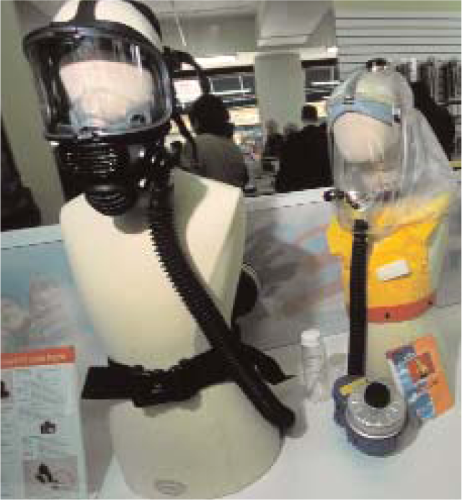
Law enforcement agencies, firefighters, “citizen corps,” and state and local governments will ostensibly receive more than $4 billion for “domestic preparedness” this year. (The president's budget requests an additional $3.6 billion for 2005.) Some of this funding will be used to purchase any number of homeland security products–escape hoods, decontamination units, search and rescue tools, logistics equipment–and Global-Secure will be competing with dozens of other companies to provide them.
The Safer America store sells an assortment of protective gear.
The department's Bio-Shield program, which would allow the government to prepurchase vaccines and medications for biodefense and could cost as much as $5.6 billion, could be a boon to pharmaceutical companies developing and producing drugs to defend against supposed biological threats.
In September 2003, North Carolina-based pharmaceutical manufacturer Chimerix received a $36.1 million bioterrorism grant from the National Institute of Allergy and Infectious Diseases to start developing oral smallpox antidotes. It all makes sense if you believe smallpox is going to get you.
Safety first?
Entrepreneurs across the land have been working overtime to keep citizens feeling safe–and to make a quick buck. Here are a few new commercial products (usefulness not guaranteed):
“Working in HazMat/Protective suits can make anyone lose their cool,” says a brochure for this cooling vest. The vest is non-toxic, nonflammable, lightweight, and washable. The inserts that cool the vest are ready to use again after only half an hour in the refrigerator. Cost: $84-$200 (Price depends on how long you want the vest to stay cool. “If you're under siege, trying to talk down a terrorist, you may be in [a protective suit] a long time,” according to a salesperson.)

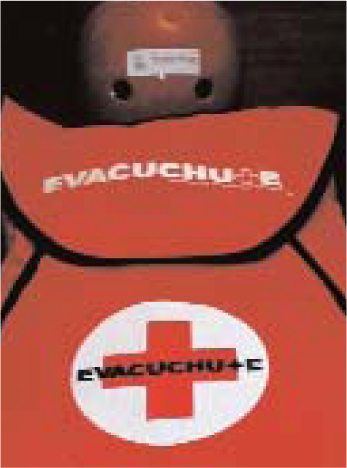
There's a way out the next time you're trapped on the upper floors of your office building. If there's a window nearby all you need is this hands-free, dummy-proof personal parachute. Once the chute is deployed, color-coded cables help you steer yourself to a safe landing. Cost: $1,803.45
If the fear of dirty bombs has you down, this personal radiation detector, which can be attached conveniently to your keychain, might be just what you need. With “10 distinct ‘chirping’ alarm levels” you'll be able to respond quickly when background radiation levels become dangerous to your health. Cost: $160, or two for $290
