




Abstract
Who was J. Robert Oppenheimer, the scientific head of the World War II bomb project? His reputation remains nearly mythic; the man himself, a mystery.
The person who had the closest contact with President Franklin Roosevelt on nuclear matters was an engineer named Vannevar Bush. He had persuaded the president to set up a National Defense Research Committee, which he then headed. In October 1941 he met with the president to brief him about the British report of the MAUD [Military Application of Uranium Detonation] committee. He then won approval to launch a full-scale bomb program in the United States. After some months it became clear that it had grown beyond the scope of various projects scattered around the country, such as those in Berkeley, Chicago, and elsewhere, and that what was needed was a central organization run by the War Department–the army–which would have the authority to set priorities and make all the decisions. One of the weaknesses in the German program was that it lacked this structure. Research was being carried out in 20-odd institutions located all over Germany and Austria, working often without adequate communication and sometimes at cross-purposes. It devolved onto Secretary of War Henry Stimson to name someone to preside over the whole enterprise, and in September of 1942 he selected then-Col. Leslie Richard Groves. 1 Groves, who had been born in 1896 and was a West Point graduate and a professional soldier in the Corps of Engineers, was not pleased. He wanted to be a fighting soldier. Indeed, on hearing the news he said in reference to the bomb, “Oh, that thing.” 2 He managed to get himself promoted to brigadier general before he took the job.
J. Robert Oppenheimer.
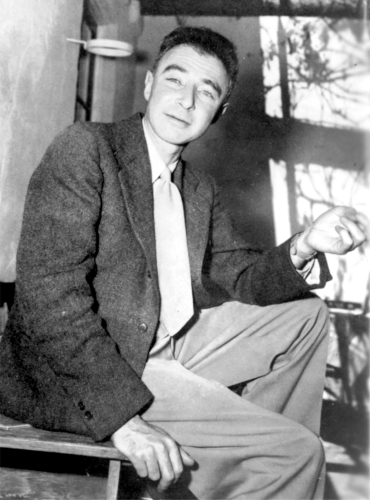
To the best of my knowledge, at the time of his appointment Groves knew nothing about nuclear physics. What he did know was how to manage large-scale construction projects such as the building of the Pentagon, which he had been responsible for. He was also a very quick study. Although he had known about the bomb project only since June, two days after he had been put in charge Groves was in the process of acquiring a site for the separation of uranium at Oak Ridge, Tennessee. What I find remarkable about this is that, at the time, the critical masses were not very well known, so it was not clear how much uranium 235 would be needed to make the bomb. It was also not clear what the best method for separating the isotopes was, so Groves simply went ahead with all of them. He had a mandate to produce a nuclear weapon as soon as possible, and that is what he was determined to do.
Groves also decided that a separate laboratory was needed where all the ingredients could be put together. For that he needed a director. Ernest Lawrence was an obvious choice. He had been involved in large scientific and engineering projects–his cyclotrons–and he had been working on isotope separation at Berkeley. Furthermore he had a Nobel Prize. One often reads that Groves did not select him because he could not be spared from the work he was doing at Berkeley. My guess is that this was not the real reason. Groves had an uncanny ability to judge people in terms of what role they might play in any project he wanted to get accomplished. He had a gigantic ego and insisted that things be done his way. My hunch is that he saw in Lawrence someone who had already developed a management style, who also had a very large ego, and who might have his own ideas of how to go about things. Lawrence pushed very hard for his associate Edwin McMillan, but by that time Groves had decided on J. Robert Oppenheimer, whom he had met in Berkeley.
Viewed from the outside, Oppenheimer was the most unlikely choice imaginable. He had never managed anything. He was a theorist whose attempts to do experimental physics had been disastrous. He was an aesthete who read poetry in several languages, and he had a ton of left-wing baggage. What seemed to appeal to Groves, apart from the Oppenheimer charisma, was his apparent modesty about the work. He told the general that no one knew much and that they would have to make it up as they went along. Here was someone who would do what he was told to do. Groves was asked to testify in the Oppenheimer hearings of 1954 on behalf of Oppenheimer. He took the occasion to make very clear what he thought Oppenheimer's role was. He said:
“Dr. Oppenheimer was used by me [from then] on as my adviser on that [different options for pursuing the work], not to tell me what to do, but to confirm my opinion. I think it is important for an understanding of the situation as it existed during the war to realize that when I made scientific decisions–in case there are any questions that come in on that–that outside of not knowing all the theories of nuclear physics, which I did not, nobody else knew anything either. They had lots of theories, but they didn't know anything. We didn't know whether plutonium was a gas, solid, or electric [sic–probably he said “a liquid”]. We didn't even know that plutonium existed, although Seaborg, I believe it was, claimed to have seen evidences of it in the cyclotron.” Actually, in February of 1941, Glenn Seaborg, McMillan, and their colleagues had produced plutonium by bombarding uranium with deuterons. By 1942 they had studied enough in trace amounts to understand some of its properties. Groves goes on:
Remembering Oppenheimer
J. Robert Oppenheimer was born on April 22, 1904. On this, the centenary of his birth, we offer a sampling of others' encounters with and impressions of him.
Physicist Richard P. Feynman wrote that he was recruited to work on the Manhattan Project by Oppenheimer. He remembered how patient Oppenheimer was with delays at the new Los Alamos, New Mexico laboratories. “He paid attention to everybody's problems. He worried about my wife, who had TB, and whether there would be a hospital out there, and everything. It was the first time I met him in such a personal way; he was a wonderful man.”
–“Surely, You're Joking, Mr. Feynman!”: Adventures of a Curious Character, by Richard P. Feynman with Ralph Leighton
Physicist Abraham Pais wrote that he met Oppenheimer in 1946 at a Physical Society meeting at Columbia University.
Pais was sitting next to Dutch physicist Hendrik Antony Kramers, who handed him a slip of paper that read: “‘Turn around and pay your respects to Robert Oppenheimer.’ I turned and there, right behind me, sat the great man, who up to that moment had been known to me only from newspaper pictures. He grinned pleasantly at me and stretched out his hand, which I shook. Most remarkably–or so I thought–he sat there in a short-sleeved open shirt. I felt I had entered a new civilization [coming to America from Europe], where you call professors by their first names and where esteemed gentlemen appear in public wearing neither jacket nor tie.”
–A Tale of Two Continents: A Physicist's Life in a Turbulent World, by Abraham Pais
Dean Acheson, secretary of state from 1949 to 1953, was appointed chairman of a committee to draft a plan for the international control of atomic energy. Oppenheimer was a member:
“All the participants would, I think, agree that the most stimulating and creative mind among us was Robert Oppenheimer's. On this task he was also at his most constructive and accommodating. Robert could be argumentative, sharp, and, on occasion, pedantic, but no such problem intruded here.
“When later I achieved a wholly undeserved reputation for expertise in nuclear matters, no one knew better than Robert Oppenheimer how fraudulent this was. At the beginning of our work he came to stay with us and after dinner each evening would lecture [former Assistant Secretary of War John J. McCloy] and me with the aid of a borrowed blackboard on which he drew little figures representing electrons, neutrons, and protons, bombarding one another, chasing one another about, dividing and generally carrying on in unpredictable ways. Our bewildered questions seemed to distress him. At last he put down the chalk in gentle despair, saying, ‘It's hopeless! I really think you two believe neutrons and electrons are little men!’ We admitted nothing.”
–Present at the Creation: My Years in the State Department, by Dean Acheson
Andrei Gromyko, Soviet diplomat, wrote of meeting Oppenheimer in the late 1940s, when the physicist was working as scientific consultant to Bernard Baruch in the U.N. Atomic Energy Commission. “By now Oppenheimer had recognized the threat posed by nuclear weapons, and he … opposed their continued production and spoke repeatedly of the need to ban them. Oppenheimer was careful to avoid phrases which could be interpreted as direct disagreement with the U.S. government's official position, even though it was plain enough what he meant.”
–Memories, by Andrei Gromyko
Physicist Freeman Dyson wrote:
“We had come from many countries to the Institute for Advanced Study [at Princeton University], each of us invited by Oppenheimer to work under his supervision…. Oppenheimer was away in Europe and did not need his office. For six or seven weeks we waited uneasily for his return….
“We sat in Oppenheimer's office and waited and worried. We knew that he bore a heavy responsibility, both for helping to bring new evil upon mankind and for trying to mitigate its consequences. We were glad that we had no share in his responsibility….
“When after some weeks I had a chance to talk to Oppenheimer, I was astonished to discover that his reasons for being uninterested in my work [on radiation theories] were quite the opposite of what I had imagined. I had expected that he would disparage my program as merely unoriginal, a minor adumbration of [Julian] Schwinger and Feynman. On the contrary, he considered it to be fundamentally on the wrong track….
“I was a friend and colleague of Oppenheimer for 14 years, from the year before his trial [U.S. Atomic Energy Commission hearings on whether he was a security risk because he refused to work on the development of the hydrogen bomb] to the year of his death. I had plenty of time to study and reflect upon the qualities of this man who played such a paradoxical part both in my personal destiny and in the destiny of mankind. I was rarely privy to his thoughts.”
–Disturbing the Universe, by Freeman Dyson
Kitty Carlisle Hart, actor and game show panelist, had “a sandwich lunch” with Oppenheimer at Princeton in the late 1940s:
“Dr. Oppenheimer's office was an astonishing sight. All four walls were made of blackboard, covered with equations and formulas from ceiling to floor. There was a sign tacked to the doorjamb: please do not erase. A cleaning woman could have changed the whole course of science.
“The great man was sitting behind his desk. I was anxious to make him like me, because I wanted to be invited back to his house. I had heard he had a collection of French Impressionists….
“During lunch Oppenheimer brought out a piece he'd written on Niels Bohr. He said Niels Bohr was like a Rembrandt–illuminated only from one side–while Einstein was like a Holbein, fully illuminated.
“I asked to see the piece, and he handed it to me. I read the first paragraph and said, ‘Dr. Oppenheimer, you are a wonderful writer!’ And he and his wife, and the Impressionists, were mine for the rest of the afternoon.”
–Kitty: An Autobiography, by Kitty Carlisle Hart
Paul Nitze, ambassador and arms control negotiator, met Oppenheimer in Washington, D.C., in 1949.
“The State Department's chief consultant on atomic energy matters was J. Robert Oppenheimer, who was also chairman of the AEC's General Advisory Committee, composed of the country's leading nuclear physicists. ‘Oppie,’ known as the ‘father’ of the A-bomb for his brilliant work on the Manhattan Project in World War II, was considered to be the leading expert on atomic energy. He opposed further research and development aimed at testing a fusion reaction. He told me he did not think such a reaction could be brought about. If it could be brought about, he did not believe it could be harnessed to produce a usable weapon; the equipment required would be so massive and heavy that it could not be fitted into an airplane.”
–From Hiroshima to Glasnost: At the Center of Decision–A Memoir, by Paul H. Nitze with Ann M. Smith and Steven L. Rearden
In 1950, radio and television producer Mavor Moore was working on Year of Decision, an hour-long U.N.-sponsored program on atomic energy prepared for the Mutual Broadcasting System.
“We had worked on the program for a year, with J. Robert Oppenheimer as our consultant. As the script developed, [colleagues] and I would take each revised version to Oppenheimer's office in the Institute for Advanced Study at Princeton. Close-cropped and tweed-wrapped, the atomic scientist looked more like an anorexic leprechaun than a public figure. He spoke sparely and softly. Reading the script, he turned pages at the rate of a slow tennis rally, giving each about as much attention as you or I might give a phone number, neither speaking nor making notes. Then he would hand the script back and begin a commentary with his eyes closed: ‘On page 2, line 14, the narrator says …' and so on throughout the 100-odd pages.”
–Reinventing Myself, by Mavor Moore
James Reston, journalist, wrote:
“I met Oppenheimer by chance one morning in January 1954 on the Eastern Airlines flight en route from Washington to New York. He was at that time a famous but remote and mysterious figure, thin and slightly stooped, with short gray hair and startling blue eyes. At 49, he was the most honored nuclear physicist in the world, consultant to the Atomic Energy Commission and the Defense Department, and head of the Institute for Advanced Studies in Princeton, New Jersey.
“If there hadn't been a vacant seat beside him on the plane, I would have no story to tell, but there was, so I introduced myself and sat down. He was not visibly overjoyed by this chance encounter, but reporters are used to that. We talked vaguely about President Eisenhower's first months in the White House. I never mentioned anything about Oppenheimer's work, and yet he seemed unaccountably nervous in my presence and obviously under some strain.”
–Deadline: A Memoir, by James Reston
Raymond Aron, a sociologist and political commentator, remembered Robert Oppenheimer's participation in the 1960 Berlin conference on the tenth anniversary of the creation of the Congress for Cultural Freedom: “He created a strong impression by the contrast between the purity of his blue eyes and the nervous tension in all his gestures and his statements. Devoured by an internal flame or by the battles he was fighting with himself, he tended to take any episode of his existence not seriously but tragically. I can see him in his room, with his wife, discussing the latest conference presentations with me, as though he were disturbed by their possible banality. I did not get past the first phase of friendship with him.”
–Memoirs: Fifty Years of Political Reflection, by Raymond Aron
Arthur Miller, playwright, talked to Oppenheimer in the early 1960s:
“Ever since Hiroshima I had been thinking about a play that would deal with the atom bomb … to try to investigate firsthand how the scientists themselves felt about what they had created….
“I went down to Princeton and found in Robert Oppenheimer a gaunt, obviously depressed man–indeed, he would be dead in not too many years and may have known it then. This, of course, was long after he had been barred from government work as a security risk despite having fathered the atomic bomb. We talked in his unadorned office, and I was reminded by it and his tweed jacket and pipe that he was an academic, though I had always connected him with power and war…. Oppenheimer's [home], as I recall it now, seemed to befit a renowned singer or artist who had surrounded himself with mementoes, photos, statuettes, carpets, and honors and gifts from around the world. It had once been a comfortable, unpremeditated house that spoke of the triumphant years when all was promise and the great had come from everywhere to pay him homage. But there was an aura of devastation now….
“Oppenheimer's protective caution made intimate discussion difficult; I suppose he had good reason to be suspicious of writers. Still, my questions seemed to interest him, even though he allowed himself mostly noncommittal replies, except to the central one–whether we all tended to deaden our connections, and hence our psyches, to those actions we found it difficult to justify. Plainly moved, his eyes filled with what I took for vulnerability, he looked directly into my eyes and said with quiet emphasis that this was not always true. In other words, he was indeed suffering, was not merely a man who had known power and was able to distract himself by recollecting his unique accomplishments. It was sufficient response for me at the moment.”
–Timebends: A Life, by Arthur Miller
“We didn't know what any of the constants that were so vital were. We didn't know whether it could be made to explode. We didn't know what the reproductive factor was for plutonium or uranium 235 [the number of neutrons emitted when these elements fissioned]. We were groping entirely in the dark. That is the reason that General Nichols [Kenneth D. Nichols was another army engineer who worked with Groves on the project] and myself were able, I think, to make intelligent scientific decisions, because we knew just as much as everybody else. We came up through kindergarten with them. While they could put elaborate equations on the board, which we might not be able to follow in their entirety, we knew just about as much as they did. So, when I say that we were responsible for the scientific decisions, I am not saying that we were extremely able nuclear physicists, because actually we were not. We were what might be called ‘thoroughly practical nuclear physicists.’”
And then he adds: “As a result of this experience, maybe because Dr. Oppenheimer agreed with me and particularly because of other questions that were raised, I came to depend on him tremendously for scientific advice on the rest of the project, although I made no effort to break down my compartmentalization. As you know, compartmentalization of information was my chief guard against information passing. It was something that I insisted on to the limit of my capacity. It was something that everybody was trying to break down within the project. I did not bring Dr. Oppenheimer into the whole project, but that was not only because of security of information–not him in particular, but all the other scientific leaders, men like Lawrence and Compton [Arthur Compton was a Nobel Prize-winning physicist who along with James Conant and Bush was one of the scientific leaders of the project] were treated the same way–but it was also done because if I brought them into the whole project, they would never do their own job. There was just too much of scientific interest, and they would just be frittering from one thing to another.” 3
Oppenheimer and family, circa 1948.
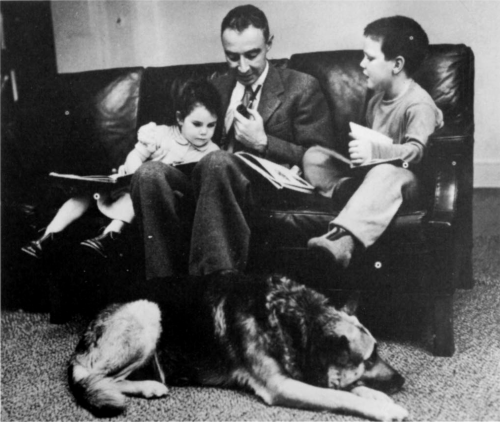
Oppenheimer was present in the room while General Groves was explaining his role. What he thought of Groves's description is not recorded. In any event, immediately upon being selected as director of the yet nonexistent laboratory he adapted himself to the role. He at once agreed with Groves's notion that it should be a military facility with everyone there, including himself, in uniform. He seems to have gone so far as to have taken a physical examination for his entrance into the army and to have ordered uniforms. He was talked out of what would have been a folly by wiser heads like I. I. Rabi. It is hard to imagine, for example, Richard Feynman as a corporal. What rank would Niels Bohr have had? Would they have had to salute each other? In any event, the laboratory was formally administered by the University of California. There was a military presence on the site, but the scientists remained civilians.
It is important to emphasize that when Groves appointed Oppenheimer he had seen the FBI reports on him. He knew that Oppenheimer's brother Frank had been a member of the Communist Party, as had his wife. He knew that Oppenheimer's own wife, as well as his former lover Jean Tatlock, had been members. He knew that some of Oppenheimer's students had been members and that he had contributed substantial sums of money to communist front organizations. He did not know the full details of Oppenheimer's relationship with Haakon Chevalier–one of the things that would be the most damaging in the hearing–but when he learned about them during the course of the war, this did not change his mind. On July 20, 1943, shortly after Los Alamos had gotten started, Groves wrote a letter to the War Department that said, “In accordance with my verbal directions of July 15, it is desired that clearance be issued for Julius Robert Oppenheimer without delay, irrespective of the information which you have concerning Mr. Oppenheimer. He is absolutely essential to the project.” 4 A great many people with derogatory information about them were “absolutely essential to the project.” Robert Serber once remarked that, if normal procedures had been applied, three-quarters of the people at Los Alamos, including very likely himself, would not have been cleared. My sense is that if the devil himself had turned out to have unexpected abilities in nuclear physics, Groves would have cleared him, but put him under constant surveillance.
So much has been written about wartime Los Alamos that it has become something of a cliché. But here are a few facts that have struck me over the years. The first is the duration of the enterprise. I find that when I tell people how long it lasted, they are surprised. The consequences were of such monumental importance that they are sure that it must have gone on a lot longer than the 27 months that were the actual time span. The project at Los Alamos began in the spring of 1943, and was over in the fall of 1945. The average age of the technical staff was 29. Oppenheimer was 39 when it started. Not only were these young people making up the science as they went along, they also had to figure out what to do about the consequences of their work. In the beginning they were the only ones who understood the dimensions of the new force they had created. This was especially true after the successful test on July 16, 1945, at Alamogordo, in the New Mexican scrub desert. Rabi, who was older and more worldly than most of them, said that at first he was overwhelmed by the spectacle of the explosion, but then he got goose-flesh when he realized what this meant for humanity.
When Los Alamos began, Oppenheimer thought that a small enlargement of the group that met in Berkeley in the summer of 1942 would be enough to do the job. When it ended there were some 3,000 people on the mesa. Never before, or since, has such a collection of scientific talent been assembled to carry out one task. I made a list of people there who either had the Nobel Prize before they came or received it after they left. I am not sure my list is complete. Enrico Fermi and Bohr had Nobel Prizes when they came. Hans Bethe and Rabi got theirs later. Rabi was not on the staff at Los Alamos, but he acted, on his frequent visits, as a sounding board for Oppenheimer. He told me that he did not go there full time because, as he put it, he was serious about winning the war. With the bomb one might win the war, but without radar one would lose it. Rabi chose to spend most of his time working on radar. The experimental physicists Norman Ramsey and Emilio Segré won the prize, as did the theorists Felix Bloch, Richard Feynman, and Bohr's son Aage, as well as the experimentalists Edwin McMillan, Owen Chamberlin, Fred Reines, and Luis Alvarez. Two of the more interesting cases were Val Fitch and Joseph Rotblat. Fitch, who had been born on a cattle ranch in Nebraska, was sent to Los Alamos as a soldier. He had not finished college, but, dressed in army fatigues, he worked in one of the laboratories. He made such a good impression that he was urged to continue with his studies in physics. He was a professor at Princeton in 1980 when he won his Nobel Prize for Physics for his work on elementary particles. Joseph Rotblat, on the other hand, was born in Warsaw and emigrated to Britain when the war began. He came as a physicist with the British delegation that included Otto Frisch and Rudolf Peierls. In late 1944 he decided to leave. He had learned that the reconnaissance mission–Alsos–that Groves had sent to learn about the German nuclear weapons program had found that there was no such program. Rotblat had come to Los Alamos to defeat the Germans and having decided that that mission had been accomplished, he left. After the war he devoted himself to the cause of making a nuclear world safer. In 1995 he won the Nobel Peace Prize.
Compared to what they were used to, the conditions on the mesa were primitive. There were five bathtubs for the whole community, located in the old school. The wartime apartment constructions had only showers. Water was always a problem. Sometimes when people turned on the taps, worms came out, and when it rained there was a sea of mud. It was like a sort of campout. The one quality that runs through all the scientists' narratives is enthusiasm. It may seem callous to say, but as hard as they worked building the bomb, they also had a great deal of fun. There were parties in which lab alcohol, 200 proof, was used to spike the punch. At one point Groves complained to Oppenheimer that people were having too many babies and overloading the medical facilities. Oppenheimer was in no position to do anything about that, especially since his second child Katherine (“Toni”) was born there. She did not have a very happy life, and in a deep depression she committed suicide in 1977. For the people who spent those two years on the mesa, it was an experience that marked them for life.
Footnotes
1.
For a full-scale biography of Groves see Robert S. Norris, Racing for the Bomb: General Leslie R. Groves, the Manhattan Project's Indispensable Man (South Royalton, Vermont: Steerforth Press, 2002).
2.
Norris, Racing for the Bomb, p. 175.
3.
In the Matter of J. Robert Oppenheimer: Transcripts of Hearing Before Personnel Security Board and Texts of Principal Documents and Letters (Cambridge, Mass., 1971) p. 164. This version has a forward by Philip M. Stern. The original version, to which this is essentially identical, except that two documents have been combined into one, was issued by the Atomic Energy Commission in 1954, just after the hearing.
4.
Matter, p. 170.