




Abstract

Malaysian Prime Minister Mahathir Mohammed's controversial remarks at last October's Organization of the Islamic Conference (OIC)–to the effect that “Jews rule the world”–drew howls of protest from the United States, the European Union, and Israel. Some critics suggested that Malaysia was fanning militant Islam, others accused Mahathir of being anti-Semitic. Yet in certain quarters of his home country, his speech was taken as “extending an olive branch to Zionists.”
Those familiar with Malaysian affairs took Mahathir's statement as more than a misunderstood, off-the-cuff remark. Rather, it appeared to be aimed at the West as much as the Islamic world, implying that Malaysia would like to set the agenda in future interactions with the West. The former prime minister, though known to be outspoken, is far too seasoned a politician to provoke the United States, Malaysia's biggest trading partner, for no reason at all. According to many of Kuala Lumpur's political analysts, the reason is that Malaysia would like to fill the leadership vacuum it sees in the present-day Islamic world. Malaysia would also like to become a regional economic and military power.
The OIC summit is the biggest annual gathering of Islamic heads of state and foreign ministers from 57 countries, and the context in which Mahathir's comment (that, like the Jews, “Muslims need to use their brains not brawn”) was made certainly touched a raw nerve among OIC members. The inability of the OIC to form a common lobby group in support of the Palestinian cause is seen as a general failing of the Islamic states. “Mahathir's message was not anti-Jewish at all; in reality he was criticizing the Middle East Islamic monarchies and dictatorships for their failure to provide effective leadership to the world's 1.3 billion Muslims,” said Shafi Abdullah, a Kuala Lumpur-based analyst of Islamic affairs.
Prime Minister Mahathir Mohammed on October 31, 2003, the day he retired.
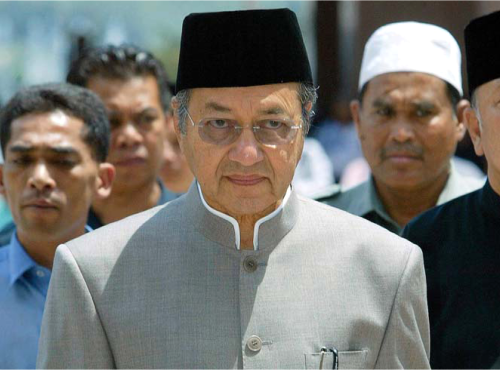
“The issues [Mahathir] referred to–poverty, lack of education, unemployment, and non-existent industrial base in much of the Muslim world” are the main problems. “The reference to Jews was in the context of how a few million people had made the best of adverse situations. His speech was a wake up call to the Muslim world to learn by example,” said Abdullah.
What was Mahathir talking about, however, when he said that “a few million Jews cannot defeat 1.3 billion Muslims”? Abdullah reasons that because Jews and Muslims have been at war for so long, perhaps Mahathir was playing on the fears of the Islamic world so they won't give up on Palestine and other causes dear to them. “The clear message which Dr. Mahathir gave was that it was time for Muslim states to look beyond wars and confrontation as a means to achieve a political aim. They should become strong economically and use trade and negotiations as a weapon,” said Abdullah.
Going by statements made by some OIC attendees, it was clear that Mahathir, and the Malaysian point of view, has quite a few takers in the fragmented OIC. Afghan President Hamid Karzai praised Mahathir for stressing the need for education and development in the Islamic world. “Dr. Mahathir spoke of the inhibitions within the Islamic world and that those inhibitions must go away, and I entirely agree with that,” he said.
Similar praise came from the foreign ministers of Egypt and Yemen who admired Mahathir's plain speaking. “Mahathir said in his speech that the Arab world must negotiate [with Israel] to solve the Palestinian problem. His comments were aimed at those governments and groups which favor an armed struggle to win back occupied Palestine,” Yemeni Foreign Minister Abubakr al Qirbi said in a news agency report.
Filling the leadership vacuum
According to Khalil Ahmed Sahadi, a Malay writer, not one Muslim country is today perceived as providing either religious or political guidance to the rest of the Islamic world. “Saudi Arabia, Egypt, Libya, and Turkey, which at one time or another were looked upon as model Islamic states, have all failed in their attempts to become militarily strong, economically sound, and to create a vibrant Islamic society which blends twentieth-century democracy and technology with traditional Islamic values,” he said.
Sahadi said that now is the time for Malaysia to fill the leadership void and lead the Muslim world away from its tendency to withhold knowledge from the general public and from its misguided religious zeal. He believes that by accepting Western technology and business policies, the region will be rewarded with economic prosperity.
Post-OIC conference coverage in the Malay press reflected jingoistic feelings about how Malaysia had provided direction and infused new life into the OIC. “Mahathir has in one stroke reminded the world that the OIC and the Islamic world need to be taken seriously,” wrote one reader in the pro-government New Straits Times.
The OIC summit in Putrajaya presented a vibrant and techno-savvy Malaysia, with its electronic and advanced agricultural products factories, its universities and training institutions, and its grassroots democratic institutions, which are unique in the Islamic world. Malaysia was presented as a showcase for how Islam can function in harmony with modernization.
Malaysia is flexing its muscles on another front. At the Asia Pacific Economic Conference (APEC) last October, Mahathir took on the United States by asserting that the forum was in danger of turning into a security grouping as Washington pushed for a greater military role in the region. “APEC was formed as an economic cooperation group. We don't agree with taking away economic matters into security, military, or politics, which are not really for APEC,” he told journalists just days before his retirement.
Malaysian women stand apart
If there is one factor that differentiates the Malay brand of Islam from that in the Middle East, it is in the treatment of women. Malaysia has women judges, soldiers, police officers, teachers, bartenders, racing drivers, and business executives. In a traditional Muslim society, these professions are the exclusive preserve of men. But in Malaysia, women have complete freedom to choose their careers and to dress as they choose without the fear of being prosecuted by religious police.
The wearing of head scarves is perhaps the only visible identification of Muslim women in Malaysia, and that, too, is optional. It is common to see head scarves on women working as bartenders or shop attendants where they have to regularly interact with men. The strict segregation of women from men, however, is non-existent.
“Malaysian women do all the work while the men laze around,” said Razlin Hamadan, a petite 24-year-old travel desk clerk in the Kuala Lumpur airport. Hamadan, who comes from a rural area, says she went to a co-ed elementary school, attended high school, and then earned a diploma in the travel industry. There are occasionally some press statements criticizing the “excessive freedom” given to women, but such opinions are not taken too seriously.
“Malays are religious, but not orthodox,” said Hamadan, adding that she has Chinese, Hindu, and Christian friends and neighbors–and religion has never been an issue on a personal level. There are many inter-religious marriages, and Islamic laws apply only to Muslims, she said. Even litigants in court proceedings have the option to choose between Islamic or common law. In case of a dispute, common law prevails.
U.S. bashing pays
Malaysia is perhaps one of the few countries in the world that has consistently opposed recent American foreign policy initiatives and still continues to have excellent business relations with it. According to Mohammed Duar, an economics writer in Kuala Lumpur, Malays “opposed the American occupation of Iraq, the sale of high-tech arms to Australia, the U.S. handling of the Palestinian crisis, and yet we continue to have excellent business relations with Uncle Sam.”
Duar said that bashing the United States has helped elevate Malaysia's standing among Islamic nations and in the Third World. “Despite the rhetoric, Malaysia has been careful not to go beyond a point. All the criticism has been limited to public speeches and press statements. At one level it is all posturing. Dr. Mahathir is the kind of person who wants to be seen to be doing something and there is no better whipping boy around than Uncle Sam,” said Duar.
While imports from the United States to Malaysia totaled $9.62 billion, Malaysia's exports to the United States totaled almost $13 billion in 2002, mainly in electrical and electronic products, textile and apparel, rubber, furniture, wood, toys, and sports equipment. Kuala Lumpur would not want to do anything to hurt its main export market. As further evidence of deepening economic ties, the United States and Malaysia are working toward a free trade agreement, and the United States has time and again praised Kuala Lumpur for its economic management, even as it has criticized the country for its handling of human rights.