




Abstract
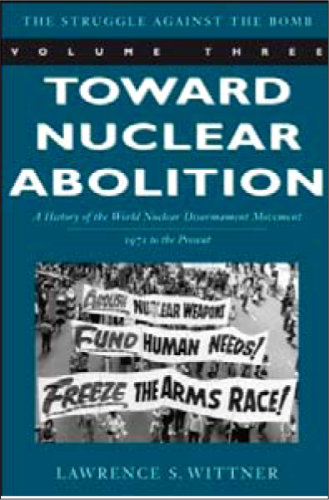
Toward Nuclear Abolition: A History of the World Disarmament Movement, 1971 to the Present By Lawrence S. Wittner, Stanford University Press, 2003, 657 pages; $32.95
The third volume of Lawrence Wittner's encyclopedic and monumental work, The Struggle Against the Bomb, is his most important. Wittner has meticulously documented the tale of a movement that began as a small collection of scientists, pacifists, and assorted intellectuals and idealists who were galvanized in the glare of the atomic bombings of Hiroshima and Nagasaki. In Toward Nuclear Abolition, Wittner argues that the movement became a global force that prevented nuclear war, ended the superpower nuclear arms race, and dramatically shifted government policies on both sides of the Iron Curtain.
These are bold claims. Wittner, a history professor at State University of New York-Albany, states his position directly: “The nuclear arms control and disarmament measures of the modern era have resulted primarily from the efforts of a worldwide citizens movement, the biggest mass movement in modern history.” The central thesis of Toward Nuclear Abolition is so contrary to conventional wisdom that to take hold it will need to be reinforced and repeated by more disarmament courses, symposia, popular books, media, and organizational efforts than currently exist.
Compare Wittner's view with the prevailing notion that it was Ronald Reagan's military buildup, determination, and staggering Star Wars spending that drove the Soviet Union from the stage. Or consider the sneering condescension of President George H. W. Bush toward “the Nuclear Freeze crowd.” Equally misleading has been the excessive fascination of mainstream scholars with the actions and achievements of government leaders and elites whose records and pronouncements are more prominent and readily tracked. Through this lens, it was John F. Kennedy who brought about the Partial Test Ban Treaty; Richard Nixon, the Non-Proliferation, Anti-Ballistic Missile, and Strategic Arms Limitation treaties; George H. W. Bush who started disarmament efforts with Gorbachev and Yeltsin; and Bill Clinton who finally delivered the (voted down) Comprehensive Test Ban Treaty (CTBT).
Instead it is citizen activists, Wittner says, who deserve much of the credit.
Using the records and archives of disarmament groups worldwide, interviews with main movement participants, interviews with former Soviet leaders, and newly available Soviet records, Wittner convincingly establishes that U.S. political actions often merely fed Soviet paranoia, convincing the Russians to escalate rather than to give in. But Mikhail Gorbachev often followed advice from Western disarmament intellectuals and activists, who made a deep impression on him.
Recounting the history of arms control and disarmament without referring to the anti-nuclear movement “is like telling the story of civil rights legislation without referring to the civil rights movement,” says Wittner. Highpoints of the anti-nuclear push include the massive European disarmament movement provoked by Carter administration plans to build and deploy neutron bombs in Europe and to deploy cruise and Pershing II missiles that could strike the Soviet Union. And when the Reagan administration declared that it could fight and win a nuclear war, European capitals (Madrid, London, Bonn, Amsterdam, Rome, and others) were clogged with demonstrations by more than 500,000 people.
These protests were matched in the United States by the Nuclear Freeze movement, which won special referenda across the country and drew one million people to New York's Central Park on June 12, 1982–the largest demonstration in U.S. history. Gorbachev's testing moratorium, pressed on him by peace activists, stirred a huge, renewed effort for a comprehensive test ban and led to the delivery by SANE and the Freeze of more than 1.25 million signatures to the first Reagan-Gorbachev summit in 1985 in Geneva. As became the pattern, Gorbachev met with activists David Cortright of SANE, Jesse Jackson, William Sloane Coffin, and others, while U.S. officials gave them the cold shoulder. Other efforts, too numerous to note here, made breakthroughs as well. When the United States claimed a test ban could not be properly verified, Tom Cochran of the Natural Resources Defense Council and others worked with the Soviets to test radiation detection devices on a ship in the Black Sea that demonstrated that verification would work. [See “Black Sea Experiment Only A Start,” by Tom Cochran, November 1989 Bulletin.] It was also American activists who convinced Gorbachev to decouple his concerns about Star Wars to gain nuclear reductions that were narrowly missed at the 1986 Reykjavik summit.
As in his previous volumes, Wittner savvily distinguishes the non-aligned, independent peace movements around the world from the pro-Soviet “peace” forces headed by the World Peace Council. Although the Reagan administration clearly knew the difference, it deliberately red-baited the Nuclear Freeze movement, falsely claiming that the Freeze was a Soviet idea and that KGB agents were among its leaders. Fortunately, these claims made little impact, were often ridiculed, and were eventually dropped. Ultimately, as Wittner demonstrates, it was the interchange between European and American disarmament figures and religious peace activists that helped stir dissent behind the Iron Curtain and played a significant role in the demise of the Cold War.
Wittner is also helpful in tracing the growing sophistication of the American disarmament movement in the late 1980s and 1990s as demonstrations and drama faded, and lobbying, legislation, and lawsuits often prevailed. The closing of Energy Department nuclear weapons production facilities, the moratorium on U.S. nuclear testing, and reductions in systems like the B-2 bomber, are triumphs of this period that have received too little attention. The rise of the Monday Lobby Group and the efforts of organizations like Physicians for Social Responsibility, the Union of Concerned Scientists, Council for a Livable World, and others finally get their due in Wittner's book.
Future historians and activists alike owe a huge debt to Wittner for his accurate and comprehensive record of a worldwide movement that has been sadly neglected and mostly forgotten. There is enough material in Toward Nuclear Abolition to provide for many, many books on the achievements of the more than 30 years recounted in this volume.
There is compelling evidence that, far from being utopian and useless, the actions of ordinary citizens and their organizations, arrayed against the greatest powers of their time, changed the course of history.
The saga of the world disarmament movement, whose complex strands Lawrence Wittner has brilliantly and lucidly woven together in Toward Nuclear Abolition, deserves the widest possible readership and retelling.