




Abstract
President Bush surrounded himself with what should have been a crack team of national security experts. So what went wrong? Did their system just not work, or did they have the wrong agenda?
There is a hilarious scene in the movie M*A*S*H where two young doctors from a field hospital at the front in the Korean War travel to Japan and proceed to have their way with local commanders and the military bureaucracy. Arriving to carry out the heart operation for which they have been summoned, the doctors call themselves the “pros from Dover.”
In the way life has of imitating art, the national security process of the Bush administration has been the province of its own fresh set of professionals. The result has not been hilarity but something else. With the Bush people having gotten the United States enmeshed in situations of grave concern throughout the globe, it is important to ask whether the American government is up to handling the job, not in terms of capabilities but of policy process.
In the American system of government, the top executive authority, the president, is assisted in areas of foreign affairs and military matters by the National Security Council (NSC). The council consists of the president, vice president, secretary of state, and defense secretary. The national security adviser to the president does not have a statutory role but is typically made a senior member of the council. The director of central intelligence and chairman of the Joint Chiefs of Staff sit as advisers to the group. The president is the king of policy hill, of course, and may arrange the NSC and its work at his whim, organizing and reorganizing whenever it suits him. NSC staff members under the national security adviser directly serve the president by coordinating the issues and providing the chief executive with their understanding of the options, pros, and cons.
Three years into the Bush administration, in spite of a host of developments in the national security realm, there has yet to be any serious inquiry into its methods of policymaking and their impact on American security. That inquiry is overdue.
President George Bush and Vice President Dick Cheney at the White House on March 7, 2002.
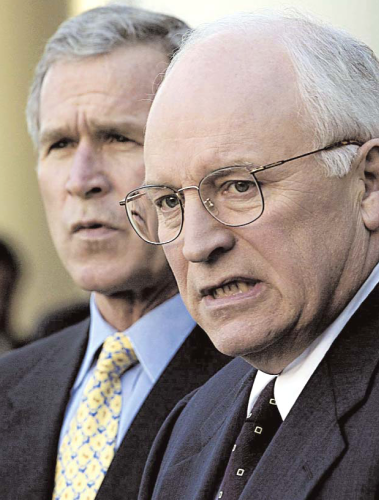
President George Bush and Vice President Dick Cheney at the White House on March 7, 2002.
The players
George W. Bush has certainly benefited from a dream team of senior advisers on his National Security Council. Bush chose carefully among people of conservative cast of mind to match his own, and while one may deplore the ideology of the crew, the president's right to be served by the officials he wants is unquestioned. Ideology notwithstanding, the Bush people have the right stuff–the credentials to actually be the pros from Dover–from the top people on the NSC to the second tier at the agencies and staff. On January 21, 2001, an observer could have said this administration was primed for success.
In terms of organization of the policy process, the Bush administration also started out on familiar ground. Presidents create their own policy machinery, and different presidents have approached the national security process in a variety of ways. 1
The Carter administration designed a two-committee structure that has become almost the standard NSC organization for subsequent presidencies, including that of George W. Bush. In the current scheme, the president meeting with his senior advisers constitutes the National Security Council. Without the president, the rump NSC meets as the Principals Committee, chaired by the vice president or national security adviser. These groups focus on decisions. Below them is the Deputies Committee, a group chaired by the deputy national security adviser, which concentrates on implementing the president's decisions. Staff assistants attend as required. Teleconferencing and secure video links between various U.S. government centers have enabled greater flexibility in participation, but the essence of the system remains the same.
The most remarkable aspect of Bush's national security organization is the role of the vice president. Historically, vice presidents have had a relatively minor impact on national security decision making. Walter Mondale and Al Gore were more active under presidents Carter and Clinton, and Bush's father, George H. W. Bush, had an enhanced role under Ronald Reagan. In the current administration, however, Dick Cheney is of critical importance in virtually all aspects of national security policy. From the first moments of George W. Bush's presidency, Cheney functioned as the power behind the throne, privately advocating policies, then coming out in public with discourse designed to build constituencies for those same policies. He also became the official whom Bush tapped for the tough jobs–and the president's hatchet man. Cheney emerged as an assistant with an agenda more ample than that of his master. His role encouraging Bush to make war on Iraq has been so widely remarked it has virtually eclipsed his work early in the administration heading a presidential commission on energy policy, his views on military transformation, and the task force on federal-local antiterrorism cooperation that Bush appointed him to chair four months before the 9/11 attacks.
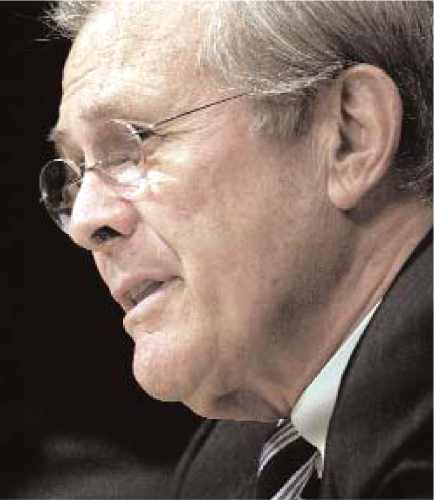
Donald Rumsfeld.
To match his policy role, the vice president has crafted a sort of mini-NSC staff among his White House retinue. Where Al Gore as vice president employed Leon Fuerth as his national security adviser (plus a couple of staff aides), and Bush's father, as vice president under Reagan, had a security staff of two professionals (plus aides), Cheney employs a national security staff of 15. The importance Cheney gives that staff is indicated by the fact that his own overall chief of staff, I. Lewis (“Scooter”) Libby, serves simultaneously as the vice president's national security adviser. Early last year, at a key moment in the run-up to the Iraq war, Cheney's deputy national security adviser Eric Edelman was appointed U.S. ambassador to Turkey, another indication of the standing of the Cheney national security staff. Edelman was succeeded by Aaron Friedberg, a China expert and former director of policy planning on the Cheney staff. That the staff even had a policy-planning component demonstrates the quantum advance of the Cheney operation over the staff resources available to previous vice presidents.
Cheney himself is no stranger to national security issues, or to government for that matter. In his current incarnation he is mostly known for his role as chief executive of the Halliburton Corporation during the 1990s, but less noted is the extent to which Halliburton worked with and for the U.S. military. More to the point, Cheney was defense secretary–the job Donald Rumsfeld now has–during the first Bush administration, including the first Gulf War. Before that, Cheney served as White House chief of staff to President Gerald R. Ford from 1975 to early 1977 and deputy chief of staff 1974-1975. At the time, he was deputy to Donald Rumsfeld, whom President Ford subsequently sent to the Pentagon. In the Ford White House, Cheney worked on a number of national security issues, most notably advising Ford on how to handle the intelligence scandals of 1975. Cheney was an architect of the presidential commission on intelligence (the Rockefeller Commission) created by Ford in an effort to head off what became the Church and Pike Committee investigations. While the attempt proved unsuccessful, Cheney gained experience he put to work later as a member of Congress and then in his own Pentagon job.
Next to the vice president, the person closest to the Oval Office is the national security adviser. For George Bush this is Condoleezza Rice. Like Cheney–like a number of the pros from Dover–Rice is no stranger to the issues, or even to the national security staff. Retired Air Force Gen. Brent Scowcroft (who held the post of national security adviser for Gerald Ford, alongside Cheney and Rumsfeld) discovered Rice during the 1980s at the Aspen Institute. She was then a recently minted academic with a doctorate in international relations from the University of Denver. Her dissertation was on Soviet political control of the Czechoslovak armed forces. She taught at Stanford University. When Scowcroft did a second tour as national security adviser in the administration of President George H. W. Bush, he brought in “Condi,” as she is familiarly known, as director for Soviet affairs. Rice was active on the NSC staff during the passing of the Cold War, when the Soviet Union collapsed, Germany reunified, and the old Yugoslavia disintegrated, leaving in its wake the Bosnian civil war.
Among the stories told about Rice that show her willingness to do whatever was necessary is one from the beginning of the first Gulf War, when the NSC staff person responsible for the Iraq-Kuwait region was Richard Haass. When the first President Bush needed a set of talking points for his initial public comment on the Iraqi invasion of Kuwait, Haass could not respond quickly enough because, unfamiliar with computers, he had to hunt and peck at the keyboard. Rice took over and typed out the paper even though Middle East matters were far from her own bailiwick. In 1991 Rice returned to Stanford as a teacher–but not for long. A month after receiving tenure in 1993 she was appointed provost of the university and held that key management position during difficult years. She quickly rallied to the presidential campaign of George W. Bush, however, and was its foreign policy director from early 1999. Rice not only coordinated Bush's issues papers but kept in line the “Vulcans”–the brain trust of national security experts who periodically assembled to give Bush the benefit of their accumulated wisdom. All the Vulcans (Richard Armitage, Robert Blackwill, Stephen J. Hadley, Richard Perle, Paul Wolfowitz, Dov Zakheim, Robert Zoellick) went on to important jobs or advisory posts in the Bush administration, and it was hardly surprising that Rice landed as national security adviser.
Stephen J. Hadley became Rice's deputy. The only other of the Vulcans to make the leap to work directly within the president's official family, Hadley regarded himself as a detail man. He too had a national security past, having served as assistant secretary of defense for policy under Dick Cheney in the first Bush administration. For those who worried about the influence of Cheney in the White House, Hadley's presence suggested that the vice president, in addition to having his own mini-NSC staff, simultaneously had a front man who was deputy director of the Rice staff itself.
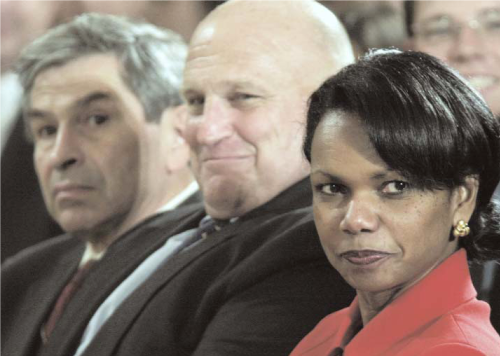
November 6, 2003: Paul Wolfowitz, Richard Armitage, and Condoleezza Rice look on as President Bush signs into law the $87 billion spending package for Iraq.
As for the seniors, the members of the actual council of the NSC, they were pros from Dover, too. Donald Rumsfeld has already been mentioned. He is the only person to serve twice as defense secretary–in two different administrations, separated by more than two decades. Colin Powell, retired four-star army general, had been chairman of the Joint Chiefs of Staff during the first Gulf War, a deputy national security adviser to Ronald Reagan, and military assistant to Defense Secretary Caspar Weinberger. CIA Director George Tenet was held over from the Clinton administration and had worked on the Hill, at the White House, or at the CIA since the late 1980s. Their seconds, people like Wolfowitz and Armitage, had similar credentials.
The system
President George W. Bush enhanced the role of his national security adviser by endowing her with cabinet rank. But formal organization of the system remained in limbo until mid-February 2001, when Bush issued his National Security Presidential Directive (NSPD) 1. That document ended speculation as to Vice President Cheney's role–a number of observers had anticipated that Cheney's deep interest in these matters would be reflected by his being made chairman of the Principals Committee. 2 This did not happen. Instead Rice, as national security adviser, would chair the group. What did happen was more significant: By avoiding the chairmanship of the Principals Committee, Cheney left himself free to be an advocate at national security meetings rather than having any responsibility to ensure that all views be aired.
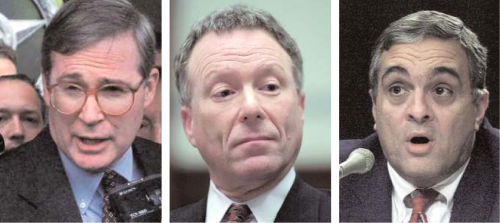
Stephen Hadley, “Scooter” Libby, and George Tenet.
The other significant thing about NSPD 1 was its lateness in the cycle. Most new administrations enter office determined to hit the ground running and typically put out their directives on NSC machinery their first day in office. Bush did not get around to this business for almost a month. By then there had already been two meetings of the Principals Committee. Even the appointments of Condi Rice and the top NSC staffers date from January 22, not the day after the inauguration. The implication is that, at least at the outset, Bush did not consider the national security agenda his top priority.
In terms of size and depth, the Rice NSC staff diminished from the standard under the Clinton administration, but this had more to do with notions of streamlining than with some idea of reducing the importance of national security. Rice cut the staff as a whole by about a third while reducing the number of professional staff from 70 to about 60. She eliminated the legislative affairs and communications offices, limited the staff to a single speechwriter and press spokesperson, and recast some functions. Most importantly, the Russian office merged into a single new desk that included all of Europe, the Balkans, and the former Soviet republics. The Asian affairs office re-absorbed Southeast Asia, which had been assigned to another regional unit in the Clinton White House. North Africa and the Middle East were combined as well. Africa and the Western Hemisphere completed the list of regional offices on the NSC staff. There were also functional specializations, including offices for defense policy and arms control and for intelligence.
Clinton had had an NSC staff unit to supervise nonproliferation and export controls. Under Rice this was reconceptualized as “Nonproliferation Strategy, Counterproliferation, and Homeland Defense.” This is instructive for it served as a device to take the ballistic missile defense issue out of the defense policy basket and put it in the much more ideological framework of “homeland defense.” That in turn became awkward after the September 11, 2001, attacks, when an Office of Homeland Defense was created at the White House as a parallel to the NSC staff, but in which “homeland defense” held a very different meaning.
The Clinton NSC staff also had a unit covering “transnational threats” and put terrorism at the top of that list. Clinton appointed Richard Clarke, a hard-headed advocate for proactive measures against those threats, to head the unit. Clarke stayed over into the Bush presidency even though, as a press account put it several weeks into the new era, what to do with the transnational threats office was “still up in the air.” 3 It is here that the real story begins.
Bush and terrorism
Bill Clinton's last national security adviser, Samuel (“Sandy”) Berger, held a number of briefings for Condoleezza Rice and the incoming national security staff as part of the transition from the Clinton to Bush presidencies. Every NSC staff office had been directed to compile a report and present its view of America's strengths and weaknesses to the new crowd. According to an account that has been disputed, the only one of these sessions Sandy Berger personally attended was that which concerned terrorism (Rice has said through a spokesperson that she recalls no briefing at which Berger was present). 4 Berger had left by the time Richard Clarke made the main presentation, but there can be no doubt that the briefing highlighted the need to act on terrorism.
Berger clearly had terrorism on his plate. The question is, did Rice? Berger would tell the joint House-Senate committee investigating the September 11, 2001, attacks that he had convened the Principals Committee every day for a month in an effort to stave off terrorist attacks timed around the millennium celebrations. 5 He quoted himself as telling Rice, “You're going to spend more time during your four years on terrorism generally and Al Qaeda specifically than any [other] issue.” 6 For her part, Rice had numerous questions for Clarke, who was asked to prepare a paper on steps against Al Qaeda. Clarke not only had the paper on Stephen J. Hadley's desk within days of the inauguration, he saw the opportunity to get the new president to sign on to an action plan against terrorism, and his paper amounted to an outline. So far, so good. But Clarke's plan then sat gathering dust for weeks.
In speeches, articles, and conversations during the 2000 campaign, Rice had written and spoken of the need in national security to separate the marginal issues from what was truly important.
What Rice and the Bush team made centrally important in the weeks and months after entering office was not terrorism but changing the U.S.-European relationship. The troubles with “Old Europe” that seem so intractable in the wake of the Iraqi war did not just happen coincidentally in 2002-2003. They were prefigured in the very stuff of the NSC staff reorganization, when the Russian and Western European offices were consolidated. Publicly the Bush administration sought to end any notion of a special relationship with Russia, the former Soviet Union, cutting back funding for special cooperative programs designed to help secure Russian nuclear weapons and expertise, abrogating the Anti-Ballistic Missile (ABM) Treaty, and in a variety of other ways. The move on the ABM Treaty also came as a shock to Old Europe, as did Bush's rejection of the Kyoto protocols on environmental action, and the equally sudden U.S. coyness on formation of an international criminal court. When President Bush made his first visit to Europe in June 2001, these issues were the main stuff of American diplomacy.
On the overarching front of defense policy, the maneuver on the ABM Treaty is itself indicative of the Bush administration's goals. Defense Secretary Rumsfeld used the word “transformation” so many times that it became enshrined as the descriptive term for Bush defense policy. Ballistic missile defenses were a key component, and indeed President Bush chose to deploy a technically immature defense system just to ensure that the United States had committed itself to this program. Rumsfeld's talk about space platforms, his predilection for air force programs, and his fight with the army over its future were the stuff of the transformation.
While circumstances dictated that an action plan on terrorism needed to move to the top of policy hill, the government was preoccupied with anything but that issue. It was only after Bush intervened that anything happened at all. One spring morning, following the departure of CIA briefers who had just given him news in the President's Daily Brief (PDB) of a manhunt for one particular terrorist, Bush complained to Rice: “I'm tired of swatting at flies…. I want to play offense, I want to take the fight to the terrorists,” Bush said. 7 Rice took the implication that President Bush wanted a plan to attack the terrorists. When she asked the NSC staff how they could put something together, Richard Clarke had his original plan ready.
By late April 2001 the NSC was ready for a policy review on terrorism. After, we are told, six weeks of preliminary sessions, the Deputies Committee met on April 30 to consider an outline plan that Clarke presented. Stephen J. Hadley chaired the meeting, which included Scooter Libby (for Cheney), Richard Armitage (for Powell), Paul Wolfowitz (for Rumsfeld), and John McLaughlin (for Tenet). Here was a case in which the State Department favored going ahead but the CIA proved more cautious. Rather than initiating action, the Deputies Committee called for not one but three policy reviews, one on Al Qaeda, a second on Pakistani internal politics, and a third on the India-Pakistan problem. 8 According to Deputy National Security Adviser Hadley, “the goal was to move beyond the policy of containment, criminal prosecution, and limited retaliation for specific attacks, toward attempting to ‘roll back’ Al Qaeda.” 9 The device of adding extra policy reviews inevitably slowed action, however. As Hadley noted in his response to 9/11 congressional investigators quoted above, between May and July there would be four successive meetings of the NSC Deputies Committee “directly related to the regional issues that had to be resolved in order to adopt a more aggressive strategy.” 10 The last one of these sessions discussed the text of a draft presidential directive on July 16.
Meanwhile, on May 8 President Bush created a new unit to focus on terrorism within the Federal Emergency Management Agency, and a new interagency board to consider terrorism issues. He put Cheney in charge of that operation. This was the only actual action President Bush took before September 11, 2001, and it was not about rollback. Cheney's mandate was merely to study preparedness for homeland defense and make recommendations by October.
A second group, the Counterterrorism Security Group (CSG), part of the NSC interagency machinery, was chaired by Richard Clarke. It would be the CSG, not the vice president, that acted, or more properly, reacted. Beginning in March, U.S. intelligence and military sources received a series of reports indicating possible terrorist attacks. First came a report that Al Qaeda operatives in Canada might attack the United States in April.
In April, one source made a rather suggestive speculation that Osama bin Laden was interested in commercial aircraft pilots as terrorists for “spectacular and traumatic” attacks. In May came a report that Al Qaeda supporters were planning to enter the United States to carry out some operation using high explosives. There was also a Pentagon report that seven key suspected terrorists had begun moving toward Canada, the United States, and Britain. Between May and July, the National Security Agency intercepted no fewer than 33 communications suggesting an attack, including one evaluated at the time as an order to execute the plan. In June, the CIA Counterterrorism Center received information that key operatives were disappearing from view. At the end of June, Clarke convened the CSG, and by July 5 there were sufficient alarms to warrant a meeting among Rice, Clarke, and presidential chief of staff Andrew Card.
By then the intelligence scene had shifted and threats seemed centered on the American embassies in Rome, Paris, or Ankara. The CSG met again on July 6, and from then through the end of August, Clarke kept up meetings two or three times a week. 11
In short, numerous disturbing intelligence reports came in over a period of months after President Bush had declared he wanted to go after terrorists, a period of time during which nothing happened with the U.S. government's planning for a rollback of Al Qaeda. Such Bush administration actions that occurred consisted entirely of putting certain selected military forces on precautionary (and defensive) alerts, or issuing warnings to the airlines.
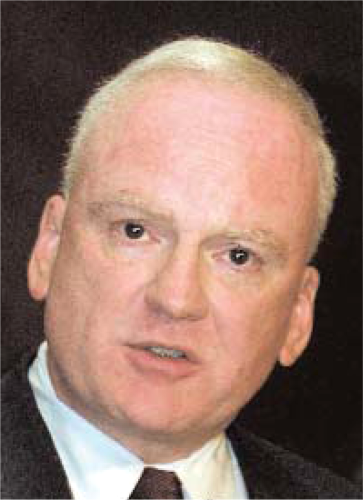
Richard Clarke.
Bush left for Crawford, Texas, and summer vacation on August 4. Two days later, he was given a fresh intelligence report–the PDB again mentioned terrorist attack. As characterized by national security adviser Rice, this PDB “was an analytic report that talked about [Osama bin Laden's] methods of operation, talked about what he had done historically in 1997, in 1998. It mentioned hijacking, but hijacking in the traditional sense, and in a sense said that the most important and most likely thing was that he would take over an airliner holding passengers [and then make demands].” 12
Much has been speculated about what Bush knew about the Al Qaeda terrorist threat, especially after the leak of the existence of the August 6, 2001 PDB and the report that it had mentioned aircraft hijacking. But the most important thing about the intelligence reports is something we already know: Neither the August 6 PDB, any of the other reports, nor the daily flurry of NSC staff activity on terrorist warnings moved Bush to demand the action plan he had supposedly called for in the spring, to ask that its preparation be accelerated, or to take any other action whatsoever. There is also no indication that Rice, whose job it was to be aware of these alarming reports, made any move to remind the president of his interest in the matter.
Absent presidential initiative, in fact, the plan to roll back Al Qaeda sat dormant six full weeks after mid-July 2001. The draft National Security Presidential Directive was finally considered by the NSC Principals Committee on September 4, and the group recommended that President Bush approve it. When Rice, or others, claim that an approved directive was on Bush's desk on 9/11, they exaggerate. The president had approved nothing. He had received a recommendation to sign a directive that had finally worked its way up through the bureaucracy.
The response of the Bush administration after 9/11 was rather different. When investigators raised questions regarding what Bush had done about intelligence he had received before the attacks, Vice President Cheney mounted a frontal assault on the 9/11 investigators, alleging they were responsible for the appearance in the press of reports of National Security Agency intercepts regarding the attacks, intercepts that White House spokesmen had themselves mentioned in press briefings in the days immediately after 9/11. Cheney demanded and got an FBI investigation of the investigators.
Ever since the 9/11 attacks the Bush White House has taken pains to avoid the revelation of any of the intelligence material provided to the president. The White House denied this material to the joint congressional committee investigating 9/11. It has also stonewalled the national commission inquiring into the attacks. The official rationale has been that no one should ever see the reports provided to a president.
That is not a legitimate declassification policy. A number of PDBs have been declassified and are in the public domain, including ones sent to President John F. Kennedy during the Cuban Missile Crisis and to President Lyndon Johnson during the Vietnam war. Excerpts of PDBs have been leaked on other occasions, not only the one to Bush for August 6, 2001, but one to his father before the Gulf War of 1990-1991. Our democracy has not been shaken by these revelations. And declassification is an ultimate step; the issue here is whether official inquiries operating under full security safeguards are entitled to view documents that are material to their investigations. The real reason to shield them is political: They would reveal the extent of warnings to George W. Bush in the face of which he stood immobile.
The November 2003 Bush compromise with the National Commission on Terrorist Attacks Upon the United States is designed to protect the president while appearing to cooperate. Under the arrangement, the White House will provide edited texts of some PDBs to a team of four (out of ten) commissioners, who will be permitted to take notes that can then be edited by the White House. Two commissioners will be permitted to review all the PDBs and ask that the White House make available additional ones. This formula will be cumbersome in practice and will not ensure public confidence in the 9/11 investigation.
Fast forward
The truth about 9/11 is one of two things. Either Rice's NSC machinery did not work, or else it worked perfectly to ensure that what Bush and his cohorts considered a marginal issue like terrorism did not clutter up the schedule of a president intent on another agenda–transforming America's relationships with traditional allies and former enemies. Either of these conclusions is disturbing. Once the Iraq war is factored into the equation the outlook is even more troubling. Again the NSC machinery operated in a fashion to prevent important objections or alternative policies from coming to the fore. U.S. policy going into the Iraq war was indifferent to alliance politics, to failures to attain needed U.N. approval, to U.S. military objections that the war plan was inadequate, to intelligence warnings that war would be succeeded by guerrilla resistance, to global public opinion, to international disarmament monitors who failed to turn up evidence supporting the Bush rationale for war, and more. 13 Dick Cheney served as an important driver of the policy that would be implemented. Condoleezza Rice became one of its most prominent public advocates; indeed Rice has served far more frequently as a public proponent than any of her national security adviser predecessors. Even Stephen J. Hadley, in the infamous manipulation of speech texts now encapsulated as the “Sixteen Words” controversy, made key contributions to a course of action that became an international and domestic political disaster.
The gang who produced all this were pros from Dover, using a tried and tested organizational structure for national security machinery. How could it be? Hubris, wishful thinking, incorrect assessment of the major issue facing the United States, wrongheaded notions of imposing change on the world–each played a role. Yet no heads have rolled. President George W. Bush promised to bring a new standard of accountability to Washington. In that he has succeeded. The picture is not a pretty one.
Footnotes
1.
An overview of presidents' practices is in John Prados, Keepers of the Keys: A History of the National Security Council from Truman to Bush (New York: William Morrow, 1991). The Bush in the title is, however, George H. W. Bush, the current president's father. There is no good study of the NSC during the Clinton years.
2.
Jane Perlez, “Directive Says Rice, Bush Aide, Won't Be Upstaged by Cheney,” New York Times, Feb. 16, 2001, p. A10.
3.
Karen DeYoung and Steven Mufson, “A Leaner and Less Visible NSC,” Washington Post, Feb. 10, 2001, p. A6.
4.
Massimo Calabresi et al., “They Had a Plan: Special Report: The Secret History,” Time, August 12, 2002, p. 30. Clinton-era NSC staffer Daniel Benjamin, who worked with Richard Clarke in the transnational threats office, confirms both the briefing session itself and the presence of Berger. See Daniel Benjamin and Steven Simon, The Age of Sacred Terror (New York: Random House, 2002), p. 328.
5.
Samuel R. Berger, “Joint Intelligence Committee Testimony,” prepared text (copy in author's possession), September 19, 2002, pp. 4-5.
6.
Daniel Benjamin and Steven Simon, The Age of Sacred Terror, p. 328.
7.
Barton Gellman, “A Strategy's Cautious Evolution: Before September 11 the Bush AntiTerror Effort Was Mostly Ambition,” Washington Post, Jan. 20, 2002, p. A1.
8.
The main sources for this account are the Barton Gellman story cited in note 7 and the study by a large team of Time correspondents cited in note 4.
9.
United States Congress (107th Congress, 2nd Session). Senate Select Committee on Intelligence and House Permanent Select Committee on Intelligence, Report: Joint Inquiry Into Intelligence Community Activities Before and After the Terrorist Attacks of September 11, 2001, hereafter cited as 9/11 Congressional Report (Washington: Government Printing Office, 2003), p. 235. White House sources deny that Richard Clarke's original January memorandum had featured an actual “plan,” Calabresi et al. (cited in footnote 4) note that Slide 14 of Clarke's presidential transition briefing on dealing with Al Qaeda included the words “rollback” and “breakup.” Although dated December 2002, disputes with the Bush White House over secrecy of material on some of the very subjects under discussion here delayed the actual appearance of this report for many months, into the fall of 2003.
10.
Ibid.
11.
The data on intelligence indications is from the 9/11 Congressional Report, pp. 201-205; the material on Counterterrorism Security Group activities is from Condoleezza Rice at her news conference of May 16, 2002 as cited in “Excerpt From National Security Adviser's Statement,” New York Times, May 17, 2002, p. A22.
12.
Rice news conference, May 16, 2002.
13.
This subject cannot be treated at length here, but see John Prados, Hoodwinked (forthcoming).