




Abstract

Like the other 103 commercial nuclear power reactors in the United States, the Tennessee Valley Authority's (TVA) Watts Bar reactor, some 40 miles southwest of Knoxville, Tennessee, is today churning out energy for its commercial and residential customers. But since last October, Watts Bar has been unique: Interspersed among its uranium fuel assemblies are numerous pencil-thin, 12-foot-long rods owned by the U.S. nuclear weapons complex. In the storm of neutrons generated by the fission reactions taking place in Watts Bar's nuclear core, lithium in these rods is slowly being converted to tritium, an isotope of hydrogen that differs from the normal variety in that it has two neutrons accompanying the sole proton of the hydrogen nucleus.
The reason? Tritium is a key nuclear ingredient in U.S. nuclear weapons, essential for transforming an atomic bomb into a far more powerful hydrogen bomb. Each year about 5.5 percent of the tritium decays, making it the only nuclear ingredient of U.S. weapons that must be periodically “topped off” to keep them in proper working order.
For nearly two decades, ever since its tritium-producing reactors were shut down for safety reasons, the Energy Department has relied on a reserve supply to replenish tritium. Fortuitously, that supply has been increased as tritium has been recovered from weapons removed from the arsenal as a result of arms reduction agreements. No shortage has occurred.
The cooling towers of the TVA's Watts Bar nuclear power plant as seen from across the Tennessee River.
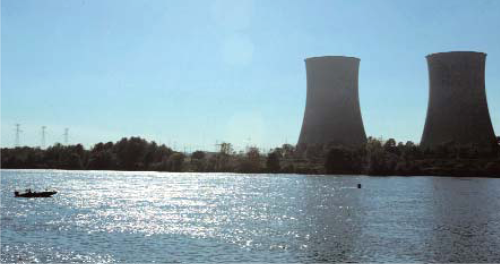
But in the late 1990s, decision makers in the bomb business, apparently uncomfortable with the idea of depending on arms cuts to keep the active arsenal up to par, conceived of a way to create a relatively cheap new supply of tritium. They would use commercial nuclear reactors as neutronic ovens for converting lithium to tritium, thereby avoiding the need to build a new and expensive dedicated tritium production facility within the nuclear weapons complex.
There was, however, one problem with their plan. As part of U.S. nonproliferation policy there had been a long-standing prohibition against using commercial nuclear reactors to produce bomb materials–the so-called no-dual-use policy. In 1998, however, government spinmeisters argued away this inconvenient policy (see my book Tritium on Ice for the sordid details), setting the stage for a deal that would allow Energy to purchase “irradiation services” from a commercial electric facility licensed by the Nuclear Regulatory Commission (NRC).
Critics of the plan to produce tritium in civilian reactors are not only concerned with the U.S. government's retreat from nonproliferation principles. They also charge that modifying TVA reactors to produce tritium at the same time as electricity could increase the likelihood that the public will one day be exposed to deadly doses of radioactivity.
For example, in January 2002, We the People, a Tennessee-based group specializing in the protection of nuclear whistle-blowers, petitioned the NRC to refuse to grant license amendments allowing the plant owners to make changes to accommodate tritium production. (TVA requested changes for both Watts Bar and the similar Sequoyah plant just down the Tennessee River, but so far only Watts Bar has been converted.) The group's petition called for public hearings on the license amendments, arguing that the proposed changes could substantially increase public risk.
We the People took as its starting point the NRC's own studies showing that these outdated and unusual TVA power plants (known as ice-condenser plants) were exceptionally vulnerable to severe reactor accidents because their containment systems are inadequate. And there is a connection between their particular vulnerability and recent concerns about terrorism, because the same design flaws that make the plants more susceptible to severe accidents also make them more susceptible to sabotage.
The concern is not so much about a possible attack by air, but rather the possibility that terrorists could penetrate the reactor buildings and subvert key safety systems, causing a core meltdown followed by failure of the ice-condenser containment building and the release of vast quantities of radioactivity into the atmosphere.
The third part of the group's argument was simply that if these plants were going to be, in effect, part of the nuclear weapons complex, they would become more attractive targets to terrorists. Moreover, since the level of security at civilian nuclear power plants is far lower than at nuclear weapons facilities, Watts Bar would be the least-defended element in the nuclear weapons complex.
The unavoidable conclusion, said We the People, was that adding the new mission would immediately and substantially compromise the safety of hundreds of thousands of people living near the plant. Consequently, the NRC had an obligation to put the license amendments on hold until public hearings could be convened and the safety issues fully aired.
To address this and other petitions opposing the license amendments, a three-judge panel was convened by the Atomic Safety and Licensing Board, one of the NRC's judicial arms. But the panel was short-lived. While the panel recognized that We the People had legal standing (a considerable hurdle to overcome), in June 2002 it ruled that all of the group's contentions were “inadmissible.” As a result, no public hearings on plant changes were ever held.
It seems shocking that arguments about safety and terrorism were rejected not because they were unfounded or unreasonable, but because they were inadmissible–revealing how clever the Energy Department's decision to utilize an existing, licensed, commercial nuclear plant to make weapon tritium had been.
If Energy had opted for a new nuclear facility, its design and operation would have had to meet the most up-to-date standards of nuclear safety. Its safety review would have reflected the sad but important lessons of Three Mile Island, Chernobyl, and the World Trade Center attacks.
But current plant owners are allowed to justify amendments to existing licenses solely on the basis on which the plants were first licensed, which was in the 1970s for Watts Bar and Sequoyah. That licensing basis excludes any consideration of core melt accidents or terrorist attacks like those of 9/11. It was perfectly legal for the judges to refuse to hear a discussion about these potential dangers, no matter how much more we now know about accidents or how much real-life circumstances have changed. Narrow legalism trumped public safety.
If the NRC's judges felt constrained by the narrow exigencies of legal rules and precedents, its licensing group had more flexibility in its review of TVA's license requests. But the licensing staff also failed to rise to the challenge, maintaining that TVA need only consider the stylized reactor accidents and sabotage threats formulated decades earlier. (Since 9/11, the NRC has been widely criticized for requiring power plant security forces to repel only the puniest of terrorist threats; see, for example, “The NRC's Dirty Little Secret,” in the May/June 2003 Bulletin, as well as the General Accounting Office report “Nuclear Regulatory Commission: Oversight of Security at Commercial Nuclear Power Plants Needs to Be Strengthened,” September 2003).
Nonetheless, the license amendments were granted in September 2002, and today Watts Bar is making bomb material.
The irony in the Bush administration's decision to continue with this program is that if the (still unratified) START II treaty negotiated by Bush the father had been respected by Bush the son, no new tritium would be needed until 2016. Stranger still is the pursuit of a new supply of tritium even as Bush the son negotiated what he described as even deeper nuclear arms cuts in the Moscow Treaty of 2002, which calls for as much as a 50 percent reduction in strategic warheads compared with START II. By the simple math of tritium decay and tritium recycling, that should translate to a 12-year extension in the date when new tritium would be needed.
Why the rush to convert civilian reactors to dual-use facilities if the United States will need no new tritium until 2028?
Part of the answer is that there has been a serious deterioration in the meaning of the words “arms cuts.” Not all nuclear weapons were counted in the numerical limits of 8,400 and 3,500 strategic warheads in the START I and START II treaties, respectively. For example, no tactical weapons were included in the count. Other excluded categories are known as “spares” or the “upload hedge.” By the time of the Moscow agreement, the ratio of “accountable” warheads (those actually limited in the agreements) to the total number in the U.S. arsenal had drifted alarmingly downward. For START I, the ratio was about 80 percent; for START II, about 50 percent. Under the Moscow agreement it will be less than 25 percent by 2012.
It appears, then, that the Energy Department's schedule for a new tritium supply is not based on maintaining enough tritium for the active stockpile, but enough to keep retired (or semi-retired) U.S. nuclear warheads fully functioning as well. The tritium program only makes sense in the context of keeping at the ready a much larger nuclear arsenal than that agreed to in START II as negotiated by the first President Bush.
But while Energy's schedule for tritium production implies an aggressive attitude about the size of the nuclear arsenal it intends to maintain, the quantity of tritium actually being produced presents a different picture. Surprisingly, only 240 tritium rods were loaded in Watts Bar last October, not the 2,304 that had been approved by the Nuclear Regulatory Commission. Meanwhile, the two Sequoyah reactors are producing no tritium at all. The current rate of rod irradiation is less than 6 percent of the requirements the Energy Department conveyed to TVA in 2002. The reduced level of tritium production would be sufficient to maintain only about 1,500 warheads, less than any of the treaties' limits. The significance of this change is difficult to assess, because the Energy Department has offered no public explanation.
The 240 lithium target rods now baking in the Watts Bar reactor will be removed in April 2005 and transported to the Energy Department's Savannah River Site where the tritium is supposed to be extracted in an expensive new facility. But the construction of that facility has fallen far behind schedule.
It is possible that the sharp reduction in rod irradiation is simply due to the construction delay, but it is also possible that Energy is now recognizing what many have said before–that the need for new tritium has been exaggerated. There is no telling. Or at least the government is not telling.
At any rate, the earliest the new tritium will be available for the nuclear arsenal is 2007. This long delay may offer some hope to those who firmly believe in the importance of U.S. leadership in global nonproliferation efforts. The no-dual-use policy has not actually been violated, because no tritium from Watts Bar has yet been used in any nuclear weapons. It may not be too late for the policy to be reversed. If the policy were reversed, the tritium now being produced at Watts Bar could be sold on the commercial market (where it is used in devices such as emergency runway lighting), and the United States could regain some lost credibility in the eyes of the world.
Optimistic? Yes, but a lot could happen between now and 2007.