




Abstract
No one within the administration or the nuclear weapons establishment is publicly advocating placing low-yield weapons in space–yet. Here's how it might happen.
Nuclear weapons in space? Inconceivable–the idea is a bogeyman from the 1950s and 1960s, a nightmare scenario put to rest by the Outer Space Treaty of 1967, which prohibits the stationing of nuclear weapons (or any other weapons of mass destruction) in space. Arms controllers regularly call the Outer Space Treaty a bedrock document of arms control.
But these days, few Cold War treaties are sacred. Witness the collapse of the bilateral Anti-Ballistic Missile Treaty, the slow-motion death throes of the Nuclear Non-Proliferation Treaty, and the dwindling life expectancy of the Comprehensive Test Ban Treaty. Could the Outer Space Treaty end up on the hit list?
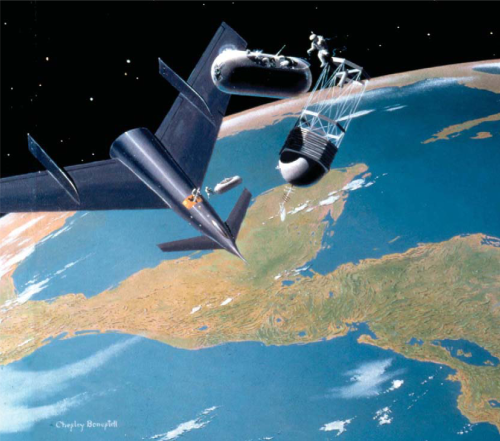
The following is highly speculative. Although it is about the possibility of nuclear weapons in space, there is no smoking gun. Even hardline space warriors say the United States can accomplish its military goals without placing nuclear weapons in space. If weapons in space are needed, they say, precision armaments will do just fine.
But things change. What seems unthinkable one year may seem prudent a decade later. A number of trends–the imperial drift of U.S. foreign policy, the Bush administration's enthusiasm for new nukes, and something known as “generational imbalance”–could help persuade American policy-makers a few years down the road that nukes in space are both cost-effective and necessary.
Since the fall of the Soviet Union, neoconservatives–along with their less rigidly ideological cousins, American triumphalists–have gained influence in U.S. public life far disproportionate to their numbers. With the election of George W. Bush, they also gained considerable power in the shaping of foreign and military policy.
Triumphalists–once simply known as “hawks”–comprise the “We're Number One!” crowd of men and women determined that the United States should forever retain its preeminent economic and military position in the world, even if that means dealing with the devil now and then.
Neoconservatives–a loose label for men and women who seek to distinguish themselves from old-style conservatives–go well beyond that. They are crusaders who hope to carry the banner of liberty, justice, and democracy to yet-unsaved lands, using U.S. armed forces as leverage. Armed conflict should be avoided if possible, they say. Nevertheless, the U.S. military is no garden club. It is useful only to the degree that terrorists and recalcitrant states understand that the United States will use decisive military force if provoked. And it would be the United States, not the United Nations, that would define what constituted a provocation.
Neoconservatives are intent on ending the dominance of liberal internationalists and realists–the men and women who have dominated the U.S. foreign policy agenda (with the exception of Ronald Reagan's tenure) since Franklin D. Roosevelt. There has been much talk in recent years in military and foreign policy circles about the “revolution in military affairs,” but the more significant revolution may be the neocon-driven “revolution in foreign policy.” The United States now operates by different rules.
William Kristol and Robert Ka-gan's “Toward a Neo-Reaganite Foreign Policy,” published in 1996, became an instant anthem for neocons and, in hindsight, it can now be understood as a preview of the U.S. National Security Strategy issued by George W. Bush in September 2002. Kristol and Kagan defined America's new role in the chaotic post-Cold War world as “benevolent global hegemony”:
“Having defeated the ‘evil empire,’ the United States enjoys strategic and ideological predominance,” they said. And “in a world in which peace and American security depend on American power and the will to use it, the main threat the United States faces now and in the future is its own weakness. American hegemony is the only reliable defense against a break-down of peace and international order. The appropriate goal of American foreign policy, therefore, is to preserve that hegemony as far into the future as possible. To achieve this goal, the United States needs a neo-Reaganite foreign policy of military supremacy and moral confidence.” 1
The 2002 National Security Strategy echoes that line. The introduction says that the “world was divided by the great struggle over ideas: destructive totalitarian visions versus freedom and equality.” But the struggle had ended; America had won. Its mission was now to promote the “balance of power that favors freedom” throughout the world. And a few pages on: “We will maintain the forces sufficient to support our obligations, and to defend freedom. Our forces will be strong enough to dissuade potential adversaries from pursuing a military buildup in hopes of surpassing, or equaling, the power of the United States.”
Teddy Roosevelt is said by insiders to be George W.'s role model. Speaking in Chicago on April 10, 1898, with a declaration of war against Spain likely but not quite certain, Assistant Secretary of the Navy Roosevelt gave his “strenuous life” speech. “Our country calls not for the life of ease but the life of strenuous endeavor.” In the coming century, he said, the United States must not “shrink from the hard contests where men must win at the hazard of their lives and at the risk of all they hold dear.” If the United States chose instead to “stand idly by,” if it opted for the “swollen, slothful ease and ignoble peace,” then “bolder and stronger peoples will pass us by, and will win for themselves the domination of the world.”
Teddy Roosevelt was a moderate when it came to domination. He simply wanted the United States to take its place among the great imperial powers–Britain, Germany, France, Russia, and lately, Japan. Today's neoconservatives would have America take its place far above the other powers. That messianic impulse may take the U.S. military more aggressively into orbital space.
For four decades, U.S. attitudes toward military space have been sensible and generally cautious. But that prudential attitude is rapidly changing. U.S. space policy was roughed out by President Dwight D. Eisenhower after Sputnik. Pared down, it says that no nation should seek to control or weaponize space lest it provoke others to do the same, triggering a dangerous and unpredictable arms race in space. With the exception of the Reagan-era flirtation with the Star Wars antiballistic missile fantasy, the Eisenhower policy–sometimes called “space sanctuary”–has remained the basic U.S. stance toward military space.
“Space sanctuary,” however, is misleading. Orbital space is anything but pristine. It has been militarized for 40 years. A diverse array of unmanned satellites–currently, about 600 active birds, the majority of them carrying a Made-in-the-USA label–have had an immeasurably large impact on the sciences, global communications, worldwide commerce, and war. America's new way of precision warfare depends heavily on space assets, among them intelligence, surveillance, reconnaissance, communication, and positioning satellites.
In the end, space sanctuary simply means that no actual weapons, or “shooters,” have been deployed in space and that there has been no widespread deployment of terrestrial weapons that could attack targets in space. The Global Positioning System is a key element in the U.S. way of war, for instance, but it is not itself a weapon. To Eisenhower-type realists, the Outer Space Treaty and several other space-related treaties play essential roles in keeping space free of weapons.
Guardian of the peace
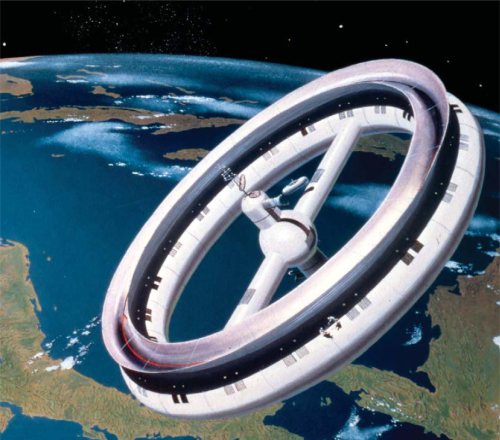
The space wheel, von Braun said, could provide meteorologists with a vantage point from which to observe cloud patterns and predict the weather more accurately, supply sailors and pilots with a navigational landmark, and give future space travelers a jumping-off point to visit the moon or Mars. But von Braun's space station would also give the nation that built it a huge military advantage.
Wernher von Braun.
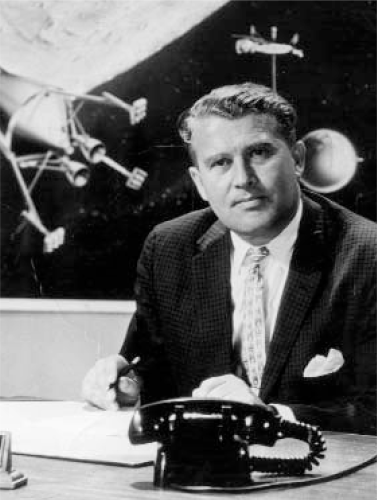
The space wheel would be in near-polar orbit, which meant that those who manned it would be able to view nearly every point on Earth at least once in a 24-hour period. Technicians “using specially designed, powerful telescopes attached to large optical screens, radarscopes, and cameras” would “keep under constant inspection every ocean, continent, country, and city. … It will be practically impossible for any nation to hide warlike preparations for any length of time.” ∗
It would cost about $4 billion to build such a space station, von Braun estimated in 1952, nearly twice the cost of World War II's atom bomb project. But, he predicted, if the United States didn't do it, another nation–possibly less peace-minded–would.
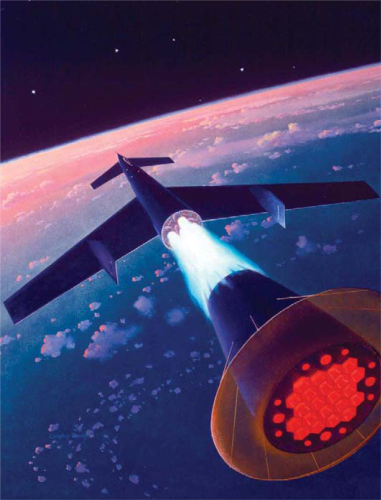
If a “freedom-loving” nation built the space station, that nation could become the “guardian of the peace.” If a nation threatened war, “small winged rocket missiles with atomic warheads could be launched from the station in such a manner that they would strike their targets at supersonic speeds. By simultaneous radar tracking of both missile and target, these atomic-headed rockets could be accurately guided to any spot on the earth.”
∗Wernher von Braun, “Crossing the Last Frontier,” Collier's, March 22, 1952.
Meanwhile, a competing realist view places little faith in the power of treaties to keep space a weapons-free sanctuary. Conflict in space, they say in the classic Hobbesian manner, is inevitable, and the United States must be ready for it with the best and the most. They are true followers of Vegetius, the Roman who declared nearly 2,000 years ago, “Let him who desires peace prepare for war.”
For two generations, these two varieties of realism have coexisted in U.S. attitudes toward military space. Although the United States has mostly followed a “space sanctuary” policy, all administrations, Democratic and Republican, have hewed to Veg-etius's be-prepared maxim. For 40 years, potential space warriors have engaged in systematic research programs and doctrine building so that they would be ready for action if conflict in space appeared to be inevitable. For these spacepower realists, “space control” means the capability to protect U.S. space assets and to deny the use of space to adversaries, at least in a time of conflict.
In contrast, the most passionate of space warriors would abandon both realist models. It is shortsighted, they say, to continue regarding space as a weapons-free sanctuary–and it is not enough simply to prepare to fight in space, should the United States be challenged. American military might is breathtaking; the United States should use that fact to its advantage. The United States should short-circuit any conceivable space arms race by winning it before it starts. It should develop the capability to control space 24 hours a day, 365 days a year.
Interest in using military space more expansively and creatively has skyrocketed in hardline think tanks, within the Defense Department, and among a host of national security intellectuals since the collapse of the Soviet Union. The report of the “Space Commission,” chaired by Donald Rumsfeld and released in January 2001, shortly before he became secretary of defense, offers insights as to which way the wind may blow:
“Many think of space only as a place for passive collection of images or signals, or a switchboard that can quickly pass information back and forth over long distances. It is also possible to project power through and from space in response to events anywhere in the world. Unlike weapons from aircraft, land forces, or ships, space missions initiated from earth or space could be carried out with little transit, information, or weather delay. Having this capability would give the United States a much stronger deterrent and, in a conflict, an extraordinary military advantage.”
But the report of the Space Commission is modest stuff compared to the dreams of some space warriors. Everett C. Dolman is a professor at the U.S. Air Force's School of Advanced Airpower Studies, a clout-heavy institution that has given birth to airpower and now spacepower theory and doctrine since the 1930s. Dolman, a self-described neoconser-vative, argues in his recent book, As-tropolitik: Classical Geopolitics in the Space Age, that the United States should “endeavor at once to seize military control of low-Earth orbit.” Only America, he says, can be trusted to regulate space for the benefit of all:
“If any one state should dominate space, it ought to be one with a constitutive political principle that government should be responsible and responsive to its people, tolerant and accepting of their views, and willing to extend legal and political equality to all. In other words, the United States should seize control of outer space and become the shepherd (or perhaps watchdog) for all who would venture there, for if any one state must do so, it is the most likely to establish a benign hegemony.” 2
Dolman is easy to like. He is receptive to contrary ideas, not contemptuous, and he deeply believes that American control of space, once people got used to it, would bring enormous benefits to humankind. “It places as guardian of space the most benign state that has ever attempted hegemony over the greater part of the world. It harnesses the natural impulses of states and society to seek out and find the vast riches of space as yet unidentified but universally surmised to be out there. … It is bold, decisive, guiding, and, at least from the hegemon's point of view, morally just.”
Good intentions aside, it does sound a bit imperial, vaguely reminiscent of American empire rhetoric more than a century ago. In 1890, Capt. Alfred Thayer Mahan, the brilliant naval theoretician and self-described imperialist, published his first great work–The Influence of Sea Power on History, 1660-1783. He argued that a nation's ability to control sea lines of communications (essentially, trade routes)–and thus build and protect an empire–was pivotal. It is “overbearing power on the sea which drives the enemy's flag from it, or allows it to appear only as a fugitive; and which, by controlling the great common, closes the highways by which commerce moves to and from the enemy's shores.”
Is the United States becoming an imperial power, in a Mahan-like sense? Or is it already an imperial power? If so, is control of space–“this new ocean,” in the words of John F. Kennedy–part of a grand imperial design?
Until recently, most Americans have had a hard time thinking of the United States as an imperial power. Despite its many interventions in the affairs of other states in the twentieth century, the United States seldom exhibited a taste for Roman-style empire building. If the United States really wanted to run the world, it blew a wonderful opportunity to do so years ago. Immediately following World War II, the United States had the best-trained and best-equipped military forces in the world, an intact industrial base, and atomic bombs. Much of Europe was still smoldering, the Soviet Union had been ravaged, the Japanese empire had been destroyed, and China was a frightfully poor country wracked by civil war.
A Pax Americana was theoretically at hand. Instead, the United States dismantled much of its military, shredded its arms budgets, and turned to churning out millions of cars and refrigerators and lawn mowers to accompany the hundreds of thousands of tract houses it built in former cornfields. As for atomic energy, it considered turning control of that over to the United Nations.
But that was nearly 60 years ago. In the twenty-first century, during the age of globalization, a time in which rogue states and terrorists thousands of miles from U.S. borders can hatch and execute murderous plots against it, the United States must be far more “forward leaning,” to use one of Donald Rumsfeld's favorite phrases. The United States must actively remake the world, refashioning it into something more congenial to U.S. interests. Although “benign global hegemony” is still the preferred description, increasing numbers of neoconservatives have come to admit, without irony or guilt, that “hegemony” does indeed sound a bit like a new kind of imperialism, a kinder and gentler imperialism–a “liberal and humanitarian” imperialism, to quote Max Boot, a rising star in the neocon firmament. 3
It is perhaps pointless these days to argue that the United States is not an empire. As always, the question about any empire is, what kind of empire? According to the 2002 National Security Strategy, a major goal of the United States is to spread liberty and justice and democracy throughout the world. But how? There is considerable clarity about that among neoconservatives. Consider this formulation by a rising neocon star, Michael McFaul, a research fellow at the Hoover Institution, a professor at Stanford University, and an associate at the Carnegie Endowment for International Peace:
“The United States cannot be content with preserving the current order in the international system. Rather, the United States must become once again a revisionist power–a country that seeks to change the international system as a means of enhancing its own national security. Moreover, this mission must be offensive in nature. The United States cannot afford to wait and react to the next attack. Rather, we must seek to isolate and destroy our enemies by eliminating their regimes and safe havens. The ultimate purpose of American power is the creation of an international community of democratic states that encompasses every region of the planet.” 4
Cover art for the March 22, 1952, Collier's.
It is here that neoconservatism definitively parts with any known variety of realism as well as with those of us–liberal internationalists–who believe that national security is best guaranteed by promoting a web of multilateral institutions to tackle regional and global problems. The neo-conservative answer to national security is flat-out military dominance, in the interest of promoting democracy among nations, free trade, and a more peaceful world.
A few highly subjective observations about some of the forces that will contribute greatly to shaping the foreign policy of the United States for many years:
The “peace dividend” that so many of us talked about a decade ago will remain elusive. The world, to use the now-hoary cliché, will remain a dangerous place. The United States must maintain the world's best-trained and capable military forces. The United States, just as Madeleine Albright used to say, is the “indispensable nation.” Does anyone really wish that the Soviet Union had “won” the Cold War?
The revolution in military affairs is a fact, and only the United States has accomplished it. No other nation-state is even in the game. The NATO air campaign over Serbia and Kosovo, for instance, demonstrated that there are a host of “interoperability” issues between the United States and the rest of NATO. With the possible exception of Britain, the United States is so far ahead of the other NATO nations in technology and doctrine that it cannot fight effectively as a team. The key U.S. takeaway: In future military actions, the United States will fight alone, albeit with enough peripheral “support” from ad hoc “coalitions of the willing” to give it some multilateral cover.
Neoconservatives will remain pleased with de facto unilateral action. They are a rhetorically muscular and bold bunch. As Robert Kagan puts it, “Americans prefer to act with the sanction and support of other countries if they can. But they're strong enough to act alone if they must.” 5
The peculiarly messianic drive of neoconservatives–their compulsion to spread American values everywhere like globe-trotting Johnny Appleseeds–will not abate.
The United States will remain committed to preserving unchallenged military dominance, a policy that took root during the Democratic administration of Bill Clinton. (It was during the Clinton administration that the Joint Chiefs publicly began speaking of achieving and maintaining “full-spectrum dominance.”) To retain that degree of dominance, the United States must protect the space assets upon which much of the new American way of life–and war–depends.
The United States will attempt to prevent rogue states from acquiring a nuclear-weapon capability and a medium-range missile capability. A rogue state is not likely to launch a nuclear-armed missile toward the United States; that would be suicidal. But it might be tempted to launch nuclear-tipped missiles into “blank” space, wreaking havoc on U.S. satellites in low-Earth orbit. Policy-makers call that a potential form of “blackmail.” The Bush administration has given ample indication that it would take preemptive action against a potentially hostile nation it believes is developing that capability.
The United States, as long as neoconservatives and triumphalists remain at the helm, will remain enthusiastic about retaining a large arsenal of Cold War-era nuclear weapons. The administration also seems to be preparing Congress for the “need” to develop new generations of nukes, and it may be laying the groundwork for a resumption of nuclear testing in a few years.
Finally, there is a hugely important wild card. The American economy may be heading for major trouble. Increasing numbers of American economists are worried about the coming impact of “generational imbalance”–the notion that fiscal irresponsibility today is likely to sap economic vitality tomorrow. Generational imbalance is shorthand for the vast topic of “unfunded liabilities,” most prominently Social Security and Medicare.
The “goal of all Americans”
“The United States must win and maintain the capability to control space in order to assure the progress and preeminence of the free nations. If liberty and freedom are to remain in the world, the United States and its allies … cannot permit the dominance of space by those who have repeatedly stated they intend to crush the free world.
“You will note that I stated the United States must win and maintain the capability to control space. I did not say that we should control space. There is an important distinction here. We want all nations to join with us in such measures as are necessary to ensure that outer space shall never be used for any but peaceful purposes.
“But until effective measures to this end are assured, our possession of such a capability will guarantee the free nations liberty–it does not connote denial of the benefits of space to others. In the past when control of the seas was exercised by peaceful nations, people everywhere profited. Likewise, as long as the United States maintains the capability to control space, the entire world will reap the benefits that accrue.” ∗
General White wound up his speech with this passionate declaration: “To assure that the United States gains and maintains the capability to control space should be the goal of all Americans.”
∗Reprinted in Space Weapons: A Handbook of Military Astronautics (New York: Frederick A. Praeger, 1958).
The possible impact of generational imbalances–bills not paid by current generations of workers that will have to be paid by future generations of workers–has long caused handwringing in Western Europe and Japan, where unfunded liabilities are proportionately greater than in the United States. But in the United States, it is a non-issue. The topic is arcane, mathematical, hard to handle on TV news channels, and certainly unpopular with a Republican Party that likes to buy votes with tax cuts and a Democratic Party that has long purchased votes with new and creative spending plans.
But as surely as the pig moves through the python, America's huge post-war “baby boom” generation is beginning to retire, and the “boomers” will–on average–draw Social Security and Medicare benefits well into their 80s. According to one study developed for the U.S. Treasury but not used by the Bush administration in preparing its proposed fiscal 2004 budget, the imbalance is $44.2 trillion. To achieve “sustain-ability” over the long haul, the United States must make draconian cuts in spending, substantially raise taxes, or both. For each year of delay, the remedy will become more severe. 6
Attempts to cope with the consequences of the generational imbalance will have unpredictable consequences. Some assert that the negative impact will be as wrenching as the Great Depression. Others suggest that such talk is sky-is-falling blather–“growing” the economy will solve all problems.
It seems likely, though, that the coming struggle to keep the economy healthy while attempting to meet domestic needs and entitlements is likely to mean that the Defense Department will no longer have the keys to the vault, as was generally the case during the Cold War and again during the current “war on terror.” While the Defense Department will remain the most powerful player in the federal budget battle, it will nonetheless have to figure out how to maintain full-spectrum dominance without breaking the bank.
Many of the schemes space warriors now speak of, particularly when they get to “force application”–the capability to attack terrestrial targets from space with lasers, particle-beam weapons, or kinetic-energy weapons–are so fantastic as to be doomed to fall of their own weight. Indeed, every military system in space is rambunc-tiously expensive, a fact of life space warriors acknowledge. If a given military task can be done by a terrestrial system, goes the rule of thumb, go with it.
It is hard to imagine that in a new era of ever-tightening federal budgets toweringly expensive space weapons would find much favor. Unless, of course, the space weapons were low-yield nuclear weapons.
Consider the position of the United States at the start of the Eisenhower administration in January 1953. Eastern Europe was a collection of “captive nations.” The Middle East and the Mediterranean were in constant turmoil. China was communist. The Korean War had settled into a bloody stalemate. And the Soviet Union was widely believed in the foreign policy establishment to be on an expansionist roll. The response devised by the Truman administration was containment. U.S. nuclear weapons combined with U.S. resolve would deter the Soviet Union from dangerous ventures. Eisenhower took the basic Truman policy, tinkered with it, refined it, dressed it in new clothes, and called it the “New Look.”
Eisenhower's bedrock belief was that nuclear war would be so terrible that neither side would let it happen. Still, the centerpiece of the New Look was massive retaliation–the threat to destroy the Soviet Union if it ever tried to take over Western Europe. That a man dedicated to peace would use the threat of nuclear war to pave the road to peace puzzles many. Some explanation can be found in the rationale behind the policy:
First, neither side wanted nuclear war.
Second, the guaranteed terror and destruction of nuclear war was thought by the administration to be the best way to ensure that the Soviet Union and the United States did not somehow stumble into one.
Third, the United States would be involved in the East-West confrontation for a very long time, perhaps 50 years or more.
The last point was pivotal. Eisenhower was a fiscal conservative. During his presidential campaign, he said that “the foundation of military strength is economic strength,” and that a “bankrupt America is more the Soviet goal than an America conquered in the field of battle.” If the United States were to prevail over the Soviet Union in a long competition of ideologies and ways of life, the U.S. economy would have to remain healthy, free, and innovative.
The national debt was $267.5 billion when Eisenhower took office. That was more than five and a half times larger than the debt just before the start of World War II. If the rate of Truman-era spending continued, the debt would reach $307 billion by 1958–$33 billion beyond the statutory limit. That does not seem to be much by today's standards, but it horrified Eisenhower. 7
Eisenhower's New Look would serve two purposes. By making it plain to the Soviet Union that nuclear war was too terrible to fight, the two nations would never come to blows. And by relying heavily on nuclear weapons instead of a huge and enormously expensive buildup of conventional forces to fight Soviet-backed forces anywhere in the world, he could keep Defense Department budgets down, thus preserving a healthy economy.
The New Look was called by all “more bang for the buck.” A few years from now–if neoconservatives and triumphalists remain dominant in U.S. foreign policy–one can imagine another president looking for a similar defense-economy compromise.
Whether nuclear weapons were really cost-effective in the old Eisenhower sense is a complex argument. A good starting point for investigating the issue is Atomic Audit: The Costs and Consequences of U.S. Nuclear Weapons Since 1940, an exhaustive study put together by a team headed by Stephen I. Schwartz, now publisher of the Bulletin of the Atomic Scientists. The nuclear-weapons enterprise of the Cold War, Audit demonstrated, was far more costly–in dollars and cents–than anyone knew or cared to admit.
But the salient point today is that many influential people within the administration, in the Defense Department, in the national weapons labs, and in hardline think tanks believe that nuclear weapons still have a great deal to offer–from classical deterrence to war-fighting.
The Nuclear Posture Review, issued in January 2002, notes, for instance, that “current conventional weapons can only ‘deny’ or ‘disrupt’ the functioning of HDBTs [Hard and Deeply Buried Targets] and require highly accurate intelligence and precise weapon delivery–a degree of accuracy and precision frequently missing under actual combat conditions. Similarly, current conventional weapons are not effective for the long-term physical destruction of deep, underground facilities.”
Because of that, the Bush administration seems intent on developing a “robust nuclear earth penetrator,” a bunker-busting weapon that could be used without causing “unacceptable” collateral damage. It seems equally intent on developing low-yield weapons for other purposes, such as “agent defeat”–the destruction of chemical or biological weapons.
The question is: Might a future administration demonstrate similar enthusiasm for deploying low-yield nuclear weapons in space? The emphasis is on “future”–no one within the administration or the nuclear weapons establishment is publicly advocating placing low-yield nuclear weapons in space. As noted earlier, the Outer Space Treaty of 1967 prohibits basing nuclear weapons in space.
But is the Outer Space Treaty an unbreachable barrier? Don't make book on it. American triumphalists and neo-conservatives have already demonstrated an enthusiasm for abandoning treaties if they–according to the mantra–“no longer serve U.S. interests.” The treaty, promoted by the United States and negotiated under the auspices of the United Nations, is undeniably an artifact of the Cold War, a pact that ensured that the East-West arms race would not extend into space.
In the 1960s, neither the Soviet Union nor the United States had the capability to control space. Today, the United States is the sole global “hyperpower,” and it, alone among the world's nations, speaks of developing a space-control capability. Add to that the fact that the Outer Space Treaty is not highly regarded by many of the most ardent of space warriors, and it is clear that the supporters of the treaty have something to worry about.
Dolman writes in Astropolitik that the United States “should declare that it is withdrawing from the current space regime and announce that it is establishing a principle of free-market sovereignty in space.” He then states the obvious: The treaty would die. Good riddance, he says in effect; it is not a good treaty anyway. For one thing, it stifles space entrepreneurship.
But would Dolman put nuclear weapons into orbital space to help establish “free-market sovereignty”? No–they are not necessary. If the United States places weapons in space, which he thinks desirable, they will be precision weapons, perhaps kinetic-energy devices.
And yet, the negative economic impact of the generational imbalance will begin to be felt within a few years, and economists predict that it will become more severe year by year. Every segment of the national government will be forced to become more efficient, to get more “bang for the buck.” The Defense Department will not be exempt.
The United States is approaching a decisive branching of the road. The high road leads to ever greater degrees of multilateral cooperation and burden sharing in global security affairs–a route traveled throughout the Cold War, happily by liberal internationalists, uneasily by realists. The low road leads to essentially unilateral attempts to establish a Pax Americana, the preferred destination of neoconservatives and triumphalists.
If triumphalists and neoconservatives remain in power through the rest of the decade–and that is far from certain–the revolution in foreign policy will continue and it will bring a clash of national priorities unlike anything seen before. A strongly unilateralist and militarized foreign policy will be incredibly expensive. But given the overwhelming budgetary difficulty the United States will face in meeting its commitments to the domestic welfare of the American people, the United States will be forced to maintain unilateral military dominance as cheaply as possible.
New nuclear-powered aircraft carriers, with life-cycle costs of $22 billion in 1997 dollars (according to a 1998 General Accounting Office estimate), will begin to look like real money. Aircraft programs, such as the Joint Strike Fighter with its $200 billion-plus price tag, may begin to look a wee bit extravagant.
During the middle decades of the Cold War, air-, land-, and sea-launched nuclear weapons were said to be exclusively to deter nuclear war. Beginning with Gulf War I, a note of ambiguity was introduced: The United States indicated in a variety of ways that it might use nuclear weapons to respond to a chemical or biological attack.
The current administration's apparent enthusiasm for a new generation of nuclear bunker-busters suggests that it has lost some degree of confidence in deterrence. If one believes administration rhetoric, a host of countries are developing chemical, biological, and possibly, nuclear weapons. Much of the work, they say, occurs in underground facilities. According to the 2002 Nuclear Posture Review, there are some 1,400 underground sites housing weapons of mass destruction programs, missiles, and command and control centers. The clear implication of the administration's rhetoric is that the country's nukes have little intimidation value these days with the leaders of rogue nations.
To remedy that, the administration trotted out a doctrine of “preemption” in its 2002 National Security Strategy. That was quickly followed by its “National Strategy to Combat Weapons of Mass Destruction,” in which the administration reserved the right to attack “WMD-armed adversaries, including in appropriate cases through preemptive measures.” The United States would destroy such weapons before they were used. The policy did not exclude the preemptive use of nuclear weapons.
Administration spokespeople repeatedly say that one of their principal goals is to “dissuade” other countries from even engaging in military competition with the United States, much less trying to win it. But dissuasion isn't working all that well in some precincts. Chief evildoer Saddam Hussein stonewalled to the bitter end. When war finally came, Iraq was a military pushover, as anyone cognizant of U.S. conventional capabilities understood it would be. But today Iraq is a long way from becoming the Jeffersonian republic that neoconservatives imagined it would be. Meanwhile, North Korea and Iran have stepped up their own nuclear programs; so far, they have not been dissuaded. If anything, they have taken the advice of Krish-naswamy Sundarji, the former chief of staff of the Indian Army, who famously said after Gulf War I: “If you are going to take on the United States, you had better have a nuclear weapon.”
The old nuclear taboo may be the problem. Does anyone short of deep left field really believe that the United States would actually use nuclear weapons–except in retaliation to a ghastly and horrific attack on the United States? The United States didn't use nukes in the darkest days of the Korean War, or in Vietnam–conflicts that collectively claimed the lives of some 90,000 Americans. Why would the United States use nuclear weapons now, particularly when its staggering “conventional” global-strike capabilities have been so amply demonstrated? If the United States wants to “preempt,” it can do so without resorting to nuclear weapons.
And yet, the maintenance of full-spectrum military dominance through conventional means is expensive, even for the United States, and it is likely to become more so. A $500 billion Defense Department budget doesn't seem far off, which is peculiar in an era when the United States faces no “peer competitor” and no Soviet-style threat to its national existence.
In the coming years, will the United States back away from its vision of unilateral, global military dominance? Or will new administrations, staffed with fresh phalanxes of neo-cons, push on, even as the economic crisis of unfunded liabilities worsens? If it is the latter scenario, a new generation of low-yield nuclear weapons in orbital space might be seen by a future neoconservative-dominated administration as a marvelous and cost-effective tool for dissuasion. Low yields coupled with precision delivery would suggest to evildoers everywhere that the United States might in fact use them. Call it the “two taboo” theory of global dominance.
The nuclear taboo is so strong that the United States is not likely to break it. Even the most ardent damn-the-torpedoes-full-speed-ahead unilateralists might well be alarmed by the prospect of worldwide condemnation and censure should the United States be the first nation since August 1945 to use nuclear weapons.
The Outer Space Treaty's prohibition against deploying nuclear weapons in space also represents a significant taboo. If the United States were to scuttle the treaty by placing low-yield nuclear weapons in orbit, would it encounter the degree of condemnation and censure that the actual use of nuclear weapons would bring? Not likely. Blowing up underground weapons factories with nuclear weapons would kill people; the mere deployment of nuclear weapons in space would not.
Meanwhile, deploying a constellation of nuclear weapons in space would surely introduce a high degree of uncertainty about U.S. intentions. If the United States were so enamored of nuclear weapons that it would sink the much-beloved Outer Space Treaty, perhaps it might actually break the nuclear taboo.
What nation-state would even think of building a military capability to challenge or “blackmail” the United States if it were reminded that U.S. low-yield nuclear weapons were overhead 24 hours a day, seven days a week? The fact that the United States had destroyed the Outer Space Treaty to put those weapons in orbit would send a message: The United States was truly serious about maintaining full-spectrum dominance, even if it meant the preemptive use of low-yield nuclear weapons–for the preservation of world peace and the good of humankind, of course.
Even as the United States abandoned the Outer Space Treaty, the Nuclear Priesthood's spinmeisters would argue that such orbital devices were not really weapons of mass destruction within the meaning of the treaty. Rather, they would be characterized as “precision” weapons–and therefore not truly inconsistent with the intent of the Outer Space Treaty, which was designed to bar weapons of mass destruction from space. When the treaty was negotiated in the 1960s, precision weapons in space was not even a concept.
To be sure, arms controllers suggest that such a scenario doesn't make sense from a diplomatic, realpolitik, or even a dollars-and-cents standpoint. If nuclear domination is what the United States wants, it already has it. Placing nuclear weapons in orbit would be far more expensive than using old-fashioned ICBMs–or the future-fashioned Joint Strike Fighter, should it ever get off the ground.
True enough–if one discounts the intimidation factor. But that can't be discounted. Although the United States has always said that it is ready, willing, and able to use nuclear weapons under the appropriate circumstances, and although it has never forsworn first use, U.S. actions have presented a different message. By not using nuclear weapons since 1945, the United States has indicated that it is not likely to use them, short of the most extreme provocation. We in the arms control field should cheer that.
But if the United States breaks the nukes-in-space taboo at some point, everyone, rogues and good guys alike, will draw the appropriate conclusions. The United States will have taken the low road to empire, and everyone not on friendly terms with the new Rome had better mind their manners.
If the United States could achieve a high degree of intimidation–or dissuasion–by placing nuclear weapons in orbit, it could then afford to cut back significantly on its conventional forces and armaments. It would be the New Look, Phase II.
The language of the Outer Space Treaty regarding orbital nuclear weapons reads: “States Parties to the Treaty undertake not to place in orbit around the Earth any objects carrying nuclear weapons or other kinds of weapons of mass destruction.”
Over the years, people who have written about Article IV of the treaty generally have been careful to quote the exact language–“nuclear weapons or other kinds of weapons of mass destruction.” But the section on international law in the report of Donald Rumsfeld's Space Commission reads: “The 1967 Outer Space Treaty proscribes placing weapons of mass destruction in space. “
The omission of “nuclear weapons” in that phrase may simply have been an oversight or a bit of carelessness. But one might also choose to read something more ominous into it. The wording may have been deliberate, an effort not to say anything in 2001 that could later constrain the United States should it choose to place low-yield nuclear weapons in space.
Again, this is a highly speculative essay. Is it also a display of liberal, multilateralist paranoia? Perhaps. But those of us who believe in the value of nuclear arms control and the desirability of keeping space free of weapons should be wary. Tri-umphalists and neoconservatives are intent on building a new global paradigm, one they believe would eventually bring an end to major wars, the scourge of humankind for millennia. A kind of Pax Americana, ensured by control of space and–perhaps–low-yield nuclear weapons in space, might someday be their engine of peace.
Footnotes
1.
William Kristol and Robert Kagan, “Toward a Neo-Reaganite Foreign Policy,” Foreign Affairs, July/August 1996, p. 18.
2.
Everett C. Dolman, Astropolitik: Classical Geopolitics in the Space Age (London: Frank Cass Publishers, 2002).
3.
Max Boot, “The Case for American Empire,” Weekly Standard, October 15, 2001.
4.
Michael McFaul, “The Liberty Doctrine,” Policy Review, April 2002.
5.
Robert Kagan, “Multilateralism, American Style,” Washington Post, September 13, 2002.

7.
See Fred Kaplan, The Wizards of Armageddon, chap. 11 (New York: Simon & Schuster, 1983).