




Abstract

How best to engage volunteers to help guard against terrorist attack? Or to respond in the aftermath of such an attack? Both the American and British governments have been trying to answer these questions.
“Are you ready?” asks the U.S. government's Citizen Corps Web site (citizencorps.gov). Since September 11, the federal government has been encouraging Americans to form local groups of volunteers to assist emergency service providers in the event of another attack.
The Citizen Corps Web site promises that “when you help your neighbor, you help your nation.” During a major incident, the Citizen Corps would provide assistance to dedicated emergency services, along with other community-based volunteer organizations like the Community Emergency Response Team and the Medical Reserve Corps. The program stresses the idea that various volunteer programs are to be organized and run–and supported–at the local level, seeking donations from local businesses as well as local and state government funds. Neighborhood Watch, one element of the program, is a 30-year-old crime prevention program overseen by the National Sheriffs' Association, which has incorporated vigilance against terrorism into its activities.
On the other side of the Atlantic, the British government is taking a somewhat different tack, announcing last fall that it plans to establish a Civil Contingency Reaction Force (CCRF) drawn from the ranks of army, navy, and air force reservists. The CCRF is designed to be mobilized on very short notice to deal with the aftermath of emergencies and will consist of 7,000 volunteers. The government hopes to have the force up and running by December.
The history of volunteers bolstering Britain's defenses stretches back to the militias of the sixteenth century, which were tasked with protecting the homeland against a terrifying threat–the French. At the close of the eighteenth century in 1798, the Castlemartin Yeomanry Cavalry, a militia unit, won honors for repelling French troops during the last invasion of Great Britain, at Fishguard, on the Welsh coast.
During World War II, the volunteer Observer Corps watched Britain's skies for German aircraft, most famously tracking Rudolf Hess's plane as it flew over Scotland during the deputy reichsführer's ill-fated “shuttle diplomacy” initiative to persuade Prime Minister Winston Churchill to sue for peace.
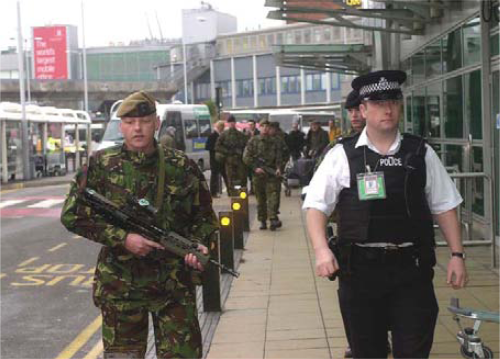
British CCRF volunteers (in camouflage) have “home defense” roles.
While the Observer Corps watched the skies, the Home Guard watched the land. A force of those too young, too old, or too vital for the war effort to fight with the regular army, the Home Guard was expected to fend off Germany's crack invasion troops with old shotguns and pipes with bayonet knives fixed to the end.
After the war, volunteers continued to be essential to the defense of the realm. The Observer Corps became the Royal Observer Corps (ROC), responsible for tracking enemy aircraft, looking this time for nuclear-armed Soviet bombers.
However, as the Cold War gathered pace, potential attack aircraft flew higher and faster and eventually out of sight of the volunteers. So a new role was devised: The volunteers would record nuclear explosions and measure fallout in the event of a nuclear war. This important information would have been relayed back to military headquarters via copper telephone lines that would have been lucky to withstand the accompanying electromagnetic pulse.
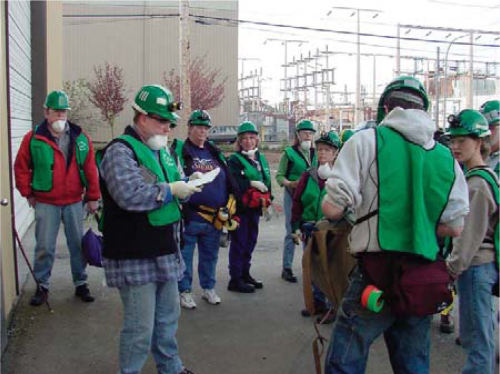
Citizen Corps volunteers train in Bellingham, Washington.
The corps' colleagues in the Home Service Force had an equally unenviable task. Formed in 1982, this collection of former soldiers was tasked with guarding key installations in Britain in times of “international crisis.” They would be the line of defense against elite Soviet “Spetsnaz” Special Forces units, which were expected to attempt to sabotage key buildings.
Today's citizen forces will continue the tradition of putting volunteers in uniform to defend the homeland. “The government is forming this civil contingency reaction force to assist blue light services, such as the police, ambulance, and fire, in the event of a major incident that requires extra support,” says Captain John Pendale (Gloucester Citizen, December 12, 2002).
Fourteen CCRF units of 500 people each will assist in everything from transport to communications, from evacuation to guard duties in the event of a terrorist attack, or a natural disaster, such as an outbreak of foot-and-mouth disease. Potential duties for CCRF volunteers include “area cordons and control, dealing with casualties and displaced people, and assisting the emergency services and the affected communities,” according to the Territorial Army. Armed Forces Minister Adam In-gram has listed other tasks for CCRF volunteers such as reconnaissance, site searches, transportation, and communications duties. Optimists hope that the CCRF will be properly equipped, with copper telephone lines and lead-pipe bayonets relegated to history.
Like the U.S. Citizen Corps' funding, the CCRF's resources do not seem guaranteed: Britain's traditional voluntary spirit will continue to go hand-in-hand with the traditional underequipping of the reserve forces. One senior army official involved with establishing the CCRF commented that there are some “shortages of communications equipment.” Unlike the Citizen Corps, CCRF volunteers must undergo a certain level of special training to be selected for participation.
There is also a concern that the CCRF will overstretch Britain's armed forces. Reservists and volunteer soldiers already contribute large numbers of troops to military operations. The campaigns in Kosovo and the Persian Gulf have included large numbers of part-time soldiers. Approximately 40 percent of troops who served with the British armed forces in the Balkans were volunteers. David Jordan, an expert in reservist forces at the Joint Services Command and Staff College, raises the question of “double-hatting”: Will there be enough volunteer troops available for a military campaign and also for the CCRF?
Here the Americans might have an advantage. Because members of the Citizen Corps are drawn from the local community, they would not have to be redeployed from a military theater back to the homeland in the event of a major terrorist attack.