




Abstract

After months of hesitation, in July the Democrats finally went on the offensive against President George W. Bush's use of intelligence to lead the United States into war against Iraq. To many rank-and-file Democrats, it seemed about time–one reason for former Vermont governor Howard Dean's early success in his bid for the Democratic nomination for president has been his early and vigorous criticism of the war.
When Congress voted in October 2002 to authorize the use of force in Iraq, only a handful of Democrats opposed the plan. Only one senator facing a close election fight, the late Paul Wellstone, dared oppose the war. Facing midterm elections, most Democrats preferred to focus on traditional Democratic issues: health care, education, and the economy.
This strategy proved a disaster: Voters preferred to support a president and a party that had a national security policy over a party without one.
Even after the president declared the end of major combat operations on May 1 in his made-for-campaignads “mission accomplished” oration on the aircraft carrier Abraham Lincoln, most Democrats said nothing. Eighty-five-year-old Robert Byrd, the senior Democrat in the Senate, became a Democratic folk hero with his lone and biting critiques of the president's war.
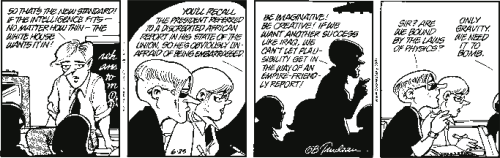
Democrats found some courage after the media began focusing on the president's false claim that Iraq had been seeking to buy uranium from Niger to build nuclear weapons. While the controversy originally centered over a mere 16 words in the State of the Union address, it spread into Bush's selective use of arguments and facts to sell not just the war to the American people, but also his tax cuts, education plan, and other programs.
Congressional Republicans stuck by their popular president, refusing to authorize an independent investigation into the selective use of intelligence. The Senate and House intelligence committees launched closed-door hearings, useful devices for burying a controversy. In the Senate, facing resistance from his Armed Services Committee Chairman John Warner, Michigan's Carl Levin, the lead Democrat on the committee, launched his own staff investigation without the Republican majority.
When the Senate considered the State Department authorization bill the week of July 7, it unanimously adopted an amendment by Joe Biden, Delaware Democrat, calling on the president to seek help from both NATO and the United Nations to rebuild Iraq. It also adopted by voice vote an amendment offered by New York Democrat Charles Schumer asking the administration to improve its grudging cooperation with the independent commission investigating September 11.
The political world and the media paid little attention. Unanimous votes and voice votes don't draw sharp distinctions between Democrats and Republicans. However, in mid-July, Senate Democrats unexpectedly pounced. The Senate began considering the annual Defense Appropriations bill, a $369 billion bill that had been politically untouchable in the wake of September 11 and ongoing military operations in Iraq and Afghanistan. Rather than focus on weapons programs, missile defense, or base closings, however, the Democrats offered amendment after amendment as a proxy fight over the war.
North Dakota's Byron Dorgan drew first blood on July 16, offering an amendment forcing the administration to include funds in the bill to pay for the ongoing cost of military operations in Iraq and Afghanistan. The week before, the Senate Armed Services Committee had dragged out of Defense Secretary Donald Rumsfeld the cost of maintaining troops in Iraq–$3.9 billion a month (with another $700 million for Afghanistan). The bill before the Senate contained none of these costs for the next fiscal year. Dorgan said, “I think we have a responsibility in Congress to try to understand … how we pay for that.” Republicans unanimously blocked the Dorgan effort 53-41.
By a party-line vote of 51-45, the Senate then rejected a proposal by Jon Corzine of New Jersey to create an independent commission to examine the use of intelligence before the war. “Simply put, the nation's credibility, in my view, is at stake,” Corzine said. (In the House, California Democrat Henry Waxman put forth a similar proposal.)
Fifty Senate Republicans voted down an amendment by California's Barbara Boxer that would have required the administration to report monthly on the war's costs, the number of U.S. soldiers remaining in Iraq, casualties to date, foreign-troop participation, and rebuilding costs. Republicans then killed an amendment by Massachusetts' Edward Kennedy that would have required the administration to internationalize postwar operations. A proposal by New Mexico's Jeff Bingaman to require public disclosure of the identities of detainees secretly held at Guantanamo Bay and elsewhere went down 52-42.
The next day, Republicans turned back a proposal by Illinois' Dick Durbin to block $50 million in intelligence spending until the president reports to Congress on the intelligence analysis leading up to the war. “The more important question is who is it in the White House who was hellbent on misleading the American people, and why are they still there,” Durbin argued. Grudgingly, all but 15 Republicans joined with Democrats in an 81-15 vote to accept a Byrd amendment requiring future budget requests to include the costs of ongoing wars.
By and large, nervous Senate Republicans fell quiet as they entombed these Democratic proposals, leaving Alaska's Ted Stevens, the Appropriations chair, to carry the verbal battle. One exception was Kentucky's Mitch McConnell, the party whip, who said of the Democrats, “In their zeal to score political points, they've sacrificed the national interest on the altar of partisan politics.”
While it took the Wizard of Oz very little to give the Cowardly Lion courage, it took more than the discrediting of 16 words in the State of the Union address for the Democrats to take heart. The drumbeat of media stories on the use of intelligence was accompanied by constant reports of American deaths from hostile fire in Iraq, which surprised the many Americans who had been led to believe that Iraqis would welcome the U.S. soldiers as liberators. Moreover, an administration that promised economic salvation through tax cuts was faced with reports of the highest unemployment level in nine years and a record $455 billion federal budget deficit.
Democratic candidates who voted for war began to challenge the president on these issues, as well as on his failure to fund his highly touted “leave no child behind” education plan, Medicare coverage of prescription drugs, international AIDS assistance programs, and AmeriCorps. On July 15, North Carolina Sen. John Edwards pointed to the administration's “problem with the truth.” The next day, Massachusetts Sen. John Kerry found a “dangerous gap in credibility between President Bush's tough rhetoric and timid policies.”
The media took notice. On July 16, the Washington Post called the Democrats' recent campaign the “broadest and most unified attack on President Bush over Iraq.” A July 18 headline in the Boston Globe proclaimed, “Democrats See a Crack in the Bush Armor.”
Prominent columnists joined in the fray. The Washington Post's David Broder, the dean of American political reporters, called July 10, when Bush officials were busy pointing fingers of blame at each other, “Black Thursday for Bush.” On July 16, in “Classic Case of Incompetence,” the Post's foreign policy columnist Jim Hoagland pointed to the “sudden tone deafness of a Bush team that has been pretty good at not giving its enemies ammunition to use against it.”
Public opinion polls confirmed that the developments in Congress and in Iraq were sapping the public's confidence in President Bush. A Pew Research Center poll released July 8 found that the president's popularity, while still high, had dropped 14 points since the height of the war. In April, 61 percent of the public felt that the U.S. military effort in Iraq was going very well, but that number had dropped to 23 percent in July. Other polls confirmed these results and found a decrease in Americans' trust in Bush's handling of the economy.
The upshot of these developments in July: There may yet be a close presidential election in November 2004.