




Abstract

Long before the United States and France began their bitter diplomatic row over Iraq, the two had been sparring on a different turf–over international arms sales. The United States is by far the market leader in weapons sales; France is a distant fourth, with Russia and Britain occupying second and third places respectively.
The British often partner with U.S. firms, but France's strategy is to go it alone. And in almost every major aircraft or ship or tank deal in the past several years, France has lost out to its more politically powerful NATO ally.
Reports quoting sources from U.S. defense contractors say the State Department “discouraged” American companies from exhibiting at the 2003 Paris Air Show. General Dynamics, one of the world's biggest aerospace companies, did not participate at all; Boeing, Northrop Grumman, and Lockheed Martin made only a token showing.
The much-reduced U.S. presence at Paris, the biennial mecca for the defense and aerospace trade, brought the transatlantic bitterness over the arms trade into the open. There were no flying displays by show stealers such as the F-16 or the Stealth bomber, and no visits by top executives of leading American defense contractors. A Pentagon directive reportedly decreed that no officer above the rank of colonel should attend, and no high-profile deals were announced by American firms. The reason given was that the Defense Department and leading U.S. contractors were preoccupied due to the Iraq situation.
June 20: Mirage 2000, Rafale, and Falcon aircraft on display at the Paris Air Show.
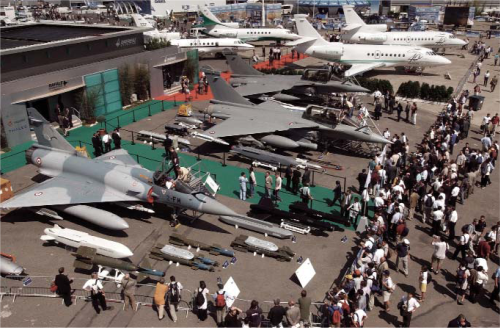
But those reading between the lines say the “Iraq factor” was merely an excuse. The real reason was the desire to downplay the show's importance and deflect the arms-buying community's focus from French companies. Maynard Williams, a British defense journalist who has covered many air shows in Europe, said, “At the Paris Air Show, French firms are on their home turf. They wine and dine generals, politicians, and bureaucrats from countries which could be their potential customers. This strategy has brought them business. If one were to look at the announcements of deals at the Paris Air Show in the past few years, the maximum business has gone to French firms such as Dassault [Aviation] (aircraft), Thales (radars, avionics), DCN (naval systems), and Snecma (engines), or to Franco-German-British firms like EADS (Airbus, Eurocopter, and Eurofighter). American firms have never struck gold here.”
Another view is that the spat over Iraq may have invigorated an anti-French lobby within the powerful U.S. National Defense Industries Association (NDIA), which competes with French firms for defense contracts in Asia, the Middle East, and Africa. “We know that some NDIA member companies have been demanding ‘action’ against French firms, accusing them of using unfair means to get business in the Middle East. This lobby could be at work to whittle down the importance of the Paris Air Show,” said a source whose company is a member of GIFAS, the French defense and aeronautics association.
The most famous squabble in recent times concerned last year's competition between Boeing and Dassault for a contract to supply fighter planes to South Korea, which Boeing eventually won with its F-15 fighter. Dassault claimed that the Rafale fighter had emerged as superior in the evaluation process, and suggested that the American company had used the State Department's influence over Seoul to bag the deal. At the time, there were contradictory reports in the Korean press–some said the Rafale was superior; other times the F-15 was said to have had the edge.
Earlier this year, new NATO member Poland chose the American F-16 fighter over the EADS Eurofighter and Dassault's Mirage 2000. The French and Germans were appalled. The French immediately linked the decision to American military aid to Poland. Polish defense journalist W. Luzak said, “It is common knowledge that the Polish government was facing intense pressure from Paris and Washington to select their respective planes. For Poland, commonality with NATO was more important than pleasing its EU friends, and the F-16 is a NATO staple as far as fighter aircraft is concerned. Of course, there could have been some persuasion from Washington, as there is in most defense deals.”
The Middle East is where the French have had the most substantial success in head-to-head competition with American firms. The oil-rich sheikhdoms of Saudi Arabia, the United Arab Emirates, Qatar, Oman, Bahrain, and Kuwait are among the biggest buyers of military equipment in the world–as a percentage of their national budgets.
The French have sold Mirage 2000s, LeClerc tanks, artillery systems, and a host of other defense equipment in the region. Always they are pitted against mainly U.S. and British firms. An executive of General Dynamics told me during the 2003 Abu Dhabi defense show that their main competition was the French, who “did everything in a way it was not supposed to be done” to get contracts. He refused to specify what “everything” meant.
The French-American competition is also affecting transatlantic mergers and acquisitions. British firm BAE Systems, which was talking merger with French company Thales for over a year, is now reported to have spurned Thales and may tie the knot with Lockheed Martin. Reports quoting BAE executives say the change has nothing to do with Franco-American differences over Iraq, and that it was a normal business decision. However, reports in the French press have been quite critical of BAE Systems for calling off the “engagement.” “It is no surprise that BAE Systems broke off the engagement just when differences over Iraq came to a boil,” added British journalist Williams.
The Americans have reason to be upset with the French over Airbus Military, which was set up to compete against the U.S. near-dominance over the military tactical transport market. A largely French initiative, Airbus Military seeks to build a competitor to the C-130 Hercules, one of the most popular defense exports from America that has been unchallenged in Europe, Asia, and the Middle East. Airbus Military hopes to get European NATO countries–France, Germany, the Netherlands, and Belgium–to be launch customers for the plane. It would mean billions of dollars of business for Airbus, and lost billions for Lockheed Martin, which manufactures the C-130.
Airbus Military's choice of suppliers may push the U.S.-French Cold War even deeper into the frigid zone. Earlier this year, Pratt & Whitney, Canada (a subsidiary of U.S.-based United Technologies), lost a lucrative aircraft engine deal to a French-led European consortium, Europrop. Pratt & Whitney has been Airbus's long-standing engine supplier and was tipped to supply the engine for the A400M, Airbus Military's first tactical transport jet. Executives of the Canadian company, quoted in the defense press, blamed politics as the reason for the change in engine supplier. Nothing else, they say, could explain the change at such a late stage in the project.
Now, say officials at Dassault, American companies buying its Falcon business jets “asked a lot of questions about its military contracting business in the Middle East.”
“Some customers were troubled because of the political atmosphere between France and the United States,” according to a Dassault spokesperson, Vadim Feldzer. At a press conference during the Paris show, Dassault's chief executive, Charles Edelstenne, remarked that “the renewed determination by the United States to assert its power may affect certain markets which are more sensitive to political influences.” Reports analyzing Edelstenne's comments said he was referring to the difficulties Dassault was having in selling Rafale and Mirage 2000 planes to certain Middle Eastern and Asian countries.
If rumors in Paris, which were promptly blown up by an eager press looking for juicy copy, are to be believed, members of Congress are lobbying to start a rival event in the United States, possibly in Dayton, Ohio (near Wright-Patterson Air Force Base). Cong. John L. Mica, a Florida Republican and chairman of the House aviation subcommittee, recently added language to a Federal Aviation Administration reauthorization bill that “would require studying the idea,” said a report from Paris, quoted in the New York Times. Reacting to the report, Pierre Bonnet, the Paris Air Show's director, said, “Good luck to them, if they succeed.”
The face-off with Washington over Iraq seems to have made the French defense industry and its political leadership determined to match, if not stay ahead, in the arms race. French Defense Minister Michele Alliot-Marie said that a new unmanned aerial vehicle (UAV) project will be entrusted to Dassault Aviation, in association with Thales and other firms. In the past, such high-tech projects involving billions of dollars of investment have been undertaken as NATO ventures–with U.S., French, German, British, Spanish, and Canadian firms all sharing development costs. Some observers in the defense press believe France has decided to go it alone in cutting-edge technology, both to access markets and maintain a military edge–and that it does not care much about NATO as a military entity.
Alliot-Marie, who could match, if not exceed, Defense Secretary Donald Rumsfeld's hawkish posture, said in a June 14 interview in Le Monde that she had asked for a study of the risks that U.S. investments might represent in companies linked to European defense. In her interview, timed to coincide with the air show, she urged European firms to stand together to resist what she called the U.S. “true preoccupation,” which was with taking over European defense concerns. “American industrialists are pursuing a logic of economic war,” she said.
The interview drew a sharp reaction from Defense Department spokesperson Jim Turner, whom Le Monde quoted as saying, “The French defense minister is entitled to her own opinion. However, her opinion does not accurately characterize the policy or position of the secretary of defense, or the position of the U.S. government.”
These statements come from countries that are supposed to be close allies. Just how deep are the scars from the battle over weapons sales? Is it possible that France's distinct anti-American posture could in the future lead to a breakup of NATO? So far, most analysts dismiss that as a farfetched proposition.