




Abstract
In May, Britain s environment Agency sent a confidential warning letter to cabinet minis-Uters saying it urgently needed £100 million to protect public safety at the Sellafield nuclear site in northwest England, where it says a 50-year-old radioactive-waste storage facility must be either repaired or replaced.
Sellafield, run by state-owned British Nuclear Fuels Ltd. (BNFL), has been beset by both safety questions and attempts by the Irish government to shut it down. Recent work at the site indicates that the roof of a storage facility has weakened, and that there is some corrosion of the steel in the facility's structural beams. In light of the findings, Britain's Health and Safety Executive wants further assessment of the situation over the next six months, and has required BNFL to have a contingency plan should the facility deteriorate further.
In July 2002, Britain's Nuclear Installations Inspectorate (NII) reported that the facility's two sets of tanks, which hold medium-level radioactive waste, were so old and rundown that they posed an unacceptable risk. Neither the structural integrity of the tanks nor the building that contains them could be guaranteed beyond 10 years. BNFL has erected a steel structure around the tanks and has commissioned specialized machinery to empty them, but the NII recommends getting new tanks or finding another way to process the waste. Although BNFL estimates that it will take £100 million to repair the roof, replacing the entire facility would cost £300 million.
That would be unwarranted, according to BNFL, which says it inspects the building regularly and that it poses “no immediate safety concern.”
“The building is now approximately 50 years old and as such cannot be expected to conform to the standards expected of a modern plant,” said BNFL in a statement. “While being demonstrably safe, it is clear that action is required to remove the bulk of the radioactive inventory over the next few years. BNFL is committed to taking this action.”
More dumping
The material stored in the tanks is technetium 99, which is a radionuclide with a half-life of 213,000 years, and one of the byproducts from the reprocessing of spent fuel at Sellafield. Discharging waste from reprocessing into the Irish Sea is standard practice at Sellafield, and is subject to the authorization of the British Environment Agency.
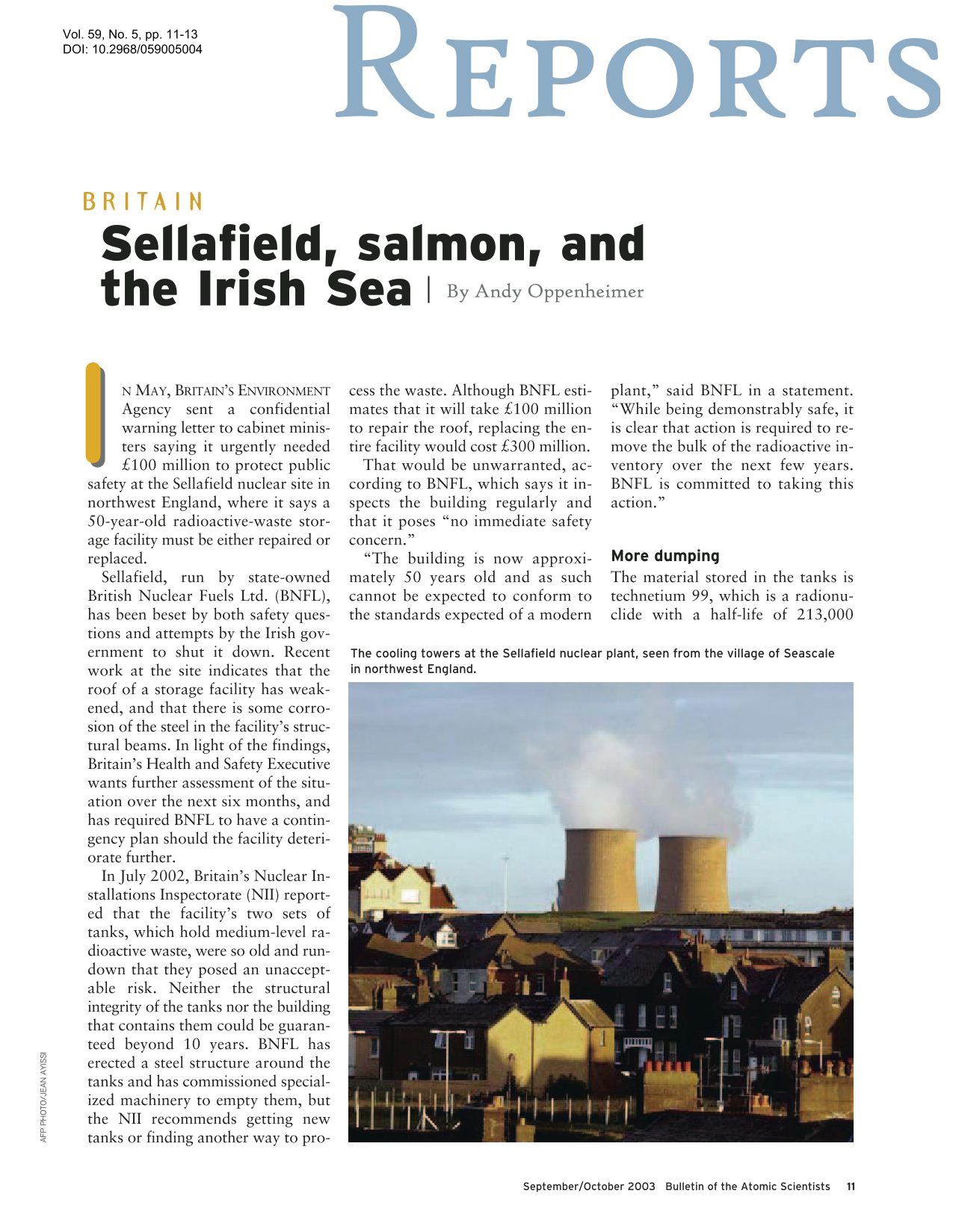
The cooling towers at the Sellafield nuclear plant, seen from the village of Seascale in northwest England.
In its confidential letter to cabinet members (which was leaked to the British press), the Environment Agency revealed that BNFL wants to increase its dumping of technetium 99 into the Irish Sea until 2007.
The letter also said that the technology now in place to make the stored technetium environmentally safe does not work, and that BNFL's solution is to dump the remaining stock in the sea before new restrictions come into force in 2007.
Sellafield has stored the waste from reprocessing in giant tanks since the early 1980s, awaiting the operation of the site's Enhanced Actinide Removal Plant (EARP). The waste is run through EARP to reduce its radioactivity before it is dumped into the sea. EARP reduces plutonium, cesium 137, and strontium 90 levels in the byproducts from reprocessing, but it does not reduce technetium 99 levels.
It takes the dumped technetium no more than five months to reach the northeast coast of Ireland; currents from the Irish Sea carry it northward to the North Sea in around nine months, and into Nordic waters in under two years. Between 1994 and 1996, there was a tenfold increase in technetium 99 levels in seaweed and shellfish off the Irish coast.
According to the Radiological Protection Institute of Ireland (RPII), technetium 99 has a low radiotoxicity that makes it generally of lesser radiological significance than cesium 137. In 1999, the average Irish seafood consumer received a cesium 137 dose as low as 0.82 nanosieverts. But Greenpeace and other groups believe that there is no “safe dose” of radiation.
Norway, along with Ireland, has long called for a halt to Sellafield's sea dumping, claiming it damages valuable fishing industries.
In late June, a study commissioned by Greenpeace and carried out at the University of Southampton found traces of technetium in salmon being sold in British grocery stores as well. Government officials noted that the levels detected were extremely low and that consumers should not be alarmed, but a public outcry ensued, and the British government quickly asked BNFL for a nine-month moratorium on technetium dumping. A BNFL spokesperson said about the study, “There are no health consequences. The traces are lower than the levels of natural radioactivity found in some foodstuffs” (The [Newcastle] Journal, June 24).
The RPII has claimed that radioactive discharges from Sellafield have polluted the Irish Sea since the 1950s (when the site was called Windscale and produced plutonium for Britain's nuclear weapons program), making it one of the world's most radioactive waterways.
A string of safety incidents in the decades following the 1957 Wind-scale fire led to the site being re-branded Sellafield. Although renaming cost BNFL millions, it has never been able to escape association with contaminated beaches, secrecy, and radioactive leaks. The current controversy over radioactivity in the Irish Sea is a sensitive issue, given the long, troubled history Ireland has had with England.
Matters were not helped when former British Energy Minister Brian Wilson criticized Ireland's “long procession of scare stories,” offending many people when he commented that upon hearing claims about clusters of Down's syndrome births along Ireland's east coast, he reaches “for the sick bag.” In fact, the RPII accepts the finding of a recent study that says Ireland's cluster of Down's syndrome births in the 1960s and early 1970s was not linked to Sellafield.
Ireland, fighting mad
The Irish government has taken unprecedented international legal action against Britain in an effort to close Sellafield down.
On June 10, a senior Irish minister said that the “might of the British empire” was blocking Ireland's legal attempts to close the plant. In May, a U.N. court refused Ireland's request for an injunction to block the startup of a £472 million ($688.8 million) nuclear-fuel manufacturing plant on the Sellafield site.
In another court battle, Ireland claimed that Sellafield's mixed oxide (MOX) fuel plant is a breach of maritime law under the U.N. Convention on the Law of the Sea. But on June 24, a tribunal at the Permanent Court of Arbitration decided to temporarily suspend the hearing, questioning its jurisdiction.
In a separate hearing, Ireland sought information on Sellafield's MOX fuel plant that had been redacted from public reports prepared as part of the plant's approval process; it felt it had the right to the information under the 1992 OsloParis Convention for the Protection of the Marine Environment of the North-East Atlantic (OSPAR), of which Britain is also a member. On July 2, the tribunal said Ireland had no such right under OSPAR. Still, Ireland's Environment Minister Martin Cullen claimed the tribunal's ruling as a victory, because it had accepted its jurisdiction and had also rejected the British requests to find Ireland's claims inadmissible.
“Ireland has established by precedent that [Britain] is now accountable to international tribunals,” Cullen said. “Our objective is to build the case, piece by piece, in every available international forum, that the operations at Sellafield constitute a clear and present threat to the Irish Sea. At the very minimum, we want to bring an end to all discharges into the Irish Sea” (Irish Times, July 3).
As a member of OSPAR, Britain agreed to a 1992 declaration that recognized “the need to reduce radioactive discharges from nuclear installations to the marine environment.”
The terrorist threat
Since September 11, the Irish government has also raised fears that Sellafield, which is unprotected by antiaircraft missiles, could be the target of a terrorist attack. Cullen, the Irish environmental minister, has expressed concern about the “inadequacy” of Britain's subsequent environmental assessment and its failure to properly assess the risk of terrorist attack on the site. The RPII wants BNFL to be candid about the possible impact such an attack would have. It is estimated that if an airliner crashed into a key structure at Sellafield, or if the cooling system were sabotaged, more than 40 times the radioactivity of the 1986 Chernobyl disaster would be released into the atmosphere.
“September 11 has added a further worry about malicious attacks and security,” wrote Cullen in a June 29 editorial. “In my view, this represents an unacceptable and avoidable risk.”
In early July, the British government admitted that it had failed for months to vet Sellafield staff with privileged access to sensitive information. Introduced after September 11, the new vetting measures are supposed to take only up to 45 days for staff with the highest security clearance level, but are taking 10 months; medium- and low-level categories of staff should be cleared within 30 days, but instead it is taking 11 months. Some fear that terrorists could seek to use an insider with “exploitable access” in an attack.
Calls for improved security at Britain's nuclear installations have been gathering momentum. “Ireland's objections to Sellafield are solidly based on the continuing radioactive contamination of the Irish Sea,” said RPII Chief Executive Tom O'Flaherty, “and most of all on the risk to this country of serious consequences from a major accident at the plant.”
For its part, BNFL is also concerned that Sellafield might be a terrorist target–but it is using that concern as a reason to withhold the details of radioactive leaks found in its 44-year-old cooling pond, according to the July 5 New Scientist. The pond has been closed since 1992 and is estimated to hold between 300 and 450 metric tons of uranium. “BNFL may be using security considerations as a way of concealing serious environmental risk,” said former British Environment Minister Michael Meacher.