



Abstract
Among the many innocent victims of the Bush administration's murderous and illegal invasion of Iraq was Jonathan Schell's thoughtful new book. Although Schell carefully mined 355 years of post-Westphalian historical ore to unearth nuggets of gold–historical developments that, indeed, appeared to argue for his “unconquerable” world–his evidence must now confront a contradictory fact on the ground: an arrogant, willful, and, arguably, unconquerable hegemon capable of breaking things around the world to the enthusiastic applause of its “famously ill-informed” citizenry (New York Times, March 2).
Before America “shocked and awed” the world, Schell could plausibly maintain that he had identified “a less-noticed, parallel history of nonviolent power … of great power war immobilized by the nuclear stalemate, of brutal empires defeated by local peoples fighting for their self-determination, of revolutions succeeding without violence, of democracy supplanting authoritarian or totalitarian repression, of national sovereignty yielding to systems of mixed and balanced powers.”
If, before Operation Iraqi Freedom, Schell was correct to conclude that “these developments … have provided the world with the strongest new foundations for a durable peace that have ever existed,” how promising do they look today?
Consider one strand of his argument: the development of nonviolent revolution, culminating in Eastern Europe's peaceful overthrow of “totalitarian” regimes. Schell ably details the persistence and courage exhibited by dissidents like Poland's Adam Michnik, Czechoslovakia's Vaclav Havel, and Hungary's Gyor-gy Konrad as they propagated truth to fill, then wrest, civil society from political control. In fact, Schell asserts that without the victory of nonviolent revolution in Eastern Europe, “the nonviolent Gorbachev reforms would have been unthinkable.”
Yet how does this nonviolent pursuit of truth stack up to the desperate search by the Bush administration for a pretext for attacking Iraq? On September 11, the day of Al Qaeda's infamous attacks, Defense Secretary Donald Rumsfeld demanded the “best info fast. Judge whether good enough to hit S. H.” But he also said, “Go massive…. Sweep it all up. Things related and not.”

Four days later, National Security Adviser Condoleezza Rice suggested launching an attack elsewhere, beyond Afghanistan, as an “insurance policy” designed to maintain domestic and international support for the war on terror. Which, as quoted in Bob Woodward's Bush at War, prompted Paul Wolfowitz to suggest “Iraq was a brittle oppressive regime that might break easily.”
By the summer of 2002 the Bush administration was conflating two pretexts for cashing its insurance policy: Saddam's weapons of mass destruction (WMD) and his putative ties to Al Qaeda. In August, Vice President Dick Cheney called for a preemptive strike on Iraq, because it was “very busy enhancing” its weapons of mass destruction. Iraq would acquire nuclear weapons “fairly soon.” In late September Secretary Rumsfeld claimed he had “bulletproof” evidence (never revealed) linking Iraq and Al Qaeda.
Without hard evidence to support either pretext, President George W. Bush nevertheless told the nation on October 7 “that Saddam posed an immediate threat to the United States.” That exaggeration, error, or lie (take your pick) was used to justify a preemptive war and deny even vastly expanded U.N. weapons inspections.
Americans now have good reason to suspect Bush's assertion to be a lie. For not only had Saddam failed to use WMD during the decade when American soldiers were enforcing no-fly zones in Iraq, his “brittle” regime collapsed with hardly a fight, used no weapons of mass destruction, and left no operational ones in the places where America's politicized intelligence suggested they might exist. When American negligence permitted Iraq's Tuwaitha Nuclear Research Center to remain unguarded for days–during which it was penetrated by looters–the absence of a plan implied a lack of serious concern about WMD.
But don't expect a national epiphany soon. For, as Leo Szilard once observed, Americans “were free to say what they think, because they did not think what they were not free to say.” Perhaps that explains why, as late as March 2003, 45 percent of the American population incorrectly believed that Saddam Hussein was linked to Al Qaeda's attacks. If so, then in a world dominated by American imperialism, how can Schell's stellar examples of speaking nonviolent truth to power hope to compete?
Even Schell's optimism fades toward the end of his book. Perhaps most disturbing is the Bush administration's determination to eschew nonproliferation agreements in favor of new nuclear weapons and new scenarios for their possible use. These policies not only undermine another historical development that Schell found hopeful–the prospect of mutual nuclear annihilation rendering both nuclear weapons unusable and total war impossible–but also appear to guarantee that proliferation will define the second nuclear age.
Nevertheless, Schell offers a persuasive argument and practical road map for the abolition of nuclear weapons and perhaps all weapons of mass destruction. But it requires cooperation, not coercion, and thus begs the question of how to move the hawks in the Bush administration, let alone that obdurate 45 percent.
Schell notes the rapid “escalation of violence around the world” since September 11, 2001, and fears “the ever increasing likelihood that a small band of criminals, or even a single evildoer … [could] conceivably cause the death of millions.” He's equally troubled by the violent response of the Bush administration. In addition to its reckless nuclear posture is a seemingly interminable “war on terror,” an official policy of “regime change,” and a National Security Strategy that not only “reserved the entire field of military force to itself,” but also sanctioned its preemptive application.
Thus, Schell concludes: “A policy of unchallengeable military domination over the earth, accompanied by a unilateral right to overthrow other governments by military force, is an imperial, an Augustan policy.”
And he warns: “If the poor and powerless react with terrorism and other forms of violence; if the nuclear powers insist on holding on to and threatening to use their chosen weapons of mass destruction; if more nations then develop nuclear or biological or chemical arsenals in response and threaten to use them; if these weapons one day fall, as seems likely, into the hands of terrorists, and if the United States continues to pursue an Augustan policy, then the stage will be set for catastrophe.”
How did we get in this mess?
Want to know?
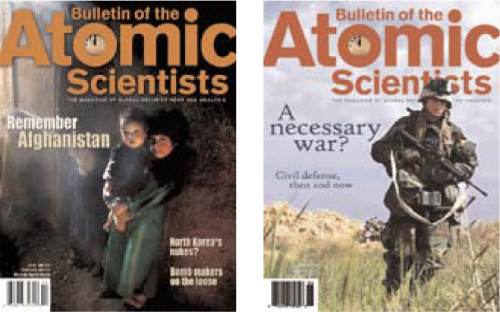
Maybe it's time to find out–by catching up with recent issues of the Bulletin of the Atomic Scientists. Whether it's the conflict in Iraq or in Afghanistan, the drive for nuclear weapons, trashed treaties, or the terrorist threat, the Bulletin has the stories behind today's headlines.
Schell quotes John Quincy Adams, who warned that the pursuit of empire would transform “fundamental maxims” of U.S. policy “from liberty to force,” thereby jeopardizing America's very ability to remain “the ruler of her own spirit.” Which goes far to explain why Jonathan Schell's thoughtful and original book appears destined for a quiet death it doesn't deserve. •