




Abstract
Why the U.S. military had no plans for post-war Iraq.
None of the nightmare scenarios predicted to follow the invasion of Iraq came to pass. Instead of an Iraqi use of chemical weapons against either concentrated troop formations or Israel, only a handful of conventional missiles were fired at targets in the Kuwaiti desert. Instead of devastating house-to-house fighting during prolonged urban warfare in Baghdad and Tikrit, both cities were taken in days, with U.S. forces suffering minimal casualties in mainly symbolic incursions. There was little sustained resistance, even by the elite Republican Guard, and the war was presented on contending 24-hour news channels in a sanitized version that surely masked a devastating U.S. campaign. For hawks, both within the administration and in its surrounding chorus, the rapid Iraqi collapse after a week of criticism only buttressed their belief in American hyperpower.
Although “major combat operations in Iraq have ended,” as President George W. Bush declared on May 1 on board the U.S.S. Abraham Lincoln, neither the military nor the administration has had much time to savor the triumph. Iraq is currently in a grey area between war and peace. Early warnings as to the danger of losing the peace may prove to be more reliable than those earlier portents about the nature of the war. Images of Iraqis ripping down the statues and murals of the megalomaniacally narcissistic Saddam Hussein were soon offset by riots in response to continued civilian casualties, whether from an explosion at an ammunition dump in a Baghdad neighborhood or in response to U.S. Marines firing into a crowd of demonstrators outside a school in Fallujah. Stories of early looting and lawlessness–the loss of medicine, machinery, and cultural treasures–included descriptions of an emerging internal weapons market driven by a policing vacuum. Initial water and food shortages were compounded by the continued absence of public services, fuel shortages, and an increase in waterborne illnesses.
There was an even more troubling trend. While gaps in U.S. preparations for the peace were revealed almost immediately, at least some actors in Iraq had consolidated their positions and mobilized networks in both the Shia and Sunni communities. In these early days, while the Americans seemed ill-prepared to restore order, the Bush administration was reluctant to ask for assistance from the United Nations and appeared to have ideas for post-war governance that took few of the Iraqi population's likely objections into account. A post-war transitional Iraqi government was expected to be in place by mid May, but what it would look like–including the role of controversial Iraqi exile Ahmad Chalabi–had yet to be determined (even if a grant for reconstituting local government had already gone to an American firm, RTI International).
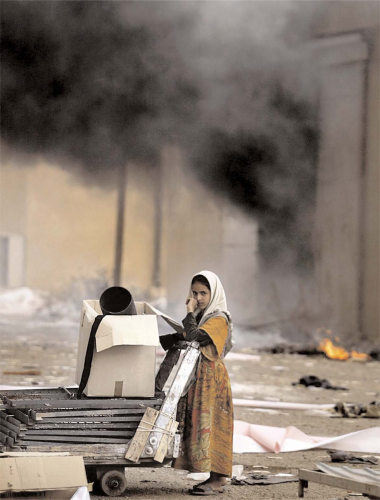
April 21: As a warehouse in northern Baghdad burns in the background, a girl waits with a cart full of looted items.
What was required were the tools that George W. Bush had harshly disparaged throughout the election campaign of 2000–the use of peacekeeping forces and a sophisticated approach to reconstituting civil authority. In its early days, the Bush administration in its foreign policy pronouncements had attacked with some frequency both American involvement in U.N. peace operations and the concept of nationbuilding itself–from National Security Adviser Condoleezza Rice's disparagement of the 82nd Air-borne's role in escorting Kosovar Serbian schoolchildren, to Defense Secretary Donald Rumsfeld's assertion that serving in the Balkans was overex-tending the Reserves. Other accusations about participation in these missions were more venomous: U.N. missions not only reduced readiness and lowered morale by forcing war-fighters to act as policemen, the story went, but U.S. soldiers were forced to serve under incompetent foreign commanders or U.N. authority, in actions that exposed them to the possibility of politicized international criminal proceedings.
Events overwhelmed these complaints. It became hard to deny that collapsed states make for ideal terrorist havens. That, and the necessities of post-conflict stabilization in Afghanistan, induced a grudging reassessment by at least some members of the administration about the duties that U.S. forces might be required to undertake. Yet many on the right continued to question the need, in Iraq as in Afghanistan, for the United States to be much concerned with post-conflict stabilization.
Not my job
But if U.S. political leaders were inclined to think simplistically about reestablishing civil administration in a country and a culture far different from their own, the lack of realistic preparation for post-war governance in Iraq was symptomatic of the wrenching dichotomy between the military's priorities, culture, and preparations. The military is highly focused on preparing for conventional warfare, emphasizing the use of high-tech weapons and massive firepower, with decreasing emphasis on the human dimension. As a result, it spends very little effort preparing for the kinds of engagements in which it overwhelmingly finds itself: As the Congressional Research Service pointed out in 1996, of the 234 occasions in which American force had been used abroad from 1798 to 1993, only five involved a formal declaration of war; more than 220 could best be described as small-scale contingencies.
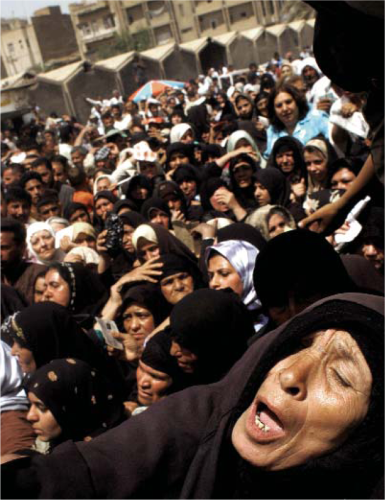
May 20: Iraqis struggle to get past U.S. soldiers in order to receive their $40 pension payments in Baghdad.
Peace operations and “Operations Other Than War” (OOTW) are merely the contemporary manifestation of these most common U.S. engagements, so much so that Ralph Peters, an army intelligence officer and noted military analyst, argues that “those who assail our present peacekeeping commitments attack America's military tradition.”
Here's the difference
In 1942, the United States had just entered a two-front global war, and the Defense Department began preparing for the anticipated nature of a post-war peace. Civil Affairs Training Schools were opened at major universities throughout the country, from the School for Military Government established at the University of Virginia to those later installed at Harvard, Columbia, Northwestern, and Stanford. In 1946, the School for the Government of Occupied Areas opened at Carlisle Barracks in Pennsylvania; in 1951 Carlisle became the site of the Army War College. Regional specialists and linguists and recent German and Japanese immigrants provided cultural and area-specific information. Units assigned to constabulary operations trained with members of the Pennsylvania State Police. (Still, these long-term preparations did not guarantee success–the initial American policy toward Germany was divided between the desire for retribution, as embodied in the almost Carthaginian methods proposed in the Morgenthau Plan for Deindustrialization and Repastoralization, and the decision to provide substantial relief and reconstruction that quickly prevailed.)
Of course, the post-war Allied military governments were generally tight-knit affairs. In contrast, today's interventions may involve a far wider array of national army contingents (some poorly equipped or previously involved in domestic human rights abuses), and an even broader collection of civilian agencies, with U.N. offices and other multilateral institutions given exclusive authority over particular areas such as civil administration, humanitarian needs, relief, and institution-building.
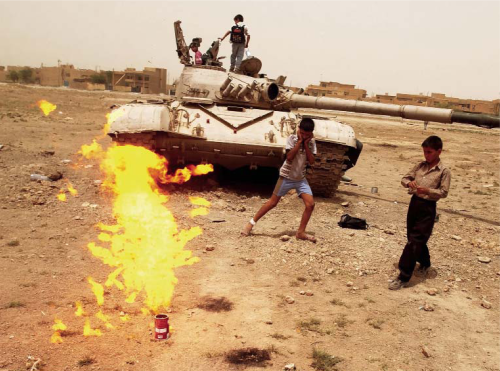
May 18: Iraqi children play on one of more than 50 fully armed Iraqi tanks abandoned in a Baghdad neighborhood. The kids have blown up a tank, destroyed a house, and fired live shells.
The debate
As was clearly shown during Operation Iraqi Freedom, the military has made great progress in war-fighting in the 1990s, with a decrease in the time between target identification, processing, and attack; the increased use of precision munitions; the more rapid movement of assets; and the evolution of unmanned drones (unmanned aerial vehicles or UAVs) from surveillance to attack platforms.
But the impact on military training and culture of overseas deployments over this same period is much more convoluted. Training for OOTW is available for units and mid-level officers, but a deep-seated reluctance, located primarily in American national military ideology, seriously aggravated by political distaste, hinders better preparation for post-war or peace operations–the very kinds of missions in which the U.S. military is now involved in Afghanistan and Iraq, and indeed in Bosnia and Kosovo.
The saving grace, given the lack of a broader orientation toward these missions, as Andrew Krepinevich of the Center for Strategic and Budgetary Assessments has pointed out, is experience–many an army officer has spent his entire career carrying out the unconventional duties that the military's senior leadership so often describes as aberrations.
The military and low-intensity conflict
The gap between what the army prepares for and what it actually does has grown increasingly pronounced in the post–World War II era. As a result, the latest technology, as well as the force structure developed for conventional conflict, is applied to, and primarily used in, small-scale contingencies–examples include the use of the B-2 bomber in Serbia and the Predator UAV in Afghanistan. As Krepinevich wrote in his 1983 classic The Army in Vietnam, the core “army concept” that developed after World War II not only proposed the maximum substitution of material firepower for human costs, but also included an almost exclusive orientation to attrition-style warfare in planning the defense of Europe from Soviet attack. From the point this key concept was adopted, no matter what other experiences the military had, its leaders preferred to remain in the comfortable territory of preparing for conventional war. As a consequence, the army spends most of its time preparing not for “the most likely threat,” but for “the preferred threat.”
President John F. Kennedy's early attempts at fundamentally integrating counterinsurgency into the army's scope of operations (although ultimately leading to the creation of the Special Operations Command) were either distractedly implemented, casually ignored, or consistently subordinated to entrenched belief–that preparing for major theater war against the Soviets was what truly mattered. Over the decades, the lessons of post-war military government in Germany and Japan were lost. Moreover, as Conrad Crane notes in his September 2002 U.S. Army Strategic Studies Institute paper, “Avoiding Vietnam: The U.S. Army's Response to Defeat in Southeast Asia,” the post–Vietnam era led not to a fundamental reassessment of American counterinsurgency strategy, but to the belief that since wars like the Vietnam conflict should not be fought, their nature need not be explored.
With the end of the Cold War, the conventional war concept was repackaged as the need to be prepared to fight two major wars at the same time. This concept was initially conceived as a guide for determining the necessary size of the standing force, but its adoption also involved the implicit characterization of both small-scale contingencies and actions in Europe as subordinate to America's primary strategic interest.
Typical of this view was Col. Harry Summers's claim in his 1995 book The New World Strategy that peace operations erode both the army's capacity and its sense of purpose. Summers advocated preparing for major wars to the exclusion of preparing for low-intensity conflict.
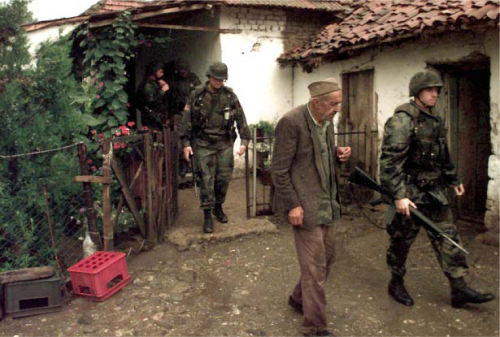
July 1999: U.S. soldiers escort a Serbian citizen from his home after finding an automatic weapon there. The soldiers were part of the international peacekeeping mission in Kosovo.
Fortunately, the best military officers seek to be highly adaptive and curious, and consider conventional thought and ingrained habit as the path to disaster. These military professionals seek–in the words of Lt. Col. Brent Benkus of the Army War College–to “break the paradigm shift” away from old, Cold War ideas. As a result, thinking about OOTW appears in abundance in military professional journals, from Parameters to the Joint Force Quarterly and the Naval War College Review. The debate is not only among certain academics and officers, but also among various defense corporations and think tanks, with their continued attempts to market or define their products in light of the frequency of these missions.
But at the highest levels, the debate is scarcely heard. Crane argues that “the senior leadership at the military and political level has denigrated OOTW,” although there are at least some middle-level officers for whom the leadership's attitude “is seen as short-sighted.”
There is a substantial cost involved in these contrasting perceptions, however. Conrad notes that “cadets hear the rhetoric [denigrating peace operations/OOTW] and believe it, and many are disillusioned when they find themselves as junior officers doing those missions.” Some leave the service after being deployed to such missions; others develop an appreciation for their utility. But the fact that the senior leadership is “highly allergic to peace operations,” as Krepinevich has said, prevents a “serious intellectual and strategic planning effort” from occurring, with little sense of the urgency of developing the sorts of skills needed in post-war Iraq.
Not enough
A few efforts at far-sighted OOTW planning have been made. For example, in the months-long run-up to the transition from the American-led Multinational Force to the U.N. Mission in Haiti, Gen. Joseph Kinzer developed a battlefield command training program to familiarize his military and civilian staff with their assigned mission and to develop cohesion. More controversially, under the rubric of “African solutions to African problems,” the Clinton administration created the African Crisis Response Initiative in order to train regional military units from Senegal, Mali, Benin, Uganda, Ghana, Kenya, and others, for future deployments. The Clinton administration also began to address the dilemma of interagency coordination through the haphazardly implemented Presidential Decision Directive 56, which sought to institutionalize mission preparation through an executive-level Peacekeeping Core Group and a political-military planning process.
Although notable programs for training American military for peace operations and OOTW have been developed, these current preparations stand in direct contrast to the far-sighted anticipatory steps taken in the 1940s.
In fact, the military leadership generally believes that its focus on versatility in individual and unit training allows it to adequately address a wide variety of tasks without making any major adjustments.
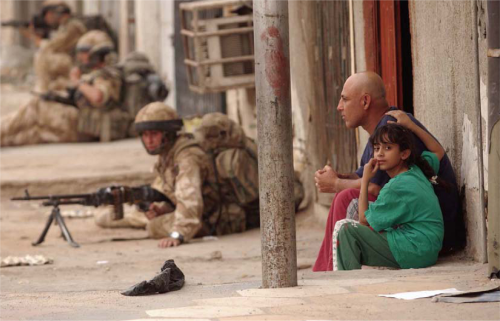
April 7: British soldiers and Iraqi citizens on the streets of Basra.
As a result, certain units have borne a disproportionate amount of the cost. Post–Vietnam era reforms shifted a substantial degree of support functions, from oil transport to military policing, to the Army Reserve.
Some 97 percent of the military's civil affairs units–with capabilities ranging from direct liaison with local authorities and municipal planning to public service reconstruction–are in the Reserves. Similarly, with most psychological operations capabilities in the Reserves, the army's only fulltime Psychological Operations Unit at the Special Operations Command is frequently deployed to fill continuing needs. Plans have recently been made to increase the size and number of active civil affairs and “psy ops” units, but the increases will be modest.
The U.S. Army is a doctrine-driven organization with the unit's tasks and standards determining its training regime. In the early 1990s, before the deployments in Bosnia and Haiti, the army suffered from both an absence of doctrine and the lack of a standard training program for OOTW and peace operations. Previous doctrine was outdated. (Field Manual 100-23 for peace operations is nine years old, written for a previous generation of operations, and oriented toward the operational, not tactical, level.) As Crane pointed out, current doctrine is not only generations behind a unit's ingrained experiences–due to sharp cutbacks at the army's Training and Doctrine Command (TRADOC) and the use of retired consultants a generation removed from field experience–but the army also has no method of formally integrating the lessons learned in recent missions. The release of the army's Peacekeeping Institute field manual, “Tactics, Techniques and Procedures for Peace Operations,” will remedy the absence of tactical doctrine.
The army's overall approach is in direct contrast to the Marine Corps' historical development of small wars doctrine, which Lieutenant Colonel Benkus has called the “best thing since canned beer.” Pre–World War II Marine Corps planning fundamentally influenced eventual army doctrine on post-war military government by cogently advocating for a broad range of principles, from the reduced use of force to the delegation of power to local authorities and structures. For the contemporary period, Marine Maj. Gen. Charles C. Krulak's “Three-Block War Model”–where full-scale battle in one neighborhood is contrasted with aid distribution and civil affairs operations in another close by–best represents the wide spectrum of capabilities required by military units in environments that involve a rapid shift from overt lethality to peaceful interaction and assistance.
A variety of stop-gap measures have been developed. For units being sent to Bosnia, the 7th Army's Combat Maneuver Training Center (CMTC) in Hohenfels, Germany, created an informal training system that included weapons-qualification training, basic language and cultural introductions, and joint exercises. For units with high turnover of personnel, the program also served as a method of establishing pre-deployment cohesion. The CMTC's training program was then transported to the Joint Readiness Training Center in Arizona, where aid personnel, the media, and civilians were introduced into the simulations.
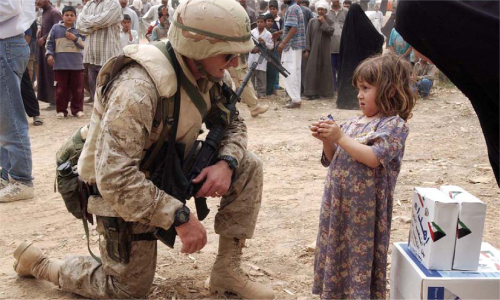
April 8: Maj. Chris Hughes talks to an Iraqi girl while distributing food and water near Al Najaf.
That training course, available to the unassigned as well as those assigned for duty, is voluntary, not mandatory. Many units opt out, fearing that the training experience will lead to a peace operations assignment, which will take time away from training for major-theater war.
Other OOTW modules are available, but again, not mandatory, for officers enrolled at the Combined General Staff College and the Army War College. For non-commissioned officers, specific guidance is provided only at the sergeant-major level. Depending on the length of notice before deployment, unit leaders can go to either the Joint Readiness Training Center or CMTC or use a variety of specific training packages relating to their Mission Essential Task List. Even with these opportunities, a military unit's preparations upon assignment are still described as “just in time, and just enough.”
The recent ideologically driven decision to close the Peacekeeping Institute at Carlisle Barracks, the sole Defense Department institution dealing with peace operations on a daily basis, further reflects the absence of formal institutionalization. With a non-salary budget of $200,000 and a staff of 10, the Peacekeeping Institute had become a global resource, with trainers often sent to provide pre-deployment training to other national units. In response to early plans for the Institute's closure, Col. George Oliver, the last head of the Institute, told the Associated Press in March 2002: “My concern is, what message does this send to the world? It's going to say that the U.S. military doesn't really care about peacekeeping.”
The Bush administration only belatedly realized the extent to which these abilities would be needed in post-war Iraq, and decided to detail Colonel Oliver to the Pentagon to work under retired Lt. Gen. Jay Garner, whom the Pentagon first named to oversee the reconstruction of Iraq.
The army's traditional officer training system may also have a deleterious effect on preparations for OOTW. OOTW deployments provide young officers with a high degree of autonomy, forcing them to operate in an environment where tactical decisions may have global and strategic reverberations. But, according to Leonard Wong of the U.S. Army's Strategic Studies Institute, the leader development system seeks to minimize risk and uncertainty, and tends to reward reactive rather than proactive thought. It does not permit young leaders “to fail, learn, and try again.” And the so-called Revolution in Military Affairs, which involves the adaptation of military organization and doctrine to the information and communication capabilities provided by new technologies, may be heightening these problems: New developments in information technology could give the battalion-level commander an unprecedented degree of battle-space awareness, which is likely to lead to an even more hierarchical command-and-control system.
Requiem for the U.N.?
Some of the early founders of the neo-conservative Project for the New American Century, who now hold undersecretary positions at both State and Defense, are largely credited for insisting on regime change in Iraq. Countering Republican congressional opposition to global engagement and founded on a belief in the United States as global hegemon and hyperpower, the Project calls for the active pursuit of American empire, focused not on territorial, but ideological, domination.
Concomitantly, the neo-cons' prewar proposals called for the U.S. rather than U.N. post-war administration of Iraq. In this scenario, the U.S. military would move from a support role to broad governance tasks like the ones it undertook after World War II.
But Col. Mike Dziedzic of the U.S. Institute of Peace questioned the wisdom of the administration's belief that the military could manage the occupation and administration of Iraq independent of assistance from the United Nations and other international bodies. Not only are many segments of the military unwilling to embrace such responsibilities, he said, the military might prove to be remarkably unready, given the failure to institutionalize lessons learned from recent overseas experiences.
What should be done
An ingrained belief exists in certain sections of the Pentagon that preparedness in one sector must be sacrificed for preparedness in another. It is true, of course, that resources are always finite, no matter how sizeable they may be when compared to those of potential enemies, and thus the variety of contingencies that can be prepared for will always be limited–even for the U.S. military, with its $400-billion-a-year budget. Funding needs to be balanced between deterring and addressing major threats (a conventional or nuclear attack), and maintaining certain capabilities (global force projection), but it should also include preparing for the most likely use of forces.
Versatility is achievable, and may well produce positive results. The British army's long history of coun-terinsurgency and its common practice of dismounting armored units for foot patrols in Northern Ireland is an example. British contingents in Kosovo were able to rapidly adapt to the changing security environment when the threat shifted from a Serbian invasion to Albanian insurgent operations on the border with Serbia and Macedonia. Given the contrast in U.S. and British military cultures, was it any surprise in the early days of the conflict in Iraq that the British and Americans responded differently to the adoption of guerrilla methods by certain Iraqi units? The British shifted tactics, noted that this was part of their spectrum of capabilities, and cited their previous experience in Northern Ireland. The Americans protested that the Iraqis were fighting by different rules, and that they hadn't war-gamed for this scenario properly.
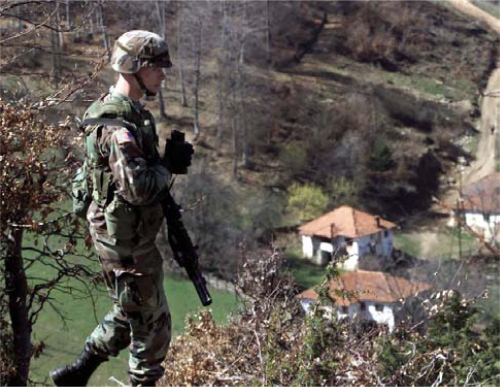
March 2001: A U.S. soldier patrols the Kosovo-Macedonia border in Yugoslavia as part of a peacekeeping mission.
Until senior American military and political leaders question the utility of an excessively formalized definition of what “real war” is and what it is not, they will be unable to take maximum advantage of the actual experiences of the bulk of their military missions, as they have failed to do over the past half-century. •