




Abstract
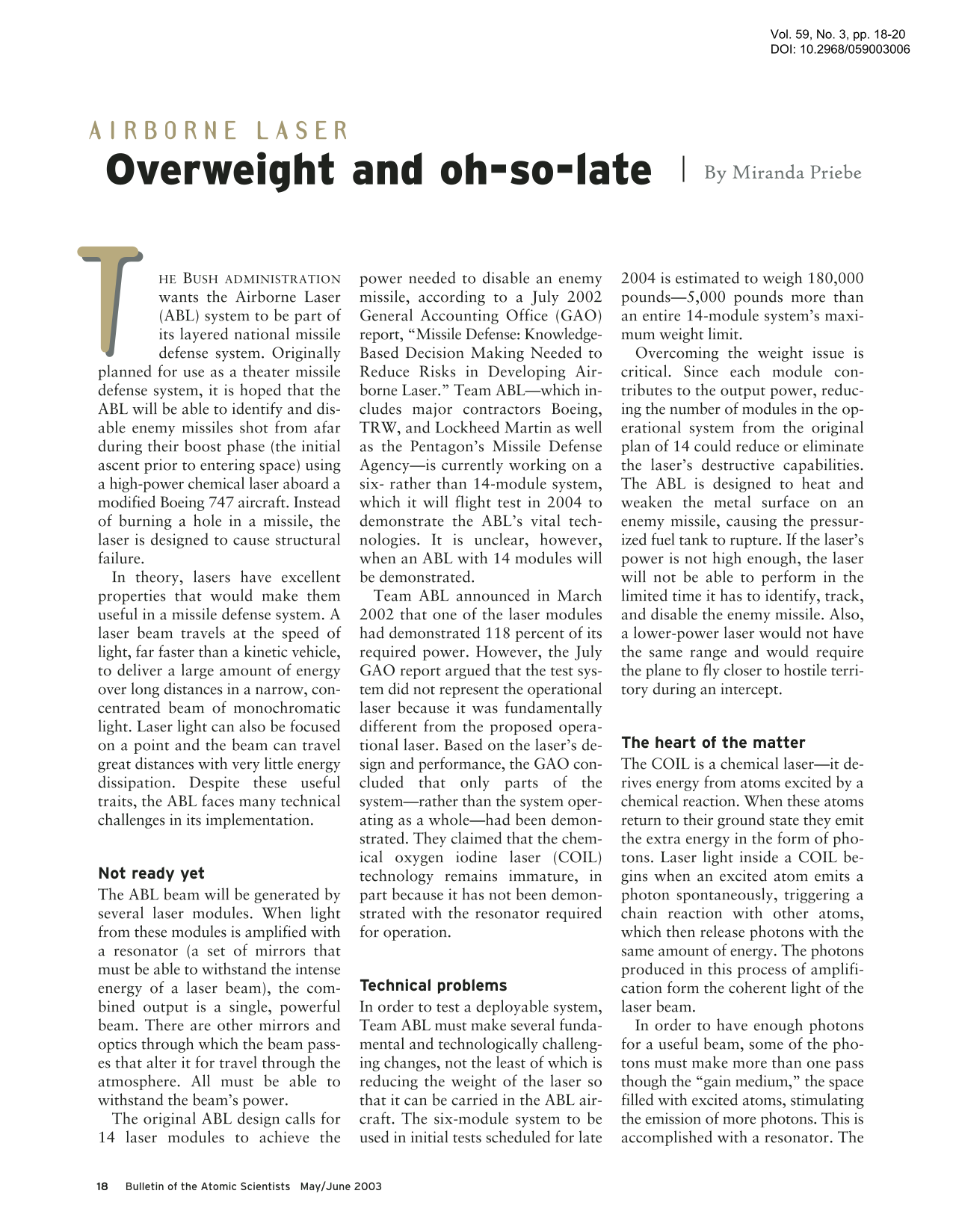
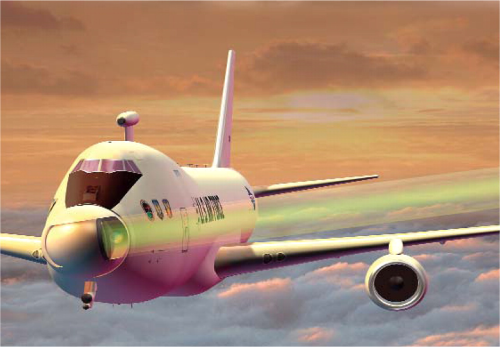
The Bush administration wants the Airborne Laser (ABL) system to be part of its layered national missile defense system. Originally planned for use as a theater missile defense system, it is hoped that the ABL will be able to identify and disable enemy missiles shot from afar during their boost phase (the initial ascent prior to entering space) using a high-power chemical laser aboard a modified Boeing 747 aircraft. Instead of burning a hole in a missile, the laser is designed to cause structural failure.
In theory, lasers have excellent properties that would make them useful in a missile defense system. A laser beam travels at the speed of light, far faster than a kinetic vehicle, to deliver a large amount of energy over long distances in a narrow, concentrated beam of monochromatic light. Laser light can also be focused on a point and the beam can travel great distances with very little energy dissipation. Despite these useful traits, the ABL faces many technical challenges in its implementation.
Not ready yet
The ABL beam will be generated by several laser modules. When light from these modules is amplified with a resonator (a set of mirrors that must be able to withstand the intense energy of a laser beam), the combined output is a single, powerful beam. There are other mirrors and optics through which the beam passes that alter it for travel through the atmosphere. All must be able to withstand the beam's power.
The original ABL design calls for 14 laser modules to achieve the power needed to disable an enemy missile, according to a July 2002 General Accounting Office (GAO) report, “Missile Defense: Knowledge-Based Decision Making Needed to Reduce Risks in Developing Airborne Laser.” Team ABL–which includes major contractors Boeing, TRW, and Lockheed Martin as well as the Pentagon's Missile Defense Agency–is currently working on a six-rather than 14-module system, which it will flight test in 2004 to demonstrate the ABL's vital technologies. It is unclear, however, when an ABL with 14 modules will be demonstrated.
Team ABL announced in March 2002 that one of the laser modules had demonstrated 118 percent of its required power. However, the July GAO report argued that the test system did not represent the operational laser because it was fundamentally different from the proposed operational laser. Based on the laser's design and performance, the GAO concluded that only parts of the system–rather than the system operating as a whole–had been demonstrated. They claimed that the chemical oxygen iodine laser (COIL) technology remains immature, in part because it has not been demonstrated with the resonator required for operation.
Technical problems
In order to test a deployable system, Team ABL must make several fundamental and technologically challenging changes, not the least of which is reducing the weight of the laser so that it can be carried in the ABL aircraft. The six-module system to be used in initial tests scheduled for late 2004 is estimated to weigh 180,000 pounds–5,000 pounds more than an entire 14-module system's maximum weight limit.
Overcoming the weight issue is critical. Since each module contributes to the output power, reducing the number of modules in the operational system from the original plan of 14 could reduce or eliminate the laser's destructive capabilities. The ABL is designed to heat and weaken the metal surface on an enemy missile, causing the pressurized fuel tank to rupture. If the laser's power is not high enough, the laser will not be able to perform in the limited time it has to identify, track, and disable the enemy missile. Also, a lower-power laser would not have the same range and would require the plane to fly closer to hostile territory during an intercept.
The heart of the matter
The COIL is a chemical laser–it derives energy from atoms excited by a chemical reaction. When these atoms return to their ground state they emit the extra energy in the form of photons. Laser light inside a COIL begins when an excited atom emits a photon spontaneously, triggering a chain reaction with other atoms, which then release photons with the same amount of energy. The photons produced in this process of amplification form the coherent light of the laser beam.
In order to have enough photons for a useful beam, some of the photons must make more than one pass though the “gain medium,” the space filled with excited atoms, stimulating the emission of more photons. This is accomplished with a resonator. The ABL's laser resonator contributes to the power and quality of the beam, and therefore the system's lethality. Resonators consist of two mirrors positioned to reflect and amplify laser light between them before the light leaves the laser as the output beam. Every time light makes a pass between the two mirrors, it generates more light, ultimately gaining enough energy to produce a powerful beam. The resonator type and design affects the concentration of energy in the beam and the beam's uniformity, one measure of its quality. If the beam is not concentrated enough, it will take too long to disable a missile. Non-uniformities in the beam also degrade its effectiveness and can cause hotspots that damage or even destroy mirrors and other optics.
The resonator used in the test was a “stable” resonator running in multi-mode, and these resonators generally produce a beam of poorer quality than is required. An operational ABL will require an “unstable” resonator that runs in single mode. (The terms “stable” and “unstable” refer to how light leaves the unit; single- and multi-mode refer to the way energy is distributed in the resonator.)
A stable resonator, like the one used by Team ABL in its test, is made of two mirrors of the same size. One is almost perfectly reflective, and a second reflects only most of the incoming photons. The photons generated by the chemical reaction are reflected back and forth between the mirrors. Those not reflected by the second mirror pass through it and become the output beam of the laser.
Artist's rendering of the ABL test flight.
But for a stable resonator to reach its highest output power, it must operate in multi-mode, where many different energy distributions exist in the resonator. Lasers operating in multi-mode have poor beam quality. In an unstable resonator, such as the one proposed for the final ABL system, photons don't escape through a less reflective mirror. Instead, the two mirrors are of different sizes, and photons escape to form the output beam around the edges of the smaller mirror.
Unstable resonators are designed to operate in single mode. In theory, an unstable resonator can efficiently extract the same amount of energy from the gain medium as a stable resonator in multi-mode–and produce good beam quality. Similar power outputs from equivalent stable and unstable resonators have also been shown experimentally. However, if a comparison between power output in stable and unstable resonators has been done for COIL lasers, the author has not been able to find it in the unclassified scientific literature.
Despite theoretical and some experimental successes with unstable resonators, some laser experts still contend that in practice, high-power lasers with unstable resonators will not produce as much power as theoretically possible due to difficulties in design and construction. This means that although Team ABL has demonstrated 118 percent power with a stable resonator, it may not recoup all of that power with the correct resonator.
Although unstable resonators are easier to design than stable ones and can potentially capture nearly all of a laser's output energy, changing the ABL resonator design will be a technological challenge. It is more difficult to align an unstable resonator, for example, than it is to align a stable one. And if the mirrors are misaligned, the modes can switch back and forth (called mode switching) which degrades beam quality. Team ABL intends to use “deformable optics,” a series of small moveable mirrors, to correct the beam. Mode switching would make it difficult to correct the beam for distortions caused by temperature variations in the atmosphere using these optics. Poor beam quality can also distort and destroy the optics of a laser system. Non-uniformities in the beam can push the optical coatings beyond their limits, causing distortions or “burnouts.” Additionally, preexisting distortions in the optical coatings themselves can distort the beam and further damage the surface of optics.
Implications of the GAO findings
When Team ABL announced it had achieved 118 percent of its required power output, the test was performed with only one laser module in an unrepresentative environment using a different resonator design than will be required in the operational version. But it is not as simple as taking out the old resonator and replacing it with a new one. The modules will have to be integrated, new data will have to be collected, and new problems will be discovered in the process.
Some beam quality issues may be solved simply by switching to an unstable resonator operating in single mode. However, alignment problems with unstable resonators and other issues plaguing high-power laser systems in general have yet to be solved. And once the new resonator has been integrated, there is still the challenge of integrating new adaptive optics, mirrors, and windows. Only then can a usable laser be tested in actual flight conditions. Further complications could also arise when the system is tested outside a controlled laboratory setting.
Of course the problems outlined here are only some of the challenges facing the ABL, but they demonstrate the importance of understanding the context in which ABL contractors and the Missile Defense Agency have claimed success. If the Missile Defense Agency continues its trend of classifying more and more information about tests and results, it will prevent independent agencies from placing the announcements in context. Therefore, funding decisions may be made without a true understanding of the program's technological challenges, shortcomings, or likelihood of success.