




Abstract
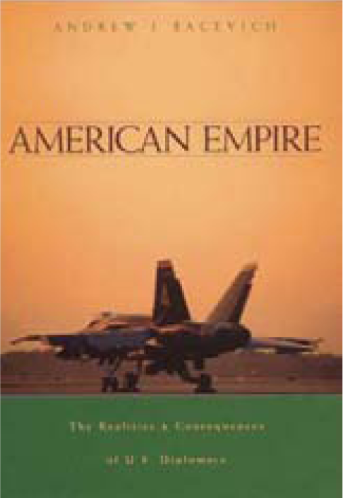
American Empire: The Realities and Consequences of U.S. Diplomacy
By Andrew J. Bacevich
Harvard University, 2002
320 pages; $29.95
PostCold War U.S. foreign policy has exhibited the sort of tri-umphalism that makes you think of Lord Actons observation that power tends to corrupt and absolute power corrupts absolutely.
According to Andrew Bacevich, a professor of international relations at Boston University, an early indication of this triumphalism was the Wolfowitz indiscretion. Shortly after the 1991 Gulf War, Wolfowitz, then the undersecretary of defense for policy, issued a Defense Planning Guidance that called for a U.S. strategy of maintaining vastly superior military power to convince potential competitors that they need not aspire to a greater role or pursue a more aggressive posture to protect their legitimate interests.
Wolfowitz, says Bacevich, had been indiscreet. His policy guidance openly suggested that calculations of power and self-interest rather than altruism and high ideals provided the proper basis for framing strategy.
Although the 2001 terrorist attacks revealed a weakness in the U.S. armor and dampened some of the countrys triumphalism, hubris has resurfaced with the war on terrorism. The author argues that while the Bush administrations campaign against terrorism is legitimate, it is also serving as a pretext for imperial adventures, including a plan to open Iraq in order to control the Middle East.
In Bacevichs view, the strategy of opening a country to U.S. influence–whether through military power or economic coercion–is a uniquely American form of imperialism. He cites two mid-twentieth century American historians, Charles Beard and William Appleman Williams, to argue that Americas commitment to global openness–removing barriers that inhibit the movement of goods, capital, ideas, and people–has been and remains central to its strategy for defending and extending its empire.
This is not a novel concept. Writers and observers from Capt. Alfred T. Mahan to Warren Zimmerman have highlighted openness and open door imperialism as being long-standing cornerstones of U.S. foreign policy. Mahan, for example, argued that establishing an empire did not necessarily require occupation, only the extension of national authority over alien communities. In support of this thesis, Bacevich quotes the conservative French intellectual Raymond Aron, who wrote, A world without frontiers is a situation in which the strongest capitalism prevails.
According to the author, virtually every U.S. president since McKinley has embraced openness, in part because of practical considerations. As former National Security Adviser Brent Scowcroft said in 1993, America has never been more dependent on the outside world for its well-being, and that dependency is steadily growing. More recently, the Bush administrations new National Security Strategy argues that military and economic power must be used to foster free and open societies.
Bacevich, a retired U.S. Army officer, worries about the potential blowback from excessive reliance on military power, reminding readers of Charles Beards warning that forcing doors open might lead the country down the path of militarism. He writes that in the decade after the Soviet Union imploded, the military component of U.S. policy became more, not less, important. Ba-cevich is disturbed by Americas increasing predilection for dropping bombs, its pursuit of full spectrum dominance, and the aggrandizement of power by the countrys new proconsuls–the commanders-in-chief of the various unified and specified commands.
The decision to pursue extreme military dominance as a way to deter would-be rivals caused the United States to miss out on a post-Cold War peace dividend. And projecting military power to encourage openness helped create enemies like Al Qaeda–and hindered the countrys ability to defend the homeland against real threats, like terrorism (as opposed to imaginary missile threats).
Bacevich believes this pattern is destined to be repeated until Americans acknowledge the existence of their empire and begin debating publicly what sort of empire they intend theirs to be. His book is an excellent place to begin the debate.