




Abstract
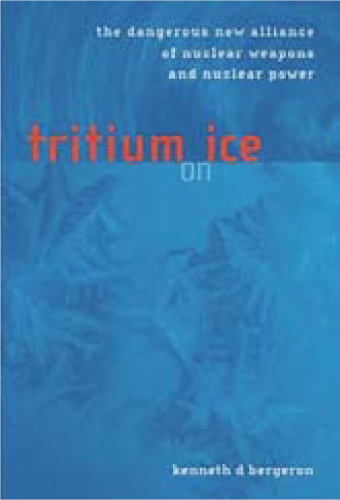
Tritium on Ice: The Dangerous New Alliance of Nuclear Weapons and Nuclear Power
By Kenneth D. Bergeron
MIT Press, 2002
232 pages; $24.95
Decades ago, Nobel laureate Hannes Alfvn warned, Atoms for peace and atoms for war are Siamese twins.
Kenneth Bergerons Tritium on Ice argues that a 1998 Energy Department policy decision spawned just such a pair of nuclear Siamese twins, with mid-level jaded bureaucrats serving as midwives. (For an earlier discussion of his arguments, see Bergerons While No One Was Looking, March/April 2001 Bulletin.) In December 1998, thenEnergy Secretary Bill Richardson announced that commercial nuclear reactors operated by the Tennessee Valley Authority (TVA) would produce tritium, a radioactive gas that enhances the explosive power of nuclear weapons.
Bergeron contends that this decision was the wrong one on two counts. First, he argues it will harm the nuclear nonproliferation regime; and second, it will jeopardize the safety of the Watts Bar and Sequoy-ah nuclear power plants, the two TVA-operated facilities selected for the tritium production mission. To set the stage for both arguments, the author provides well-written introductions to the fields of nonproliferation and nuclear reactor safety.
As a physicist who specialized in nuclear safety issues at Sandia National Laboratories for 25 years, Bergeron writes with authority on this field. From a safety perspective the U.S. government could probably not have made a worse choice of a type of commercial reactor for this new military mission, he states.
All three reactors at Watts Bar and Sequoyah use ice condensers to absorb the heat and steam that could be released in a major nuclear accident. Because ice condensers would be capable, in principle, of significantly reducing the pressure buildup inside the containment building during an accident, plant designers reasoned that they could save money by constructing smaller and weaker containments than those more typical U.S. power plants use. Only nine of the 103 operating U.S. commercial nuclear reactors employ ice condensers. If the ice condenser system should fail during an accident, the resulting pressure buildup might rupture the containment, potentially releasing radioactivity.
This fear is not farfetched. To demonstrate it, Bergeron discusses a Sandia analysis of the inadequacy of the ice condensers and the discovery of more than 200 broken screws in the Watts Bar ice condenser system.
Nuclear safety received little consideration in the run-up to Richardsons decision, because Energy Department officials preferred to rely on the Nuclear Regulatory Commission (NRC) to ensure the safety of the reactors. Bergeron, however, argues that bureaucratic pressure and national security concerns would compel the NRC to keep the reactors operating even if safety problems arose. Moreover, a veil of secrecy stemming from the military mission could block safety advocates from uncovering potential problems.
Writing under the shadow of the September 11 terrorist attacks, Bergeron conjectures that the plants where tritium is produced could become prime targets for terrorists. Though the NRC ordered security at all commercial plants upgraded in response to the attacks, the author asserts that it is highly unlikely that security at the Watts Bar and Sequoyah plants could ever be brought up to the level of the facilities of the nuclear weapons complex.
Although nonproliferation was a consideration in the Energy Departments decision, it was not given nearly as much weight as some would have liked. Critics chided Richardson for abandoning a longstanding policy that had kept atoms for peace and atoms for war separate. Because tritium is not classified as a special nuclear material in the Atomic Energy Act, however, no U.S. law or regulation directly prohibited its civilian production for military purposes. Bergeron traces the history behind the Energy Departments policy reversal.
Because tritium, a heavy form of hydrogen, decays at the rate of about 5 percent a year, it must be periodically replenished in U.S. nuclear weapons. The country has not produced tritium since 1988, when it shut down the last of the unsafe production reactors at the Savannah River site. Although the United States drew up plans during the late 1980s and early 1990s to restart tritium production, nuclear arms reductions proceeded faster than tritiums decay rate. Recycling of tritium from the dismantled warheads to the remaining arsenal delayed the need for new production.
Based on a START I-level stockpile, the government anticipated needing new tritium production capability by 2006. Because of the long lead time needed to build a new tritium-producing facility, Congress mandated that the Clinton administration decide on a production method by the end of 1998. The Energy Department pursued a dualtrack approach, testing possible tritium production in both reactors and linear accelerators.
Initially, the reactor option was limited to the idea of the government purchasing or constructing a facility that would be dedicated to military uses. Only later, in 1997, was the lease of commercial reactor services considered.
Bergeron questions the way in which the commercial option became a contender. Before the mid-1990s, the government held to its decades-long policy of not using civilian reactors to produce weapons materials. Surprisingly, the Environmental Impact Statement (EIS) used in the production decision switched the description of the commercial option from unreasonable to reasonable, although the majority of public comments to the EIS opposed this approach.
Among the many factors that influenced Richardson, technology and cost stood out. While the reactor option involved proven technology, the accelerator approach had never been attempted on an industrial scale. And using a pre-existing commercial reactor was clearly the cheapest choice.
Bergeron is highly critical of the government bureaucrats who crafted the 1998 interagency review of the nonproliferation implications of tritium production technologies. This review argued that the civil/military separation has never been absolute, citing as an example the case of the Hanford N reactor, which produced military plutonium but generated civilian electricity. Bergeron counters that this was a case of a military facility producing a civilian byproduct, an opposite case to that of a civilian power plant taking on a military mission. (The review also cited the governments purchase of electricity from TVA power plants to operate uranium enrichment plants at Oak Ridge National Laboratory, where highly enriched uranium was produced for naval propulsion and nuclear weapons–a case that is not really on point.)
Bergeron thinks that one of the strongest arguments against the commercial reactor approach is that nuclear proliferators will decide that the United States does not practice what it preaches. But Leonard Spector, a leading member of the interagency review, told me that Thomas Graham, a prominent nongovernmental analyst, advised the review team that building a large, dedicated tritium production facility entirely within the nuclear weapons complex might send an even stronger message–that the country is becoming more entrenched in the nuclear arms business.
Using the Freedom of Information Act, Bergeron uncovered evidence that the NRC and the Office of Science and Technology Policy (OSTP) did not have records of attending the interagency review meetings at which the issue was reportedly discussed. But Spector told me that all relevant government agencies, including the NRC and OSTP, commented on and approved the report. Still, concerning government accountability, Bergeron raises an important point about the apparent inadequate documentation of the interagency review.
If the commercial reactor option truly compromises U.S. nonprolifer-ation policy, what should the government do? Citing an analysis that Frank von Hippel and I did four years ago, Bergeron argues that there is no rush to produce tritium because additional modest nuclear arms reductions could delay production to 2029. Von Hippel and I based our 2029 estimate on an arsenal containing a total of 3,500 nuclear warheads. However, Bergeron errs when he writes that the Bush administration is planning much greater reductions.

The Bush administrations news briefing about its Nuclear Posture Review, released in early January 2002 and available before Tritium on Ice went to press, said that tritium will be needed for operationally deployed warheads (up to 2,200) and the responsive force. While the exact size of the responsive force is not openly known, the briefings published slideshow stated that downloaded warheads [will be] preserved for the responsive force. These downloaded warheads are expected to number in the many thousands. About 1,000 tactical warheads will also require tritium.
Faced with this news, Bergeron should have concluded that the Bush administration has little or no intention of delaying tritium production. Despite this analytic omission, Tritium on Ice is well worth reading, especially as an expos on how nuclear policies are born.