



Abstract

Robert Dohrmann's “Composite Reactor B–N.” Opposite page, “Atomic Pie” and “Guide to Frenchman Flat.”

As American as atomic pie
JUST HOW DOES ONE make an atomic pie? First, start thinking about how the nuclear age has colored modern culture. Then, take some oils and acrylics, add a little sculpture, mix in some mixed media–and voila! If youre like Robert Dohrmann, youve got Atomic Pie–a sizeable body of nuclear-related artwork.
Dohrmann cooked up the idea for his multimedia project three years ago, when looking for a flexible but focused topic, something of consequence relevant to everyone. The title, chosen for its juxtaposition of the unhealthy versus the wholesome, reflects Dohrmanns penchant for dualities.
When you walk into a gallery and look at my pieces, its colorful and almost happy-looking, Dohrmann says. But look closely, and its very dark.
Dark indeed–the subject matter includes mush-room clouds and missiles, communism and civil defense, fallout and Fat Man. Dohrmann, a University of Oklahoma art professor, says that sometimes his younger students dont initially see the connection between their lives and his work until they understand that their generation and their kids generation will have to deal with the [nuclear legacy].
Dohrmanns research into the imagery and iconography of the atomic age led him on a journey through nuclear America. It was a roadtrip that took him from ground zero at the Trinity test site in New Mexico, through a red-carpet, personal tour of the Energy Departments facilities in Hanford, Washington, with a stop in the middle at the Nevada Test Site archives. The result–more than 20 pieces that critique societal factors involved in the atomic age, the continuing effects of nuclear production (and storage), and the aftermath of the Cold War.
In the archives of the Nevada Test Site, Dohrmann found a halfcentury old black and white photo of the testing grounds baseball team. Inspired, he digitally altered the image and replaced the original players heads with those of the original nuclear priest-hood–Oppenheimer, Fermi, Seaborg, and Teller, to name a few–in a piece titled The Los Alamos Atom Smashers. Then theres Dorhmanns Collector Card Series: more than two dozen brightly colored, Topps-style cards memorializing the famous people, places, and icons of the early atomic age–Gen. Leslie Groves, the Enola Gay, a hand-held radiation detection device.

In a digital image from 2002 called Yucca Mountain Casino, mannequins wearing protective masks and holding martini glasses in one hand and fallout signs in the other, pose before barrels stacked in a desolate landscape–a commentary, Dohrmann says, on nuclear waste storage.
For the newly paranoid
It may look like a sci-fi alien aircraft, but the Guardian is the latest fallout shelter/personal bunker made by Miami-based U.S. Bunkers. Described as mobile by the company, this personal shelter weighs in at a svelte 13 to 15 tons–of steel, fiberglass, reinforced concrete, rebar, and polymer fiber.
The company describes the Guardian as seating up to six adults in comfort. Standard features include a dual-turbine air-filtering system, portable toilet, first aid kit, TV/VCR, surveillance cameras, and battery bank. Options include exterior M-2 guns, air conditioning, solar panels, and emergency escape ladders.
With solar panels, a battery bank, and an internal water supply, the Guardian can remain off the grid during extended disasters.

One of Dohrmanns most colorful pieces is a series of brightly painted and inked wood blocks, individually decorated with symbols and emblems of the atomic age–arranged on the wall in the shape of a mushroom cloud. That sense of irony pervades Atomic Pie–as does a healthy sense of humor, obvious in titles like Up N Atom, Halfter Life, and, in reference to Fat Man, Large Male.
Interest in his work increased substantially after the terrorist attacks and anthrax mailings of 2001. Before September 11, nobody would touch me, he says, remembering how quickly his gallery applications were returned and criticized as outdated. But the new paranoias un-surfaced the old paranoias, and Dohrmann soon had offers for several shows.
Dohrmanns recent work has focused largely on postSeptember 11 issues like dirty bombs and biological weapons. But he hasnt left the Cold War behind entirely–for one new project he is fashioning mock pieces of the Berlin Wall, what he calls postmodern faking.
More pieces of atomic pie can be found online at www.ou.edu/finearts/art.
Glowing with excitement
Although the U.S. governments supply of tritium–the radioactive gas that adds explosive punch to thermonuclear weapons–may be running low, private companies across the globe appear to have little trouble procuring the gas for their products. And business, it seems, is booming.
Tritiums commercial value stems from its ability to make things glow. Traser, a British outlet for the Swiss company MB Microtec, sells an assortment of items that incorporate phosphor-coated glass tubes filled with tritium gas. The gas emits low-energy electrons that excite the phosphor, producing a dull light that the company claims can last up to 10 years. Trasers products include Glow-Ring key rings, illuminated compasses, and krill lamps.
Traser does not sell its products in the United States, however, because of what it says are stringent U.S. regulations. According to a company representative, the Glow-Ring–one of Trasers best selling items–emits more than 500 microcuries, meaning the company would have to get special U.S. licensing to import its products. Otherwise, we could sell millions [of GlowRings] in America, lamented the company rep.
Glow Rings.

Some tritium products–like luminescent watches–are widely sold in the United States. Luminox, a California-based company, uses MB Microtecs self-powered illumination system to produce watches for the U.S. military. According to company literature, major customers include the SEALs and the air force. The company is now developing the Lockheed Collection, a line of watches that will be tied to specific jets, like the F-117 Night-hawk, the F-16 Viper, the Joint Strike Fighter, and the F-22 Raptor.
Across the border in Canada is SRB Technologies, an MB Microtec competitor. Included in its line of products are emergency lights for commercial jets, exit lamps, and penlights.
Both MB Microtec and SRB Technologies purchase their tritium from the same source–Ontario Power (formerly Ontario Hydro). Tritium builds up in the heavy water surrounding the reactor cores of the companys Candu nuclear power plants. Because the buildup can expose workers to added radiation, the company extracts tritium from the heavy water and chemically immobilizes it. Some of it is then sold to commercial enterprises.
That Ontario Power has tritium to spare raises an intriguing arms control question: Why doesnt the U.S. government buy Canadian tritium for its nuclear weapons instead of moving forward with its controversial (and more expensive) plan to produce the gas in commercial U.S. reactors? Says Marv Peterson, an official at the Office of International Programs of the Nuclear Regulatory Commission, That idea has been going around for a long time. But Canada is dead against the export of anything for nuclear weapons.
Joan Rohlfing, a former Energy Department adviser now with the Nuclear Threat Initiative, agrees, adding that the U.S. government also has a security concern about not being dependent on another country for its supply. (For more on tritium for U.S. weapons, see Policy by E-mail, page 70.)
Back in Canada, tritium is causing security concerns for people living near SRB Technologies. The Concerned Citizens of Renfrew County, in Ontario, reports on its Web site that independent testing of vegetation shows heightened levels of radiation near the plant.
In October 2000, David Hoel, a professor at the Medical University of South Carolina who served on the Committee on the Biological Effects of Ionizing Radiation, reviewed the groups findings, concluding that tritium levels considerably higher than expected are being found in urine samples. The levels, which were 500 times normal, could cause an increase in cancer-related deaths as well as health risks to developing fetuses, Hoel told the group.
Responding to the groups concerns, a spokesperson for Canadas Atomic Energy Control Board said, Were naturally exposed to radioactivity everyday. High doses of radioactivity can cause genetic defects and cancer, but at these levels there are no dangers (Reuters, September 28, 2001).
The Register, an on-line tech journal that markets the Traser GlowRing, assured potential buyers in an article last November that the beta particles emitted by the key rings were too weak to penetrate skin.
On the other hand, the journal ironically warned that it is conceivable that were the Iraqis to get their hands on a million Glow-Rings and carefully extract the tritium, theyd probably be only a matter of hours away from detonating their own nuke. Its a chilling thought. [Our] operatives have been placed on the highest state of alert and have been advised to get on the red telephone immediately should such an order come through from Baghdad.

In Brief
As if the National Institute of Standards F1 atomic clock were not precise enough (its described as accurate to within one second in 30 million years), a new project funded by NASA–the Primary Atomic Reference Clock in Space, or PARCS mission, aims to place an atomic clock on the International Space Station where, the theory goes, functioning in microgravity will provide a ten-fold improvement in clock accuracy (National Institute of Standards and Technology TechBeat, October/November 2002).
The recent unpleasantness with North Korea has alerted almost everyone to the less-than-tactful nature of Korean rhetoric. But some striking verbal assaults on the Indian subcontinent may have gone unnoticed (BBC, January 8). George Fernandes, Indias defense minister, bragged that if war came, Pakistan would be wiped out in a nuclear conflict between the two countries, to which Pakistans information minister, Sheikh Rashid Ahmad, replied that Fernandess remarks were the ravings of a crazy man. Ahmad insisted that Pakistan cannot be wiped out through nuclear weapons, and added that were an Indian attack to come, We have the will to give a crushing reply. Fernandes, in turn, shrugged off the Pakistani threat, saying, We can take a bomb or two. Ahmad responded that Indias ability to wreak havoc with its nukes was nothing but a pipe dream.
As Steven Aftergood revealed in the December 18 issue of his always informative e-mail journal, Secrecy News, the U.S. Navy takes tough steps to protect its essential secrets. For instance, it has classified as secret certain technical data about its washing machines–namely, their service manuals. The effect? Disclosure is subject to severe criminal penalties, including fines and imprisonment. Nonetheless, as discovered by intrepid investigator Franois Boo of GlobalSecurity.org, the navy posts several of these secret manuals on line–warnings against disclosure and all.
Boeing has been showing a new sales film, titled The Army–Objective Force: Realizing the Vision, to British firms to promote its next-generation of weaponry–unmanned aircraft and high-speed robot tanks. The animated film, which resembles a high-res video game, is supposed to show a high-tech assault in 2016. But apart from Boeings shiny new weapons, what has struck viewers most is that the city being attacked in the film is dotted with mosques (London Daily Telegraph, December 2, 2002). One industry representative said he found the films seeming premise–that any future wars will be fought in Islamic countries–distasteful.
Ever since a May 2000 fire burned thousands of acres and threatened parts of the Los Alamos National Laboratory, workers have been thinning some of the forests near the lab (Los Angeles Times, November 29, 2002). But Los Alamos has placed some of the trees in Bayo Canyon (formerly known as Technical Area 10) off limits to the loggers–because they are radioactively contaminated. In addition, one particular 1-acre site has been fenced off, even though lab officials say that recreational users of the canyon are not at risk. (The trees that are logged are given to the public to use as firewood.)
According to the December 8, 2002 Los Angeles Times, for at least the last 10 years California has allowed mildly radioactive waste from nuclear sites to be carted off to city dumps that were not licensed to handle any sort of radioactive material. Now anti-nuclear activists and environmentalists are demanding to know where the waste went. But the California health department says it didnt keep any records because the stuff was not a health hazard. The deputy director of the department, Kevin Reilly, added that low-level radioactivity doesnt matter because of the ability of the human body to repair itself.
In November, the Nuclear Regulatory Commission proposed a new rule that would permit the disposal in unlicensed dumps of waste uranium and thorium, materials whose radioactive level would allow exposures five times higher than the level the U.S. Environmental Protection Agency says is not protective of human health (Alliance for Nuclear Accountability, November 20, 2002).
Perhaps anticipating France and Germanys reluctance to get on board the U.S. war-with-Iraq train in January, long-time Pentagon adviser Richard Perle took the occasion of his trip to Europe last November to complain that the continent had lost moral direction (Guardian, November 13, 2002). Perle singled out Chancellor Gerhard Schrder and his leadership of Germanys moral[ly] numbing pacifism, and the French lack of moral fiber.
All the rage in New York
A Geiger counter, circa the 1950s.
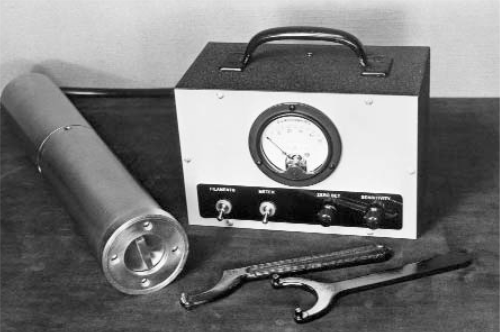
Clear those dusty Post-its and dried up highlighters from the office supply cabinet, or make a little room in the linen closet. Shopping for survival gear could be the next hot retail trend.
Since September 11, theres been an upswing in both Web and store sales of survival gear. From haz-mat suits and Geiger counters to executive parachutes and escape hoods, people and companies are investing in whatever reassurance they can throw their credit cards at.
Take Safer America, for example, which opened a retail outlet last fall in lower Manhattan. It claims to be the first store to specialize in Homeland Security products, and features a wide variety of personal safety and emergency preparedness gadgets designed to offer peace of mind to office workers and homebodies alike.
From its busy financial district corner, Safer America (tucked neatly under a bold red, white, and blue awning) provides customers with a comforting and educational environment. Understanding our options and being prepared for anything makes us stronger, the stores Web site declares.
For the executive who isnt convinced that stocking up on parachutes is a necessity, store employees are trained to assess a companys needs (what floor employees work on and how many exits their building has, for example). A variety of other vulnerabilities and hypothetical situations can also be discussed with helpful clerks, including bomb threats; nuclear, biological, and chemical attack; and high-rise escapes procedures.
For shoppers requiring less customized solutions, Safer Americas ready-made kits might be just the thing. Their High Rise Kit, at a promotional price of just $945, gives top-floor denizens an escape parachute, an escape hood, a full-body suit, a package of potassium iodide pills, a pair of Nitrile gloves and booties, a flashlight, and a roll of duct tape. The Family Kit accommodates as many as four family members and includes a baby-sized protective wrap.
Whats really hot this year? One employee I spoke with said that recalibrated surplus Geiger counters from the 1960s are selling especially well.
Knowing/not knowing Mr. Kim
Almost all of what is known about North Koreas Kim Jong Il comes from leaks by U.S. intelligence and the South Korean government, which have found it convenient to periodically play up or play down Kims reputation for bizarre behavior. Very little information about Kim is actually verifiable.

In any case, nearly everyone agrees that the Dear Leader is something of a playboy. But there is some dispute about whether he is a playboy of the Western world.
In a story on June 10, 2000, the Montreal Gazette reported that Kim trained as a pilot in East Germany in 196162. On the other hand, according to the January 13 News-week, Kim is afraid to fly. During the last two years, he traveled to Moscow and Beijing in a special armored train, a gift from Stalin to his father, Kim Il Sung.
According to a North Korean defector, Lee Young Kuk, allegedly a one-time member of Kims extensive corps of bodyguards, Kim has a luxurious villa in each of North Koreas eight provinces and two in Pyongyang, where he indulges his appetites for pretty women and French wine (others say his preferred drink is cognac).
Lee, the defector, reported that Kim refused to eat, drink, or smoke anything from abroad, except for wine. (On the other hand, Newsweeks Evan Thomas claims that Kim smoked Dunhills.) Lee said that even Kims hair oil had to be made in North Korea.
This display of North Korean juche–a xenophobic insistence on total national self-reliance–doesnt seem to square with a mysterious final paragraph in the News-week story, containing a claim repeated (or begun) by Republican Cong. David Drier of California, asserting that Kim owns an additional half dozen villas in Europe (how does he get there? how often? and, once there, what does he eat?). In contrast, the January 11 Ottawa Citizen points out that Kims trip to China in 2001 was only his third foreign trip.
Before the beginning of a warming with South Korea in June 2000, Kim was consistently portrayed as the self-indulgent playboy, but during the two years of dtente that came crashing to a halt in the fall of 2002, a number of experts reported that behind Kims moodiness and selfish behavior was a brilliant mind; that if he was crazy, he was crazy like a fox. The Toronto Star reported that on June 16, 2000, after South Koreans saw and heard Kim on videotape welcoming then South Korean President Kim Dae Jung to Pyongyang, many of them described him as warm, witty, and bright.
Now, with the latest weapons flap, bad boy Kim is back. In all the world, says Newsweek, Kim is the key danger.