




Abstract

The B61 bomb is perhaps the most versatile and abundant nuclear weapon in the U.S. stockpile. Close study of its complex history reveals something that the nuclear weapon labs may not want to admit: After mastering the basics of sub-megaton nuclear bomb design several decades ago, the only subsequent innovations have been marginal improvements to B61 safety and security features. The fact is that many of the original plutonium pits, some more than 30 years old, are still in service–calling into question the need for much of the $5 billion-a-year Stockpile Stewardship Program and the future $2 billion-$4 billion Modern Pit Facility.
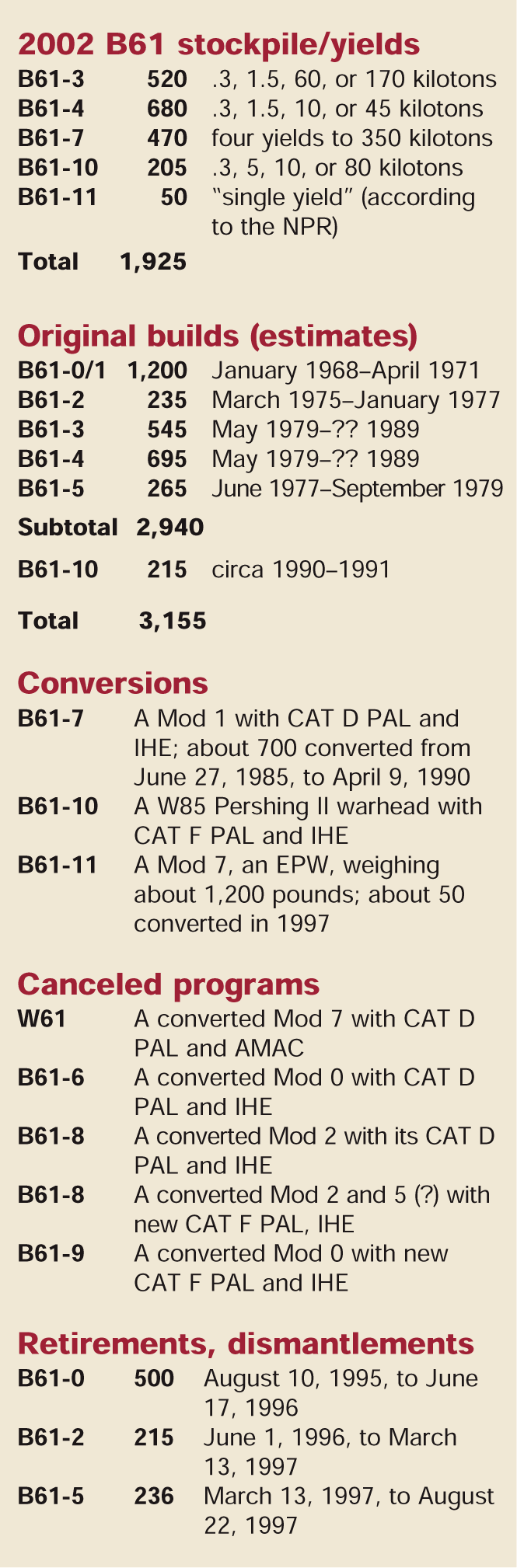
We estimate that the total stockpile of intact B61 bombs is approximately 1,925, of which 1,265 are considered operational. All B61 models are scheduled to undergo life extension and retrofit programs over the next decade, and approximately 400 bombs are scheduled to be “consumed” in quality and reliability testing through 2025.
The basic B61 bomb weighs approximately 700 pounds, is slightly over 13 inches in diameter, and is 11.8 feet long from nose to fin-tip. The earth-penetrating version, the B61-11, weighs an additional 450 pounds.
For more than 30 years, the B61 bomb has been the bread and butter of the Los Alamos National Laboratory in New Mexico. A series of underground tests was conducted from 1963-1968 at the Nevada Test Site to certify the bomb's yield and confirm its military characteristics. “Shot Halfbeak,” one of six B61-associated tests conducted in 1966, is suspected of being fired on June 30 at full yield–about 350 kilotons. Nuclear testing resumed in the mid-1970s to perfect the Mod 3 and 4 versions, which entered the stockpile in 1979.
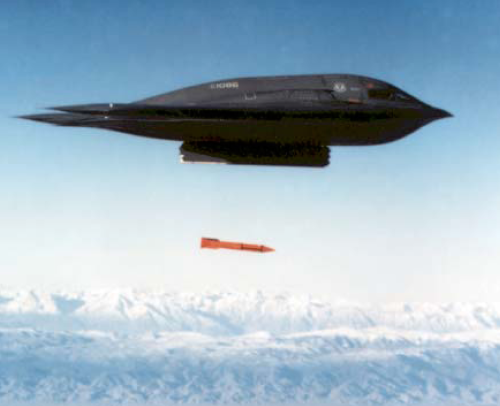
November 22, 1996: A B-2 Stealth bomber test drops a B61-11 earth-penetrating weapon at the Tonopah Test Range in Nevada.
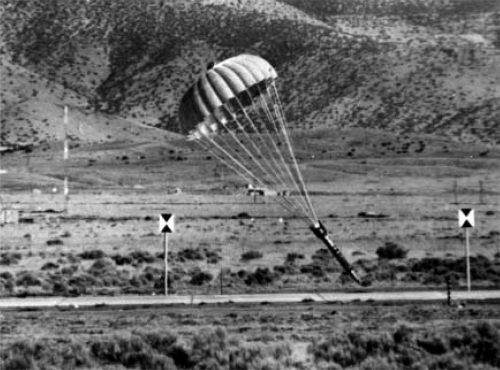
The bomb can be delivered as a free-fall airburst, a retarded airburst, a free-fall surface burst, or in “lay-down” mode from aircraft flying as low as 50 feet. In laydown mode, the bomb must survive ground impact; to do this, a parachute quickly slows the bomb's descent and controls its trajectory. Originally, a 17-foot diameter nylon parachute was used. Later models switched to a 24-foot diameter nylon/Kevlar version.
The B61 has been deployed on a wide variety of tactical and strategic aircraft. Strategic versions have been carried on B-52, FBI 11, B-1, and B-2 bombers. Tactical versions, with lower yield options, have been deployed on a variety of U.S. and NATO air force aircraft, including the F-100, F-104, F-4, F-105, F-15E, F-16, Fill, F-117, and Tornado. The U.S. Navy and Marines have used the B61-2/5s on A-4, A-6, A-7, and F/A-18 aircraft. After the navy terminated the nuclear strike mission from U.S. aircraft carriers in the early 1990s, the bombs were retired and disassembled. According to the Bush administration's recent Nuclear Posture Review (NPR), some future Lockheed Martin F-35 Joint Strike Fighters may be nuclear capable. They would most likely use the B61 bomb.
The B61 has also served as the basic design for three other warheads: the W80-0 sea-launched cruise missile warhead; the W80-1 warhead for the air-launched cruise missile and the advanced cruise missile; and the W85 warhead for the Pershing II missile. The Intermediate-Range Nuclear Forces (INF) Treaty, signed on December 8, 1987, marked the Pershing II missile (among others) for elimination. Although the missiles and launchers were destroyed by mid-1991, as the treaty called for, the warheads were retained, converted, and probably returned to European air bases as B61 bombs. The “physics package” (the guts of the nuclear explosive) was removed from the W85 warhead, repackaged in a bomb casing, and re-designated the B61-10. While not technically illegal under the INF Treaty, it can be argued that this violated its spirit (see the November 1990 Bulletin, pp. 14-16).
B61 safety and control features
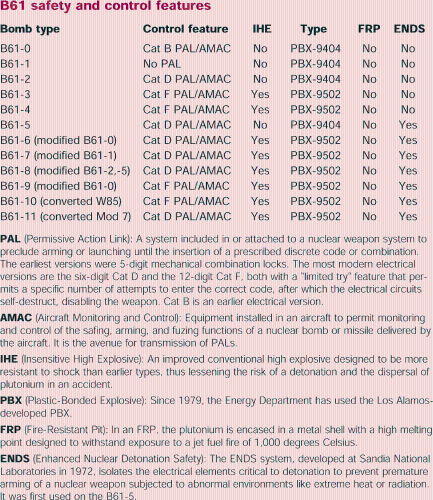
Development of the B61-11 was initially proposed by U.S. Strategic Command, endorsed by the 1994 Nuclear Posture Review, and directed by Presidential Decision Directive 30. The first four production units were delivered to the air force in December 1996. It is estimated that in 1997 some 50 B61-7s were converted to B61-1 Is and deployed to Whiteman Air Force Base (AFB), Missouri, home of the Stealth bomber wing. B61-7 bombs are stored at four other bases: Barksdale AFB in Louisiana, Minot AFB in North Dakota, Nellis AFB in Nevada, and Kirtland AFB in New Mexico.
The B61-7 “laydown” bomb also served as the basis for the W61 program in the late 1980s and early 1990s, which was an effort to equip the small Midgetman intercontinental ballistic missile with a strategic earth-penetrating warhead. When the Midgetman program was canceled by the first Bush administration, so was authorization for the W61.
2002 B61 stockpile/yields
The Robust Nuclear Earth Penetrator program, recommended by the latest NPR, could use the B61 (or B83) in an effort to build an earth-penetrating weapon that would be more effective than the B61-11. But a serious flaw in the concept of nuclear earth-penetrating weapons, even those with relatively low yields, is that they cannot penetrate deeply enough to contain a nuclear explosion and its deadly radioactive fallout. If used in an urban environment, such a weapon would cause thousands of casualties (see Robert W. Nelson, Science and Global Security, Vol. 10: pp. 1-20, 2002).
The “laydown” version of the B61 bomb, slowed by a parachute.
The United States fielded two earth-penetrating weapons in the 1950s, the Mark 8 and Mark 11 bombs. The uranium gun-type Mark 8 bomb (nicknamed “Elsie” for LC, or light case) was almost 10 feet long, 14 inches in diameter, 3,250 pounds, and had a yield of approximately 25 kilotons. It was developed by the navy for targeting underground facilities, enemy submarines located in sheltered pens, and armored ship decks. It was in service from 1952 to 1957. The Mark 11 was an improved version of the Mark 8, slightly heavier, and according to the National Atomic Museum, “able to penetrate up to 22 feet of reinforced concrete, 90 feet of hard sand, 120 feet of clay, or five inches of armor plate, “ and fuzed to detonate 90-120 seconds after penetration. The W86, an earth-penetrating alternative to the W85 Pershing II warhead, was developed in the 1970s but canceled in September 1980.
The B61 bomb has the unique distinction of being the only remaining nuclear weapon deployed outside U.S. borders (excluding the missile warheads on patrolling nuclear-powered ballistic-missile subs).