




Abstract
There may be a gap between when the current generation of Advanced KH-11 and Onyx reconnaissance satellites stop working and when their replacements are ready.
Current-generation satellites could be used to fill the gap. But they must be launched on giant Titan IV-B boosters like this one–and very few Titans remain.

In the mid-1950s, the United States feared there might be a “bomber gap”–that the Soviet Union had or would soon have a significantly greater number of long-range bombers, and that those bombers could deliver nuclear payloads to the American homeland. But as the imagery from U-2 spy plane missions over the Soviet Union accumulated over the next few years, it became clear there was no gap.
In the late 1950s, the possibility of a missile gap alarmed national security officials, members of Congress, and the public. Once again, technology was able to provide a definitive and reassuring answer. The images from Corona spy satellites, the first of which was orbited in August 1960, led to a September 1961 National Intelligence Estimate that dramatically lowered the number of intercontinental ballistic missiles (ICBMs) believed to be in the Soviet arsenal.
But now, in the early years of the twenty-first century, a different sort of gap could seriously impact U.S. national security–a satellite gap.
Unlike the earlier cases, anxiety is not caused by the prospect that Russia, China, or some other nation will outpace the United States in developing an advanced military technology. Instead, it is feared that key satellite intelligence and surveillance systems currently under development–the Future Imagery Architecture (FIA) and the Space-Based Infrared System (SBIRS), which are scheduled to take over the missions of current systems later in the decade–may not be ready in time.
Future Imagery Architecture
On October 5, 2001, a Titan IV-B rocket lifted off from Vandenberg Air Force Base in California carrying a $1 billion payload the size of a school bus–an advanced KH-11 reconnaissance satellite. Today, it is one of three advanced KH-11s that orbit the earth at altitudes between 250 and 550 miles–the others having been launched in December 1995 and December 1996. During daylight their electro-optical systems can instantaneously transmit, via a relay satellite, images of their targets on earth, with a resolution of about 6 inches. In darkness (in the absence of cloud cover) their infrared sensors provide imagery of somewhat less clarity. 1
Cong. Porter Goss.

In addition to the KH-11s, there are three radar imagery satellites, previously designated “Lacrosse” but more recently known as “Onyx.” Rather than relying on reflected light or thermal emissions, Onyx satellites transmit radio waves that bounce off their targets. When the returns are received by the satellite they can be converted into an image of the target. The oldest of the three Onyx satellites, launched in March 1991, may be nearing the end of its operational lifetime, if it has not already reached it. The other components of the Onyx triad are of more recent vintage, having been orbited in October 1997 and August 2000. 2
In early September 1999, the National Reconnaissance Office (NRO), which is responsible for supervising the research and development of America's intelligence satellites as well as operating them, announced it had awarded a contract to the Boeing Company to serve as prime contractor for the development and production of the next generation of electro-optical and radar imagery satellites–designated the Future Imagery Architecture. The contract, with a value in the neighborhood of $6 billion, runs through 2010. 3
The origins of FIA go back to the NRO's Imagery Architecture Study, which was completed in the summer of 1996, at a time when both congressional and outside advisers were suggesting developing more–but smaller–imagery satellites. In January 1997, NRO director Keith Hall told the representatives of more than 50 companies that the study “convinced us that we can move to a new generation of smaller imagery satellites within budget and with improved capabilities.” 4
Putting a larger number of satellites in orbit would give the NRO the ability to cover more of the earth at any given time and to “revisit” targets more frequently–allowing U.S. intelligence analysts to keep targets under closer scrutiny and hopefully avoid surprises such as the 1998 Indian nuclear tests, as well as to provide combat commanders with better information in fast-moving military conflicts.
But even before Boeing was selected as the prime contractor and the hard work of developing and building satellites began, the program's schedule was pushed back. In May 1998 it was reported that NRO had slowed the program while attempting to resolve differences between prospective contractors and the NRO as to the cost of the effort. Contractors were claiming that the FIA could be achieved within the NRO's budget, but an independent assessment suggested that the contractors' proposals would run 25 percent over budget. As a result, Hall delayed the next phase of FIA by about six months, noting that he didn't want to start it only to “get into a train wreck two years from now.” As a result, the projected first launch of a FIA satellite was moved from 2003-2004 to 2004-2005. 5
Cong. Jerry Lewis.
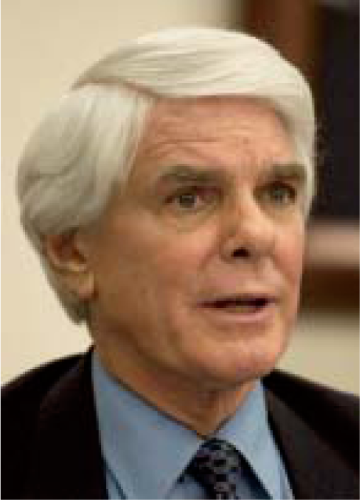
In late March 1999, a little over five months before Boeing was awarded the contract, Republican Cong. Porter Goss of Florida, the chairman of the House Permanent Select Committee on Intelligence, characterized FIA as “over budget and behind schedule.” Later that year, Goss's committee raised another issue: the lack of attention to what is labeled TPED–tasking, processing, exploitation, and dissemination. The committee had concluded that little effort had been devoted to the critical issue of insuring that the imagery interpreters at the National Imagery and Mapping Agency (NIMA), as well as at assorted service and unified command intelligence organizations, would be able to cope with the vastly increased number of images that the new satellites were expected to transmit. There was already a substantial gap between the ability of NRO satellites to produce imagery and the ability of America's imagery analysts to use (“exploit”) the imagery produced. FIA would only make it worse.
In November 1999, the committee threatened to cut funding for FIA. As committee vice-chairman Jerry Lewis, a California Republican, observed: “In plain English, it does not do any good to take pictures that no one will ever see.” He threatened that “unless there is a plan implemented that will process the satellite data FIA will collect, we will not buy the satellite system as currently proposed.” He noted that congressional warnings had been ignored for several years, adding, “Enough is enough!” 6
According to Pete Rustan, former head of small-satellite development for the NRO, at least $1.5 billion was added to the 2001 budget to address the TPED problem. In any case, July 2001 NIMA briefing slides portrayed FIA as a system that would significantly improve U.S. satellite imagery capabilities. The slides promised a “tremendous increase in area and point collection,” a “rapid revisit” capability, an “improved all-weather, day-night capability,” and the improved ability to track and locate targets as well as to provide battle damage assessment. They also noted that “FIA means moving to an imagery collection-rich environment.” 7
The United States seems to be running out of all-weather radar satellites–and there is no adequate commercial replacement for them.
Boeing has claimed that all is well with FIA, and that claim was supported in February 2002, to a degree, by Undersecretary of the Air Force Pete Teets, who had replaced Keith Hall as NRO director a few months earlier. Teets told reporters that Boeing was “fundamentally” on schedule and within budget, but admitted that he had “some concerns” and feared “downstream problems.” 8
Since that time more reports have suggested that FIA is over budget and behind schedule. In April 2002, Martin Faga, who served as NRO director in the first Bush administration, chaired a nine-member panel examining the status of FIA. Serving along with Faga on the review group were David Jeremiah, former Joint Chiefs of Staff vice chairman; Jimmie Hill, former NRO deputy director; and Thomas Moorman, former Air Force vice chief of staff. The group apparently identified eight shortcomings in the program–including weight problems and difficulty communicating with ground stations. One consequence of these shortcomings is a potential delay of between 18 and 30 months in the currently projected 2006 launch date for the first satellite. 9
That delay could mean more than that the more capable FIA satellites may not be available when promised. As Allen Thomson, a former CIA analyst who monitors the reconnaissance program, observed, it “looks like there may be a gap” between when the current generation of Advanced KH-11 and Onyx satellites stop working and when their FIA replacements are ready. 10
The attempt to produce smaller yet more capable satellites may be a significant cause of that gap. For not only is there the challenge of putting greater capabilities into a smaller package, but the decision to produce smaller satellites was intimately intertwined with the decision to terminate the run of the massive Titan IV-B launch vehicles, the use of which was required for every advanced KH-11 or Onyx launch at a cost of $300 million each. As a result, there are only a handful of Titan IV-Bs left, and they are also needed to orbit payloads such as the Milstar communications satellite, an advanced signals intelligence satellite, and two missile-warning satellites. More imagery satellites of the current generation cannot be launched on the lighter boosters that are being procured to send the FIA satellites into orbit.
One apparent attempt to increase the lifetime of the current satellites was a June 7, 2002, memo from Director of Central Intelligence George J. Tenet mandating that current NRO satellites not be used for mapping purposes if at all possible, with the task being assigned to commercial satellites like Space Imaging's Ikonos and Digital Globe's Quick-bird. And some, but no means all, of the intelligence community's imagery intelligence needs could also be satisfied by those satellites, further lengthening the lifetimes of the NRO's remaining space assets. These commercial capabilities were demonstrated by the Defense Department's use of Ikonos and Quick-bird imagery of the Al Qaim phosphate plant and uranium extraction mine, the Radwaniyah presidential site, and Abu Ghurayb (an alleged bioweapons facility) in its October 2002 presentation on Iraqi denial and deception activities. 11
A more difficult challenge, though, will be preventing a gap in all-weather radar imagery coverage. As Thomson told me, the United States “seems to be running out of radar satellites.” And there is no adequate commercial replacement for them. If FIA fails to replace them on time, says Thompson, there could be a “major squeeze.”
Despite its earlier comments, the NRO is no longer willing to offer either reassurance or information about FIA. According to an NRO spokesman, Teets considers FIA a classified program and “he doesn't want to discuss any details of that program.” That includes costs, projected launch dates, or whether the gap between collection capabilities and ability to process and analyze the information has been reduced significantly. 12
The Space-Based Infrared System
During the first half of 1995, the U.S. Air Force announced that its current generation of missile warning satellites, known by the euphemistic title, “Defense Support Program” (DSP), would be replaced by the Space-Based Infrared System-High (SBIRS-High). An additional system, SBIRS-Low, would provide additional capabilities needed for missile defense.
That announcement, along with strong congressional support, appeared to end what had been a long, tortuous search for a successor to the DSP system, which was first launched in November 1970.
The search for a DSP replacement had begun by the late 1970s and became far more intense in the late 1980s and early 1990s. A parade of programs with associated acronyms (BSTS, FEWS, ALARM, and AWS to name a few), were regularly announced and canceled, announced and canceled. Ambitious requirements that had their origins in nuclear war-fighting strategies and the Strategic Defense Initiative often led to cost projections that then required a reduction in projected capabilities–and a loss of confidence in the air force's competence.
During hearings in the House in 1994, an exasperated Norman Dicks, a Washington State Democrat, asked a senior air force official if “we are ever going to make a decision and stay with it?,” adding that he was “not yet convinced that you know what you are doing.” 13
SBIRS has been the decision stayed with. By 1995, the DSP system had evolved to include, in addition to its ground facilities, four satellites equipped with infrared sensors and nuclear detonation detectors in geosynchronous orbit. They are expected to detect missile launches, nuclear detonations, aircraft flying on afterburner, satellite movements, and a variety of other infrared events on the planet's surface–such as aircraft crashes and explosions of weapons depots. In addition, NRO signals intelligence satellites flying the highly elliptical “Molniya” orbit were equipped with an infrared sensor code-named “Heritage,” allowing coverage of the polar regions that were not accessible to DSP sensors, a legacy of a concern that advanced Soviet submarine-launched nuclear missiles could hit the United States from polar regions. The SBIRS-High system would continue the practice of using two of NRO's elliptically orbiting signals intelligence “birds” as hosts for infrared sensors.
SBIRS-High was offered as an improvement in DSP capabilities. In addition to a scanning sensor similar to the one carried on DSP satellites, the SBIRS-High satellites would also carry a staring sensor that could continuously focus on a target area. Attempts to develop such a sensor stretch back two decades. The new satellites would, it was asserted, allow the detection of dimmer exhaust plumes and earlier recognition of missile launches. Eventually, Lockheed was selected as prime contractor, with Aerojet General (since absorbed by Northrop Grumman) being awarded the contract to develop the infrared sensor, as it had done for DSP. They, along with a number of secondary contractors, were to deliver five satellites, seven sensor packages, and related ground systems. 14
Artist's rendering of the Space-Based Infrared System-High.
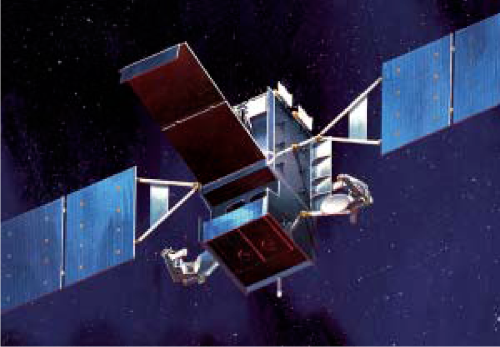
SBIRS-Low, to consist of approximately 24 satellites orbiting about 1,000 miles above the earth, would provide a key element of a national missile defense system. The SBIRS-Low satellites would also be equipped with two sensors–an acquisition or scanning sensor which would quickly scan from horizon to horizon and a staring or tracking sensor. The latter, after being notified by the acquisition sensor of a target, would track it through its midcourse trajectory and into its reentry phase–two portions of an ICBM's flight path that SBIRS-High would not be able to view. The satellite would use an inter-satellite crosslink to alert the next appropriate satellite to track the target. Onboard processors carried by the SBIRS-Low satellites would work out the missile's trajectory, predict its impact point, and relay the information to anti-missile forces, allowing them to intercept and destroy the incoming warhead. 15
However, the air force, the Missile Defense Agency (which has assumed responsibility for SBIRS-Low), and its contractors have been faced with substantial cost growth, technical problems, and delays in attempting to transform SBIRS from vision to reality.
In 1996, the initial cost of the SBIRS-High system was estimated at $1.9 billion. By March 1999, the price tag was estimated at $2.3 billion and Brent Collins, the air force program executive for space, raised the possibility that it could cost another $1 billion. In late 2001, $3.3 billion was judged to be not nearly enough–the estimated bill had risen to at least $4.5 billion.
Not surprisingly, the cost growth in the larger and even more technically challenging SBIRS-Low program was also substantial. In late 2001, the House Appropriations Committee reported that the program's life cycle cost had grown from $10 billion to $23 billion. 16
The increase in projected costs is partially the result of an assortment of technical challenges that have slowed development of both SBIRS components. Those involved in the program “underestimated again and again [the] technical challenges,” according to Philip Coyle, the Defense Department's director of operational test and evaluation during the later years of the Clinton administration. 17 SBIRS-High's troubles included software development for the elliptically orbiting satellites, additional weight for the geosynchronous satellites, sensor vibration, inadequate infrared sensitivity, and the sensor acquisition of stray sunlight (the latter requiring the addition of a shield to block the sunlight). Additional dollars were also required for developing software for the SBIRS ground station and developing the mobile vans that could be employed in case the fixed ground station and its backup were destroyed or believed to be threatened. 18
In February 2001, a General Accounting Office report warned that the SBIRS-Low “acquisition schedule is at high risk of not delivering the system on time or at cost or with expected performance.” There were problems with five of six technologies critical to the success of SBIRS-Low–the scanning infrared sensor, the tracking infrared sensor, the cooling system for both the satellite's optics and the tracking infrared sensor (needed to allow the satellite to detect the dim signature from rockets during their midcourse flight), and the satellite communications crosslinks. Only the on-board computer processor had reached an adequate state of maturity. A few days later, Col. Michael Booen, the air force program manager for SBIRS-Low, called the GAO report “false and misleading,” arguing that it was based on an earlier development and deployment strategy that was aban-doned. 19 Booen also asserted that the air force decided to stretch out the launch schedule for SBIRS-Low so it could be tested more thoroughly.
The SBIRS programs' technical challenges have led both to cost growth and schedule delays. In 1996, the first launch of a geosynchronous SBIRS-High satellite was projected for October 2002. In 1999, the air force told Lockheed that the first launch would not occur until October 2004. The following year, the planned second launch was pushed back a year–to 2005. In April 2002, it was reported that the first launch was not expected until 2006. Now the new date for the first launch is 2007. The delivery of an infrared sensor to be placed on a high-elliptical NRO satellite, which had been set for 2001, has been rescheduled for 2003. 20
If SBIRS-High is not ready in time, America's missile-warning capability might not only be less than projected, it could even be less than it is today.
Not surprisingly, the launch date for SBIRS-Low has slipped from 2004 to 2006 (which was the air force's planned date before pressure from congressional missile defense advocates, which led to it being advanced). Current plans call for the launching of two demonstration satellites in 2006 and 2007. A plan to launch two demonstration satellites had been set in 1998, but was canceled for budgetary reasons. The plan was resurrected as part of an April 2002 SBIRS-Low restructuring. 21
While delays in SBIRS-Low could impede effective deployment of a national missile defense system, delays in SBIRS-High could reduce the U.S. capability to detect missile launches and collect intelligence about events with significant infrared signatures (from steel production to detonations). There are only two DSP satellites left in the inventory–satellites that require heavy Titan IV-B boosters to get them to geosynchronous orbit. If SBIRS-High is not ready in time, America's missile-warning capability might not only be less than projected, but less than it is today.
Uncertain future
Developing advanced space systems has always been a demanding and challenging task. The history of military space contains more than a few examples of systems, including DSP, that were successfully developed despite the doubts of government officials and scientific advisers. Marvin Boatright, a former Aerojet executive who worked on the DSP and predecessor programs, notes that one key to eventual success is to “stick with it.” 22 The contractors, as can be expected, have expressed confidence that they can deliver the satellite systems according to their current schedule.
Key government supervisory officials like NRO's Teets and Pete Aldridge, Defense undersecretary for acquisition, have also expressed optimism, although at times it has been guarded. When Aldridge announced his decision in May 2002 not to cancel SBIRS-High after a review required by law (for any program 25 percent or more over budget) he expressed confidence in contractor management changes (as had Teets) but he also said, “If we find that six months from now, the program is going south, I [will] have no hesitation to pull the plug.” 23
But even if the plug is not pulled and the FIA and SBIRS remain on track, gaps are still possible, for they can also be created by the failure of satellites now in orbit and the few remaining on the ground. A DSP launch failed in 1999, with the satellite winding up in a useless orbit, and only two satellites remain. How many Advanced KH-11 or Onyx imagery satellites remain isn't publically available information, and the NRO isn't telling. What is certain is that there are only a handful of Titan IV-B boosters left.
Gaps may be avoided only if the satellites in orbit and those to be launched perform at least as well and as long as expected–or better and longer–which is by no means an unknown occurrence. However, launch disasters or unexpected failures in orbit could leave U.S. military and intelligence officials wishing they had been somewhat less optimistic about their ability to replace last century's models with satellites that can satisfy all the demands of this century.
Footnotes
1.
Craig Covault, “Secret NRO Recons Eye Iraqi Threats,” Aviation Week & Space Technology, September 26, 2002, pp. 23, 26.
2.
Ibid.
3.
NRO, “NRO Announces FIA Contract Winner,” September 3, 1999 (www.nro.gov); Boeing, “Boeing Team Wins Future Imagery Architecture Competition,” September 3, 1999 ( ); Joseph C. Anselmo, “Loss of NRO Contact Hits Lockheed Hard,” Aviation Week & Space Technology, September 13, 1999, pp. 27-28.
4.
“NRO Presses New Satellite Imagery Architecture,” Aerospace Daily, May 1, 1996, pp. 175-76.
5.
“NRO Slows FIA to Resolve Cost Differences,” Aerospace Daily, May 21, 1998, pp. 289-90.
6.
“Eye Spy,” Aviation Week & Space Technology, March 29, 1999, p. 29; “Watching the Watchers,” Aviation Week & Space Technology, November 15, 1999, p. 27; Warren Ferster, “DoD Faces Big Bill for Data Handling,” Space News, November 22, 1999, pp. 1, 20); House Permanent Select Committee on Intelligence, “House Passes Intelligence Committee Legislation Requiring Changes in the Administration's Plans for Imagery Collection and Exploitation,” November 9, 1999.
7.
“Profile: Pete Rustan,” Space News, March 13, 2000, p. 22.
8.
“I Spy a Problem,” Aviation Week & Space Technology, February 11, 2002, p. 23.
10.
Interview with Allen Thomson, October 9, 2002.
11.
12.
Telephone call from NRO spokesman, October 11, 2002.
13.
U.S. Congress, House Committee on Appropriations, Department of Defense Appropriations for 1995, Part 4 (Washington, D.C.: U.S. Government Printing Office, 1994), pp. 114-15.
14.
Jeremy Singer, “U.S. Air Force Proceeds with Modified SBIRS High Design,” Space News, December 4, 2000, pp. 4, 28; Harry N. Waldron, History of the Space and Missile Systems Center, October 1994-September 1997, Volume I (Los Angeles Air Force Base, Calif.: Air Force Space and Missile Systems Center, 2002), p. 116.
15.
Waldron, History of Space and Missile Systems Center, pp. 124-25.
16.
John Donnelly, “Missile-Tracking Satellites' Cost Grow $1 Billion Plus,” Defense Week, November 19, 1998, pp. 1, 12; Warren Ferster, “SBIRS High Facing $1 Billion Increase,” Space News, March 15, 1999, p. 4; Jeremy Singer, “Problems Plague SBIRS High Program,” Space News, December 17, 2001, pp. 1, 3; Carla Anne Robbins, “One Troubled System Shows Hurdles Facing Missile-Defense Plans,” Wall Street Journal, June 15, 2001, pp. A1, A6; Marcia S. Smith, Military Space Programs: Issues Concerning DOD's Space-Based InfraRed System (SBIRS), (Washington, D.C.: Congressional Research Service, June 24, 2002), p. 4.
17.
Telephone interview with Philip Coyle, October 9, 2002.
18.
“Tests Begin on Troubled SBIRS-High Software,” Space News, July 17, 2000, p. 2; Jeremy Singer, “SBIRS High Could Face More Cost Growth Schedule Delays,” Space News, November 5, 2001, p. 6.
19.
General Accounting Office, Space-Based Infrared System-Low at Risk of Missing Initial Deployment Date (Washington, D.C.: GAO, February 2001) pp. 3-4, 16-17; Jeremy Singer, “Air Force Official Slams GAO Report About SBIRS-Low,” Space News, March 12, 2001, pp. 3, 20.
20.
Robert Wall, “Pentagon Delays SBIRS Launches,” Aviation Week & Space Technology, January 18, 1999, pp. 26, 29; Gopal Ratnam, “Delay of Satellites May Hobble NMD,” Space News, April 8, 2000, pp. 4, 28; Warren Ferster and Jeremy Singer, “Pentagon Proposes Staggering Launches of SBIRS Satellites,” Space News, December 11, 2000, pp. 1, 19; Michael Mecham and Robert Wall, “It's High Noon For SBIRS-High,” Aviation Week & Space Technology, April 8, 2002, pp. 85-87; Jeremy Singer, “Air Force Funding Requests Run Into Opposition,” Space News, July 8, 2002, p. 16.
21.
Smith, Military Space Programs: Issues Concerning DOD's Space-Based InfraRed System (SBIRS), p. 6.
22.
Telephone interview with Marvin Boat-right, October 9, 2002.