




Abstract
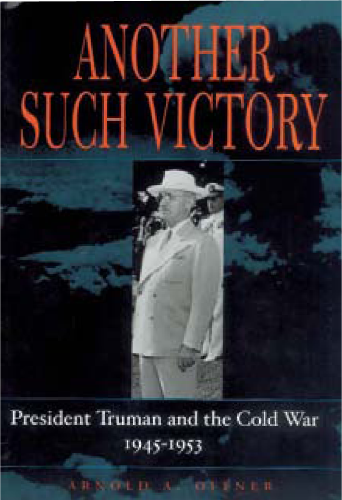
Another Such Victory: President Truman and the Cold War, 1945-1953
Stanford University, 2002 626 pages; $37.95
In 279 B.C., King Pyrrhus of Greece defeated the Romans in the Battle of Asculum. The victory was so costly, however, that when a jubilant soldier congratulated the king, he commented: “Another such victory, and we are undone.” According to historian Arnold Offner, it is useful to think of King Pyrrhus's victory when assessing the legacy of President Harry Truman.
In Another Such Victory, Offner, a professor at Lafayette College in Pennsylvania, describes Truman as a parochial nationalist who “lacked the qualities of the creative or great leader.” He was a president who “narrowed Americans' perception of the world political environment and the channels for policy choices, and created a rigid framework in which the United States waged long-term, extremely costly global Cold War.”
Whether or not readers agree with his view, Offner must be congratulated for assembling an impressive array of documentary sources to produce his book, including “recent revelations” from Soviet, German, Chinese, and Korean archives, as well as many U.S. sources. Although his writing style–his frequently awkward sentence structure, for example–does not make for easy reading, he conscientiously presents both the “pros” and the “cons” of each major presidential decision that he examines.
As an example of the pro-Truman argument, Offner quotes David Lilienthal, chairman of the Atomic Energy Commission during the Truman administration, who wrote in 1948: “Truman's record is that of a man who, facing problems that would have strained and perhaps even floored Roosevelt at his best, has met these problems head on in almost every case. The way he took on the aggressions of Russia; the courage in calling a special session of an antagonistic Congress controlled by the opposition to put through an extensive program for the restoration of Europe; his civil rights program, upon which he hasn't welched or trimmed–my God! What do [these] people want?”
After building the case against Truman in 470 pages of analysis (and another 94 pages of fine-print notes), Offner's conclusion is much different: “Truman's presumptions about the political-economic-military-moral superiority of the United States led him to believe that he could order the world on America's terms, and he ascribed only dark motives to nations or leaders who resisted its will.”
Truman's first mistake, says Offner, was his decision to use the atomic bomb on Japan. He writes that both Truman and his secretary of state, James F. Byrnes, were “American politicians of limited international experience and vision [who were] inclined or readily tempted to use atomic bombs not merely to end the Second World War expeditiously but to ‘win’ the peace on U.S. terms.”
“The answer to the question of whether the bombs were used for diplomatic or military purposes (historians generally agree that the second bomb used on Nagasaki was not militarily necessary) is evident,” writes Offner. “In short, the prospect, or temptation, of diplomatic-political gain precluded serious thought or mature consideration … about not using atomic bombs.”
Although Truman's decision “may not have foreordained Cold War,” the author argues that it led to increased “Soviet-American discord, while the people of Hiroshima and Nagasaki were left to bear the unique burden of atomic death and suffering.”
Further missteps were taken at the 1945 three-power conference in Moscow. Infuriated with Secretary Byrne's “compromises”–including his acceptance of Stalin's refusal to allow free elections in Bulgaria and Romania, or to withdraw from Iran–Truman grumbled that he “was tired of babying the Soviets.” With that, says the author, Truman made a “personal declaration of Cold War”–six weeks before George Kennan sent his famous “Long Telegram” (in which he advocated “containment” of the Soviet Union) to Washington, and two months before Churchill delivered his “Iron Curtain” speech.
With the development of the “Truman Doctrine,” writes Offner, the U.S. government abandoned “diplomacy as a means to deal with the Soviets.”
The author devotes an entire chapter to the “double policy in China”–the problem of dealing with two governments, that of Chiang Kai-shek (the author uses “Jiang Jieshi”), whom Truman intensely disliked, and that of Mao Zedong, whom Truman intensely mistrusted. The president adopted a hostile and aggressive foreign policy, says Offner, that eventually led him to send the Seventh Fleet into the Taiwan Strait, presumably to defend Taiwan. This “fixed the matrix for long-term, counter-revolutionary policy toward the People's Republic of China,” which together with the conflict in Korea, resulted in “a generation of bilateral hostility and Asian wars.”
Offner extensively analyzes Truman's relationship to Gen. Douglas MacArthur, arguing that his view of China and North Korea, as well as his early war aims, were similar to MacArthur's. “The basic disagreement between the president and the general,” the author concludes, “derived from Truman's political realization that he had to quit the war.”
In a rare moment of unvarnished praise, Offner writes that “the Marshall Plan proved to be perhaps [Truman's] most enduring and inspiring foreign policy initiative.”
This narrative of the particulars of the Truman years, along with the organization of factual material, is, overall, a welcome update. But it is not without contradictions. For example, at one point in his discussion of China policy, Offner states that Truman “wrongly” considered Mao to be Stalin's tool. But later, he writes that Mao was “goaded by Stalin, and, fearful that opponents at home and abroad would be ‘swollen with arrogance’ if enemy troops reached the Yalu, Mao committed the [People's Republic of China] to a war that, for many reasons, would have dire consequences for the Chinese, American, and Korean people.”
Offner's assessments attempt to rebut conclusions drawn by many other historians. According to his analysis, the Cold War would never have materialized had Truman not protected the anti-communist regime in Taiwan, not responded aggressively to the North Korean attack on South Korea, and been more indulgent with Stalin.
A provocative–but not altogether persuasive–argument. •