




Abstract
Relief efforts in Palestinian refugee camps are not for the faint of heart.
August 2002: A U.N. relief worker distributes bags of wheat flour to Palestinians at the Deheisheh refugee camp in the West Bank.
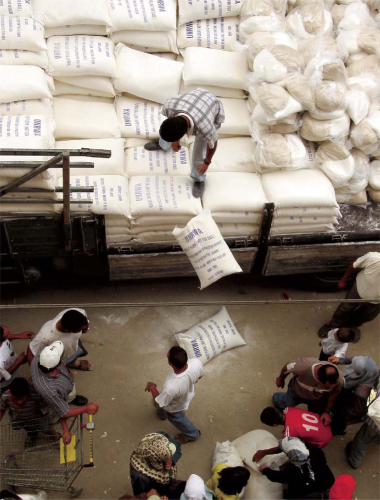
Providing humanitarian assistance to Palestinian refugees in the West Bank and Gaza Strip can be a hazardous business, for both aid workers and recipients. On May 20,1 joined a large convoy of U.S. and European Christian relief organizations that were attempting to deliver food, water, and medical supplies to a U.N.-run warehouse at the Balata refugee camp in the West Bank, which was suffering severe shortages because of a two-week-long Israeli Army curfew. To ensure the safety of the aid workers, we coordinated with the Israeli forces on the route, destination, and entry and exit points of the convoy.
It was more difficult, however, to take precautionary measures regarding the reaction of the desperate refugees to the arrival of aid. When the convoy reached the warehouse, several families rushed toward us from their homes. Although an Israeli tank fired warning shots, more and more people continued to leave their homes. Responding to the Israeli shots, gunmen inside the camp began firing back. The exchange of gunfire lasted several minutes, creating a chaotic and extremely dangerous situation.
Although no one was injured in this incident, similar events occur frequently, preventing aid from arriving and jeopardizing the lives of refugees and aid workers. But political tension is only one of several factors complicating relief efforts. The region's history, the lack of economic opportunities for refugees, as well as the long duration of the refugees' plight all combine to make the implementation of relief and development initiatives extremely difficult.
Five decades in exile
The plight of Palestinian refugees is unique in terms of length, scope, and complexity. In 1947, after several decades of Jewish migration to the Middle East, the U.N. General Assembly approved the partition of Palestine into separate Jewish and Arab states (Israel announced its statehood in May 1948). Although the Arab population was substantially larger, Israel was given more than half the land, leading to a conflict between the two sides during which Israel seized more land. By 1949, Israel controlled more than three-quarters of the territory. Some 750,000 Palestinians fled as new Jewish settlements were established on the seized lands. Although most of the refugees fled to urban areas in neighboring Arab countries, about a third moved to what remained of Palestine–the West Bank and Gaza Strip.
September 2002: Palestinian families from a camp in southern Lebanon wait outside a U.N. office in Beirut. They want the camp, destroyed by Israeli raids and shelling in the 1970s, rebuilt.
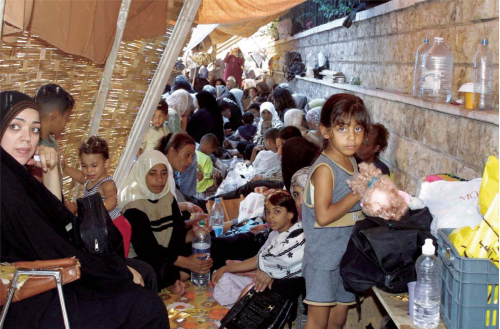
In 1967, a new wave of Palestinian refugees was created when the Israeli Army occupied the West Bank and Gaza Strip during the Arab-Israeli Six-Day War. Of the 350,000 people who fled to Jordan, Egypt, Syria, and Lebanon, an estimated 175,000 were members of the original refugee population in the Palestinian territories.
More than three generations after they were first displaced, the Palestinian refugee population has grown to nearly 5 million, although the United Nations recognizes only 3.9 million. About a third of the refugees continue to live in 59 camps scattered throughout the region. Initially, the camps consisted of tents and hastily constructed shelters. More permanent structures made of metal sheets, brick, and concrete soon replaced the tents. Today, the camps are impoverished, densely populated mini-cities, some of which house more than 15,000 people. Although camps usually have water and electricity, they suffer from serious under-development. Open sewage drains run along the surface of the ground, many camps lack adequate schools and hospitals, job opportunities are scarce, and large families are often forced to live in tiny two-bedroom apartments. Most families use mattresses that can be packed away each morning and eat their meals on the floor because there is no room for tables and chairs.
In 1949 the United Nations established the U.N. Relief and Works Agency for Palestine Refugees in the Near East (UNRWA) to provide aid and promote development projects. Although UNRWA has been the only provider of basic education, health care, and social services for the refugee population, during the last decade a limited number of programs have been set up by other international and non-governmental organizations, including ad hoc food distribution, youth activity centers, and women's development projects.
At the time of UNRWA's creation, the United Nations was busy negotiating the establishment of the U.N. High Commissioner for Refugees (UNHCR). Concerned that the new refugee agency, as well as the soon-to-be-created refugee convention, would not emphasize the right of refugees to return to their homes, Arab states lobbied to have the refugees excluded from the refugee protection regime. As a result, both UNHCR and the 1951 Refugee Convention specifically exclude “persons who are at present receiving … protection or assistance from other U.N. agencies.” UNHCR provides assistance to Palestinian refugees only if they leave the geographical area covered by UNRWA's mandate–Syria, Lebanon, Jordan, the West Bank, and Gaza Strip.
Political camps
In 1982, during a period of intense civil unrest in the Palestinian territories, I visited a family at the De-heisheh refugee camp in my home town of Bethlehem after the family's eldest son–a friend of mine–was arrested because of his work with the student union at Bethlehem University. When I arrived at the home, I found the mother alone, deeply saddened, and worried. She told me that the army had taken three other sons during a raid on the camp just a few days earlier, leaving only her 14-year-old son, Mohammed. “I pray to God every day that they arrest him too.” When I expressed surprise at her statement, she explained: “My son, when they raid the camp they either kill or arrest whoever is in the street. If they arrest him I know that he is not going to be shot in the street.”
The extremely complicated and polarizing political situation in the Middle East has always been a major obstacle to refugee relief efforts. Beginning in the early 1950s, many Palestinians started to organize political and armed groups aimed at liberating their homeland. The refugee camps became the default arena for these efforts–and, as a result, the target of Israeli Army operations.
Many Palestinian and outside observers argue that there is another reason the army targets the camps–to prevent the reemergence of an internationally recognized Palestinian nation. The creation of the Israeli state in the Middle East was partly based on the argument that Palestine is a land without a nation and Jews are a nation without a land. Because the camps are highly concentrated areas of political activity and manifestations of Palestinian national identity, goes the argument, many Israelis see the camps as threatening the rationale used to create their country. Until the signing of the Oslo accords in 1993, military orders were applied in the “West Bank and Gaza Strip that prevented Palestinians from holding a Palestinian flag or employing the word “Palestine.” There were numerous cases of students getting shot at for trying to hang flags at school, and educational curricula could not mention Palestine or include Palestinian history.
In the early 1980s Israel began constructing fences and revolving gates around most of the camps in the West Bank and Gaza Strip to control the movement of people. Living conditions in the camps deteriorated rapidly as curfews became more frequent, forcing people to stay in densely packed homes and shelters for days on end; more and more men were arrested, leaving entire families without a single bread-winner; and tear gas filled the streets during demonstrations and general strikes.
The impact of conflict on relief programs has been immense. Aid efforts are frequently interrupted by gun battles, denying an already extremely vulnerable population much needed food and medical supplies. Further, because aid programs are staffed by people from the camps and other local communities, activities grind to a halt during periods of turmoil. Local relief personnel are often subjected to the same restrictive measures as their fellow citizens.
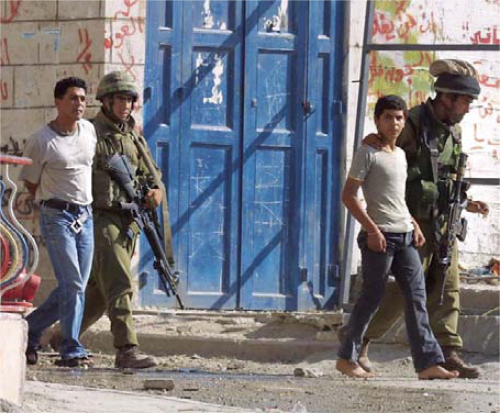
Israeli soldiers arrest two Palestinian men at the Deheisheh refugee camp during a June 2002 search for Islamic militants.
Host country relations
Because Palestinian identity is closely tied to the goal of establishing a state and refugees stubbornly maintain their right of return, relief programs often fall victim to political agendas. For example, the suspicion that some relief and development programs are ultimately aimed at resettling refugees away from their original homes and normalizing their status in host countries has caused some aid programs to be rejected or delayed.
Host countries also tend to keep refugees in total or partial isolation from the rest of the population. The political structures in these countries are very fragile and power is not supported by constitutional or electoral mandate. To survive, ruling families and political parties rely on the support of influential tribes or groups who are given key positions in the army and the government. The presence of a large number of armed and politically influential refugees is seen as threatening because they can be a source of weapons and military assistance for smaller and less powerful groups in the countries. In the early 1970s, some Palestinian political groups became indirectly involved in the internal politics of Jordan and Lebanon, which led to a massive military confrontation with the Jordanian Army in 1970 and a civil war in Lebanon in 1975.
Today, the refugees' relationship with host countries varies widely. In Jordan, refugees were granted citizenship in 1954; although Syria has not granted citizenship, it allows refugees to work and own property; and in Lebanon, the most restrictive host, refugees are allowed to work in some professions (about 70 others are off limits) and to own property, but only after they acquire special permission. In all three countries the refugees are often considered destabilizing and are closely watched by state intelligence apparatuses. Because of the stigma attached to them, many refugees have been unable to benefit from certain basic rights or to integrate into the societies in which they live.
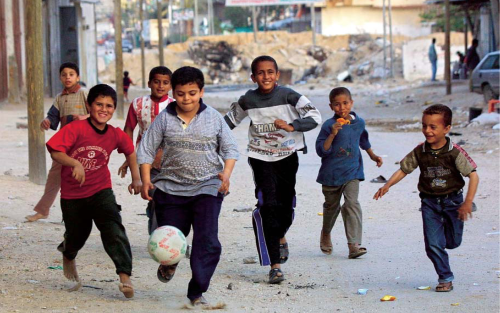
May 2002: Palestinian boys play soccer in the Gaza Strip's Rafah refugee camp.
Development interrupted
As the refugee population continues expanding and the length of their time in exile grows, they have increasingly been viewed as a financial burden by the international community. Even though the United Nations is partly to blame for creating their plight–and thus has a moral responsibility to finance relief efforts–the emergence of other refugee crises across the globe has put increasingly greater demands on the limited resources donor countries make available for refugee relief.
Beginning in 1982, UNRWA ceased distributing food rations to all refugees and instead focused on those most in need. And since the early 1990s its declining budget has forced the agency to cut back on needed services. For example, in 1998 the number of students per class exceeded 40 in most camps, and more than two-thirds of schools operated on double shifts, one in the morning and one in the afternoon. Budget cuts have also forced aid personnel to be more selective when choosing whom to aid. Staff has been cut, and the amount of resources, equipment, and vehicles at aid workers' disposal has declined. The reduced donor commitment not only increases the vulnerability of refugees and stretches relief programs beyond their limits, it feeds the perception of many refugees that the international community is deliberately attempting to diminish the influence of refugees in negotiations on their final status.
July 2002: Palestinian guerrillas patrol the streets of the Ain al-Hilweh refugee camp in southern Lebanon.
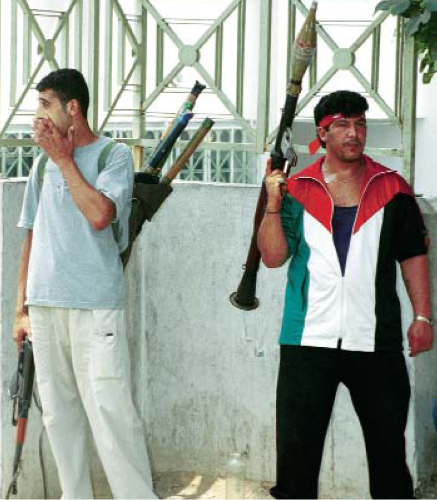
Of course, donors don't deserve all the blame for the deteriorating situation of the refugees. It is exceedingly difficult to sustain millions of people for a long period without any socioeconomic development. But most refugees do not own land, have little or no capital, and have few means for generating income. Political obstacles and limited economic opportunities are obstacles throughout the region. The refugees of the West Bank and Gaza Strip, for example, work as wage laborers in Israel, many of them on construction sites in Jewish settlements. For the refugees, it is humiliating to have to choose between working for the occupation–and indirectly serving its objectives–or not generating any income for family survival.
Those employed inside Israel must also contend with frequent interruptions whenever political tensions arise and the Palestinian territories are closed off. Since 1948, there have been seven wars and five rounds of massive civil unrest. The endless series of conflicts prevents refugee development and creates a near-impossible situation for relief efforts.
Finally, the refugees see UNRWA and host governments as the embodiment of international recognition and concern for their situation. With so few resources at their disposal, the refugees have developed an attitude of dependency in their relations with the international community and believe that they have a right to benefit from additional programs and handouts. For example, when employment in Israel was disrupted in the late 1980s, UNRWA introduced a microfinance program to provide self-employment opportunities for refugees with entrepreneurial skills. The initiative was widely perceived as being a grant program that would provide money to every refugee family. Of course, this was not the case, but the program took a long time to start up as a result. •