




Abstract
From the beginning in 1974, Greek Cypriots who fled the Turkish invasion of the north have had the full aid and support of the government of Cyprus.
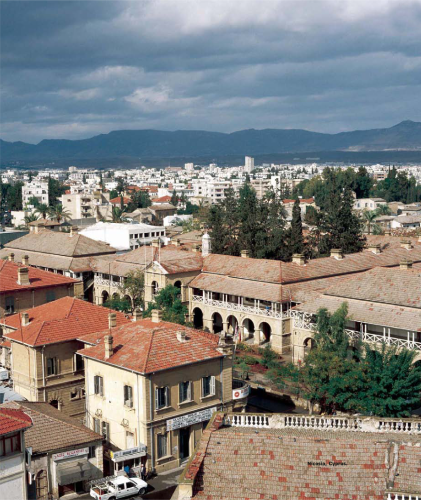
Angelique Chrisafis, a Greek Cypriot born and raised in “the second-largest Cypriot city–the London borough of Haringey, where Greek and Turkish Cypriot communities get along fine”–recounted the story of her first visit to Cyprus in the March 1 London Guardian. Her extended family members still living in Cyprus, displaced from the city of Famagusta in the occupied north, practice acts of “nostalgic defiance” to mark their time as refugees in their own country. “I sleep,” she writes, “in the bedroom of a house bought for my missing cousin Solomis, 13 years after he disappeared, so he has somewhere of his own when he returns. His bike is against the wall.” She travels from one relative's home to another in a 1972 Datsun, the car in which her family fled from the Turkish army, the car in which they intend to return one day to Famagusta.
Chrisafis's relatives are among the 200,000 Greek Cypriots who claim to be refugees in their own country. Although one may argue whether they are more properly called refugees or displaced persons, this group is a force to be reckoned with in Cypriot society. And after 28 years, a happy ending may finally be in store for them.
A Web project–by and for Greek Cypriots who were displaced from their homes as Turkish troops invaded and occupied more than a third of Cyprus–keeps alive the memory of men missing since the violence of the struggle in 1974. But the displaced have a larger agenda, one aimed at ending the Turkish occupation, restoring Cyprus to a unified state, and allowing Greek Cypriots to reclaim their homes and property in the north. The Occupied Cyprus Project (kypros.org/Occupied_Cyprus) tells a part of the story of a people who became refugees in their own country.
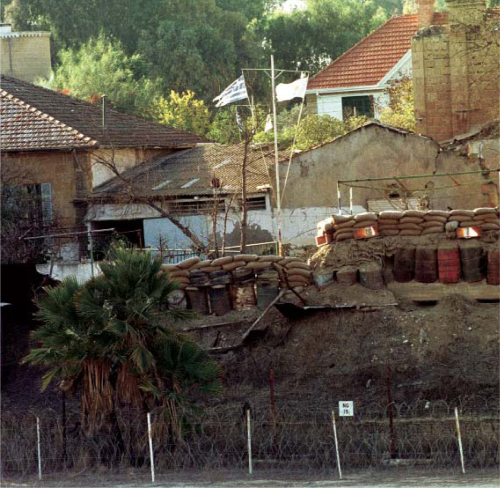
Village pages off the main Occupied Cyprus page demarcate divisions in their presentations with barbed-wire graphics, a symbol of the real barbed-wire that has split Cyprus into north and south, Turk and Greek, since 1974.
Cyprus gained independence from Great Britain in 1960. Under terms of the Treaty of Guarantee, Britain, Turkey, and Greece were assigned the responsibility of ensuring the island's independence. At the time, the population was about 80 percent Greek and 20 percent Turkish. Although they had been divided by the British colonial administrators in all aspects of civil life, the communities were expected to form a bi-communal state in which power was shared.
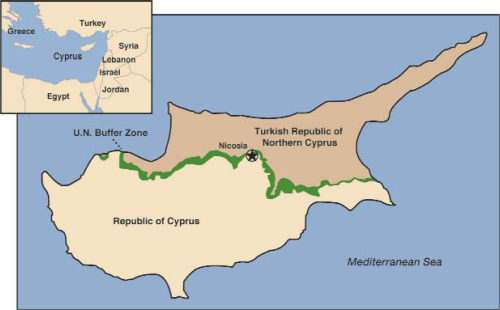
But political violence from the pre-independence era spilled over as militant Greek Cypriots pursued the goal of uniting Cyprus with Greece. Turkish Cypriots resisted, and conflict erupted. The United Nations launched a peacekeeping operation in 1964. As the peacekeepers deployed, Turkish Cypriots gathered in enclaves to better protect themselves from what they considered acts of genocide. As they tell the story, they were the first refugees within their own country.
The U.N. operation did not succeed in bridging the divide between the two communities; armed violence and self-imposed segregation intensified into the 1970s.
In early 1974, pro-Greek forces deposed the elected government and declared a plan to join Cyprus with Greece. In the midst of both inter-communal and Greek-on-Greek violence in the aftermath of the coup, Turkey–claiming to be acting under its obligations in the Treaty of Guarantee–intervened with 40,000 Turkish troops on July 20, 1974. The troops quickly took control of some 37 percent of the country, and then declared a cease-fire.
Although the coup soon failed and the elected government was restored, Turkish troops remained entrenched in the north. In the following days, weeks, and months, 200,000 Greek Cypriots fled south, while 50,000 Turkish Cypriots fled north. The decades-long division of Cyprus had begun.
Refugees in their own country
According to the U.S. Committee for Refugees, there are only about 250 refugees and asylum seekers in Cyprus–the only group with which the U.N. High Commissioner for Refugees is concerned. The larger problem in Cyprus is not refugees, but internally displaced persons. But the refugee label, with its powerful connotations, is widely used to refer to the persons displaced from both the south and the north.
The government of Cyprus recognizes as a refugee any person who fled to the south to escape the invasion and who remained, thereafter, deprived of the right to return and live in their home and make use of their property in the north.
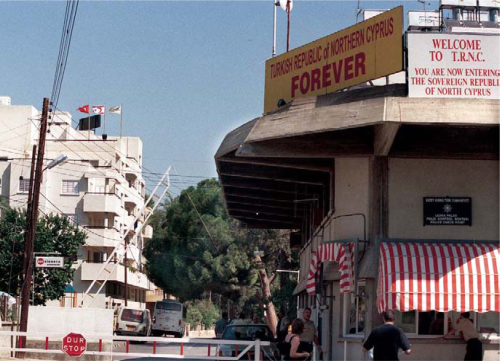
The Turkish army still deploys a “peace force” of around 35,000 troops in northern Cyprus, and the north is administered by Turks and Turkish Cypriots through the self-declared Turkish Republic of Northern Cyprus (TRNC). There are a few small pockets of Greek Cypriots, but they are generally elderly people who refused to move and depend on U.N. peacekeepers for food and medicine. Meanwhile, a number of Turks from Anatolia in Turkey have immigrated to the north, altering the demographics. Whether their movement from Turkey was compelled (by force or economic incentive according to Greek Cypriots) is a point of contention. What is not debatable is the fact that the number of Turkish immigrants or settlers has now reached around 100,000, a number that rivals the native Turkish population. The presence of Turkish troops and settlers makes the return of Greek Cypriot refugees all the more difficult, as the remedy for their displacement would now require the displacement of a significant number of other people.
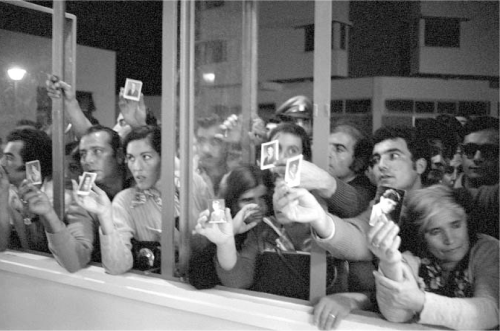
October 1974: Greek Cypriots hold up pictures of relatives missing after Turkey's invasion of the island.
Because the Greek Cypriots were displaced a generation ago, the government extends the refugee label to their children as well. A whole generation of Greek Cypriots has been born in the south yet remains tied emotionally, politically, and legally to homes in the north.
The designation is more than a label. From the beginning the government has provided refugees with housing assistance. Many live in government housing estates built immediately after the 1974 partition. The government's decision to respond quickly to their housing needs served as a powerful engine for economic development in government-controlled Cyprus in the mid-to-late 1970s. 1
Beyond the estates, the government supplies grants of as much as half the cost of new single-family homes, should refugees choose to use their own resources for new construction. As official refugees, their children are entitled to the same housing benefits as the first generation.
Beyond housing, other government-supported activities help to maintain the profile of the refugees in Cypriot society and beyond. Until the mid-1990s, the government retained pre-1974 electoral constituencies and even printed telephone directories that listed old numbers (in the occupied north) alongside the new numbers (in exile). 2
Clearly, meeting the housing needs of the initial refugees was a practical government decision, while extending housing benefits to a second generation, which is a little more problematic, is also defensible on practical grounds, because the second generation cannot enjoy family property to which they would be entitled under normal circumstances. But the maintenance of telephone directories–like building a house for a son who had disappeared 13 years before–is an act of defiance of considerable political import, part of a campaign to maintain the inseparable causes of refugee rights and a unified Cyprus. Within Cypriot civil society, the refugees maintain their identification through refugee associations. These associations keep track of members of the old towns and villages both in Cyprus and abroad in the expatriate communities located primarily in Britain, Australia, New Zealand, and to a lesser degree, the United States. The associations sponsor cultural and sporting events aimed at continuing old social networks and organize protest marches along the “green line” dividing the capital city of Nicosia. The refugee associations also engage in some activities that suggest that they will maintain a more permanent presence in the south even if the right of return is guaranteed. For instance, the refugees of Ayios Epiktitos, a village in the valuable Kyrenia district in the occupied north, have built a church that replicates the one they left behind.
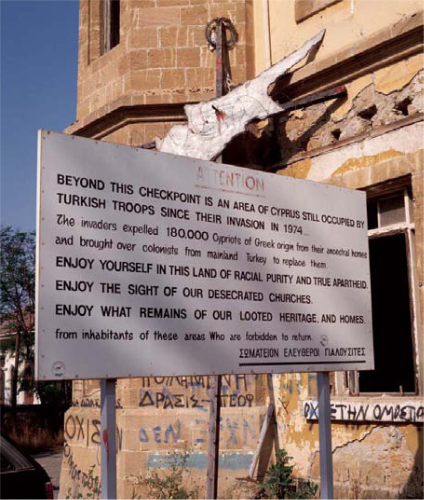
The refugee associations also engage in large public education campaigns, such as the Occupied Cyprus Project online. As part of this project, refugee associations and second-generation refugees display vivid testimonials to pre-invasion Cyprus, voice their demand for an end to the Turkish occupation, and maintain unwavering support for their right of return. More than two dozen village sites show and tell the same essential stories in pictures of missing men from 1974 as well as pictures of the webmasters' parents and grandparents in happier times. There are also pictures of home villages and towns before they were “Turkified” by the “barbarians.” One of the most consistent expressions of outrage concerns destruction by the Turks of Greek antiquities and religious buildings and shrines.
The “Ledra Palace” crossing point on the Green Line in Nicosia.
The Turkish Cypriots in the north
The refugee association Web sites are quick to blame Turks for the division of Cyprus and for the denial of Greek Cypriot rights, but much less is said about Turkish Cypriots. Indeed, the government and refugee groups say the “Cyprus issue” was created by Turkey, and that the continued Turkish presence in the north is as harmful to Turkish as to Greek Cypriots.
The refugee associations insist that Turkish troops and settlers must leave Cyprus. The Lobby for Cyprus, an expat lobbying group in Britain, has proposed that a one-time payment be made to the settlers to help them repatriate. Beyond this, they are adamant in their calls for the removal of the settlers.
But Turkish Cypriots are treated differently. News stories consistently feature statistics about the outmigration of Turkish Cypriots from the occupied territories. The government reports that some 55,000 Turkish Cypriots have left the north, with only 88,000 remaining. This outmigration is a testament to political and cultural repression, as well as to the continued economic problems of the north.
A number of Turkish Cypriots who leave the north have found their way to Cypriot embassies in Britain and Germany, where they apply for Republic of Cyprus passports. In recent years some 400-500 Republic of Cyprus passports have been issued to Turkish Cypriots, and the number is said to be growing as talks on Cyprus's accession to the European Union (EU) draw closer.
The requirements for obtaining a passport for Turkish Cypriots, reports the English-language Greek Cypriot Cyprus Mail, “are the same as for Greek Cypriots. They need to prove they have Cypriot parentage and have Cypriot identity cards.” 3 The government has exploited the growing number of Turkish Cypriots wanting Republic of Cyprus passports, claiming that it shows that all Cypriots have been harmed by the Turkish occupation. The government also claims that Turkish Cypriots found in possession of Republic of Cyprus passports while in the occupied territory are subject to hearings before military courts. 4
If Republic of Cyprus passports are illegal in the north, Republic of Cyprus identity cards are not. As reported in a column in the northern Cyprus opposition newspaper Nicosia Avrupa, the identity cards make it possible for some 4,000 Turkish Cypriots to draw monthly pensions from the “Greek Cypriot government.” According to the July 5, 2001 Nicosia Avrupa, these pensions from the south support nearly 15,000 people in the north.
Championing the refugees' cause
The government has promoted its claims against Turkey in multiple international organizations, all with essentially the same result. The U.N. Security Council weighed in on the conflict on the first day of the Turkish invasion with Resolution 353 (1974), demanding “an immediate end to foreign military intervention.” About a month later, on August 15, it demanded that all parties fully respect the U.N. peacekeeping personnel, some of whom had been killed or wounded in the violence. On August 16, it recorded “its formal disapproval of the unilateral military actions undertaken against the Republic of Cyprus.” At the end of August it noted that “a large number of people in Cyprus have been displaced, and are in dire need of humanitarian assistance.” In this resolution, the Security Council for the first time referred to the displaced as “refugees,” and urged all parties and the secretary-general “to search for peaceful solutions to the problems of refugees and take appropriate measures to provide for their relief and welfare and to permit persons who wish to do so to return to their homes in safety.” (Italics added.)
In 1975, the Turkish Federated State of Cyprus was declared, but was recognized by Turkey alone. In November 1983, the Turkish Republic of Northern Cyprus was declared by another unilateral proclamation and again was recognized solely by Turkey. The Security Council denounced the declaration and determined the action to be invalid, noting that the sole, legitimate government was the Republic of Cyprus. The Committee of Ministers of the Council of Europe rejected the declaration and reiterated its position that the Republic of Cyprus was the sole and legitimate government, a position also taken by the Commonwealth Heads of Government.
In 2001, the government of Cyprus alleged that Turkey's continuing occupation of northern Cyprus was in violation of a number of articles of the European Convention on Human Rights. The European Court of Human Rights ruled in favor of Cyprus, declaring Turkey in violation of the convention for refusing to allow displaced persons access to and use of their property, failing to offer effective remedies for displaced persons, and interfering with the religious, cultural, educational, and property rights of Greek Cypriots still living in northern Cyprus. Turkey did not contest the case, suggesting that its previous strenuous defense of its position regarding northern Cyprus may be undergoing some rethinking.
Political currents in Europe and in Turkey point toward a resolution of the Cyprus problem in the near future. The desire expressed by some political parties in Turkey for greater integration with–and ultimate membership in–the European Union may lead Turkey to urge Turkish Cypriot authorities to seek a negotiated settlement with Cyprus. And these pro-Europe forces in Turkish politics may not even have a choice–the European Union is forcing everyone's hand on Cyprus.
Settlement takes a front seat
The European Union's next expansion in membership begins this December at a summit in Copenhagen. Cyprus is one of the countries that will begin the formal process toward membership.
Turkey–many times rebuked in its own efforts to join–has threatened that any move to admit the “Greek Cypriot” part of Cyprus could result in its annexation of northern Cyprus. The official position of the Bulent Ecevit government (the same prime minister who ordered the Turkish intervention in 1974) is that the Turkish Cypriots will be further denied their national rights by the admission of the Greek Cypriot government into the European Union. Ecevit was quoted in a January 2002 article in Middle East: “If the wishes of certain foreign circles … are agreed to and the Turkish Cypriots are forced to live alongside the Greek Cypriots, they will be confronted with worse than the genocide faced before the Turkish Peace Operation [the 1974 intervention].” But Ecevit's failing health, and the defections in the summer of 2002 of key pro-Europe government officials to new political parties, suggest that Turkey's official position may not hold.
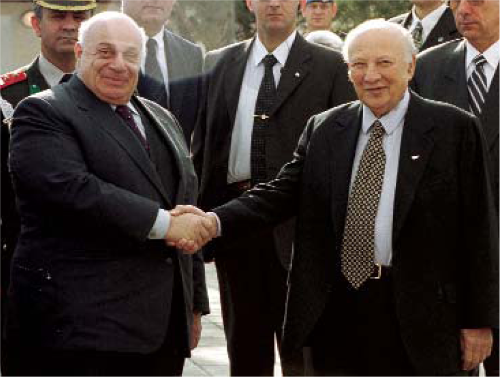
January 2002: Turkish Cypriot chief Rauf Denktash (left) shakes hands with Glafcos Clerides, Republic of Cyprus president, at the beginning of reunification talks.
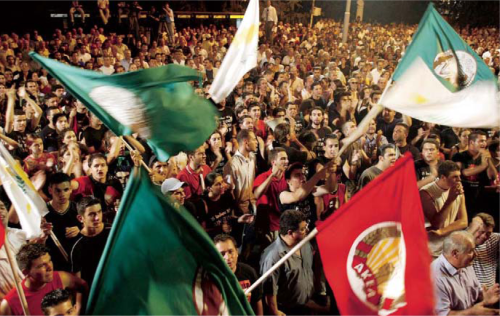
July 15, 2002: Greek Cypriots in Nicosia hold a rally to protest continuing Turkish military presence on the island.
The old guard in Turkey and in northern Cyprus, as embodied by Turkish Cypriot leader Rauf Denk-tash, won't let go without a fight, though.
The EU's position is that there is one government of Cyprus–the Republic of Cyprus. This government can apply for EU membership if it demonstrates that it has, like other applicants, implemented the acquis communautaire, or necessary legislation to bring its own laws in line with those of the EU. This is the only prerequisite for starting accession negotiations. Resolution of the Cyprus problem is not a prerequisite, as long as it “can be shown that Glafcos Clerides, Greek Cypriot leader, has tried to reach a settlement with North Cyprus.” Without a settlement, the real losers will be the Turkish Cypriots. As the Boston Globe explains, “Turkish Cypriots could be left in no-man's land: de facto EU citizens with no access to EU privileges such as the right to work and freely travel across the bloc. The prospect of EU membership has enticed thousands of Turkish Cypriots to head south in search of Republic of Cyprus passports.” 5
Imminent EU membership is proudly proclaimed on many of the refugee associations' Web sites in the Occupied Cyprus Project. Imminent EU membership for Cyprus has also compelled the Turkish Cypriot authorities to engage in new face-to-face talks with the Greek Cypriots. Their leader, Rauf Denktash, had resisted earlier talks, including some scheduled to occur on September 12, 2001, at U.N. headquarters in New York City. The September 11 terrorist attacks caused Cypriot President Glafcos Clerides's plane to be diverted to Canada and then, after a few days, he returned to Europe.
Denktash's resistance to direct talks has vanished in the face of the looming December 2002 EU Copenhagen summit and, at his insistence, the two sides began meeting at the abandoned international airport in Nicosia at the start of 2002. A special U.N. envoy has sat in on the talks, but takes no part in the discussions.
Denktash's long-standing position has been that the two communities must be recognized as separate, sovereign nations. This position was maintained throughout the discussions spanning the first half and more of 2002. Before any discussions of territory and property can proceed, Denktash has insisted that the “Greek Cypriot government” recognize the TRNC. Once this occurs, he says, subsequent discussions could focus on the creation of essentially a confederation of two politically equal states. In a November 2000 interview in the official newspaper of his ruling regime, the Nicosia Halkin Sesi, Denktash said that “as a result of the incidents in Cyprus we want property rights to be reorganized,” with property issues resolved through a method of compensation. Refugees could be allowed to return only “after the persons who will be affected [by the return] have been satisfactorily relocated.” 6
But the Cypriot government led by Clerides, having staked its ground on the right of refugees to return to their homes and property, will not budge on this point. Politically, it would be difficult to retreat from the position that refugees have the absolute right of return when Cyprus has so stridently supported this position in so many international bodies. More importantly, Clerides may not wish to oppose the committed, large, and vocal refugee community both within Cyprus and abroad. The refugee community strongly opposes property exchanges and compensation. 7
Although the Clerides government does not seem likely to retreat from defending the absolute right of refugees to return, the government has been willing to concede territory to a Turkish Cypriot administration. Clerides has proposed that Cyprus should be a single state with a central government, but that it would also function as a bi-zonal, bi-communal country. Under this idea, the central government would not be able to intervene in the affairs of either community and the judiciaries would be separate. 8
As of this writing, Denktash called for an August break in the talks because of the notorious heat of Nicosia in late summer. Some have wondered whether political turmoil in Turkey also prompted the break. To date, no settlement has been announced. Various U.N. diplomats, particularly European ambassadors, have already blamed the Turkish Cypriot side for the lack of success. This is important politically because accession rests not on settlement, but on best efforts, and this establishes a public record that the international community recognizes and appreciates the efforts of the Clerides government.
The fortune of the misfortune of being a refugee in one's own country
If Nicosia in August was too hot to continue settlement talks, it is only a short ferry ride east to a region on the verge of boiling over. In late summer, the Israeli-Palestinian war continued in the West Bank, Gaza, and Israel–another protracted conflict in which refugees and settlers figure prominently. The Palestine refugees are, according to the U.N. Relief and Works Agency for Palestine Refugees in the Near East (UNRWA), those persons “whose normal place of residence was Palestine between June 1946 and May 1948, who lost both their homes and means of livelihood as a result of the 1948 Arab-Israeli conflict.” UNRWA provides relief assistance to all such refugees and their descendente as well as to persons displaced in the 1967 Arab-Israeli war. Around half of the estimated 3.9 million Palestine refugees live in 59 UNRWA administered refugee camps throughout the countries of the Middle East, including refugee camps in the West Bank that have been the scene of intense and deadly military actions and counter-actions in 2002.
If political events appear to be moving in favor of the Greek Cypriot refugees, the situation for the Palestine refugees and the Palestinians in general does not look so sanguine. There are significant differences in the two cases, but it is worth noting that the Palestine refugees have never been as successful as the Greek Cypriot refugees in vocalizing their demands for the restoration of their rights. No doubt this has much to do with the environment in which the two refugee groups found themselves. The Greek Cypriot refugees fled to another part of their own country and have been given critical government assistance for housing and critical support for their rights in international bodies. Simply put, the Greek Cypriot refugees have had their own government to turn to, and that government's agenda and the refugees' agenda have been consistently inseparable.
Sandbags and barbed wire separate north and south in this section of Nicosia.
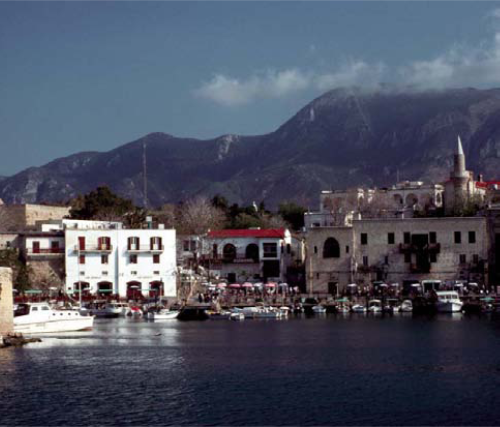
The port of Kyrenia, a valuable area in northern Cyprus.
The Palestine refugees and the Palestinian nation do not have a government of their own that could support and protect them while promoting their cause internationally. This is, of course, part of their ongoing problem. The Palestinians, divided among several sovereign states with each having its own distinct political agenda apart from the issue of Palestinian rights (and sometimes having political agendas in direct opposition to Palestinian rights), have yet to find their voices represented in their own government. Even Yasir Arafat's Palestinian Authority has agreed formally on several key occasions to put refugee issues on a second track for resolution.
Despite these and other critical differences between the cases, there is an affinity between Greek Cypriote and Palestinians. The spring 2002 Israeli military siege of the Church of the Nativity compound in the Palestinian city of Bethlehem was ended when Israeli and Palestinian authorities agreed that Israel would deport 12 wanted Palestinian gunmen who had been holed up in the church. On their way to various destinations in Europe, the first stop for these Palestinians was the Flamingo Hotel in Larnaca, Cyprus. Russell Working, reporting in the Boston Globe on May 13, noted that “Many Greek Cypriots, who see themselves as a small nation illegally dominated by a powerful neighbor, equate the Palestinian struggle with their own.” A member of the Cypriot parliament told Working, “We might feel a little closer to the Palestinian people because we had a number of Cypriot refugees expelled from their own homes by the Turkish army…. And they're powerless to do anything.” This conclusion, though, doesn't seem warranted any longer.
The Greek Cypriot refugees seem within reach of their goal, which is, when all is said and done, the right to decide what to do with their own property and their own homes. It is likely that many refugees and second-generation refugees will choose to stay in the urban south rather than “return home,” a reflection of their economic and social integration in southern Cyprus. But the time appears to be near when they might be able to safely exercise their property rights in the north for the first time in 28 years. Their unique situation as refugees in their own country has helped them maintain national and international focus on their cause and may very well get them home at last. •
Footnotes
1.
Roger Zetter, “The Greek-Cypriot Refugees: Perceptions of Return under Conditions of Protracted Exile,” International Migration Review, vol. 28, no. 2 (1994).
2.
Ibid.; Robert Fisk, “Dead Zone: 25 Years Ago this Month, War Split Cyprus into a Turkish-controlled North and a Greek-controlled South,” The Independent, July 17, 1999.
3.
Rita Kyriakides, “Immigration Department Confirms Rise in Turkish Cypriot Passport Requests,” Cyprus Mail, May 9, 2001 (Foreign Broadcast Information Service [FBIS] Europe).
4.
“Spokesman–Turkish Cypriots–‘Military Courts,’” Cyprus News Agency, August 31,2001 (FBIS Europe).
5.
Toula Vlahou, “Conflict in Cyprus Gains New Urgency, Resolution Sought Amid EU Drive,” Boston Globe, April 21, 2002.
6.
Christopher de Bellaigne, “Conciliation in Cyprus?” Washington Quarterly, Spring 1999.

8.
“Europe: Breakthrough? Cyprus,” Economist, May 25,2002.